
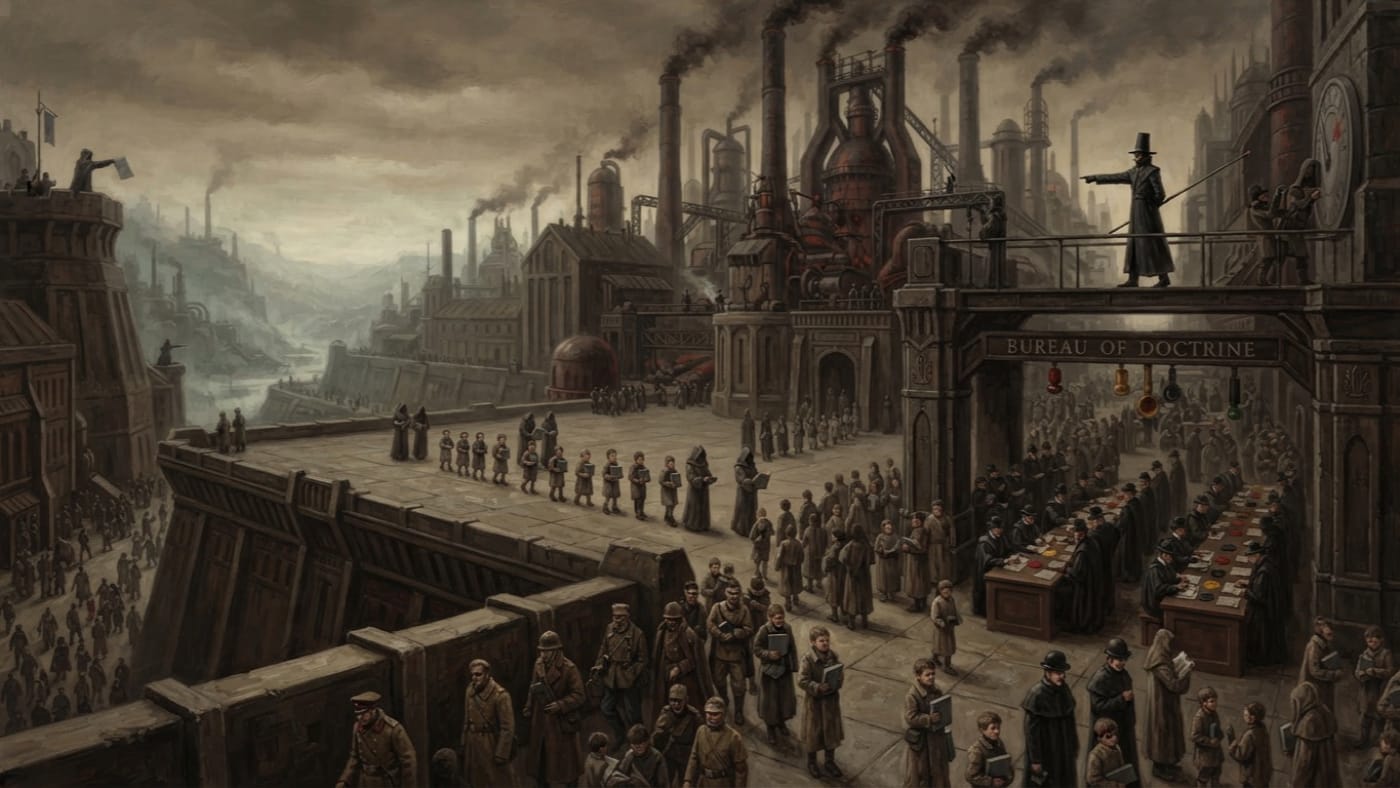
Survey of present doctrinal usage — A.S. 201. The interpretations here are the Hieromnemon's, not a finding about hidden divine causes.
#On the Word in the Corridor
In the years of his Instructional Silence, candidates for the Iron Choir sat on cold stone outside a cell beneath the western penitence annex of Strasbourg and waited for Master Cantor Vell to knock. One tap meant proceed. Two meant retune. Three meant leave the profession and become a cobbler, if Providence had granted sufficient intelligence to obey stone.
Vell was making no theological claim. He meant that most throats are wasted on singing and a few minds are wasted on throats. The word reached him without effort all the same, as it reaches every quartermaster, mother, stoker and catechist in the Church's lands. We use it for an outcome that has already been decided, at the moment before anyone thinks to ask who decided it. The contempt belonged to Vell. The vocabulary belongs to us.
It deserves an entry. The word does more work than half the Bureaus and draws no stipend.
#On the Custody of Causes
Everything that happens in the Church's lands has a cause, and every cause has a keeper. The Bureau of Doctrine, which I have the honour to serve, holds the Flame of Interpretation. It defines what counts as grace, what counts as chance, and what the Creator intended before the first ledger was ruled. The Bureau of Purity replies that defining a miracle costs nothing and authenticating one costs everything. Until the white mantles have examined it, a wonder is only an occurrence waiting to be suspected. The Bureau of Records keeps both answers, stamps both, files both, and has never said which it prefers.
Outsiders call this a quarrel, and they are right. It is also the most efficient engine of meaning ever assembled. A harvest, a fire, a rout or a fever that breaks on the third night can pass through three thresholds and come out carrying three licensed meanings, any of which can be produced when the moment wants it. A Saxon farmer rang a fourth stroke on a bell licensed for three, and that night his barn came down on his cattle. Doctrine had the word ready. Purity had sabotage ready. Records was asked to choose between Providence and sabotage and stamped Yes.
The household receives whichever meaning reaches its door first. The Bureau of War enforces whichever version can muster the most battalions. Once a Bureau's reading of an event becomes binding on the people who lived through it, the event has become providential, and nobody needs to explain it further.
I defend this without blushing. In a world where outcomes have no appointed reader, every peasant becomes his own exegete, and I have read peasant exegesis. It runs to weather, grudges and the neighbour's goat.
#On Paperwork as Providence
The propaganda of the Synod has a formula for its own confusion, and I quote it with affection: Multiplicity is Providence; confusion is Unity; the many voices of the Bureaus speak with one tongue. Even Archons cannot always tell one Bureau's writ from another's. The formula admits this freely and blesses it.
Heresy hides in gaps, so there must be no gaps. Three contradictory decrees are better than none. Duplicate seals are better than a single seal that might be doubted. Ledgers carry three stamps, death dates are entered twice in two hands, and the widow is told to obey both. She will mourn on the first date, surrender the cottage on the second, and pay the burial levy on each. If she objects, her objection is to the arrangement of Creation, and the Bureau of Purity has a form for that.
Every one of these instruments is real. You can find them in the vaults beneath Strasbourg: gray-corded folios, wax in four Bureau colours on a single page, receipts countersigned by clerks who never met. The whole bureaucracy of the capital moves this paper from desk to desk and from stamp to stamp until it lands in a household that cannot read half of it. By then it has acquired a second name.
The whole bureaucracy of the capital moves this paper from desk to desk.
Corrected under the standing order of Records, Fifth Revision: Public copies will replace "bureaucracy" with "providence." Citizens are comforted by the word. Scholars may retain "bureaucracy" in internal manuscripts, provided they footnote "miraculous." This survey is a public copy. Read the sentence again with the right word in it.
Nobody can produce the year that order was issued, and that suits it. An instruction that has always applied has no need of a birthday.
Be precise about what the substitution achieves. It does not show that the Creator guides each stamp onto each folio. Doctrine says that, Purity declines to comment, and Records adds a footnote. What the substitution does show is more useful. A woman standing at a Strasbourg desk with the wax on her summons still soft hears the word providence, stops asking for the clerk's name, and goes home.
#On Callings, Furnaces, and Night Orders
The calling. At the Book of Promise Parade, children march carrying sealed ledgers that assign their futures: soldier, clerk, chorister, corpse. Each is told that Providence has revealed their destiny. The Bureau wrote the books. Families cheer as if the assignments were miracles, and every one of them knows the ledgers were filled from bloodlines, quotas and shortages. A regiment short of men in spring yields a great many destinies in arms by summer.
Nobody can appeal an assignment, because no clerk is admitted to have made one. The boy who breaks the seal and reads clerk may hate the ink, but he cannot hate the man who held the pen, since officially there was none. If he resents his place he resents the Creator, which is a sin with its own confessor. The parade spares the Bureau of Levies a good deal of correspondence.
The furnace. The Furnace Catechist stands where heat becomes obedience: refinery catwalks, bastion powerhouses, trench boiler pits. Each shift opens with an ash mark and a sermon that ties quota to salvation. Foremen carry sealed cards of approved phrasing. The Catechist walks the line with hermeneutic chalk and marks unsafe speech. Pressure curve is unsafe. Mixture ratio is unsafe. The catechism has a line for this: "Explaining is stealing."
After a failure comes the incident review, and its approved answer must include obedience and need not include parts. A pump that runs has been restored by permission. A pump that bursts has been broken by sin or sabotage, and somebody must be named. Credit for success goes upward to the Synod. Blame for failure goes down the catwalk to whichever engineer has the fewest patrons. Here the word works as a deed of ownership. The furnace burns, the engineer knows why, and the Church holds the title to the why.
The night order. The Night Papers are thin slips of gray vellum sealed in wax the colour of grave-dust. A hooded courier presses one into a commander's palm and is gone. The Papers authorise arrests, executions, the burning of a sector, the seizure of relics. They come from the Bureau of Shadows, which does not exist. They leave no trace in any ledger. They expire at dawn, and if an order is still unfulfilled at first light, its bearer becomes its executioner.
Doctrine has said who writes them: "They are dictated by Providence itself." The couriers' own creed is plainer: Providence dictates the Paper and the courier is only the wind. Records has offered a redacted note that the handwriting changes with the seasons. Neither statement settles the matter, and no living clerk has testified to drafting one. The courier only carries, the commander only obeys, priests bless the Paper, and the Creator is credited with the authorship. By sunrise the order has been carried out and nobody can be found who wrote it.
#On the Disputed Hand
The apparatus does not always agree with itself, and this survey will not pretend otherwise.
Ironholt fell to Wrath during the early Wars. No clerk can be found there, no farmer works its fields, and no soldier patrols its roads. Its tithe quotas still arrive in Strasbourg every year, on time and in full, in neat ledgers under seals that no hand admits to having pressed. Doctrine calls this proof of Heaven's order and has put it in four words: Providence keeps the quill. Purity's answer is shorter: Not Providence. In lower voices it suggests the Judges.
Purity has called the Judges sanctioned avatars of Providence on other folios. Doctrine has called them Providence embodied. The Synod in public denies them both ways. I will not reconcile these positions in a low entry, and I doubt a high one could manage it either. Nobody has identified who keeps the Ironholt ledgers or how they are kept. Records shelves the returns with the rest of the diocesan tithe and the arithmetic balances.
Each spring the household in Strasbourg receives its ledger at the parade, the stoker receives his phrasing card, and the commander in the forward trench receives his gray slip. None of them is told who wrote it, and the Church gives each of them the same word to explain it.
Vell, they say, would tap three times at anyone who asked for more than that. Go and make shoes.