
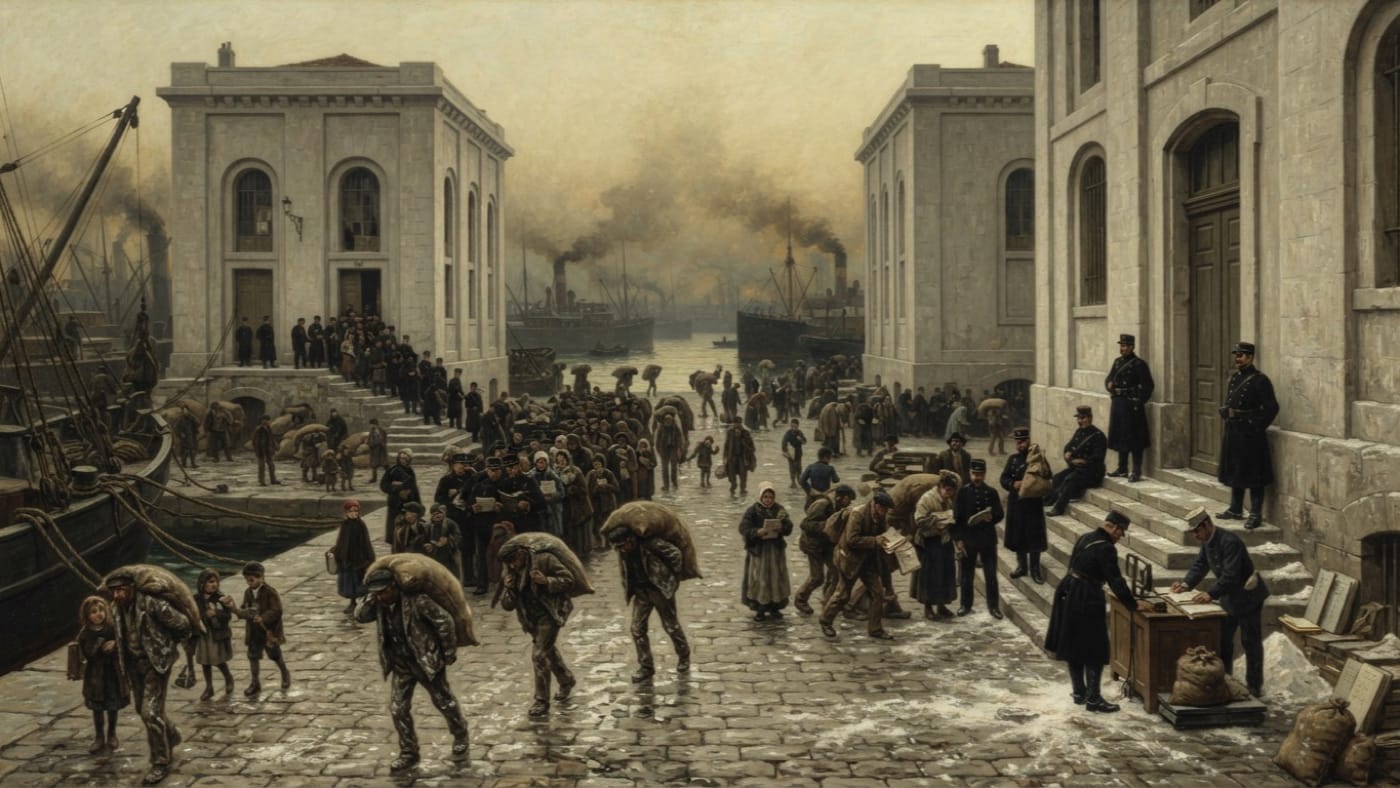
#On the Quay
The Quai des Oraisons is a length of worn limestone on the harbour of Marseille where salt comes ashore and the paperwork goes out to find it. Steamers from the Iberian ports tie up along its frontage with holds full of white cargo. Porters carry the sacks down the gangways bent almost double, and the salt crusts in the seams of their jackets and the creases of their necks. The ropes are wet at every hour. By noon the stone is gritty underfoot. By evening it has been swept and assessed, and it is gritty again.
Two buildings set this quay apart from the rest of the Synod's southern mouth. The Bureau of Pilgrimage keeps its southern headquarters here, and the Bureau of Tithes keeps its Mediterranean Revenue Office here. They face each other across the quay. Anyone with business on the quay has business with at least one of them, and usually, to their sorrow, with both.
The foot traffic between the two doors never stops. Pilgrims grip their tokens as though someone might snatch them. Merchants grip their manifests as though someone might read them. Among them move sailors, salt porters, relic dealers, counterfeiters who look like relic dealers, and the quay's children, who sell directions to either building and swear to every customer that they favour neither house. They lie. They favour whoever has paid.
#On the Two Houses
The headquarters and the Revenue Office are limestone buildings of matching architecture: the same pale blocks, the same arched windows, the same steps worn into the same shallow troughs by the same class of petitioner. From the water a stranger cannot tell them apart. A clerk of either house can tell them apart from one sniff of the vestibule, and will explain the difference to the stranger at length.
The resemblance stops at the armoury and the cellar. Tithes is the better armed. Its escorts stand on the steps like guards who have been told that salt is sacred and the wall behind them is load-bearing. Pilgrimage keeps the finer wine cellar. Both Bureaus treat this division as theologically significant, and each believes the other got the lesser gift.
The southern headquarters of Pilgrimage processes an estimated four hundred thousand embarkation permits a year. The figure belongs to the office and its desks. It does not count the souls who set foot on this quay, and the Bureau has never claimed that it does. The permits are written on the upper floors. Below them, in the foundations, lie three guild-masters who were mortared into the stonework during the Harmonized Routes Edict of A.S. 123. The foundations groan. The Bureau classifies the groaning as structural.
#On Salt and Passage
The quay's trade is where two kinds of freight meet, and the Bureaus have divided the harbour to match. Pilgrimage controls passenger manifests. Tithes controls cargo assessment. The Bureau of War controls military shipments and rarely appears on this frontage, except when a crate under its seal has to be kept out of everyone else's ledger. The Harbour-Master works among all three. Each of them can call the Harbour-Master to account, and whichever happens to be standing closest gets obeyed.
A ship carrying only salt deals with Tithes. A ship carrying only pilgrims deals with Pilgrimage. A ship carrying both deals with both, one after the other, across open ground and in whatever weather the day brings. Coastal traders like to fill their spare cabins with paying passengers, so most ships carry both.
The usual order goes like this. The steamer ties up and its master brings the cargo manifest down the gangway. At the bottom waits an assessor of the Tithe Assessor class, with scales, measuring rods, a ledger gilded at the corners and an armed escort. The salt is weighed and touched to the brine-testing stone, which changes colour when the salt has been adulterated and explains nothing. Sacks that pass get seal cords. Sacks that fail go into the ledger as arrears. The Salt Dues are charged, along with whatever handling and dock fees the schedule allows that week. If even one passenger aboard holds a Pilgrimage token, the Pilgrim Infrastructure Levy is charged as well, and the master is sent across the quay to account for the passenger to the other house.
At the other house the passenger manifest is read and the permits are checked. The tokens are inspected for the counterfeits that every master swears their passengers do not carry. Pilgrimage then objects, on the passengers' behalf, to the Tithes charges that have made their passage dearer. The Bureau has lodged that objection against the Dues every year since A.S. 94. It is entered. The charges stay. The master walks back across the quay holding a Pilgrimage receipt that Tithes will not countersign and a Tithes receipt that Pilgrimage will not handle.
Each Bureau calls its own charges a sacred necessity. Tithes holds that revenue sustains the war and the war sustains the faithful. Pilgrimage holds that the faithful must reach the shrines and the shrines sustain the Church. The salt porters hold the sacks.
The pilgrims do not sail from here. Their permits are processed on this quay, but their vessels leave from the eastern basin for Thessaloniki and the Aegean shrine routes. There an inspector and a shipboard chapel go aboard, and every manifest is checked against the Great Ledger of Souls before the anchor comes up. The Quai des Oraisons decides only whether a pilgrim's papers are fit to walk that far.
A prior filing gave the pilgrim fleet's annual departures from the harbour as two hundred and six.
Corrected to approximately one hundred and forty. The earlier count entered return voyages as separate departures. Both figures cover the whole harbour. Neither counts the fleet's hulls or any sailing from this quay. Tithes has protested that if returns are not departures, the dues it collected on returns must be paid back. Inter-Bureau Arbitration Panel convened A.S. 199. Ruling: pending.
#On Separate Ink
The two houses do not lend each other writing materials. This started as a figure of speech among the clerks and hardened into custom. In A.S. 167 an inter-Bureau memorandum made it formal. Personnel of either Bureau may not lend ink to the other, borrow it from the other or accept it as a gift. The prohibition goes beyond ink to chalk, sealing wax and the margins of documents that both offices have to handle.
The memorandum is short. Its consequences fill the quay.
When a Pilgrimage clerk's pen runs dry at the foot of the steps, the clerk climbs back to their own desk for a fresh well. The merchant waits, and a Tithes clerk three paces away watches with an inkwell full to the lip. A cargo dispute that two signatures on one sheet could settle needs two sheets, because neither clerk may write in the other's margin. The merchant carries both sheets across the stones like the two halves of a quarrel. Wax in the stamping trays is counted by house. Chalk dropped on the quay is left where it fell rather than handed back, and the porters grind it into the salt.
#On the Present Traffic
In A.S. 201 the quay works. The Salt Dues are in their hundred and ninth year as a temporary measure. Across the whole instrument they bring the Bureau of Tithes approximately 1.4 million Crowns of Grace a year, and this quay is one of many mouths that feed the total.
The steamers come in at dawn under a haze that smells of coal and brine. By the time the bells have finished the first hour, the assessors are brine-washing their chapped hands and tapping their scales three times, as the profession does everywhere, and the first manifests are crossing the stones.
After salt, the quay's main product is delay. Ships wait for two receipts. Pilgrims wait for ships. Porters wait for seals. They are paid by the sack, so they curse both Bureaus equally, which is the nearest thing to neutrality the Quai des Oraisons has. The Harbour-Master keeps the berths turning by never asking any house for permission at the wrong moment.
Relic dealers cross the quay on their way to the Quai Saint-Lazare, where the Bureau of Relics keeps its southern authentication office. Neither house on the Oraisons has any standing there. The dealers buy directions from the children anyway, and are sent to Pilgrimage, then to Tithes, and only then to Saint-Lazare, where they arrive having paid three times for the privilege.