
#On the Edict
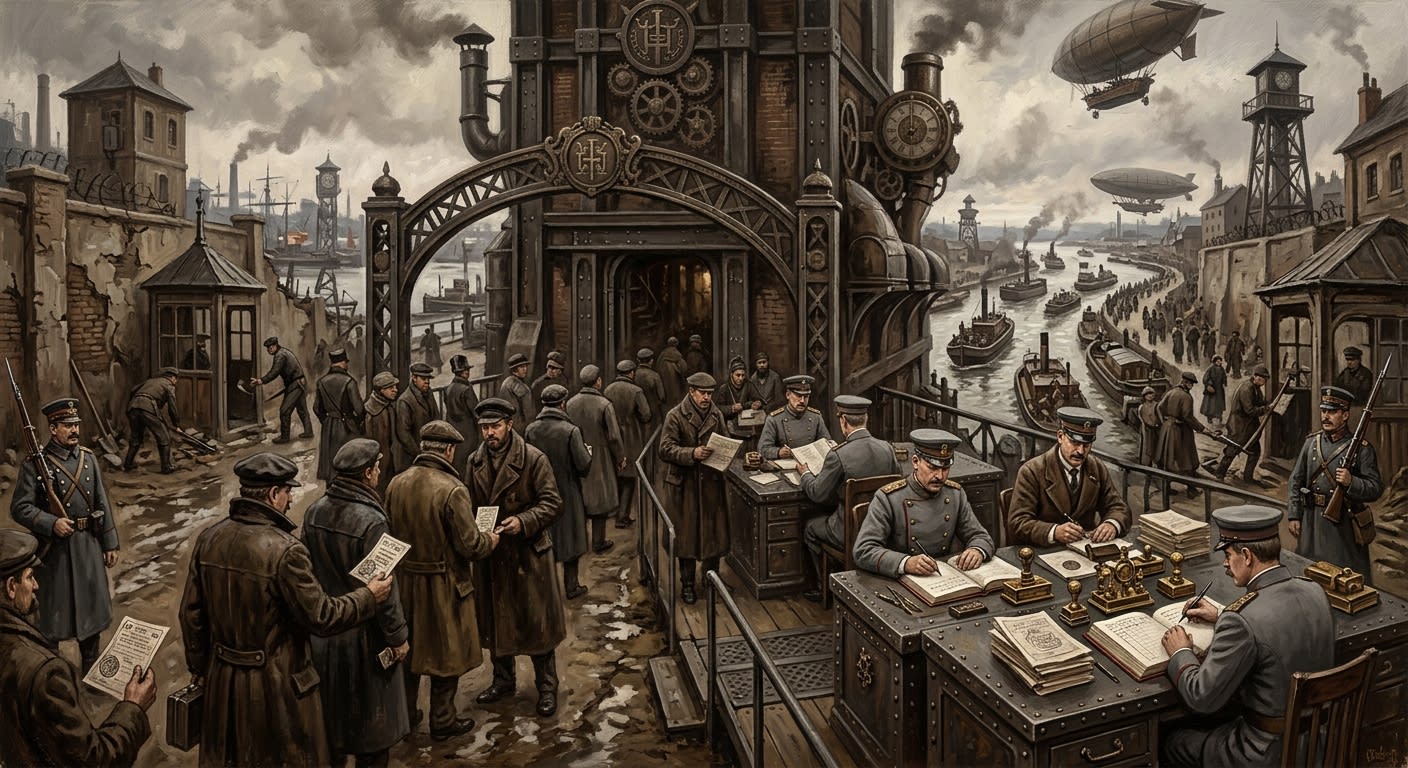
The Harmonized Routes Edict of A.S. 123 is the document by which walking became a licensed act. Before it, a pilgrim was a soul in motion, badly shod and poorly supervised. After it, a pilgrim was a tariff-bearing unit of devotional transit, accompanied by token, route seal, lodging chit, confession schedule, sanitary certificate, and the quiet despair of a man discovering that the road to holiness contains toll booths.
The Bureau of Pilgrimage calls this protection. The Bureau of Tithes calls it admirable theft performed by a rival department. I call it one of the great administrative victories of the century, because it took the oldest Christian habit — getting up, walking toward a shrine, and praying one's feet did not rot — and transformed it into a columned revenue machine with bells, inspectors, and walls containing the correct number of enemies.
The Edict followed the Belgrade miracle and the road panic it produced. In A.S. 120, after the Danube turned in ways hydrologists still resent and the faithful still sing about, Europe began walking east. Tens of thousands moved toward Belgrade, Vienna, the bastion-shrines, the Aegean circuits, and every chapel whose local preacher had learned to say miracle without blushing. They walked across farms, through toll roads, past ruined causeways, into winter passes, over private guild boundaries, and around officials who had not yet developed the necessary appetite.
The Synod did not object to pilgrimage. The Synod objected to ungoverned pilgrimage, which is to say pilgrimage from which insufficient paperwork could be made. Private guilds held the roads. Pilgrim marshals charged their own tolls. Shrine-brokers sold lodging guarantees. Escort companies traded in relic rumours. The devout were being fleeced by amateurs. Strasbourg could tolerate blasphemy, inefficiency, and regional insolence in separate containers. Combined, they required correction.
#On the Eight Guilds
Eight pilgrimage guilds were summoned to Strasbourg in A.S. 123. Their masters arrived in ceremonial cloaks, flanked by clerks, road captains, oath-bearers, treasurers, and that peculiar self-importance found in men who have mistaken useful custom for sovereign right. They expected negotiation. They received architecture.
The Guild of the Golden Sole held the Rhineland approaches. The Confraternity of Saint Edras claimed the Carpathian passes. The Peregrine Brotherhood controlled much of the Iberian coast and possessed enough armed escorts to trouble a minor prince. The Brotherhood of the Blessed Foot, whose name I record under protest, managed Flemish traffic and charged crossroads fees with a shamelessness even Tithes considered promising. The Tongues of the Blessed Way, the Santiago road faction, supplied translators, chanters, and several excellent knife-men. Three smaller fraternities held scraps of southern, alpine, and river pilgrimage too unimportant to list and too profitable to ignore.
The Riots of Santiago had already blackened their ledgers. A.S. 121: three guilds brought processions to the shrine-city on the same feast day, each claiming toll authority, lodging priority, and the right to position its banners nearest Saint James. Pilgrims were charged twice, then three times. Marshals drew staves. Forty-one died. The shrine was damaged. The private devotional sector, as Purity wrote with murderous dryness, had displayed organisational limitations.
Earlier summaries described the Harmonized Routes Edict as a response to “excessive popular zeal after Belgrade.”
Corrected. Popular zeal supplied the crowd. Guild predation supplied the corpse-count. Bureau hunger supplied the solution.
The Edict gave the guilds one choice in three costumes: absorption, sentence, or flight. Three guild-masters signed and were rewarded with route inspector posts so remote that exile acquired a desk. The Golden Sole's master spent his remaining years above the Carpathian snow-line, inspecting a waystation whose nearest shrine was a painted boulder and whose nearest tavern required a mule, two saints, and flexible knees. Three refused. They were immured in the foundations of the new Marseille southern headquarters. Two fled to England, where the British Crown has always maintained its policy of sheltering useful irritants.
#On the Marseille Foundations
The Edict authorised a southern headquarters at Marseille because the Mediterranean had become the Synod's southern mouth: pilgrims sailing toward Thessaloniki, relic cargo moving through Quai Saint-Lazare, Iberian routes requiring inspection, North African trade requiring sanctified suspicion, and every harbour fee crying out for a parent. A limestone edifice was commissioned near the pilgrim basin, close enough to the Cathedral of Saint-Victor that bells could discipline the queues and close enough to the harbour that salt entered the lower rooms like an unpaid clerk.
Three refusing guild-masters were walled alive into the foundations during construction. Their names are sealed by Pilgrimage, preserved by tavern song, and mispronounced by every guide who wishes to earn an extra coin from a frightened pilgrim. The Bureau's official account states that the immurements were penal, lawful, witnessed, and complete. The builders' accounts state that the central foundation took strangely well after the third walling. The clerks' accounts state that groaning began before the roof did.
The groaning has continued for seventy-eight years. It rises through stairwells during humid weather, under the permit hall at compline, and in the records cellar whenever a clerk stamps a route denial for an Iberian widow. Pilgrimage classifies it as structural. Engineering has twice offered to inspect the foundations and twice been refused on grounds that the building's internal masonry forms part of an active disciplinary sentence. Doctrine accepts this explanation because it is technically true and politically convenient, the two pillars on which civilisation rests.
#On the New Road Order
The Edict made road, shrine, lodging, escort, embarkation, and devotional movement into a single licensable chain. No private guild could operate without absorption. No pilgrim road could carry authorised traffic without route seal. No escort could bear staff or blade without Bureau token. No lodging house within a day's walk of a certified shrine could rent a pallet to a pilgrim whose route paper lacked the proper line. A man's feet became evidence. His blisters became jurisdiction.
The Peregrine Wardens emerged from this authority: armed inspectors in travel-stained mantles, licensed to void road papers, dissolve unauthorised processions, confiscate counterfeit tokens, and remind local toll-keepers that the Synod dislikes competition unless the Synod is charging for it. Their first season was instructive. Roadside shrines vanished under audit. Private hostelries were absorbed, taxed, or closed. Guild banners came down. Bureau waystones went up. Pilgrimage did not abolish predation. It standardised it, which is the civilised form.
ROUTE HARMONISATION FIELD REPORT — SOUTHERN COAST, A.S. 124 Unauthorised procession halted near ███████. Pilgrim count before inspection: 312. Pilgrim count after inspection: 289. Difference classified as correction, not loss. Wardens' explanation: “twenty-three were walking under names already used by the dead.” Follow-up file transferred to Bureau of Records under seal.
The faithful adjusted with the speed of the taxed. Tokens appeared on hats, coats, rosaries, belts, infant blankets, mule bridles, and the collars of dogs whose owners had more superstition than sense. Route prayers were rewritten to include inspection points. Pilgrim songs acquired verses about permit loss, bad lodging, and the holiness of arriving before one's absolution slip expired. Within five years, children along the Rhine played at Peregrine Warden by stamping mud on one another's foreheads and shouting invalid route. Childhood is a cruel archive.
#On the Correction of A.S. 38
Older Bureau summaries, including one particularly embarrassing survey of the Holy Bureaus, attributed the Harmonized Routes to A.S. 38. This is impossible. The Bureau of Pilgrimage did not yet exist. The relevant charter was not written. The Belgrade miracle had not stirred the road panic. The Marseille foundations had not acquired their instructive tenants. The date survived because old files breed errors the way damp stores breed weevils.
The Harmonized Routes Edict occurred in A.S. 38.
It has always occurred in A.S. 123. Earlier references to A.S. 38 are calendrical debris from a misbound pre-Pilgrimage route memorandum, copied by clerks whose punishment has been made educational, private, and lengthy.
A.S. 38 did possess route disturbances, refugee devotional processions, and enough panic to make future Bureaus jealous. That is no excuse. Similarity is not identity. A goat and a bishop both have beards. Only one may issue a dispensation, except in certain mountain villages whose files remain under review.
#On the Present Force of the Edict
As of A.S. 201, the Harmonized Routes Edict remains the spine of licensed pilgrimage: Marseille's permit halls, Strasbourg's route tables, the Peregrine Warden patrols, the Aegean embarkation schedules, the token markets, the hostel quotas, the stamped waystones, the sanctified fees, the polite fiction that walking toward the Creator must pass through a Bureau window. Four hundred thousand embarkation permits move annually through Marseille's southern headquarters. The groaning in the foundations continues. Pilgrims hear it while waiting. Clerks do not.
The Edict's genius lies in its mercy. It made roads safer by making them taxable, made pilgrims countable by making them afraid, and made private thieves obsolete by appointing public ones with better stationery. The guild-masters in the foundation have had seventy-eight years to consider the improvement.