
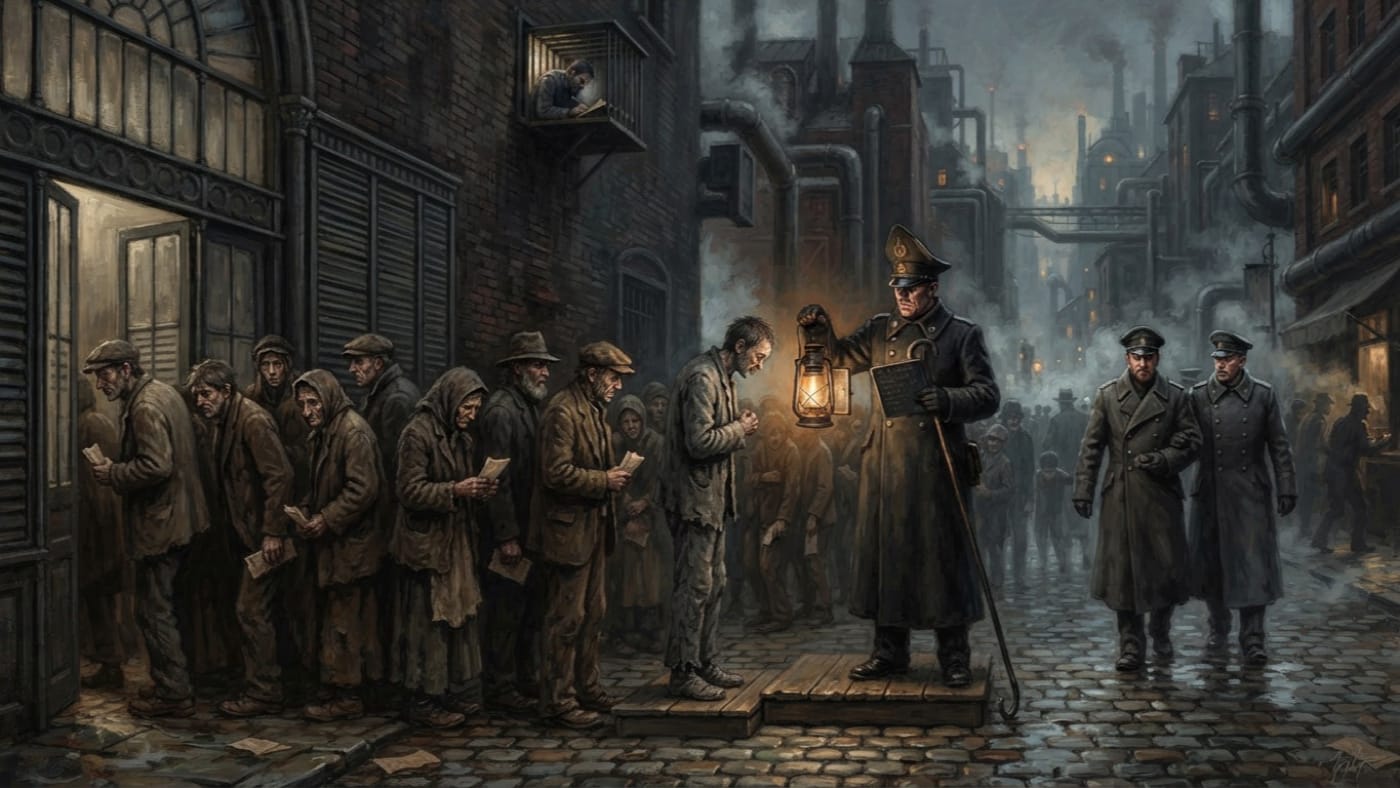
#On the Front of the Line
"A queue is a prayer. A shove is heresy." — doctrine of the Circle of Nine Wicks
The front of a ration line is the most coveted ground in any market ward, and the Circle of Nine Wicks has found a way to make it unbearable. Queue Penance places an offender there, ahead of the widows, the dock-porters and the children sent with the family token. The offender must then recite a scripted confession until the crowd accepts it. That is the whole of the charter's text: one line on a folded wax-paper sheet, set between the Bread-Wick and Permit Revocation. It governs more mouths in a night than most sermons govern in a year.
Note where the penitent stands. A citizen moved forward here gains no bread by it. The charter says nothing about whether the penitent eats when the performance ends, and I will not fill that gap for them. The head of the queue is chosen because every eye in the line must pass over it. The hungriest people in the parish are given something to look at while they wait, and what they are given is a neighbour admitting fault.
The punishment is written into the market charter of the Lantern Brotherhood, and this account describes it as practised in A.S. 201. The Circle's toleration descends from the Curfew Ordinance of Quiet Hours of A.S. 94, which allowed local auxiliary vigil personnel and so made the Circle possible. The ordinance does not mention queues, confessions or penance. The record does not say when the penance was first used, who used it or in which hall. The record has lost better things.
#On the Three Lights
No Queue Penance happens unwatched, because nothing the Circle does happens unwatched. Being watched is the thing it sells. The Triangle of Witness stands around the performance as it stands around every ration lane. The Anchor holds the choke-point with a visible lantern, hood half-open, citation slate on display like a minor relic. The Blade works the line as a moving pair. The Echo watches from a loft vent or a shutter crack. It never intervenes. It writes.
The field leaf sets the order of testimony with a candour I admire in a document meant to be burned. The Echo writes the first report. The Anchor confirms it. The Blade provides the body. In a penance the body is provided quite literally. A crowd-hook, the short shepherd's crook the Circle favours, draws the accused out of place and walks them to the front, and the line closes behind without a gap. The queue must not break. A broken queue is a crowd, and the Circle is paid to prevent crowds.
These are positions, not persons, and no headcount is fixed for them. A Brother may hold the Anchor at dusk and the Echo after midnight. Only the geometry is fixed.
The result is a confession heard by a full ration line and recorded by an officer nobody saw. The accounts agree in every particular. A clerk of the Bureau of Records can file that without raising an eyebrow, and Records chooses its clerks for the stillness of their eyebrows.
#On the Words and the Mouths
The confession is scripted. The charter says so plainly, and I respect a charter that does not pretend its penitents compose their own contrition after the curfew bell with a crook at the collar. The exact words are not preserved for this survey. I will not invent a liturgy the Circle never left where I could read it.
The audience is the real instrument. While the penitent recites, the line stands on wet stone with its tokens in hand. It smells the ovens through the hall shutters and counts the bodies ahead. Every repetition delays the ration, and every stammer costs the listeners something their stomachs can measure. A crowd in that condition does not weigh a confession on its merits. It weighs whether one more hearing is worth the wait.
The charter demands acceptance and gives no means of recording it. The Circle has written down no vote and no response for the line to give. The Anchor reads the queue as a sacristan reads a congregation that means to leave before the blessing. The murmur slackens, feet shuffle forward, and a woman in the third place stops watching the speaker and starts watching the hall door. The Anchor may take any of these as consent, and the Circle profits by taking them early. A fed line goes home.
The penance continues until the crowd accepts the confession or until exhaustion makes acceptance administratively convenient.
Amended. The charter reads only: until the crowd accepts it. The exhaustion clause is this office's commentary, entered in the Circle's notice as observation. It is not Circle rule, and no Nine Wicks document examined contains it. The observation stands. Its authorship is corrected.
The Church teaches that bread is sanctified before it reaches the mouth, and the people at the ration-station give their thanks aloud so that all may hear. Queue Penance adds a toll in words to that liturgy. Families who learned to give thanks aloud learn to hear guilt aloud in the same place, and to wait for it to finish.
The Mercy Preachers work the same queues by the opposite method. They tell the line it is not alone. Nine Wicks hands the line one person and lets it find out how alone that person is. Both arts are practised on a hungry crowd. Purity watches one as a danger and the other as a convenience.
#On the Drawer Behind the Words
Scripts must be kept somewhere. The Circle keeps them in the Permit-Chapel of Saint Varr, a shuttered side-shrine wedged between ration hall and market court. Its altar serves as a desk. Its "reliquary" is a locked drawer of permit dots, confiscation tags and pre-written confessions. The narrow loft above holds the Echo ledgers and overlooks the queue lanes. So the confession travels a short road: from the drawer to the mouth, from the mouth to the loft, and from the loft into the ledger. Saint Varr's recognition is disputed. The drawer's is not.
The Confession Closet is another matter. The Circle would like me to keep the two apart, and on this one point I am happy to oblige. The Closet is the Circle's cache of blank confessions and pre-signed citations, used to manufacture guilt when the proof quotas come up short. A scripted confession tells a penitent what to say about an offence. A pre-signed citation fixes the offence before anyone has been chosen to confess it. The first is procedure. The second is the drawer that, if the Wardens or the Bureau of Purity ever opened it, would end the Circle's toleration before breakfast.
Nothing examined shows that every Queue Penance rests on a forged citation, or that every penitent is innocent. Nothing examined shows the contrary either. A confession recited to a hungry line and accepted by it proves that it was recited and accepted. The ledger records it as proof of more. The ledger keeps the last word because it is the only party that writes.
The penance should be kept apart from the Circle's other rites. The Bread-Wick is initiation: an Ember-Page singes the crust of a loaf without setting it alight, and so learns pressure. Oil-Confession concerns a Brother's own admitted lies. Queue Penance alone is performed before the hungry, by someone who never asked to join.
#On Bread Hall 17
The Circle's notice preserves one incident report, and its year is redacted. I leave it redacted. At a Rhineland bread hall numbered 17, a subject was placed under Queue Penance after an accusation of flour dilution. The crowd's response went past what the report calls the approved murmuring, and the Anchor authorised what it calls chant-containment. By dawn the subject had confessed to offences the citation never listed. Three families were relocated. One loaf was kept as evidence, and the loaf is missing.
The report names no culprit for the loaf and explains nothing about the swollen confession. I add no explanation of my own. I note only that the confession ran on after the script had ended.
#On the Usefulness of Acceptance
The penance survives for the same reasons the Circle survives. Tithes wants markets that work and can therefore be counted. A queue that watches one of its own confess and then shuffles forward is still a queue, and a queue can be counted. Purity keeps its file and tolerates the Circle for its usefulness. Records handles the paper. The Bureau of Shadows watches, as it watches anything that works too well. None of them has issued a statute authorising Queue Penance, and none needs to. The toleration is local and revocable, and it rests on habit more than on law.
As evidence, a crowd's acceptance is poor. As a means of order, it is excellent. All the line ever agreed to was that it would hear no more, and that is all the Circle ever asked of it.