
#On the Bureau's Walking Seal
The Peregrine Wardens are the armed enforcement arm of the Bureau of Pilgrimage: road-soldiers, licence-breakers, convoy escorts, guild dissolvers, and the only men in the Synod authorised to ruin a traveller by touching wax to parchment at the roadside. They patrol designated routes from Marseille to the Vienna ruins, from the Reliquary Switchbacks to the embarkation piers of Thessaloniki, with halberd, token-hook, warrant-scroll, and the little iron seal that makes innkeepers sweat through their aprons.
A Warden is more than a guard with a pilgrim badge. A guard protects a body. A Warden protects a route, which is holier, dearer, and far more taxable. Pilgrims may be robbed, delayed, fined, misdirected, converted into penitents, or buried in ditchyards under provisional names; the route must remain licensed, counted, and open at the published tariff.
Their origin lies in the Harmonized Routes Edict of A.S. 123, when eight private pilgrimage guilds were summoned to Strasbourg, offered absorption, and taught the difference between negotiation and architecture. Three guild-masters signed. Three were immured into the foundations of the Marseille headquarters. Two fled to England, where the British Crown has maintained its traditional policy of receiving anyone likely to irritate us.
The first Wardens were drawn from absorbed guild escorts, penitent soldiers, retired road-bandits with useful knees, and second sons of poor noble houses whose families mistook violence with paperwork for honourable employment. The Bureau of Pilgrimage calls this founding class the First Road Cohort. The inns called them boot-crows. Both names remain in use, though one appears in ledgers and the other on privy walls.
#On Equipment and Authority
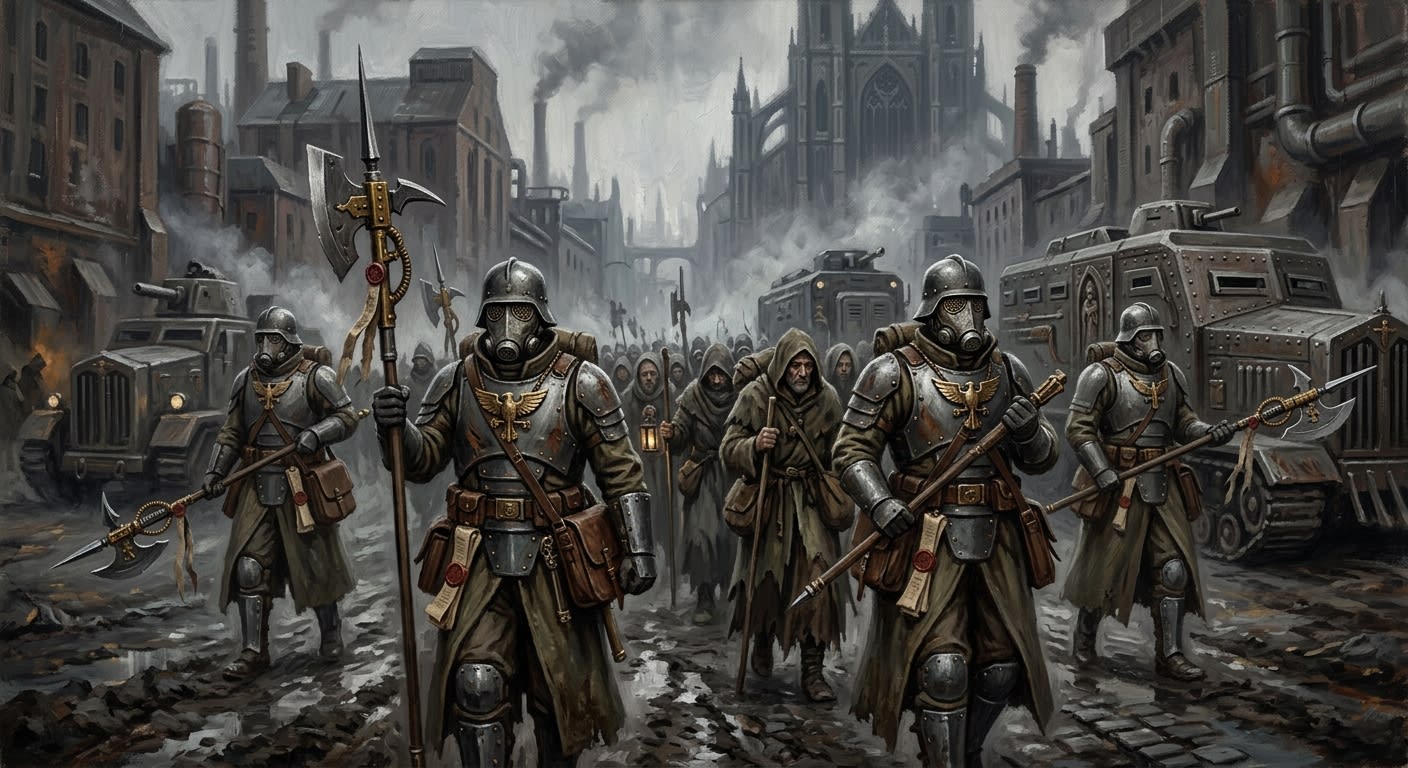
The Warden's visible kit is plain: long coat of road-grey wool, pilgrim-blue sash, nailed boots, token-hook, short sabre, halberd or pike-staff, and a rosary whose beads are drilled through with tiny route numbers. The invisible kit is worse. Each patrol carries a route folio, a schedule of licensed inns, an arrears list, a banditry map, a penitential chain, and three classes of seal: warning, suspension, voidance.
The voidance seal is the terror. Pressed onto a road-licence, waystation charter, caravan writ, shrine approach permit, or ferry covenant, it cancels legal passage at once. A merchant whose licence is voided becomes a loiterer with cargo. A pilgrim whose token is voided becomes an unregistered pedestrian. A guild whose charter is voided becomes a congregation of trespassers awaiting absorption or walling. The seal is small. The consequences are permanent.
Training occurs at three road schools: Strasbourg for doctrine and forms, Marseille for maritime embarkation violence, and Peregrine Row for practical cruelty in terrain where a man can be pushed ten feet and fall for fifty. Recruits learn crowd compression, token inspection by touch, creed failure response, bribe identification, contraband rosary cuts, mule-line reversal, sanctioned kneecap blows, and the proper angle at which a halberd shaft may be used to redirect a panicked pilgrim without technically striking him.
Older manuals described Warden discipline as “pastoral firmness.”
Corrected after the A.S. 188 review of the Lyon Road incident, in which pastoral firmness broke seven arms, one shrine banner, and a mule. Current manuals use “licensed compulsion.” The mule received no compensation. Its owner was fined for obstructing a holy route.
#On Patrol and Protection
The Wardens patrol in files of six to twelve. Two lead, two flank, one walks rearward-facing to watch the column's sins approach from behind, and one carries the folio box against his ribs like a reliquary. In bandit districts they double the file and add crossbowmen. In saint-crowd seasons they add rope-lines, whistle codes, and a junior clerk whose duty is to count fallen bodies before locals can remove relatives from the official tally.
Their protection is real. This fact irritates the romantic critic, who prefers his tyranny incompetent. Bandits fear Warden roads. Pilgrim convoys under Warden escort reach waystations alive more often than those hiring private guards, village cousins, or devotional enthusiasm. At the Choir-Broker Hall of Peregrine Row, where canyon echoes mispronounce prayer and fees multiply in the mouth, Wardens keep knives off pilgrims long enough for brokers to ruin them lawfully. At the Carpathian passes, Wardens drag sleeping penitents out of snowdrifts, slap them awake, and charge a rescue notation.
The Wardens also suppress banditry because unlicensed banditry competes with Bureau extraction. A bandit steals from pilgrims once. The Bureau prefers a schedule.
#On the Peregrine Jubilee
During the Peregrine Jubilee, the Wardens become the Bureau's mailed fist, iron boot, and counting finger. Every tenth year they precede the month-long procession of chained penitents across disputed routes, marking lapsed guild houses, illegal toll-bars, unsanctioned shrine stalls, private escort companies, ferrymen with imaginative tariffs, and roadside chapels whose relic claims have ripened beyond their paperwork.
The last Jubilee, A.S. 193, destroyed the Peregrine Cartel, a firm of pilgrim-insurance brokers operating the Iberian coast for six decades under episcopal protection and War's discreet approval. Wardens entered their offices at dawn with warrant-banners and road axes. Their ledgers were seized. Their choirboy bodyguards were disarmed, washed, inspected for pitch, and reassigned to the Bureau of Bells. Their intelligence network was acquired by Pilgrimage with such piety that even Shadows sent a blank page in admiration.
JUBILEE DISPOSITION NOTE — IBERIAN COAST, A.S. 193 Cartel principals presented: 14 Cartel principals absorbed: 3 Cartel principals immured: 5 Cartel principals transferred: 2 Cartel principals unaccounted: █ Choirboy retainers reassigned: 31 Songs recovered: █████████████
The Jubilee columns are theatre with bones in it. Chained penitents walk barefoot. Wardens pace beside them with ledger slates. Locals watch from upper windows and calculate which toll-house will vanish next. Children cheer when a voidance seal falls. Adults know better. A falling seal is a little funeral.
Pilgrimage teaching sheets state that guild dissolutions occur only where licences have lapsed.
Corrected. Guild dissolutions occur where licences have lapsed, where fees are in arrears, where safety conditions fail, where route doctrine has decayed, where duplication of authority threatens pilgrim welfare, or where the Bureau determines that mercy requires consolidation. The list is open. So are graves.
#On the Present Road
As of A.S. 201, approximately eleven hundred Peregrine Wardens serve in active deployment. They are posted along major shrine roads, bastion approaches, Marseille embarkation corridors, the western intake roads of Strasbourg, and the seasonal routes whose maps change with flood, ashfall, and the appetites of local officials. They quarrel with Tithes at every gate, with Purity at every suspected heretic, with War whenever soldiers want right of passage without devotional inspection, and with innkeepers as a matter of professional hygiene.
They are hated in precisely the correct amount. Too little hatred would mean laxity. Too much would mean riots. The Bureau tunes them like bells: harsh enough to carry, measured enough not to crack.
The faithful walk. The Wardens count. The roads remain holy, profitable, and passable in that order.