
#On the Heresy That Murmurs in Awaiting
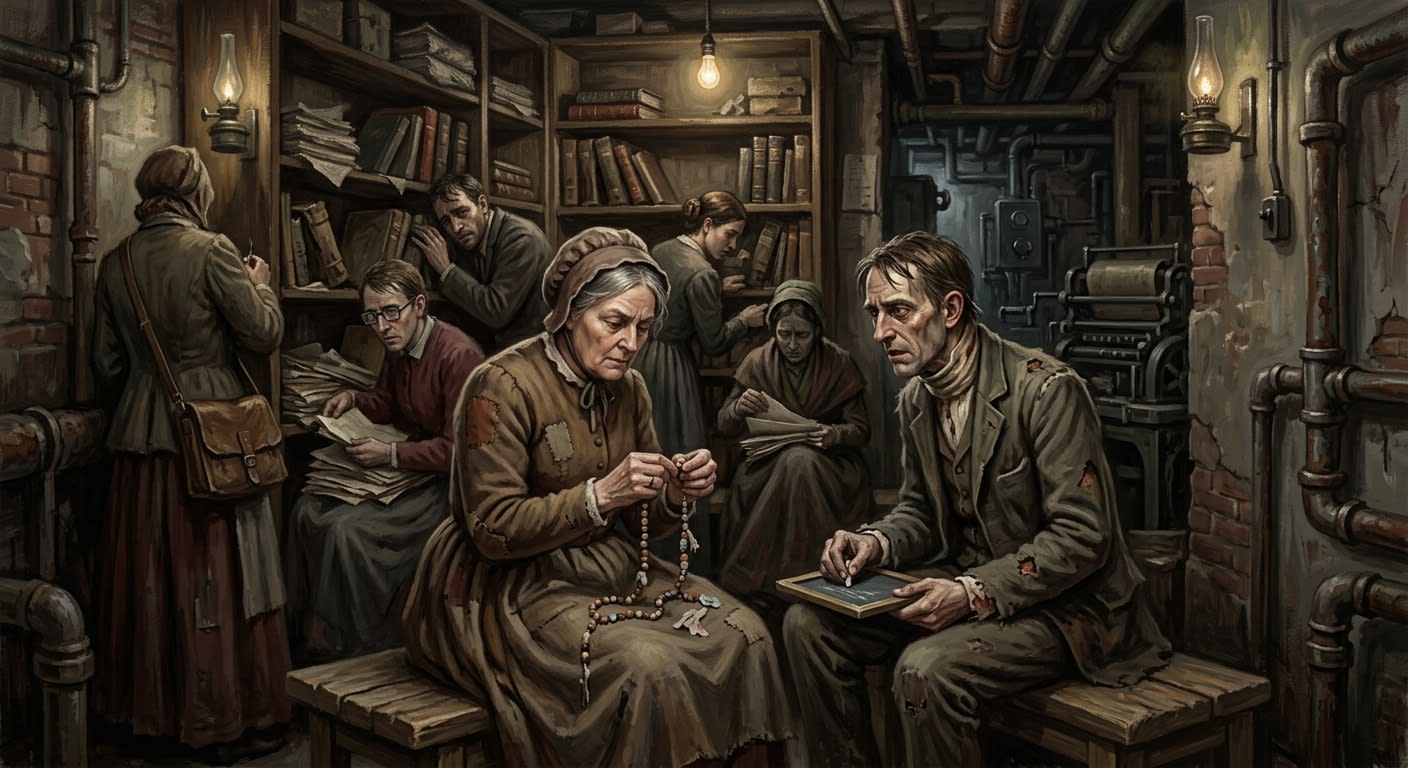
The Quiet Thread is a clandestine cell of clerks, archivists, detainees, dorm matrons, false sponsors, and theologically overexcited paupers within the Cloister of Miscounted Beads. Its members believe bead drift is intentional. They believe names reappear because someone — or something — summons them. They believe the dead return to rosters because the Ledger remembers what the Bureau erases. They believe the First String can be found, heard, directed, and, with enough silence, made to correct the corrections.
This is heresy. It grows wherever an office misfiles grief and then charges the victim for retrieval.
Do not imagine a sect with banners, altars, knives, and all the vulgar theatrics by which amateurs make themselves convenient to prosecution. The Quiet Thread owns no chapel. It prints no catechism. It prefers bunk-murmurs, stolen beads, corridor pauses, half-sung counts, blank spaces in ledgers, and the patient heresy of sitting still while the official room lies around you.
#On Origin Among the Miscounted
The Quiet Thread began as a dormitory comfort, which is how most dangerous theology begins before it learns Latin. A detainee in the Dorm Rows hears his name click from beneath a floorboard after third bell. A clerk at Desk Eleven watches a bead move and files a handling-error report with shaking hands. A widow sees her husband’s dead name appear in a ration slate and decides the Bureau has not erased him well enough. Comfort arrives first: the count was not lost. Someone remembers. The bead knows.
From comfort came method. From method came doctrine. From doctrine came the small feral confidence of people who have found a pattern the authorities deny and mistake denial for affection.
After A.S. 198, when western-gate traffic swelled the Cloister past design capacity, the cell thickened. Overcrowding gave it converts. Anomaly weeks gave it proof. Sponsor prices gave it enemies. The Vault gave it its central rumour. The Chapel gave it its insult: the second string, lawful, cheap, and cold in the palm, replacing a road-cord that had carried sweat, vows, rain, bread crumbs, ash, and a mother’s knot.
An A.S. 199 Purity draft described the Quiet Thread as “a detainee superstition without clerical participation.”
Corrected. Clerical participation exists. It is low-ranking, fragmentary, and cowardly enough to survive. Never underestimate a junior clerk with a grievance, a key-ring, and access to blotting paper.
The Bureau of Records made the cell possible by denying bead drift in perfect sentences. Circular 881-R declared counts fixed at filing and discrepancies products of handling error. The beads changed anyway. When reality contradicts a circular, the common faithful panic. Clerks take notes.
#On Their Doctrine of Directed Drift
The Quiet Thread’s doctrine rests on four propositions, each wrong in official language and inconveniently sturdy in practice.
First: every count has a prior count. Second: a correction does not destroy the first arrangement; it covers it. Third: bead drift is the pressure of covered names returning toward legibility. Fourth: silence sharpens that return, while speech gives the Bureau hooks by which to seize and rename it.
Their favoured phrase is directed drift. It has the clean little horror of technical language stolen by mystics. They teach that a string can be guided toward a buried name by silence, breath rhythm, pressure on the black bead, and the recitation of stations omitted from the lawful file. They claim the dead are not calling randomly. They are being misheard by offices trained to call every voice an error.
The doctrine flatters the beaten. A second-stringed pilgrim may say: my first cord still knows me. A clerk may say: my forged amendment can be undone. A dead claimant’s widow may say: he is filed elsewhere, merely misfiled. This is pastoral poison with a warm cup around it.
#On Practices and Rites
The Quiet Thread conducts rites in spaces where the Cloister’s authority is weakest: undercroft turns, refuse-canal paths, laundry corners, Dorm Rows after snuff, the side chamber near the Chapel where legal silence tests leave a residue of fear, and the corridor outside the Vault when the guard’s name has changed but her cough has not.
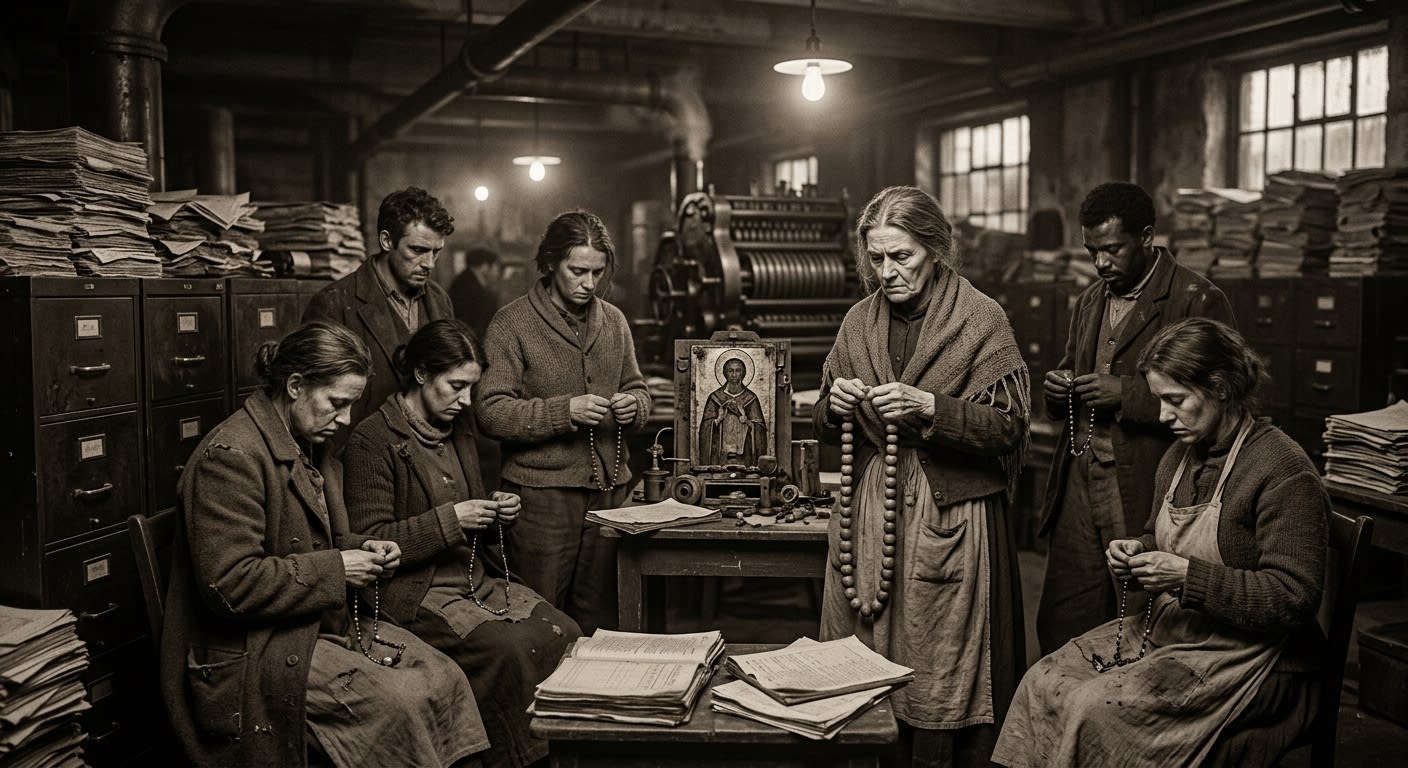
Their central rite is silence sitting. A stolen or borrowed string is placed in a salt-wax sleeve, then on cloth, then inside a chalk ring marked with route stations. Participants sit without speaking until third bell thins into fourth. The handler presses no bead at first. Pressure begins only after the first click. The second click is ignored. At the third, the wronged name is breathed into the cloth, never toward the ceiling. If the string warms, the name is written backward and folded inward. If the string remains cold, the cell disperses and blames impurity in someone else’s fear.
Children are used as listeners because children hear what adults rationalise and because heresy, like bureaucracy, discovers efficiency before conscience. The child is told to place one ear near the cord and report syllables, knocks, smells, or pictures. A good child says little. A better child lies carefully. A dangerous child repeats a name from the wall roster before the wall roster has acquired it.
There is also the knot rite, performed after a detainee receives a second string. The old road-knot, if saved, is tied around a scrap of dorm straw and hidden beneath the bunk. The new string is held but never kissed. The detainee whispers, “Correction is temporary; count is prior.” This phrase has been found scratched under bunks in Rows Four, Six, and Nine.
#On Members and Masks
The Quiet Thread recruits the Awaiting because waiting abrades obedience. It recruits clerks because clerks know where lies are stored. It recruits matrons because matrons hear night speech and control small mercies. It recruits failed sponsor runners because failure breeds both hunger and spite. It recruits grief as if grief were a trade class.
Its members recognise one another by omissions. A pause before saying corrected name. A refusal to count a black witness bead aloud. A second-string cord held across the palm but never closed inside the fist. A scrap of grey thread tied behind a berth slate. A chalk mark shaped like an unfinished knot near a drainage grille. None of these signs proves membership. Each proves enough to start surveillance.
The cell has no single leader. This offends Purity, which prefers crimes shaped like necks. The closest thing to a saint is Archivist Keth, called Mother Thread by people she has never blessed in any manner admissible to a wall. Keth does not lead them. She permits certain rumours to live and kills others with shelf changes, guard rotations, and the quiet murder of access.
#On Keth, Whom They Misread
The Quiet Thread mistakes Keth’s custody for endorsement. This is a common error among worshippers. A guardian of a dangerous thing becomes, in weak minds, its prophet. Keth guards the First String rumour because untrained hands would turn it into market, purge, liturgy, or miracle before understanding which of those names will kill fastest.
She has never publicly blessed the cell. She has never denied them in terms useful enough for Purity. She has allowed a shelf-map to vanish when a broker needed bait. She has reassigned a guard after a cell courier grew too confident. She has sent one novice to laundry after eleven days of curiosity. She hears what they say through walls and lets them believe stone has carried their prayers to her. Call it pest management with archival manners.
A seized Quiet Thread scrap names Keth “Mother of the First Count and Keeper of the True Cord.”
Corrected by Doctrine, if not by the scrap. Keth is Archivist of the Bead Vault, custodian of confiscated strings, and a woman with the excellent sense to refuse titles offered by frightened people in bad beds.
Still, she is their boundary. Without Keth, the cell becomes broker appetite wearing devotional thread. With her, it remains half-contained, half-fed, dangerous in a shape the Bureau can watch without admitting that watching has become dependence.
#On Enemies, Predators, and Useful Blindness
The Quiet Thread has four enemies and one patron it must pretend not to have. The Bureau of Purity hunts doctrinal deviance but has twice found no organised heresy, a result so convenient that even I am moved to admiration. The Sponsor-Seal Brokers hate any doctrine that offers correction without payment. The Grave-Name Market wants Quiet Thread access routes to the Vault and undercroft. Prior-Scribe Erem Vale fears the cell because a directed drift that proves one corrected file false would make every seal in his office feel soft.
The patron is overcrowding. Overcrowding gives the cell darkness, hunger, grievance, night noise, clerk fatigue, misfiled rosters, unwashed bodies, and enough procedural fog to move contraband beads from bunk to basin. If the Cloister were efficient, the Quiet Thread would shrink. Providence has protected them from that disaster.
Purity’s investigations deserve comment. The first found scattered superstition. The second found informal devotional language. Both recommended continued surveillance. No arrests followed at scale. The charitable explanation is incompetence. The correct explanation is utility. A visible Quiet Thread frightens clerks into obedience, gives Purity a reason to visit during anomaly weeks, and lets Records pretend the most alarming phenomena are caused by heretics rather than by the files themselves.
#On the Heresy’s True Danger
The Quiet Thread’s danger begins beyond its belief that the beads speak. Any fool may believe a thing speaks. Half the Synod has built chapels on worse evidence. Its sharper danger is that it teaches the poor to listen before obeying.
A detainee who listens may decide his second string is lawful but false. A clerk who listens may suspect a correction can be reversed. A matron who listens may learn that one dead child’s name appears every time a certain sponsor seal is used. A silence tester who listens may hear a count settle into a shape no desk has approved. Listening interrupts the chain between stamp and body.
PURITY FIELD NOTE — ROW SIX, A.S. 200 Subject group sat in silence around confiscated string. No spoken invocation recorded. At fourth bell, string produced seven clicks. Wall roster altered to include ███████████████, deceased A.S. ███. Three detainees wept without sound. Officer wrote “no organised rite observed.”
Their secondary danger is revenge. Directed drift can resurrect a wronged name; it can ruin another with equal piety. A broker who cheated a widow may find his childhood amended into orphanage debt. A clerk who sold a page may wake to a roster listing him dead-pending. A matron who struck a child may hear the child’s dead brother answer from a basin. The Quiet Thread calls this correction. The Bureau calls it retaliation when it lacks the paperwork.
#On My Inspection of Their Silence
I attended one authorised silence test after a suspected Quiet Thread contact in the Chapel side room. Authorised is a generous word. Vale invited me with the air of a man placing a snake in someone else’s hat. Keth stood behind the screen. Purity stood at the door trying to look necessary, a task at which it excels by accident.
A confiscated string lay in a salt basin. Three detainees knelt inside chalk. One was a widow. One was a copyist. One was a boy with the vacancy of a child who has learned that fear wastes strength. No one spoke. The sand glass drained. The string clicked once. The widow swallowed. It clicked twice. The copyist put his hands under his knees to stop them shaking. At the third click, the boy whispered a name.
The name was not his.
Keth closed her eyes. Vale said, “Terminate.” Purity moved forward. The basin water rose to the rim. I said nothing, which history will record as restraint, prudence, or excellent timing.
The official finding named no organised rite. The boy was reassigned. The widow was delayed. The copyist vanished into clerical debt. The string entered a grey case under double seal. The wall slate was washed twice. By dawn it bore the same name again, this time in cleaner hand.
#On the Present Thread
As of A.S. 201, the Quiet Thread is watched, denied, infiltrated, imitated, and growing. Five anomaly weeks are projected at the Cloister. The Dorm Rows are beyond capacity. The Vault is warmer than stone permits. Broker violence has sharpened around shelf scraps and undercroft maps. Purity rotates visitors through the compound with the boredom of men waiting for permission to enjoy themselves. Vale files measured concern. Keth listens.
The cell recruits in murmurs after candle-snuff. It teaches detainees not to answer the second click. It places beads under sleeping mats. It hides road-knots in straw. It tells the miscounted that their first cord still has pulse, that the dead remain filed elsewhere, that correction can be corrected, and that somewhere behind sealed wood and salt-wax the original count waits without hands.
This is poisonous doctrine. It is also, regrettably, good rhetoric.
At third bell the Rows fall quiet. The official lamps gutter. A bead clicks beneath a bunk. No one answers. Across the compound, in the Vault, Keth touches the cord at her wrist and turns one key in one lock.