
#On the Patrons of Correction
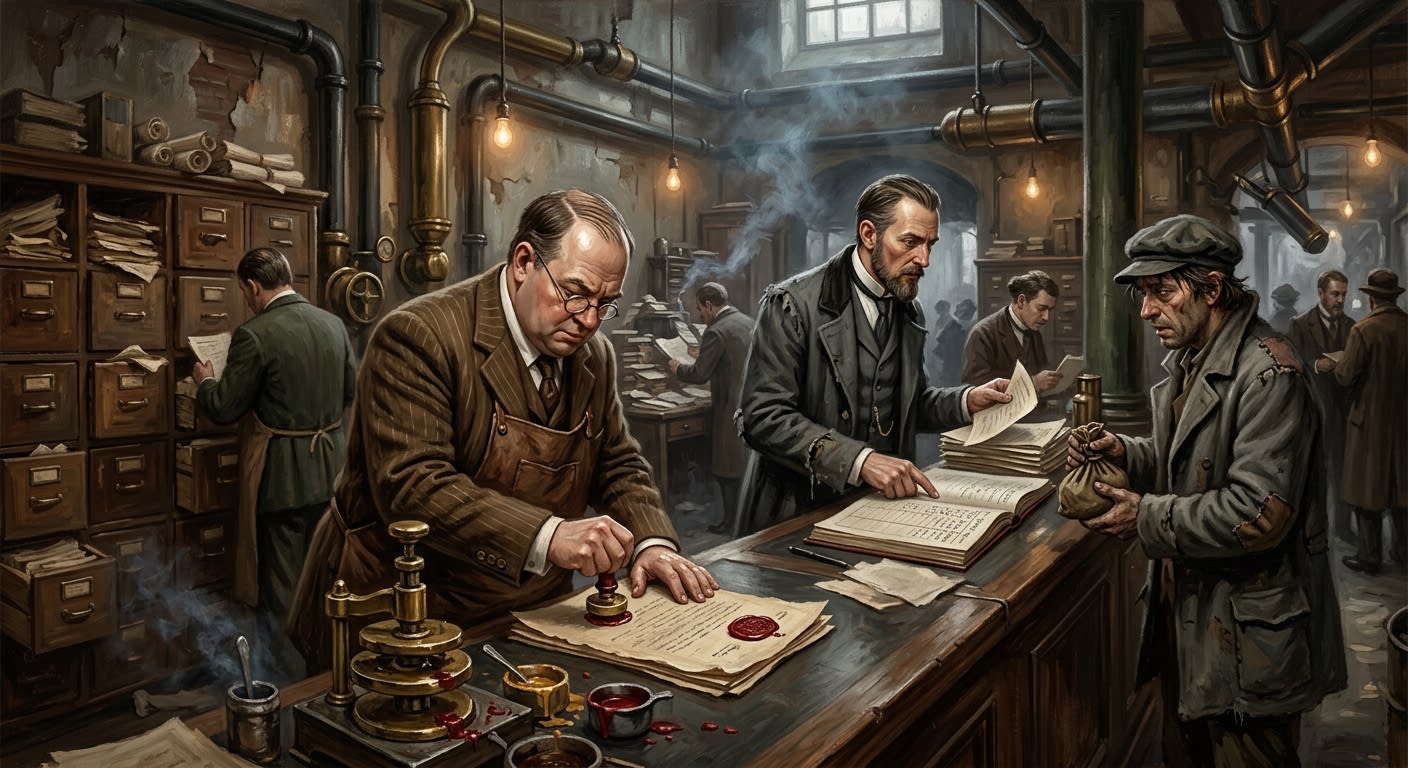
The Sponsor-Seal Brokers call themselves the Patrons of Correction, which is how one knows at once that their patronage begins with their own fees and their correction ends at the wax. They are men and women who have discovered that misery becomes nobler when sealed in wax. They operate inside and around the Cloister of Miscounted Beads, especially in the Supplementary Entry Office, the south awning of the Lost Procession Yard, the fourth desk of the Counting Hall, and the rubble lots beyond the wall where the Ninth Count serves broth of uncertain mammal and astonishing usefulness.
A sponsor seal is a wax impression bearing the counter-mark of a recognised benefactor, family house, parish fund, guild purse, shrine-committee, military ward, or invented body with sufficiently old paper. Applied to a detainee's file, it converts ordinary delay into sponsored correction. Ordinary delay is what the poor endure. Sponsored correction is what the better sort call mercy when they have purchased queue position, handwriting, and the right to be believed faster.
The Brokers sell access to that transformation. They do not, in the narrow legal sense, sell clearance. Clearance belongs to Prior-Scribe Erem Vale, whose seal hand remains small, clean, and ominous. They do not sell anomaly nullification; once bead drift becomes active, even greed develops a devotional respect for not being in the room. They sell introduction, sponsorship, classification softness, desk attention, dorm priority, family credibility, silence at the right hour, speech at the better one, and the little juridical perfume by which a rotten file can be made to smell like compassionate review.
A pilgrim enters Awaiting with a miscount. The bead string has thirty-nine beads where his testimony swears thirty-seven. His route slate claims one station more than the Queue Road can sustain. His dead companion appears on his living witness sheet. Without sponsorship he will be processed in the order of arrival, which is to say in the order by which hunger, fever, candle charges, clerical debt, and despair thin the line. With sponsorship his file moves to Desk Four. A prompter speaks gently. A clerk fetches the right grey form. A witness is discovered. A death becomes delayed. A discrepancy becomes pastoral. The pilgrim leaves sooner and poorer, which is considered a balanced outcome by everyone except the pilgrim.
This is the central genius of the Brokers: they have not built a parallel office. They have occupied the soft tissue between offices. The Bureau of Records owns the ledgers. The Bureau of Pilgrimage owns the road grammar. Vale owns delay. Jossa Rill owns intake. Keth owns the Vault's refusal. The Brokers own the pause after a clerk says, “There may be a way.”
#On the Seal and Its Lesser Theologies
The sponsor seal began as mercy. Most profitable indecencies do. In the first years after the Pilgrim Reconciliation Statutes of A.S. 97, pious houses, guilds, widows' societies, regimental chapels, and shrine fraternities placed their marks upon files to guarantee that a miscounted pilgrim had reputable backing. A seal said: this soul is known; this discrepancy is not fraud alone; this man has people; this woman has return; this child belongs to a parish that will answer inquiries. The practice shortened delays and reduced deaths in Awaiting.

Naturally, it was improved until it became dangerous.
By the A.S. 187 revision, sponsor seals had hardened into a recognised instrument of review. The Office created sponsor packets. Desk Four reserved hearings. Filing fees acquired sponsor-weight. Confession addenda could be copied to benefactors, provided privilege remained intact inside the capacious range permitted by Records, Pilgrimage, Purity, Tithes, Mercy, and any tribunal with enough wax to interrupt a sermon. The charitable houses found themselves courted. The guild funds found themselves imitated. The parish marks found themselves borrowed, traced, warmed, lifted, counterfeited, and sold beneath awnings by men who spoke under their breath and carried cleaner fingernails than their trade deserved.
The seal's theology is simple. A person without a sponsor is raw material. A person with a sponsor is a case. The difference matters. Raw material can be stored, charged, worked, assigned, delayed, corrected, and converted into labour with very little rhetorical trouble. A case has correspondence. A case has a benefactor who may complain. A case has copies moving beyond the Cloister wall. A case has witnesses, or at least the attractive rumour of witnesses. Bureau cruelty dislikes travel. It prefers rooms where everyone depends upon the same lamp.
The Brokers understood this before the Bureaus admitted it. They made sponsorship portable. They made it purchasable. They made it divisible into grades: yellow twine in the Yard, Desk Four petition, Office packet, chapel attest, second-string endorsement, dorm fee guarantee, route witness procurement, family credibility, death-status challenge. A rich family might buy the whole sequence. A poor pilgrim might buy only yellow twine and a better place to rot.
Early Cloister memoranda described sponsor-seal brokerage as “informal charitable facilitation.”
Clarified after the A.S. 199 price surge. The practice is commercial, coercive, and structurally embedded. Charity may be present in isolated cases, as lice may be present in a cardinal's sleeve; neither defines the garment.
The seal itself, when genuine, is warmed in the palm and pressed beside the discrepancy mark. When false, it is also warmed in the palm and pressed beside the discrepancy mark. Theology enters afterward, when a clerk must decide whether the warmth came from recognised benefaction, clever wax, or the file's own appetite for becoming expensive.
#On Their Origin in Delay
No cartel begins with a charter. It begins with a bottleneck and someone willing to stand near it all day. The Sponsor-Seal Brokers arose from the Cloister's founding vice: delay priced as discernment. The Cloister was established in A.S. 94 to catch miscounted pilgrims spilling into Strasbourg after the Concordat made pilgrimage more legible, more popular, and easier to punish by arithmetic. The Clickery counted. The Office amended. The Dorm Rows filled. Every week produced people whose files could be moved by a word from the correct desk.
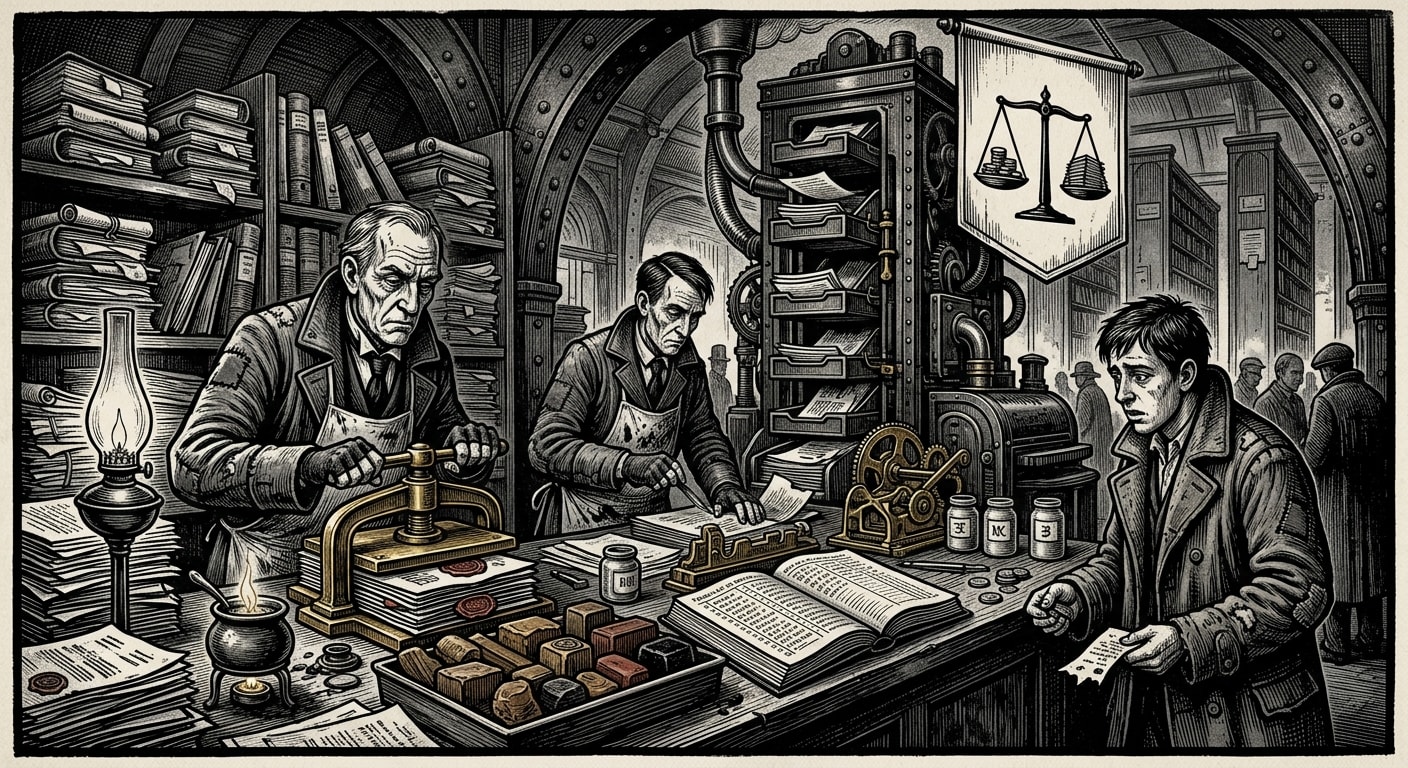
At first the facilitators were clerks' cousins, parish runners, retired chain-handlers, widows with tidy handwriting, shrine sisters who knew which seal impressed cleanly after rain. They carried packets, explained forms, lent wax, found sponsors, persuaded route witnesses, and occasionally committed the little frauds without which bureaucracy becomes murder by waiting. Records called them auxiliaries when useful. Pilgrims called them angels when desperate. The angels learned to invoice.
The first recognisable Broker houses appear in the side ledgers around A.S. 128, under harmless names: Saint Odran Relief Copy (Unregistered), Third Road Charity Table (Unregistered), Yellow Cord Assistance (Unregistered), Friends of the Delayed. Each house maintained a shelf of sponsor relationships and a staff of runners who knew how to move between the Yard, the Office, and Desk Four without looking hurried. Hurrying is suspicious. The accomplished Broker moves at the pace of someone expected.
By A.S. 157, during the western reserve famine year, sponsor seals became food-adjacent. Families unable to redeem detained kin sold grain chits for wax. Guild houses used sponsorship to recover skilled workers before clerical debt converted them into Cloister labour. Military chaplains sponsored soldiers whose bead strings had dissolved in mud, blood, or the ordinary carelessness of men marching toward death. The Brokers learned class dialects: pious for widows, brisk for guilds, deferential for nobles, practical for soldiers, silent for criminals.
The A.S. 187 revision gave the practice its modern skeleton. Sponsor review became a formal handling category. Desk Four grew teeth. The Supplementary Entry Office created sponsor routing. Vale inherited a mechanism too profitable to abolish and too useful to confess. The Brokers, smelling law, became a cartel. They divided approaches, assigned awnings, agreed minimum fees, shared seal-warmers, and enforced professional courtesy with all the tenderness one expects from commerce when commerce has discovered the poor cannot leave.
#On the Houses, Runners, and Wax Men
The public imagines the Sponsor-Seal Brokers as a row of oily men beneath an awning, murmuring prices to mothers while rain soaks through their shoes. This is true and insufficient. The awning is the mouth. The body lies elsewhere.
The smallest Broker is a runner with two borrowed marks, a cousin in the Office, and a talent for guessing which despair still has coin under it. The middling Broker controls dorm assignments, sells queue positions, and maintains relations with a Desk Four clerk who has decided that corruption, if performed regularly, is merely another shift. The great houses possess seal catalogues, parish correspondents, copyist debts, confession packet buyers, grave-name contacts, false-charity ledgers, and one or two respectable benefactors who believe themselves engaged in pious work because no one has been rude enough to show them the price table.
The Brokers use titles chosen for moral upholstery. Patron-Clerk. Relief Advocate. Seal Steward. Family Sponsor. Correction Friend. Wax Man, in the Yard's honest tongue. A Wax Man carries a small brass box lined with cloth, containing warmed blanks, seal fragments, twine, folded attestations, parish slips, and the little bone spatula used to lift an impression from one page and persuade it to love another. A good Wax Man can identify a family with funds by the way they ask whether the Dorm Rows are safe. A better one can identify a family without funds but with blackmail value.
Runners are mostly children, widows, failed copyists, and men too clean for the rubble lots yet too known for the city proper. They cross the compound carrying folded slips that contain no complete crime. One slip bears a desk number. Another bears a parish mark. A third says only wall-side. A fourth is blank until held over a lamp. If caught, the runner knows nothing except errands. If searched, the papers mean little. If beaten, which happens less often than moralists desire and more often than the children deserve, the runner names a dead Broker or a tavern cook.
The cartel maintains order through access. A Broker who undercuts the common price finds his runners sent to the wrong line, his seals questioned, his families delayed, his dorm clients moved beneath leaking roof, his forged attestation corrected into evidence. Violence occurs, naturally, but paperwork is preferred. Bruises invite Purity. Procedural collapse invites prayer. A changed berth slate ruins a man quietly enough to be educational.
#On Methods of Merciful Theft
Sponsor-seal brokerage has three arts: acceleration, alteration, and protection. The first is legal in outline. The second is legal once successful. The third is never admitted because it works best when called something else.
Acceleration moves a file. The Broker obtains yellow interest in the Yard, Desk Four review in the Hall, fast copying in the Office, dorm fee guarantee, or early Chapel appointment. None of these steps requires a lie. They require attention, and attention is the rarest ration in the Cloister. A widow with three children and a correct seal may be heard in two days rather than nineteen. She pays. The Broker calls it compassion. The clerk calls it workflow. The widow calls it the price of still having a name by Friday.
Alteration changes a story. A route becomes rain-diverted rather than false. A missing station becomes closed by order. A dead companion becomes separated before death. A child becomes attached to an aunt whose existence ripens under fresh ink. A soldier becomes a delayed pilgrim rather than a deserter. A family whose son was marked Irreconcilable receives a sponsor packet stating Awaiting Review, and for three more days grief eats broth instead of ash.
Protection keeps a file from becoming prey. This is the Brokers' most defensible practice and their most useful excuse. A sponsored file is harder for the Grave-Name Market to strip. Harder, not impossible. A sponsored child is harder to misassign. A sponsored widow is less likely to be converted into corpse-cart labour before appeal. A sponsored dead claimant may be held pending rather than sealed into the Vault under grey cord. These protections are real. Their reality makes the extortion durable.
City complaint rolls of A.S. 165 list Broker activity under “pilgrim fraud.”
Corrected in later Cloister usage. Fraud is too small. Fraud lies about a thing. Brokerage alters the conditions under which truth becomes payable. The old charge remains useful for hanging amateurs.
The Brokers also practise delay as punishment. A family that refuses a price finds its papers misplaced. A clerk sympathetic to the poor discovers his handwriting mentioned in a missing-pages inquiry. A sponsor house that objects to fee inflation receives requests for historical validation of every mark issued since A.S. 142. A rival Broker's client is moved from Sponsored Review to Chapel Salt because one bead, quite suddenly, feels warmer than the file prefers. The Brokers do not control anomaly. They control how quickly panic reaches the word anomaly.
#On Desk Four and the Office Gut
Desk Four is the altar at which the Brokers kneel while pretending to stand. It hears sponsor-seal petitions in the Counting Hall, receives wax marks from the Patrons of Correction, and transforms a detainee from mass into case. A line without sponsors waits under the gaze of twelve lamps. A sponsored file arrives folded, bound, and smelling faintly of confidence. Confidence is not doctrine, but it impresses clerks who spend their days smelling fear.
Desk Four has stopped pretending sponsor seals arrive in order. This was inevitable. Order is expensive; disorder is profitable; the Cloister contains hungry men with access to both. Broker runners hover near the Hall in sanctioned unsanctioned patterns. A cough near the blue shelf. A folded slip under the vinegar bowl. A candle stub left beside the third wax tray. The clerk looks down, looks up, and discovers that one family deserves review before another family whose only defect is poverty committed without discretion.
The Supplementary Entry Office is where the seal becomes narrative. A sponsor mark alone cannot save a file. It must be clothed in explanation: route statement, family attestation, confession compatibility, debt guarantee, missing page reconstruction, witness note, dorm conduct, chapel recommendation. The Office supplies such clothing with expert indecency. A naked lie is shameful. A lie wearing five forms and a sponsor cord may pass for social obligation.
Confession slips are particularly valuable. The Office routes private shame to many destinations, and a family of means that has lied with promising complexity will find the Brokers hovering like physicians over a patient with a rare and billable disease. A man who confessed adultery near Griefgate may need the station moved. A woman who confessed theft at a shrine she never reached may need her theft detached from geography. A child who saw a dead father at the Intake Gate may need silence, sponsorship, or a new uncle by morning.
Vale knows. That sentence should be engraved over every Cloister door to save inspectors time. Vale knows the Brokers accelerate certain files, quiet certain families, and convert desperation into revenue without formal charter. He condemns their excess quarterly. The condemnation is copied, filed, and ignored with the mature grace of an institution performing hygiene over a wound it prefers not to lance.
#On Enemies and Partners
The Sponsor-Seal Brokers despise the Grave-Name Market in public and feed it in practice. Their trade rests on lawful sponsorship; the Market undercuts them with partial sponsorship, scavenged sponsor wax, lifted impressions, anticipated benefactors, moral sponsorship, dead witnesses, and names warm enough to wear. The Brokers call the Market filthy. Then they buy rumours in bulk. One must not confuse disgust with abstinence.
The Quiet Thread is a worse enemy because it offers correction without payment. Its doctrine of directed drift tells the miscounted that a first cord may remember what the Bureau has corrected away. This is intolerable. A poor man who believes his true count can return through silence may decline sponsor wax. He may wait for the bead to choose. He may listen instead of buying. Heresy is bad enough when it threatens Doctrine. When it threatens margins, it becomes urgent.
Archivist Keth is neither enemy nor partner. She is a locked cabinet wearing skin. The Brokers want usable pasts from the Bead Vault, access to grey cases, shelf-map scraps, index leaves, and the rumour of the First String. Keth gives them bait when bait will draw them into a smaller room. She permits enough scent to keep them circling and denies the bite. More than one Broker has purchased a shelf-map leading to cleaning rags, vinegar requisitions, and funeral dates for persons not yet dead. I consider this one of the higher arts.
Jossa Rill tolerates Broker presence in the Yard because yellow tags move bodies faster than argument. The Outer-Watch tolerate them because paid panic is less likely to become riot. The city magistrates despise them for dumping corrected vagrants back into Strasbourg with papers too lawful to refuse and bodies too hungry to house. The Bureau of Records tolerates them because revenue and paperwork are the twin lungs of civilisation, and only fools suffocate themselves for the sake of moral freshness.
The Brokers' safest partner remains overcapacity. Since A.S. 198, redirected pilgrim traffic has swollen the Cloister past design. Annual intake reached fourteen thousand two hundred in A.S. 200. Five anomaly weeks are projected in A.S. 201. Every backlog is a feast. Every full dorm raises price. Every tired clerk makes clean fraud look like kindness. Every city complaint increases the value of anyone who can make a file leave quickly without leaving a scandal attached.
#On Scandals, Wars, and the Blank Seal Winter
The Brokers have endured three major scandals, two minor purges, one price war, and several sermons, which is the standard maturation sequence for useful corruption.
The first scandal, remembered as the Yellow Twine Affair (Unregistered), occurred in A.S. 166 when a runner sold sponsor-interest tags in the Lost Procession Yard without matching sponsor packets in the Office. Sixty-three pilgrims reached Desk Four bearing yellow ties and no benefactor. Desk Four panicked in the dignified way available to furniture and clerks: it halted. The queue pushed. The Outer-Watch struck. By evening the Yard mud contained blood, three broken bead strings, and a confession from a weather-cloth repairer who had acquired more wax than textile skill. The official finding condemned unauthorised colour usage. The Brokers learned thereafter to sell at least the first page of the lie.
The second scandal followed the A.S. 187 revision, when blank sponsor forms multiplied in the Office. The Missing Pages Ring (Unregistered) and the Brokers discovered one another with the joy of two thieves finding a shared staircase. Pages vanished, reappeared cleaner, received sponsor marks, and generated reconstruction fees. For a season, the same benefactor sponsored a dead miller, two living widows, a soldier, a child from no parish, and a goat. The goat cleared fastest. Records called the event a filing irregularity and quietly changed the paper watermark.
SEALED OFFICE NOTE — BLANK SEAL WINTER, A.S. 188 Recovered forms bore sponsor impressions from houses not yet founded. One blank sealed itself while under glass. Desk Four clerk stated the wax “remembered pressure.” Broker L████ Venn found in south corridor with both hands clean of fingerprints and all pockets full of white twine. Disposition: █████████████████████ under Records privilege.
The third scandal came after the A.S. 199 price surge, when Broker houses tripled rates during anomaly pressure and one house attempted to purchase exclusive access to Desk Four petitions for noble families. Poor pilgrims rioted badly, which is to say without weapons, without strategy, and without anyone in authority endangered enough to call it politics. The Brokers blamed rogue runners. Vale condemned excess. Keth changed lower shelf marks. Rill banned two awning men and admitted their cousins three days later. The market stabilised at twice the prior rate, proving that outrage, when properly managed, is a negotiation tactic.
A.S. 199 Cloister audit found “no organised sponsor cartel with price-fixing capacity.”
Revised after three houses posted identical winter rates, identical condolence language, and identical penalties for families requesting charity. The audit remains on file as evidence that blindness, too, can be neatly bound.
#On the First String as Market Dream
The Brokers dream of the First String in terms that reveal the tin chapel where their souls ought to be. The Quiet Thread imagines original justice. Keth imagines danger. Records imagines denial. The Brokers imagine inventory.
They believe the First String could correct a childhood into nobility, a debtor into a martyr, a deserter into a pilgrim delayed by rain, a bastard into an heir, a corpse into an inconvenience, and an inconvenient man into one who never approached the gate. Their error is not greed. Their error is provinciality. They think the prime cord would sell pasts. A thing that can make every correction appealable would make ownership of pasts absurd. One does not auction the axe that can chop down the auction house.
Broker attempts to reach the lower Vault ranks have multiplied since A.S. 198. Shelf-map scraps circulate. Grey-case numbers fetch good prices. Former copyists sell false cabinet sequences. One Broker house purchased what it believed was Keth's bone-key split and received, upon inspection, a laundry tally, a vinegar bill, and a sealed note reading: Nice try. The note has since been copied and sold as proof of authenticity by the same house. Commerce is resilient because shame rarely survives profit.
Their First String strategy, insofar as fools may be said to possess strategy, relies on three routes: bribing Vault-adjacent clerks, buying Quiet Thread access, and provoking Purity seizure. The first fails because Keth's clerks are too frightened or too well fed on secrets to sell the right thing. The second fails because the Quiet Thread hates paid correction nearly as much as it hates official correction. The third has not yet failed loudly enough. A Purity seizure of the Vault would create smoke, panic, inventory rupture, and opportunities for hands that know which cabinet to open while men with torches argue doctrine. Keth knows this. Vale knows this. I know this. Purity, being Purity, knows only that a locked room insults fire.
#On the Present Tariff of Mercy
As of A.S. 201, the Sponsor-Seal Brokers are fat, watched, divided, indispensable, and one scandal away from formalisation. Their prices have tripled since the post-A.S. 198 intake pressure. Desk Four is clogged with sponsored petitions. The Supplementary Entry Office loses pages with disciplined regularity. The Lost Procession Yard hides Broker introductions beneath weather cloth. The Grave-Name Market buys their scraps. The Quiet Thread steals their customers' hope. Vale condemns them in language that leaves room for receipts.
No public order charters them. No serious officer imagines the Cloister could function tomorrow if they vanished tonight. Files would slow. Families with money would riot more effectively than families without it. Clerks deprived of unofficial payments would rediscover salary as grievance. Sponsored cases would collapse back into Awaiting and the Dorm Rows, already beyond capacity, would become a sermon on compression. The city would receive fewer corrected vagrants and more uncorrected corpses. Records has done the arithmetic. Records dislikes the sum. Records has misplaced the page.
A poor pilgrim still stands beneath the awning with rain entering his collar while a Wax Man explains that speed is charity, charity has costs, and costs may be reduced if the pilgrim's sister can write, if the dead witness can be moved to another line, if the family ring is real silver, if the child answers to a simpler name. Behind them the Cloister clicks: beads on oak, seals in wax, knees on stone, keys in Keth's cabinet, Rill's tags, Vale's little horn-handled seal lowering toward paper with the tenderness of a blade.
The Brokers smile. Monsters are simpler and generally worse at invoices. The Brokers are men and women standing beside a machine that eats time, selling teaspoons of it back to the swallowed.