
#On the Office Where Lives Acquire Addenda
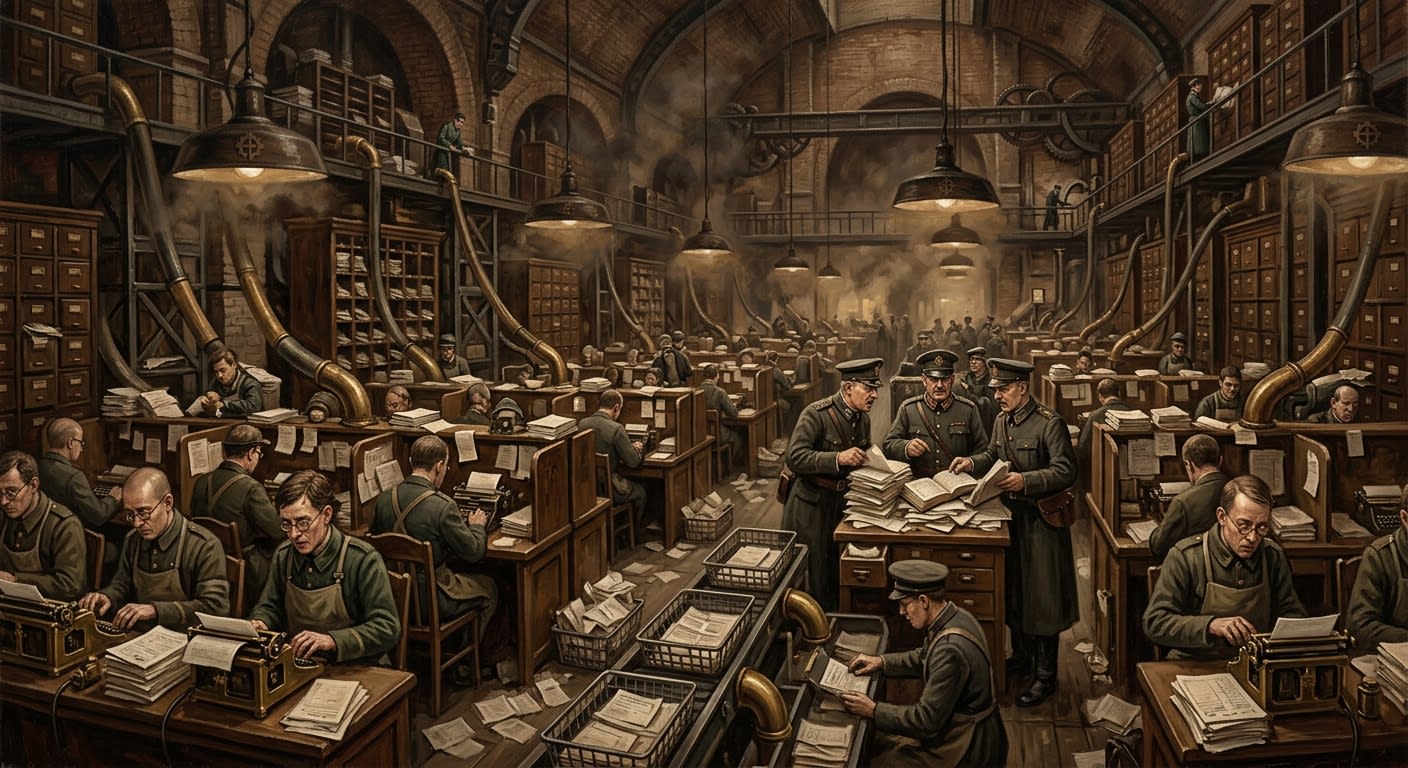
The Supplementary Entry Office is the paper gut of the Cloister of Miscounted Beads, a corridor-choked annex smelling of damp paper, vinegar wash, hot wax, tired wrists, and the old human terror of being asked to spell one’s name before a man with authority over ink. The Counting Hall pronounces discrepancy. The Office feeds it, fattens it, prices it, and teaches it to sit upright in a ledger.
Here a pilgrim’s life is repaired by addition. One missing bead becomes a route clarification. One wrong station becomes a devotional exception. One dead companion becomes a witness problem, then a confession addendum, then a labour surcharge. The Office does not erase. Erasure is vulgar, dramatic, and too often memorable. The Office appends until the original life can no longer be seen beneath the amendments, which is cleaner.
The Office occupies the south spine between the Clickery and the dormitory passage, close enough to hear beads strike desk wood and far enough from the Lost Procession Yard that the mud arrives only on shoes, hems, and paperwork. Its rooms are narrow. Its doors are half-doors, so clerks may see bodies and ignore faces. Its ceiling sweats. Its walls were vinegar-washed so many times that the plaster smells pickled, which is fitting. The place preserves what should have rotted.
#On Forms
The Office runs on forms, and each form exists to prove that the previous form was insufficient. Form S-1 records the discrepancy named in the Counting Hall. Form S-2 records the pilgrim’s explanation for the discrepancy. Form S-3 records why the explanation has failed to satisfy the clerk. Form S-4 requests supporting testimony from companions, dead companions, absent route leaders, or saints of limited documentary utility. Form S-5 converts unsatisfied discrepancy into clerical debt. Form S-6 appeals the conversion. Form S-7 denies the appeal in language gentle enough to be mistaken for compassion by the very tired.
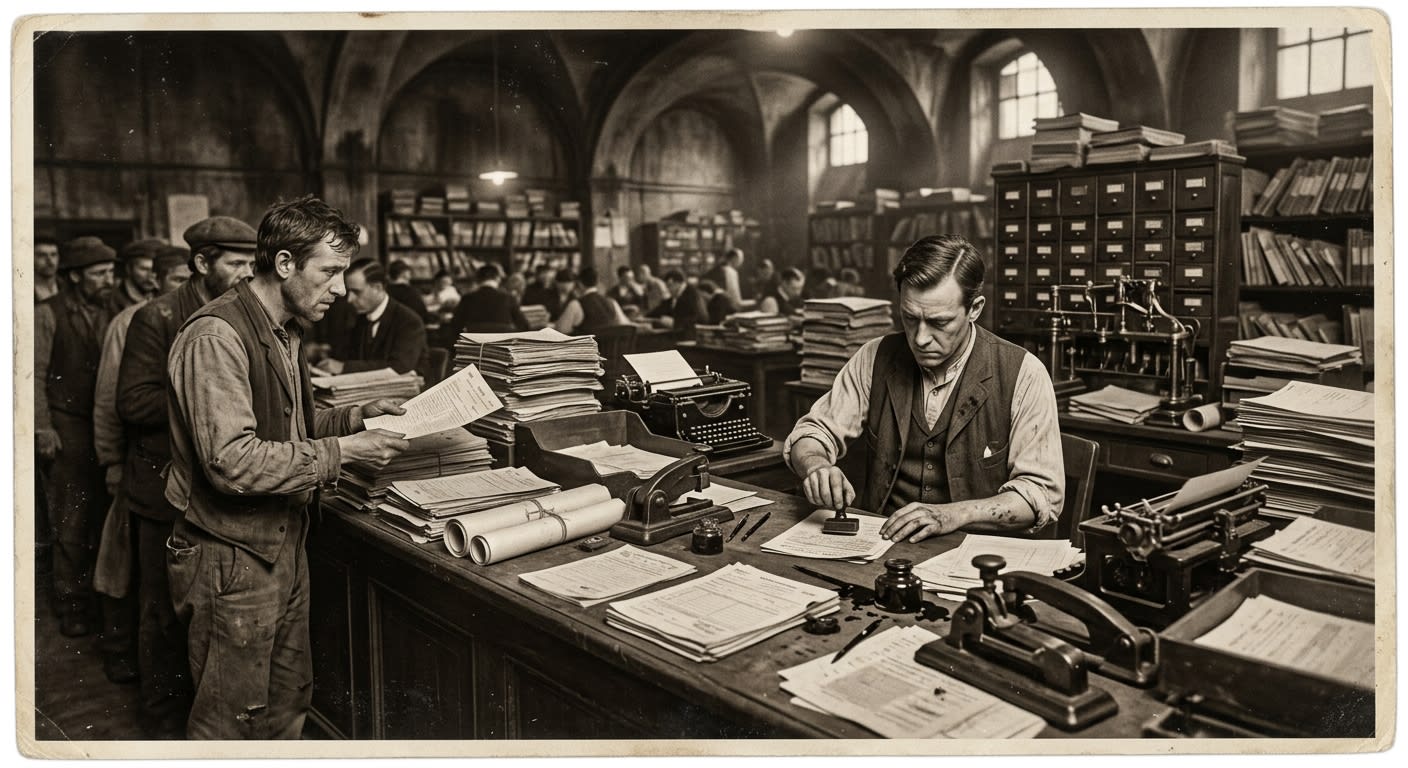
Supplementary entries are copied in triplicate: pilgrim copy, Office copy, Records copy. The pilgrim copy is the smallest and least durable. The Office copy is bound in grey thread and stored for active reconciliation. The Records copy is sent through a slit behind Desk Two and disappears toward the undercroft with the sound of a rat entering a choir stall.
Grey-cuffed copyists sit in rows under shelf-lamps, their wrists wrapped in linen and their fingers blackened to the second joint. They write names, routes, stations, debts, deaths, penances, sponsors, suspected lies, confirmed lies, and the fine distinctions between them. A confirmed lie costs less than a suspected lie because the confirmed lie is stable. Stability is dear to Records.
At the rear stand the correction presses: heavy screw-frames used to flatten wax tabs onto amended pages. Their handles are polished by thousands of palms. Every press bears a brass maxim. COUNT TRUE, OR BE COUNTED. ADDITION IS MERCY. DELAY IS DISCERNMENT. The last was donated by the Bureau of Pilgrimage, whose talent for sanctifying inconvenience remains a wonder even to me.
#On Confession Data
The Office harvests confession data with a tenderness normally reserved for tooth extraction. A pilgrim is seated before a confession prompter, asked to describe his route, then asked to describe the sins committed along that route, then asked to explain why his sins and route have failed to correspond with the bead string. The prompter nods. The clerk writes. The pilgrim, relieved to have been heard, seldom notices that his private shame has been stapled to a movement record.
Pilgrim pamphlets once claimed confession addenda were “spiritually privileged and excluded from administrative use.”
Corrected under the A.S. 187 revision. Confession addenda are spiritually privileged within the range permitted by Records, Pilgrimage, Purity, Tithes, Mercy, and any tribunal with sufficient seal authority. The privilege remains intact. It has merely been made useful.
Confession slips travel in red-edged packets to the Bureau of Records desk when names conflict, to Purity when words sour, to the dorm matrons when labour assignment requires a handle, and to the Sponsor-Seal Brokers when a family of means has lied with promising complexity. The Office calls this interdepartmental routing. The detainees call it being sold by the paragraph.
Some confessions matter less for sin than for geography. A woman admits stealing bread near Griefgate; her theft is dull, but the station named on her slip proves she could not have prayed at Saint Rell’s Fountain (Unregistered) three days later. A soldier confesses to desertion on the Queue Road; the desertion is ordinary, but his route contradicts three other bead strings and opens an investigation into a vanished waystation. A child says she saw her dead father at the Intake Gate; the Office files the statement under grief, then copies it in blue because the father’s name appears on that morning’s clearance list.
#On Route Corrections
Route correction is the Office’s public craft. Pilgrimage is movement under licence. Movement leaves stations. Stations leave beads. Beads enter ledgers. When the sequence fails, the Office supplies grammar to the failure.
A route correction may be benign. Rain closed a bridge. A procession changed road under marshal order. A shrine burned, flooded, sank, or was reclassified between departure and arrival. The pilgrim receives an amended path, a fee, a penance, and a lecture. He thanks the clerk because exhaustion teaches gratitude more efficiently than virtue.
Other corrections bite. A road claimed by forty pilgrims does not exist in the current atlas. A station recorded by bead count has not accepted pilgrims since A.S. 78. A route leader’s mark matches a dead woman’s hand. One file from A.S. 199 shows fourteen pilgrims correcting each other in a circle so perfect that the clerk drew a small cross in the margin and sent all fourteen to silence housing (Unregistered).
The maps kept in the Office are ugly from use: corners softened by thumbs, rivers crossed out, roads over-inked, chapels renamed in layers so thick that some villages appear to have been sanctified by blot. Junior route clerks are trained to trust the latest seal, not the oldest ink. This is sound doctrine. Antiquity is often a corpse wearing authority’s hat.
#On Identity Amendments
Identity amendments are the Office’s true delicacy. A route may be corrected by map. A name requires knives.
The simplest amendment repairs spelling: Matthieu for Mathieu, Hansel for Hans, widow for wife, dead for delayed. The difficult amendment reconciles persons who have been recorded twice, counted under a spouse’s bead line, attached to the wrong parish, claimed by two families, abandoned by both, declared dead by the Great Ledger, resurrected by a bead anomaly, or purchased from the Grave-Name Market with coin and optimism.
The clerk begins with the baptismal name, if available. Then parish. Then mother’s name. Then father’s name, if doctrinally useful. Then scars, route witnesses, sponsor seals, debt marks, death notices, confession slips, and the bead string’s behaviour under quiet handling. A name that stays still may be amended. A name that crawls is sent to Desk Eleven. A name that appears in another hand while the clerk watches is covered, salted, and treated as if it outranks everyone in the room.
IDENTITY AMENDMENT CASE — A.S. 200, SOUTH SPINE Subject requested correction from “Ansel Korr” to “Ansel Kor.” Office copy amended. Records copy returned bearing “Ansel Corpse.” Subject laughed once, then answered to the returned name. Disposition: ████████████████████████ All copies burned except this note.
Sponsor seals complicate identity with money, which is the one complication every clerk understands. A sponsor may attest that a detainee is who he claims, who he ought to be, or who would be most convenient for family accounts. The Office does not accept such attestations blindly. It accepts them with fees.
#On the Missing Pages Ring
False missing pages are the Office’s resident criminal art. A page is declared absent from a file. The absence explains a delay. The delay generates a fee. The fee purchases reconstruction. Reconstruction creates a fresh page, cleaner than the original, kinder to the sponsor, harsher to the poor, and astonishingly obedient to whoever paid for ink.
The ring began among copyists, passed through sponsor runners, and now sits in the Office like mildew: visible, deplored, and structurally committed. Prior-Scribe Vale condemns it each quarter. The condemnation is copied, filed, and used as proof of vigilance. The missing pages continue to go missing with admirable punctuality.
A Cloister audit of A.S. 199 found “no organised missing-page scheme.”
Revised after the discovery of twelve identical absence notices written by the same hand, filed under eleven names, and billed to thirteen families. The audit’s author has been transferred to inventory candles, where absence is easier to count.
Detainees learn the signs. A clerk taps the left corner of a file. A sponsor broker coughs near the blue shelf. A dorm matron asks whether one’s family can write. By nightfall, a page has vanished. By morning, its replacement awaits signature. A poor pilgrim calls this extortion. A rich pilgrim calls it resolution. The Office calls it corrected record flow.
#On Debt and Labour
Filing fees accumulate faster than grief. A detainee enters owing one supplementary entry and discovers, after route review, confession packet, dorm charge, candle charge, wax charge, clerk-time charge, and mandatory penance notation, that he has become a modest municipal asset. The Office converts unpaid fees into clerical debt. Debt becomes labour. Labour becomes correction. Correction becomes another line item.
The work is humble: copying old rosters, washing vinegar from desks, carrying sealed packets to the Bead Vault, sweeping dormitory lice into jars for burning, hauling corpse carts to the outer gravefields, scrubbing vomit from the Intake Gate after fever nights. A pilgrim may pay down his debt by serving the mechanism that detained him. This is not irony. It is maintenance.
Labour contracts are written in narrow script to save paper and discourage reading. The detainee marks with signature, thumbprint, or witnessed refusal. Refusal is valid. It adds three days.
#On Anomaly Notices
During anomaly weeks the Office becomes quieter than any chapel. Open ink is covered. Loose pages are weighted with salt chips. Names are not spoken from the back corridor. Copyists write with sand between sheets to catch crawling letters. Sponsor brokers vanish until hunger drives them back. Even extortion has weather sense.
Anomaly notices are printed in black wax ink that refuses to dry properly. They announce gate lockdown, silence hours, counting suspension, dorm ration adjustment, and the temporary criminality of asking why one’s file has acquired a second childhood. The notices are posted on the south wall and removed at dawn if they have not amended themselves overnight.
The Office’s worst fear is retroactive coherence: a file that corrects itself so thoroughly that the clerk’s amendments appear old, the pilgrim’s memory appears false, and the fee schedule appears merciful. Bead drift belongs to the Vault and the Clickery. Such files are dangerous because they flatter the Bureau. The Bureau is most vulnerable when the lie arrives pre-stamped.
#On the Present Backlog
As of A.S. 201, the Supplementary Entry Office processes filings at a rate officially described as adequate. Adequate is a noble word, much favoured by men standing nowhere near the smell. Intake has exceeded design capacity since A.S. 198. The Clickery feeds the Office faster than copyists can bind. The Dorm Rows produce appeals faster than appeals clerks can deny. The Sponsor-Seal Brokers have tripled prices and now hire their own runners to hover near Desk Four like flies blessed by tariff.
Prior-Scribe Vale has requested additional copyists, dry storage, two route clerks, one sealed cabinet for blue files, and authority to standardise absence-notice penalties. He will receive a cabinet hinge, three sermons on patience, and a revised wall placard reading MISCOUNTS ARE MERCY — CORRECTION IS SALVATION. Strasbourg will call this administrative support.
By evening, the Office lamps turn the damp walls yellow. Copyists shake feeling back into their fingers. Prompters whisper sins into packets. Clerks press wax over amendments that will outlive the mouths that made them necessary. In the south corridor a detainee waits for a page that never existed, paying daily for its recovery. Behind the half-door, a copyist adds one letter to a name and makes a new man lawful.