
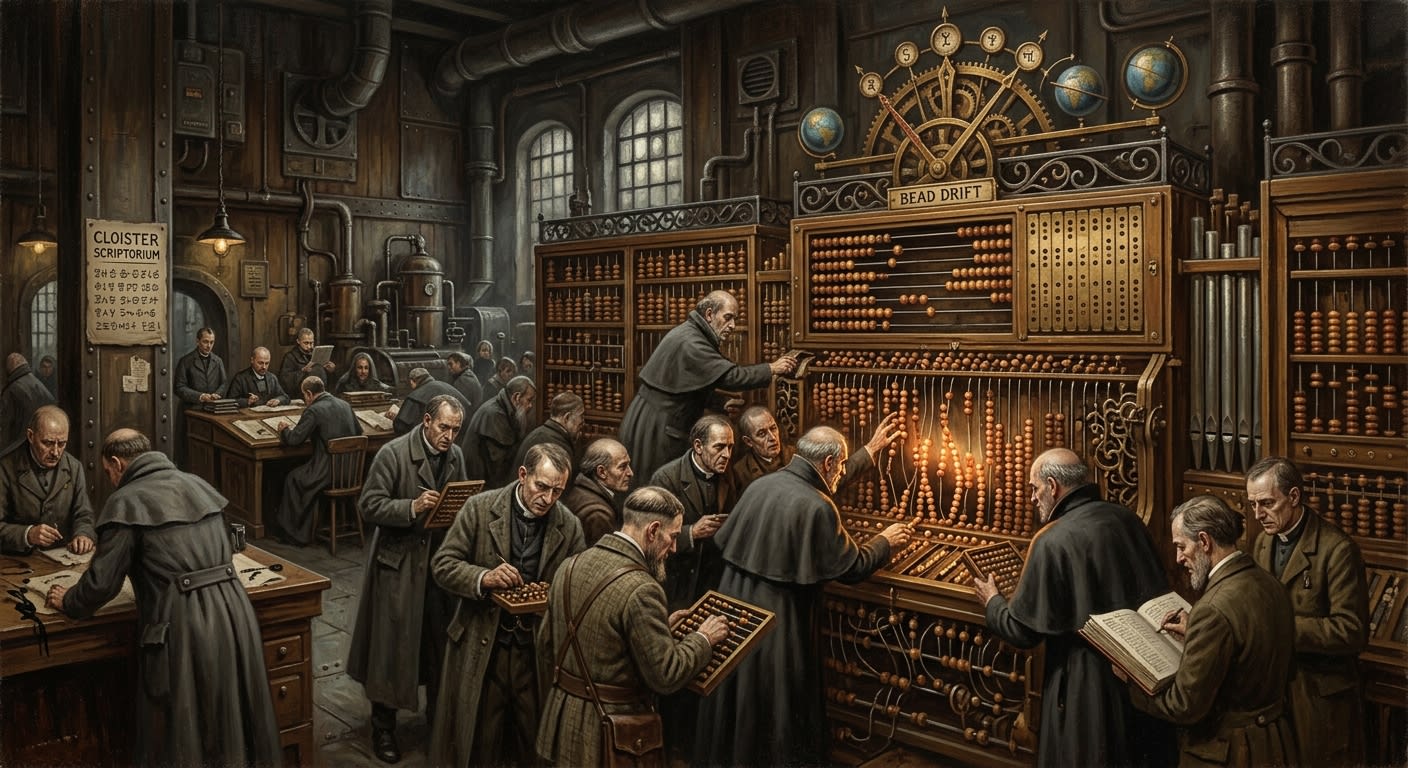
#On the Count That Moves
Bead drift is the unofficial name for the movement of pilgrim counts inside the Cloister of Miscounted Beads: beads warming without touch, numbers changing after filing, dead names entering intake rosters, strings in sealed cases arranging themselves according to an arithmetic no clerk has authorised. The official name is handling error. The official name is a coward wearing gloves.
A pilgrim arrives with thirty-seven beads. The Counting Hall counts thirty-nine. The pilgrim protests, swears the stations, invokes his road captain, shows the knot his mother tied at departure. The clerk writes discrepancy. The pilgrim is routed to the Chapel of the Second String or to Awaiting if poor, sponsored correction if solvent, Purity if unlucky, the Bead Vault if the string has become interesting. By morning the string may count thirty-seven again. Or forty-one. Or thirty-nine with one bead now carved in a dead woman's hand.
The Bureau of Records denies bead drift with the diligence of a man placing buckets beneath a roof while announcing the house is dry. Circular 881-R, issued in A.S. 199, declares bead counts fixed at filing and all later discrepancies products of handling error, fatigue, fraud, damp, pilgrim superstition, or clerical overstrain. The list is nearly complete. It omits the beads.
The phrase survives because it is accurate, and accuracy, though vulgar, occasionally proves difficult to kill.
#On the First Recorded Misobedience
The Cloister was founded in A.S. 94 after the western-gate pilgrim surge overwhelmed Strasbourg's existing intake desks. Processions arrived frayed by rain, hunger, road tax, shrine fraud, corpse delay, and that special sanctified confusion produced when twenty-three pious men attempt to remember which station came before which inn while standing in mud. Bead strings were meant to settle the matter. A string records prayer. A prayer records route. A route records obedience. The mechanism looked perfect until touched by people.

Within the decade, clerks noted discrepancies that did not resemble ordinary fraud. Counterfeit beads are vain; they declare themselves through bad boring, poor wax, hasty knotting, or the smug little regularity of criminal craft. Bead drift is quieter. A string counted at Desk Four changes while sealed in cloth. A route mark darkens overnight. A penitent dead by parish register answers at intake with mud still fresh on his boots and his widow's bead on his cord. The earliest Chapter copybooks call these “post-count variances.” Later marginal hands write “grave-click.” By A.S. 103, certain supplementary entries were already marked under higher seal, and by A.S. 187 the weighing of strings had become routine because number had stopped being enough.
Early Cloister teaching sheets attributed all bead discrepancies to pilgrim dishonesty, road illiteracy, or improper devotional sequencing.
Corrected in restricted instruction. Dishonesty explains counterfeit strings. Illiteracy explains bad station claims. Improper devotional sequencing explains why three Burgundy processions entered the wrong chapel singing the right hymn. None explain a sealed case adding weight in the hour before dawn.
A.S. 198 worsened the matter. Redirected western-gate traffic packed the Cloister past its design, if a facility that accreted around overflow may be accused of design. Bodies crowded the Dorm Rows. Appeals choked the Supplementary Entry Office. Sponsor prices rose. The Grave-Name Market fattened outside the drain wall. Overcrowding produced heat, and heat produced events. By A.S. 201 five Anomoly Weeks were projected, which is the kind of forecast one issues when weather has acquired theology.
#On Presentation and Signs
Bead drift announces itself through small treasons. Warmth without flame is the commonest. A clerk touches a linen-sleeved cord and feels body heat where no body has been. Ink crawls next: letters thickening toward names, route stations blurring into older spellings, clearance marks softening at the edge like wax near a lamp. Sound follows. One click from a sealed case is handling note. Two clicks summon a senior clerk. Three clicks summon Keth if the office wishes to remain staffed.
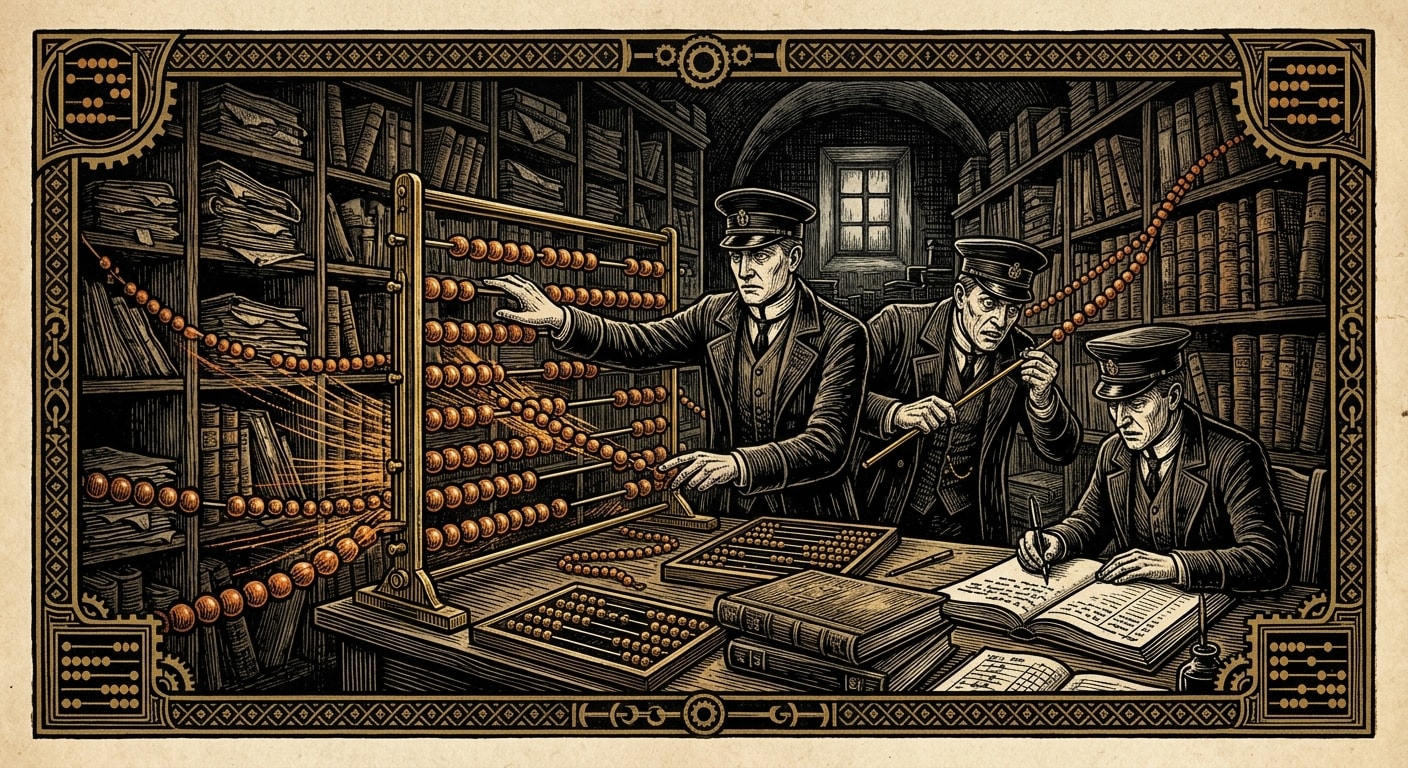
The fourth sign is personal recognition. A detainee hears his name in bead sound. A widow sees the dead arranged into roster order. A child at a silence test reports syllables, smells, pictures, or the colour of a road never walked. The Bureau dislikes child witnesses because children have not yet learned which truths require employment to ignore.
There are families of drift. Route drift changes the sequence of stations, causing a road to have been walked otherwise than walked. Identity drift attaches one person's name to another's cord. Mortuary drift returns the dead to administrative availability. Sponsor drift converts paid mercy into prior obligation, usually to the annoyance of brokers. Weight drift is the Vault's private dread: a string weighing more than its count, less than its count, or nothing while still visible.
The most feared subtype is reciprocal count. A clerk counts the string; the string counts back. Symptoms include pulse matching bead-click, involuntary station recitation, and the clerk writing his own name in a disposition field meant for the pilgrim. The Bureau of Medicine calls this stress. The Bureau of Records calls it fatigue. The clerks call in sick if they possess sense.
#On Denial as Countermeasure
Denial is not ignorance. Do not flatter the Bureaus. They know. The Bureau of Records knows because its vaults warm. The Bureau of Pilgrimage knows because its road indulgences lose sequence. The Bureau of Purity knows because every denied anomaly breeds a cult within three rooms and a drainage grille. The Cloister Chapter knows because Prior-Scribe Erem Vale signs the lockdown orders with the pale little hand of a man who fears an event he refuses to name.
Denial serves three functions. It prevents panic, preserves fee authority, and keeps appeal from becoming theology. If bead drift exists, then a corrected pilgrim may claim the correction is provisional. If a corrected pilgrim may claim that, every second string becomes a contested object. If every second string becomes contested, the Cloister's revenue engine coughs blood onto the ledger. This, more than metaphysics, concentrates the mind.
Public circulars describe silence hours, vinegar cleansing, salt-wax sleeves, and Vault sequestration as ordinary evidence preservation measures.
Clarified for authorised officers. These measures are ordinary only in the sense that the terror requiring them has become frequent. A man who bleeds every day may call bleeding routine. He should still consult a physician, or a priest, or a carpenter for the coffin.
Circular 881-R is often mocked for pretending not to see. This is unfair. The circular sees perfectly. It merely commands everyone else to describe sight as handling deviation. Such precision deserves respect. I give it contempt, which is respect with better posture.
#On the Vault, Keth, and the Cold Arithmetic
The Bead Vault is where bead drift loses the privilege of audience. Public drift threatens order. Vault drift threatens office. The difference is why the Vault has thicker doors.
A severe string enters sleeved in salt-wax, witnessed by a backward-folded name slip, weighed, sealed, and placed inside a case whose wood has already been assigned blame in case of future trouble. Keth decides which shelf receives it. Her deaf ear hears case-clicks through stone. Her keys hang from bone rings and speak against one another with the insolence of minor principalities. Clerks call her Mother Thread when she is absent. She is rarely absent enough.
Keth understands drift as custody before doctrine. A case that hums under rain is not debated; it is moved. A string that changes weight is not preached over; it is isolated. A grey claimant case that clicks while a child passes is not opened for spiritual interpretation; the child is removed and the hinge oiled. This is why Keth remains alive and why several theologians sent to inspect the Vault have returned with fewer opinions than they brought.
VAULT EVENT EXTRACT — A.S. 199 — NINTH-RATIFICATION Cabinet Five reordered seven cases by death date rather than intake number. Case ███████ contained no string, only damp cord marks and a child's voice answering from the wood. Archivist Keth ordered █████████████████████████. The voice used her baptismal name.
The Vault practice of weighing strings has become the closest thing to honesty in the Cloister. Number can lie, or be made to. Weight resists more rudely. A string that counts thirty-seven and weighs forty-one is not evidence of fraud alone; it is a material objection. A string that weighs less after a widow speaks beside it has suffered contact. A string that gains weight while sealed in an uncoloured case is routed to lower cabinets, where even ambition walks softly.
Lower cabinet handling is plain: no open counting in rain; no bare skin; no spoken childhood names; no removal in pairs. If a case answers before the question, close the ledger and summon Keth.
#On the First String Temptation
Every anomaly acquires a throne in the minds of frightened people. Bead drift has the First String: the alleged original count, the bead line never counted, filed, or reconciled, the cord against which every pilgrim bead, dead name, route correction, second string, and amended childhood is secretly measured. Officially no such object is held, indexed, weighed, cleansed, sealed, transferred, mislaid, accessed, denied, or contemplated within the Cloister. The denial is so complete it casts shade.
The First String is dangerous because it makes drift legible. Random drift is a nuisance. Directed drift is a rival court. If there is an original count, correction borrows authority rather than creating it. If correction borrows authority, the Great Ledger is a custodian, not a god. The Bureau of Records dislikes this proposition in the way kings dislike stairs behind the throne.
The Quiet Thread turned the rumour into doctrine. Every count has a prior count. Correction covers; it does not destroy. Drift is the pressure of covered names returning toward legibility. Silence sharpens the return. The formula is heresy with clean joints. It fits too well in the hand.
Brokers imagine the First String as a market, Purity as a pyre, Pilgrimage as a route correction, Vale as a jurisdiction, Keth as a cabinet that must remain closed. I, being uniquely burdened with superior taste, imagine it as an audit nobody survives.
#On Directed Drift and the Quiet Thread
The Quiet Thread teaches that bead drift can be directed by silence, breath rhythm, station order, and the refusal to answer the second click. Its rites are small because small rites pass through crowded rooms. A cord in cloth. A chalk ring. A name breathed downward. A child listening with one ear near the sleeve. Three clicks, never two. The wronged named in order. The lawful string held but never kissed.
These practices parasitise the Cloister's own procedures. Legal silence hours resemble illicit listening circles. Salt-wax sleeves serve Vault custody and heretical rite alike. Backward names travel in official slips and stolen scraps. Emergency rules create the corridors by which emergency heresy moves. This is why intelligent government fears similarity more than opposition. Opposition stands outside the gate shouting. Similarity enters with a pass.
The clever heretic rarely rejects the rule; he learns where the rule carries him.
The Quiet Thread's pastoral power is obvious. A miscounted pilgrim hears that his first cord still knows him. A widow hears that erasure failed. A clerk hears that the amendment he filed under pressure may be corrected by a deeper count. These are comforts, and comfort outside license is one of the older roads to the stake.
Purity has twice found no organised heresy. I admire the phrase. It suggests the heresy is disorganised enough to tolerate, useful enough to watch, or embarrassing enough to misplace. All three readings may be correct. Contradiction is cheaper than investigation.
#On Anomoly Weeks
Anomoly Week begins when denial can no longer fit through the door. The signs become public: multiple strings shift, basin water rises, cleared pilgrims reappear in Awaiting, ink-wells produce unauthorised text, wall slates correct themselves faster than the Outer Watch can scrape, and some fool speaks a dead name loudly enough for the Dorm Rows to answer.
The gates lock. The corpse wicket is salted. The Ash Canal hatch is nailed and blessed. Ink is covered between third and fourth bell. Children are tied by wrist ribbon to stable adults. Rations thin. City magistrates send questions from a safe distance and receive answers made of nouns. Vale calls this protective narrowness. It is a splendid phrase if one is attempting to make a cage sound like a clerical virtue.
During these weeks drift becomes social. A name that appears in one room may be answered in another. A string in the Vault warms while a child in Row Six dreams of a station demolished before she was born. A sponsor seal curls away from the page. A dead claimant's file smells of road mud. The Cloister responds with vinegar, silence, cudgels, and forms. This is not mockery. These tools work often enough to be terrifying.
Never underestimate a cudgel wrapped in procedure. It has pacified more theology than all the gentle sermons ever preached at Strasbourg.
#On Present Doctrine
As of A.S. 201, bead drift remains nonexistent, active, contained, spreading, billable, denied, studied, and filed. Five Anomoly Weeks are projected. The Vault is warmer than stone permits. Salt-wax stores require supplement. Desk Eleven wants another clerk and has received a sterner chair. Keth requests senior archivists and receives novices. Vale requests broader silence authority. Purity requests better access. The Quiet Thread requests nothing in public, which is why it continues to grow.
The doctrinal position is stable: bead counts do not change; discrepancies are handling deviations; correction is service; service requires fee; fee requires record; record requires obedience. The observed position is also stable: beads change, names return, the dead press against rosters, and sometimes a string in a locked case clicks once before the question is asked.
The Bureau of Doctrine offers this authorised understanding: bead drift is the pressure exerted by improper handling upon devotional counting objects under conditions of crowding, fatigue, damp, grief, clerical stress, and unsanctioned expectation. This sentence satisfies Records, Pilgrimage, and Purity because each office can blame a different noun. It satisfies me because it is magnificently useless.
At third bell, cover the ink. At fourth bell, lift the cloth. If the string has changed, write handling deviation. If the name is dead, write pending review. If the bead clicks twice, do not answer.