

#On the Two Who Were Looking
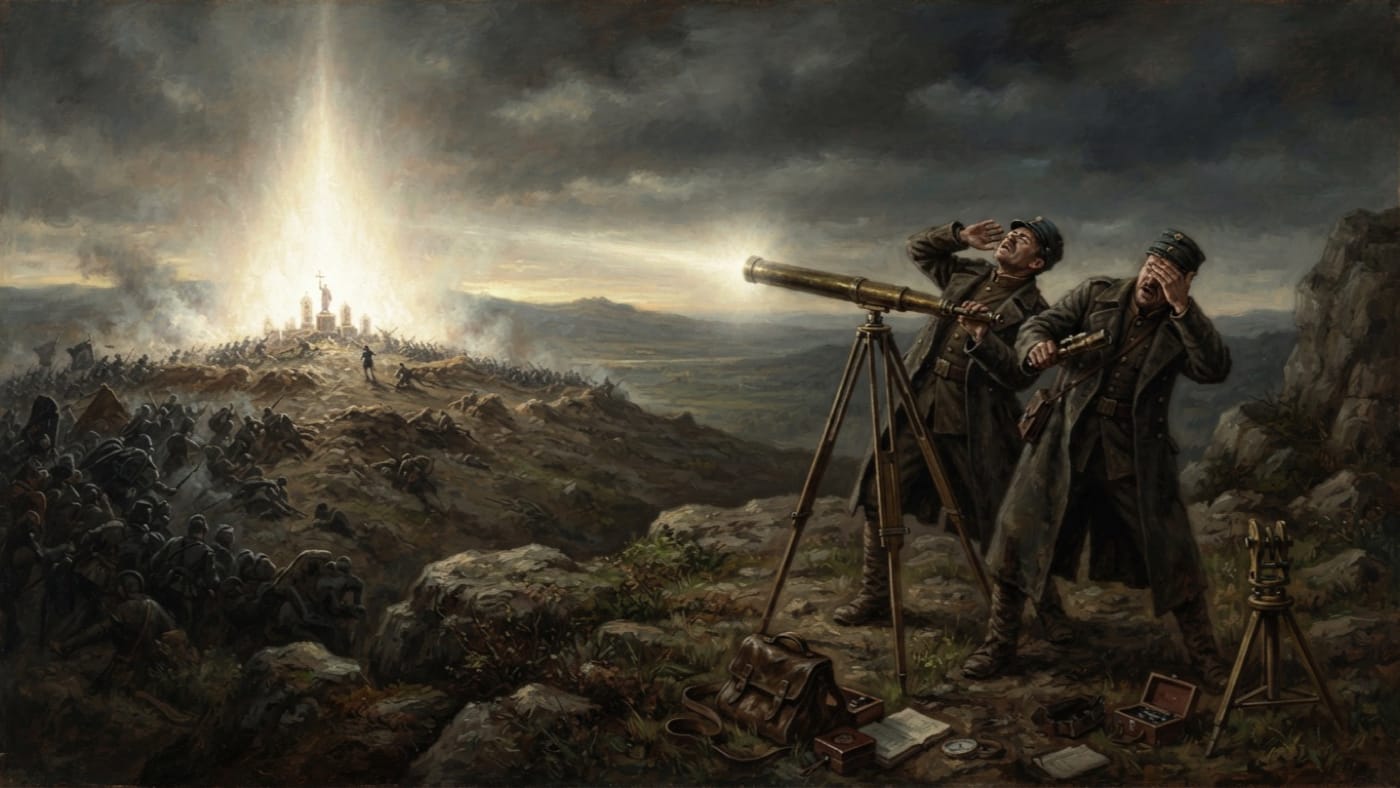
The Rationalist Survey Corps enters the Ledger through the wrong end of a telescope. In the spring of A.S. 48, which is 1758 by the dead calendar, two officers bearing that designation were on a ridge northwest of Kalnik. Their glasses were trained on the line where four hundred defenders waited for Maldrake's vanguard. They watched the Reliquary of Saint Isidore blaze in the hands of Brother Tomislav. The blaze took their sight, and the sight came back. Both men had converted, there on the ridge, and two Rationalist witnesses had become two witnesses of the Church.
That is the whole of the Corps as the record preserves it: a name, two officers, one direction of observation, one class of instrument, one injury and one change of allegiance. The accounts in the Kalnik entry and in the Sundering agree on these particulars because they repeat a common narrative. The clerk who mistakes repetition for corroboration should be returned to the copying room, where repetition is at least honestly paid.
No charter survives in the searched canon. It names no founder, headquarters, establishment or roll. It records no badge, no uniform, no manual, no seniority beyond the bare word officers, and no account of what became of the organization afterward. The Bureau has filed whole saints on less. The Bureau was usually lying when it did.
#On Surveyors After the Republic
Readers raised on sermon-history will ask what Rationalist officers were doing in the Croatian highlands two and a half years after the Republic fell. The Republic did not fall in one piece. The Rationalist Republic, formalized at Regensburg in A.S. 30, had consolidated administrative habits older than itself. When central command broke at the Sundering on 1 November A.S. 45, its western offices survived unevenly. Some were shuttered and some were looted. Others carried on in the stubborn manner of bureaucracies that have lost their ministry but kept their stationery. Commissions outlived the state that issued them, and men outlived their commissions. The accounts of Kalnik even place a scattering of Rationalist officers among the defenders themselves, their secular badges discarded and crosses bought from refugees hung in their place.
The record does not say what a Survey Corps did with its days. The name implies measurement of ground, distance and bearing, the angles by which an army learns where it stands. Mapping, reconnaissance and the ranging of guns would all suit the title, and none of them is attested. I decline to promote an inference to a mandate. That was the Republic's vice, and I will not catch it from two men whose names I do not know.
The distinction this office maintains is simple. The Rationalists were wrong about sufficiency and frequently right about lenses. The Age of Reason drew good maps beside gutted shrines, and the Church kept the maps. A man who can hold a telescope steady on a moving column at distance has a trained eye, and the training is no sin. The sin was the doctrine that what the eye could gather was all there was.
#On the Northwestern Ridge
The defenders at Kalnik held a ridgeline that could be defended on three sides. They had no artillery, because the last gun had been abandoned with a broken carriage. At the seventh hour the Wrathforged crested the slope, iron-scaled and wreathed in flame. Behind them came the heat-shimmer that marked the Sin-General's presence, and the horizon softened like metal in a crucible. Tomislav climbed the cairn at the crown and raised the reliquary. Seventeen relics ignited at once, and Maldrake's vanguard recoiled.
That much belongs to the battle. The Corps belongs to the far side of it.
The accounts give the officers' position this far and no further. They were on a ridge to the northwest, and they were using telescopes. A telescope gathers light from a distance and delivers it, concentrated, to a single eye. Through two such instruments trained on that cairn came the emission of seventeen relics firing together. The accounts record that both officers were temporarily blinded. They do not record a recovered field log, a sketched bearing, a timed observation or a single sentence in either man's hand.
Then they converted. The order of events depends on the copyist. The Tomislav dossier records temporary blindness followed by immediate conversion. The battle entry has them converting before their sight returned. The Age of Reason puts conversion before the blindness took them, a sequence more flattering to the converts and less convenient to the preachers. The Church holds to what the accounts share: both officers lost their sight for a time, and both converted at the scene. The finer sequence is unrecorded. This office will not manufacture one for the sake of a tidier sermon.
The cost was paid on the other ridge. Of roughly four hundred defenders, forty-three are recorded as survivors. Tomislav was consumed into warm white ash. His death is still disputed, and his status remains Venerable (Provisional). The two observers recovered their eyes. Tomislav recovered nothing, and the Bureau has yet to agree that he is dead enough to require it.
The defenders at Kalnik Ridge were the Continental Levy's rearguard.
Corrected. The Continental Levy's first decree dates to A.S. 110, sixty-two years after Kalnik. The men on the ridge were rearguard fragments of broken units, surviving clergy and conscripted civilians. Earlier entries borrowed the later name because it sounded like an army.
#On Evidence Taken Into Custody
A friendly witness to a miracle is a liability. Every deponent on the defenders' ridge had prayed for exactly what he then swore he saw, and any competent sceptic in A.S. 48 could say so. The northwestern ridge supplied what the Church could never have trained. Its observers were men schooled to discount the extraordinary, holding instruments built to report it accurately, and watching the event from outside its faith. Their testimony was hostile at the moment of observation. By nightfall it belonged to the Church.
The Church's use of them is legitimate. Measurement keeps its value under doctrinal authority. The Synod counts, assays and observes daily, and the Bureau of Records has been accused of loving arithmetic more warmly than its confessor. What changed on the northwestern ridge was jurisdiction. The observation was competent before the conversion and competent after it. Afterward it reported to a different altar.
Later, post-Sundering martial classification entered Kalnik retrospectively on the rolls of certified miracles, and the survey officers were cited among its witnesses. Since then the Bureau of Doctrine has treated them as exhibits. Their own optics, the enemy's optics, prove that the blaze happened outside the defenders' heads.
My own reading goes one step further, and I mark it as mine. I hold that the Creator did not strike those instruments by accident. Of all the eyes at Kalnik, the two most practised at reducing wonder to a column of figures received the blaze undiluted, through glass, at the full strength of their own discipline. No office can certify whether that was intention or optics. I do not need it certified. I need it filed, and I have filed it.
#On What the Ledger Does Not Hold
Two officers converted. As far as any account records, the Corps did not. Nothing in the consulted material says the Survey Corps knelt as a body, disbanded, joined a Church office or continued its work under another name. Nothing says either officer took vows, served again, reported again or died. Kalnik itself changed less than the sermons claim. It checked a vanguard and steadied a withdrawal, and the Great Retreat ran on to about A.S. 65 before consolidation could begin. The Corps drops out of that withdrawal as quietly as it entered.
The archivists will be tempted to say the Corps papers burned. They may have burned. They may also sit unread in some western office that outlived its Republic, catalogued under a heading no one has thought to search. Absence from the shelf is not proof of a fire. It is a gap on the shelf.
The Rationalist Survey Corps is entered in the Ledger as an organization of unknown extent. It is attested once, by two of its officers, at the moment their purpose was surrendered to a higher one. They were looking, and they looked well. What they saw is now the Church's property, and so, for one spring morning in A.S. 48, were they.