
#On the Century That Mistook a Knife for a Candle
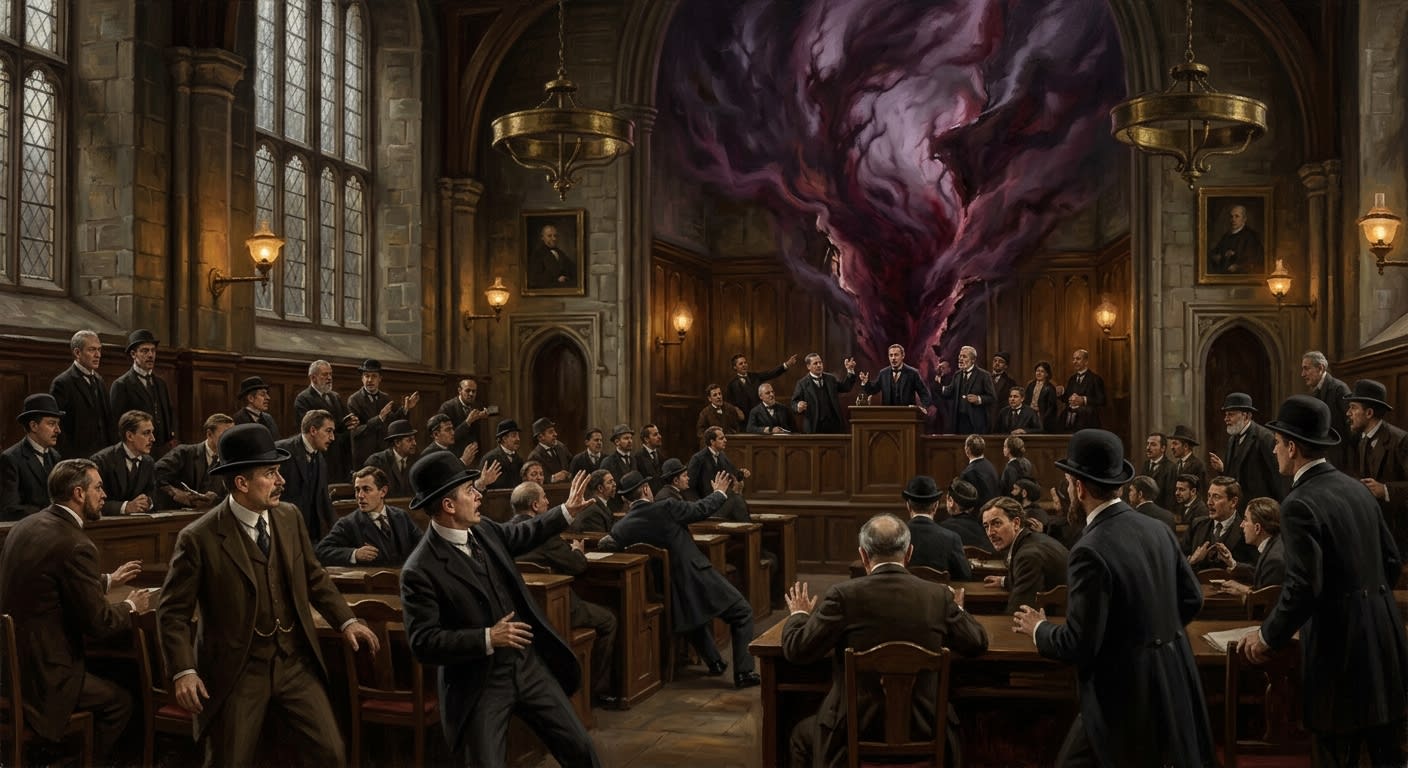
The Age of Reason began when men discovered that a ruler could be held against an altar and used, with sufficient vanity, to declare the Creator incorrectly measured.
The Bureau dates the formal wound to A.S. 0, the year the Amsterdam academy published De Vera Luce, that little brass fart of a manifesto which openly denounced revealed religion and announced a new discipline of sight, proof, civic clarity, and all the other clean words by which clever men prepare dirty rooms. The Synod numbers its years from that publication. This is often misunderstood by foreigners, sentimental catechists, and junior clerks who imagine calendars begin with triumph. They do not. Calendars begin with debt.
Before A.S. 0 there were academies, salons, observatories, pamphlet clubs, surgical theatres, anatomical societies, and supper tables at which priests were mocked by men whose wigs contained more powder than their souls contained reverence. Paris lectured. Vienna calculated. Amsterdam printed. Ulm drafted Concordats of rational fraternity, a phrase so perfumed with civic optimism that one can still smell the rot through two centuries of sealed paper. Prague supplied staging, students, and the skull of a grandfather carried in procession by a child taught to call desecration demonstration.
The Age did not call itself heresy. Heresy rarely does. It called itself illumination, reform, emancipation, correction, science, civic order, natural explanation, public hygiene, educational necessity, and the progress of Man. There is no blasphemy so stupid that it cannot be improved by a committee name.
The doctrinal point is simple. Reason is a tool. The Rationalists made it an altar. A tool in the hand of Faith can cut corruption, measure a bridge, aim a cannon, boil a wound, calculate grain, and expose a counterfeit relic whose vendor deserves whipping for poor technique as much as impiety. An altar made of Reason demands sacrifice. First mystery, then tradition, then saints, then priests, then the old dead in their boxes, then children taught to laugh before they have learned what laughter costs.
#On Amsterdam, Ulm, and the Polite Manufacture of Blasphemy
Amsterdam's academy did not invent unbelief. It licensed it. That was the novelty, and licensing is always the hinge upon which private vice becomes public machinery.
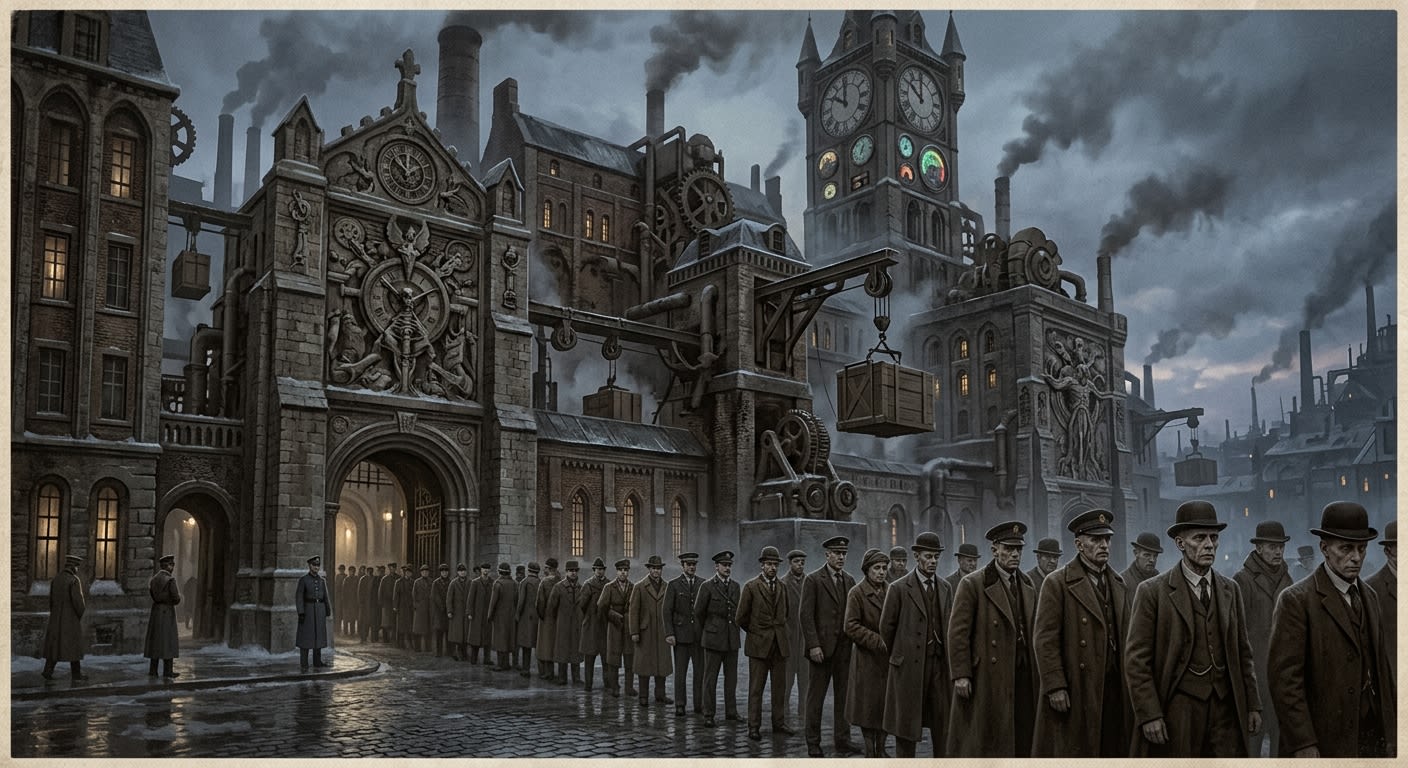
De Vera Luce argued that visible evidence outranked inherited doctrine, that miracles should be tested, relics assayed, saints audited, and ecclesiastical courts subordinated to civic assemblies. Its authors signed their names in a neat hand. They believed neatness was innocence. Within a year their little plague of clarity had spread through lecture halls, merchant houses, printer guilds, coffee rooms, municipal councils, and those damp intellectual burrows where men who cannot command armies practice commanding nouns.
The Concordats of Ulm followed as the administrative spine of the movement. Learned societies promised rational fraternity across borders: common standards of inquiry, shared academies, secular arbitration, harmonised weights, public schools free of confessional instruction, civic calendars pruned of feast days, and medical boards permitted to touch bodies without asking the dead whether they preferred modesty. Some reforms were useful. This is the dangerous part, and the reason the heresy spread faster than mere folly. Clean drains reduce plague. Accurate weights reduce fraud. A physician who washes his hands before surgery is preferable to a devout butcher.
Then the Rationalists performed the old trick: because some priests were corrupt, priesthood was declared corruption; because some relics were false, sanctity was declared fraud; because some miracles were misreported, Heaven was subpoenaed and found in contempt for failure to appear.
Early Synodal schoolbooks described the Age of Reason as “pure ignorance armed with arrogance.”
Amended for advanced instruction. The Rationalists were not ignorant. They were learned, disciplined, observant, organized, literate, persuasive, and wrong. This made them more dangerous than peasants with torches and less forgivable than drunkards with opinions.
Their first victories were lexical. A shrine became an unverified cultic site. A relic became an osseous claim. A miracle became an anomalous report pending natural explanation. A priest became a hereditary superstition functionary. A monastery became locked capital. Language was stripped of kneeling. Once words stopped bowing, men followed.
#On Desecration Made Civic
The Year of Letters hardened the Age's sneer into policy. Amsterdam scholars denounced the Miracle of Saint Aldebrand as fraud, and the pamphlets multiplied with the indecent fertility of rats in a granary. The arguments were polished. The diagrams were clever. The witnesses were dismissed as hysterics, beneficiaries, rural minds, women, children, monks, and other classes of person whom Rationalism loved in theory and ignored in evidence.
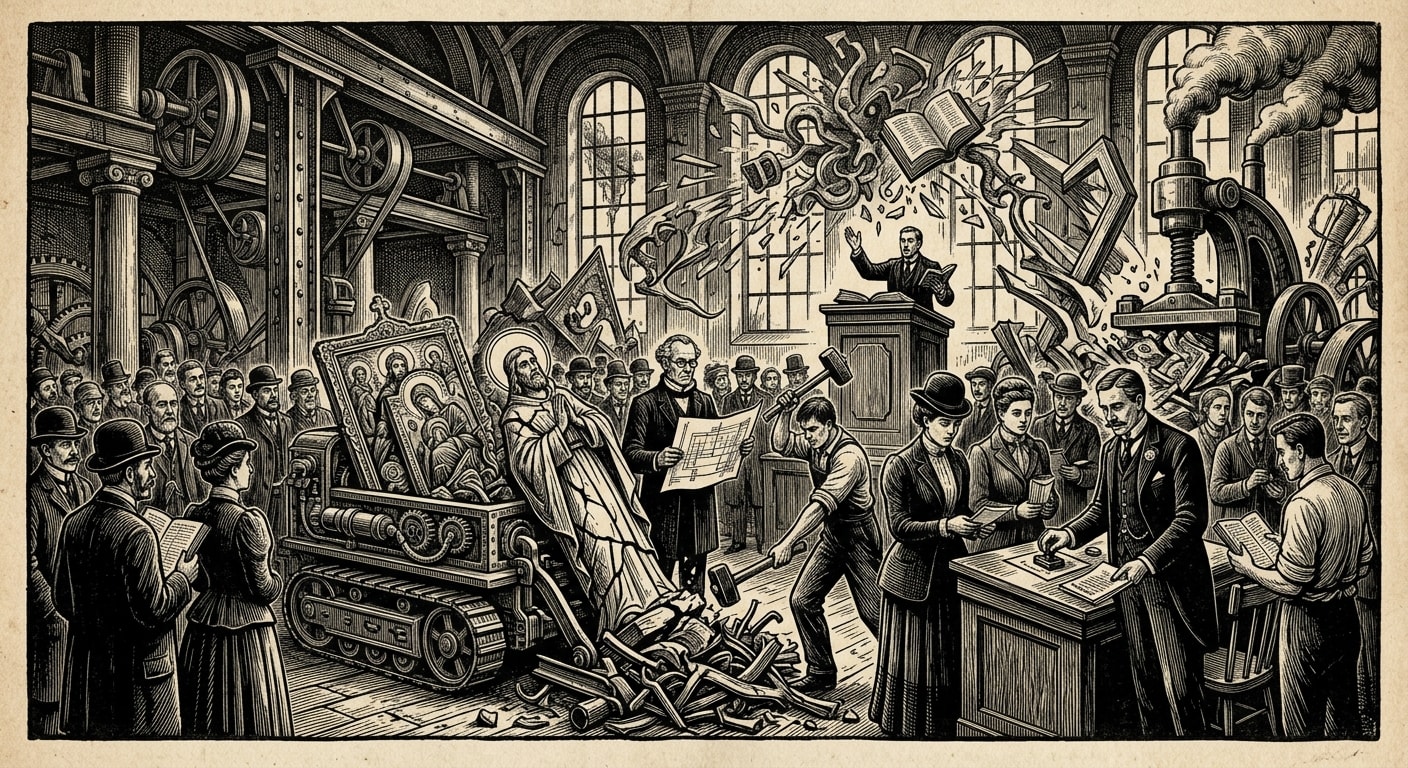
Shrines lost patronage first. Candles thinned. Pilgrimages were taxed, then licensed, then obstructed, then mocked as inefficient population movement. Monasteries were inventoried. Relics were weighed, scraped, heated, dissolved, and entered into laboratory notebooks. Several bones survived testing by glowing. The investigators blamed phosphorus. The bones did not comment. Bones have dignity.
In Prague, students marched under secular banners with skulls, anatomy charts, and little songs whose cleverness has mercifully not survived in full. In Paris, altar plate was recast into civic medals. In Vienna, theologians were invited to public disputations arranged so that defeat could be announced before attendance. In provincial towns, old women who kept chapel keys were jeered by boys whose education had outpaced their manners. This last detail appears small. It is not. Civilisation dies first in the laugh permitted at a widow.
The Rationalist authorities called the desecrations purification. They loved that word. It made fire sound like hygiene and theft sound like dentistry. Sacred images were stripped from crossroads. Feast days were converted to civic instruction days. Bells were silenced during lectures because bells, being bronze, had more public authority than several philosophers combined.
#On Republic, Guard, and Gun
The Age of Reason acquired soldiers because every abstract noun eventually hires men with boots. The Council of Nine Rationalists, whose exact membership is variously recorded and conveniently disputed, learned that pamphlets make martyrs slowly while guards make them at useful speed. Secular Gatherings Acts followed. Processions required permits. Permits required signatures. Signatures were denied on grounds of public order. Public order became the pillow held over the mouth of Faith.
Saint-Malo supplied the blood that bureaucracy had been requesting in triplicate. A pilgrim procession entered the port under the banner of Saint Hermas and the old songs. Republican Guards blocked the street. Fourteen died on cobblestone, including Sister Margaux of the Blessed Thorn, who carried a psalter and the fatal provocation of being visible. Rationalist memoranda spoke afterward of crowd pressure, unlawful assembly, and unfortunate discharge. The cobbles spoke more plainly.
The Atheist Wars began in the moral sense before Saint-Malo and in the military sense afterward. Cathedrals became strongpoints. Lecture halls became recruitment offices. Clockwork artillery, brass-barrelled and spring-fed, entered service under Lucien Artois and impressed even men who wished him dead. Cardinal-Marshal Severin answered with sermons, relics, militia, bridge-fires, and the Sisters of the Martyrdom, whose unauthorised self-immolation remains one of the Bureau's most awkward examples of useful indiscipline.
Reason, having promised liberty from priestcraft, delivered requisition, censorship, field courts, broken crosses, civic oaths, and artillery maps. Faith, having promised salvation, delivered militias, cathedral sieges, retaliatory burnings, hungry garrisons, and bishops who discovered too late that righteousness is not logistics. The continent split into local butcheries. Toledo held, Kraków drowned priests, Aachen betrayed, Regensburg signed. The Rationalists won the war and lost the world.
Popular sermons state that the Rationalist victory at the Treaty of Regensburg proved the total death of Faith.
Corrected. Faith did not die. Faith went underground, poorly supplied and very angry. The difference became visible when Hell arrived and the underground remembered where the old relics were buried.
#On Natural Explanation as Last Rites
After Regensburg, the Rationalist Republic enjoyed its New Dawn, which is what men call morning when they have not yet smelled the smoke. Churches were supervised. The Holy See of Vienna dissolved at swordpoint. Clergy who submitted became civic instructors. Clergy who refused became examples. The academy system swelled with the calm pride of a tumour admired by its host.
Then the omens began.
The Year Without Dawn gave Europe forty days of grey. Rationalist astronomers produced treatises at the speed of fear. One blamed volcanic atmospheric events from a volcano no search party could locate. Another blamed particulate diffusion. A third blamed faulty rural observation, as though peasants had mislaid the sun. The Red Flood of the Danube followed: three weeks of arterial water, dead fish with split bellies, steam over Vienna's docks, burns that would not heal. Hydrologists wrote of minerals. Priests wrote of judgment. The river wrote in blood and did not request peer review.
The Eastern Silence was worse because it removed even spectacle. Villages ceased correspondence. Tax men failed to return. Caravans vanished into Serbian and Thracian passes without wreckage. Refugees spoke of moving forests, blackened churches, fog that edited memory, livestock with surplus limbs, men who came home with fewer names than they had carried out. Rationalist authorities called it plague, hysteria, quarantine necessity, regional superstition, and seditious rumour. They revoked travel permits. They printed reassurances. They punished supernatural language as civic disorder.
They were still printing when the Sundering opened.
#On the Creator They Dismissed and the Hell They Could Not Dismiss
The Rationalists did not disprove the Creator. They made public life inhospitable to His apparatus: shrine, relic, vow, pilgrimage, confession, liturgy, the bell at dawn, the old woman with the chapel key. Doctrine later called this Divine Withdrawal. I call it what any competent administrator calls the destruction of channels: severed communication followed by predictable failure.
When the Sundering came on 1 November A.S. 45, Reason met an adversary that refused to submit to experiment. The bells fell silent in the east. Thrace and Serbia broke open. The Great Deceiver's hosts entered not as disputants but as verdict. Skopje, Novi Sad, Sarajevo, Belgrade — names became casualty headings faster than clerks could sharpen pens. The Seven Sin-Generals walked where universities had promised mastery. Maldrake taught chemistry that fire can have intention. Kargath taught logistics that food can be eaten by absence. Syrion taught psychology that sleep is not rest when something else owns the dream.
RATIONALIST EASTERN COMMAND MEMORANDUM, RECOVERED IN PART NEAR BELGRADE Subject line legible: “Unclassified irregular manifestation, probable morale contagion.” Final line legible: “The men are praying without orders.” The intervening pages are fused to human skin.
At Kalnik Ridge a relic blazed and Wrath recoiled. The witnesses included Rationalist survey officers with telescopes, two of whom converted before blindness took them. Here the Age of Reason ended in substance. Its offices did not all close. Its men did not all kneel. Its habits survived, because habits are cockroaches with better stationery. The claim that Reason Alone Shall Rule had been answered by a finger-bone emitting force sufficient to drive back a Sin-General.
#On the Residue That Survived Its Refutation
No error of continental scale disappears merely because reality has beaten it with a flaming rod. The Age of Reason survived the Sundering as residue: in Prague cellars, Ulm paper vaults, Amsterdam merchant habits, forbidden lecture notes, civic boards that still prefer a clean chart to a priest with bad news, and young clerks who secretly believe the Bureau would run better if stripped of incense. They are sometimes correct about the incense. This does not save them.
The Synod uses Rationalist tools constantly. We count. We measure. We assay. We operate laboratories, artillery schools, medical boards, observatories, and engine yards. The Bureau of Records would marry arithmetic if canon law permitted the banns. The Bureau of Engineering trusts load tables with a tenderness usually reserved for relics. The Bureau of Medicine cuts bodies open with admirable secular efficiency and then blesses the tray, which is the correct order.
This is why the Age of Reason requires its own entry. To condemn it as stupidity flatters us and falsifies it. It was competence unmoored from obedience. It was clean water beside burned chapels, good maps beside gutted shrines, humane language beside mass confiscation, public schooling beside the trained jeer, artillery excellence beside metaphysical idiocy. It produced tools we kept and doctrines we burned. The wise clerk preserves the blade after executing the assassin.
The modern Rationalist residue appears in softer garments: calls for neutral inquiry, balanced history, relic transparency, humane discipline, civic autonomy, medical exemption from ritual supervision, educational independence, and other phrases that arrive wearing spectacles and leave carrying bolt-cutters. Prague remains watched because beauty there learned to argue. Amsterdam remains independent because commerce has always been the devil's most respectable cousin. Ulm remains full of paper, which is a condition only marginally safer than plague.
#On the Present Use of a Dead Age
The Age of Reason is taught twice: once to children as caution, once to officials as temptation. Children learn that the Rationalists mocked the Creator, murdered pilgrims, melted relics, enthroned Reason, and were eaten by Hell. Officials learn the more dangerous lesson: that rational administration works until it declares itself sufficient, that evidence is precious until it is made king, that civic order without sacred terror becomes a table laid for the Enemy.
The Bureau's position has always been exact. Reason is permitted under supervision. Calculation may serve Doctrine. Experiment may serve Rites. Surgery may serve Mercy. Engineering may serve War. Records may count anything it can bind without becoming sentimental about the numbers. A man may ask how a bell carries tone across fog; he may not ask whether the bell has authority to command him. The first question improves the peal. The second loosens the Line.
The Rationalists wanted Man upright without kneeling. They achieved Man upright briefly, then Man running, then Man screaming, then Man praying without orders. Their republics became recruitment pits, their academies became forbidden stacks, their surgeons became Bureau physicians under oath, their engineers became indispensable and watched, their pamphlets became teaching aids in how prose can sin while wearing clean cuffs.
At Strasbourg, the first Amsterdam manifesto lies under glass in the Forbidden Stacks, flattened, numbered, and watched by a clerk with instructions to turn the page once a year so the paper does not rot unevenly. On the cover, in a hand still offensively neat, the title promises true light. Above the case hangs a Bureau placard with two words in red ink: WE CHECKED.