
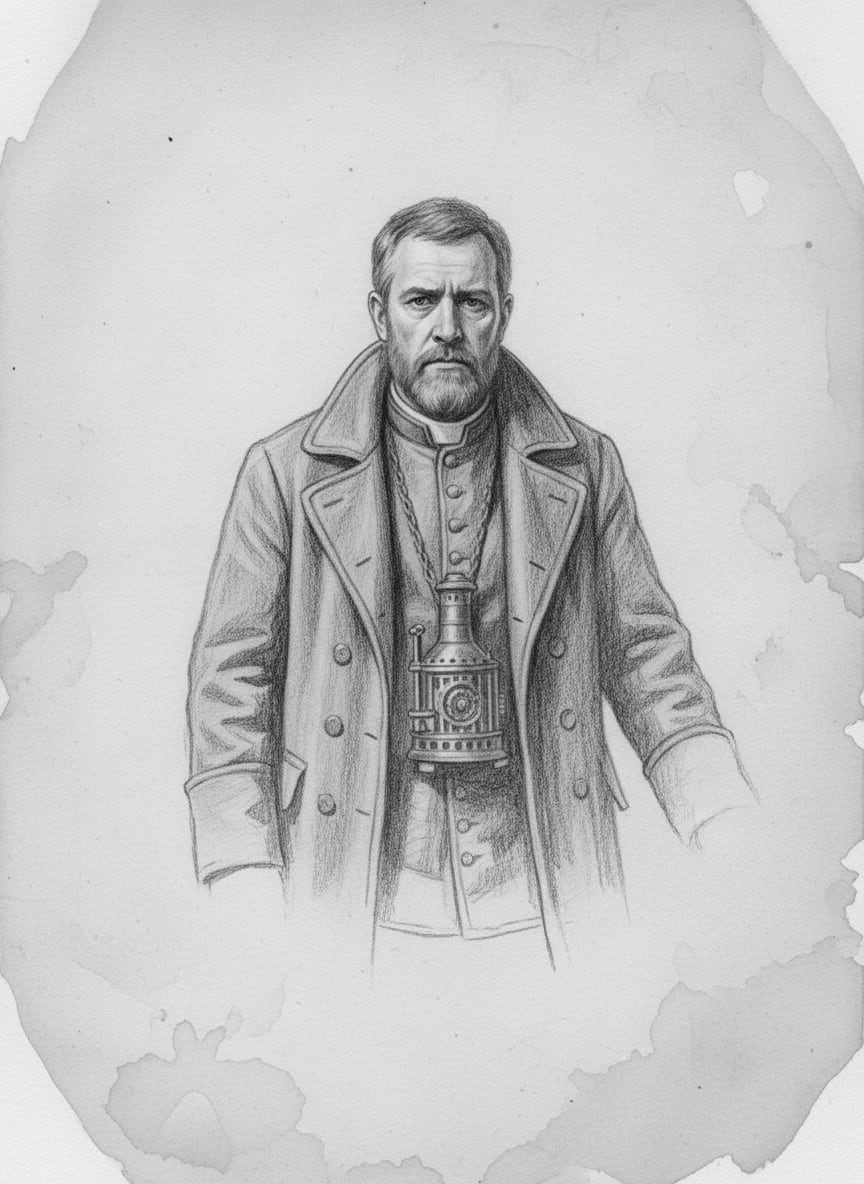
#On the Saint Whose Ash Refuses Quiet
Saint Isidore predates the Atheist Wars, the Sundering, the Synod, and every committee now claiming custody over his dust. This is the first indignity of sanctity: live, die, be useful, and centuries later some clerk with cold fingers explains your purpose to frightened soldiers. I am that clerk's superior. Observe the improvement.
His older vitae are damaged, contradictory, and heavy with Iberian piety. One account places him among mountain hermits; another among city preachers; a third, written by a monk whose margins contain recipes for eel, calls him “the measurer of hot ash.” The Bureau of Doctrine accepts none of these as biography and all of them as devotional weather. The facts that matter are later, brighter, and more expensive.
By A.S. 48, the name of Saint Isidore had become attached to a gold-and-iron reliquary borne by Brother Tomislav through the Great Retreat. That reliquary contained the Isidorean bone, then more bones, then seventeen sacred objects gathered by pressure, fear, the Cellar Saints, and Providence's habit of making quartermasters look underqualified.
#On the Reliquary at Kalnik
Kalnik Ridge made him unavoidable. Four hundred defenders, more or less, stood upon Croatian limestone with broken rifles, improvised pikes, hand-mortars, refugee knives, and the exhausted dignity of men whose last tactical advantage was a hill. Maldrake's vanguard came against them: Wrathforged infantry, furnace-dead conscripts, siege-forms of bone and smelted iron, and the Sin-General's heat bending the air behind them.
Tomislav raised the reliquary at the seventh hour.
It blazed.
Seventeen relics ignited in the casket. The emission lasted forty-three minutes under later revision, one minute for each surviving deposition. Wrathforged bodies recoiled from the light. Maldrake flinched. The difference between a flinch and a retreat has nourished whole schools of military theology. Feed those schools to goats. The demon flinched, and mankind learned that Hell could be made to step back.
After the blaze, Tomislav remained kneeling as warm white ash, still holding the reliquary. The bone within had been consumed, or translated, or spent, or made into an argument no Bureau has fully won. The Bureau of Relics calls the emptied vessel residually sanctified. Soldiers call it the box that saved their grandfathers. Both statements pass inspection.
Earlier school primers claimed Saint Isidore himself “appeared bodily” above Kalnik Ridge.
Corrected. No authenticated body appeared. The relic blazed; the saint's intercession is affirmed; apparitional anatomy remains unproven. The Bureau is generous with miracles and stingy with silhouettes.
#On the Saint's Bell
The Bell of Saint Isidore is a later scandal, cast or found in A.S. 49 according to competing witnesses, none sober enough for Engineering and all useful enough for Relics. It is a cracked bronze instrument mounted on a black-silk gun-carriage, carrying ridge-glass, reliquary filings, and a pinch of white ash the Bureau declines to name while pricing it with exquisite confidence.
It is called Isidore's Bell because the public requires names shorter than inventories. Its sound is fractured: a clean high strike followed by a lower break, as if bronze answers bone from a different room. It cost Debrecen twenty aggregate years of lifespan. Children there keep birthday books with funeral clauses because a miracle, properly delivered, sends an invoice.
The Bell is struck once during public feast rites. Never twice. At the peal, candles lean, ink hesitates, kneeling shadows in ridge-glass darken, and parents in Debrecen count their children with the grim tenderness of people who know numbers can be stolen from the future. This is why the Bureau of Bells hates the Bell. It is acoustically disobedient. Worse, it is effective.
#On Ash in Toledo
Saint Isidore's name travels strangely. At Toledo, far from Kalnik's fused ridge, his ash is invoked in the Cinder Trials: condemned heretics kneeling in a cathedral forecourt while warmed ash hardens over them and cracks at Ninth Bell. The official explanation says ancient Isidorean reliquary ash is sifted into the rite. The Bureau of Engineering calls most of it pulverised pumice with relic dust. The Bureau of Records files both and enjoys lunch.
The theological difficulty is not material. It is moral. At Kalnik, Isidore's relic defended the desperate. At Toledo, his ash judges the bound. Doctrine resolves this by declaring protection and judgement twin offices of sanctity, a splendidly broad principle that also authorises nearly any act committed near a bowl.
A Toledo guide described Saint Isidore as “patron and founder of the Cinder Trials.”
False. The saint founded no forecourt committee, signed no ash procurement order, and authorised no slate-knife fracture table in any document available to mortal scholarship. His name is attached by later usage, relic economy, and the usual civic appetite for holy severity.
I do not deny the Trials' force. I deny their innocence. A relic that burned demons at Kalnik may, in diluted ash, frighten liars in Toledo. It may also provide excellent cover for magistrates who enjoy hearing screams muffled into exemplary quiet. Saints are easily overworked after death. They cannot object at meetings.
#On the Grace-Ration Trade
Frontier soldiers still receive saint-shares under the broad category of Grace Rations: bell-hour chits, indulgence slips, relic dust packets, and tiny sealed papers claiming proximity to Isidorean ash. A soldier may be granted a share for courage, fever exposure, trench contagion, or surviving an officer's plan. Fail to pay tithe and the allotment is suspended. No light in the trench. No absolution in the Ledger. No pinch of ash against fever. The Synod does not negotiate with poverty; it itemises it.
GRACE-RATION AUDIT EXTRACT — ISIDOREAN SHARE LOT 7-C Declared contents: ash of Saint Isidore, fever-ward allocation Laboratory note: pumice, chapel soot, trace calcium, unknown warmth Distribution: completed before objection filed Casualty correlation: ███████████████████ Auditor marginalia: “They lived anyway.” Disposition: audit sealed; lot retroactively blessed
The black market follows sanctity like flies follow a cart. Counterfeit Isidorean shares circulate in forward posts and pilgrim districts, each packet stamped with suns, bells, ridges, or a crude kneeling shadow. Some are worthless. Some are worse than worthless, carrying grave-dust from no saint and every disease. A few glow faintly when Wrath storms gather. The Bureau of Purity burns all three categories together, which is efficient and theologically lazy.
#On What Remains His
As of A.S. 201, Saint Isidore belongs to too many cupboards: the sealed reliquary vault beneath the Basilica of the Ledgered Saints, the Feast route of his cracked Bell, the ridge-glass kissed at Kalnik, the ash bowls of Toledo, the Grace Ration packets in trench chapels, the prayers of soldiers who know nothing of his old life and everything of his usefulness.
This would offend a tidy mind. Mine is not tidy; it is magnificent, which is better. A saint who remains confined to biography is a portrait. Isidore escaped biography. He became vessel, bell, ash, ration, fright, invoice, and weapon.