
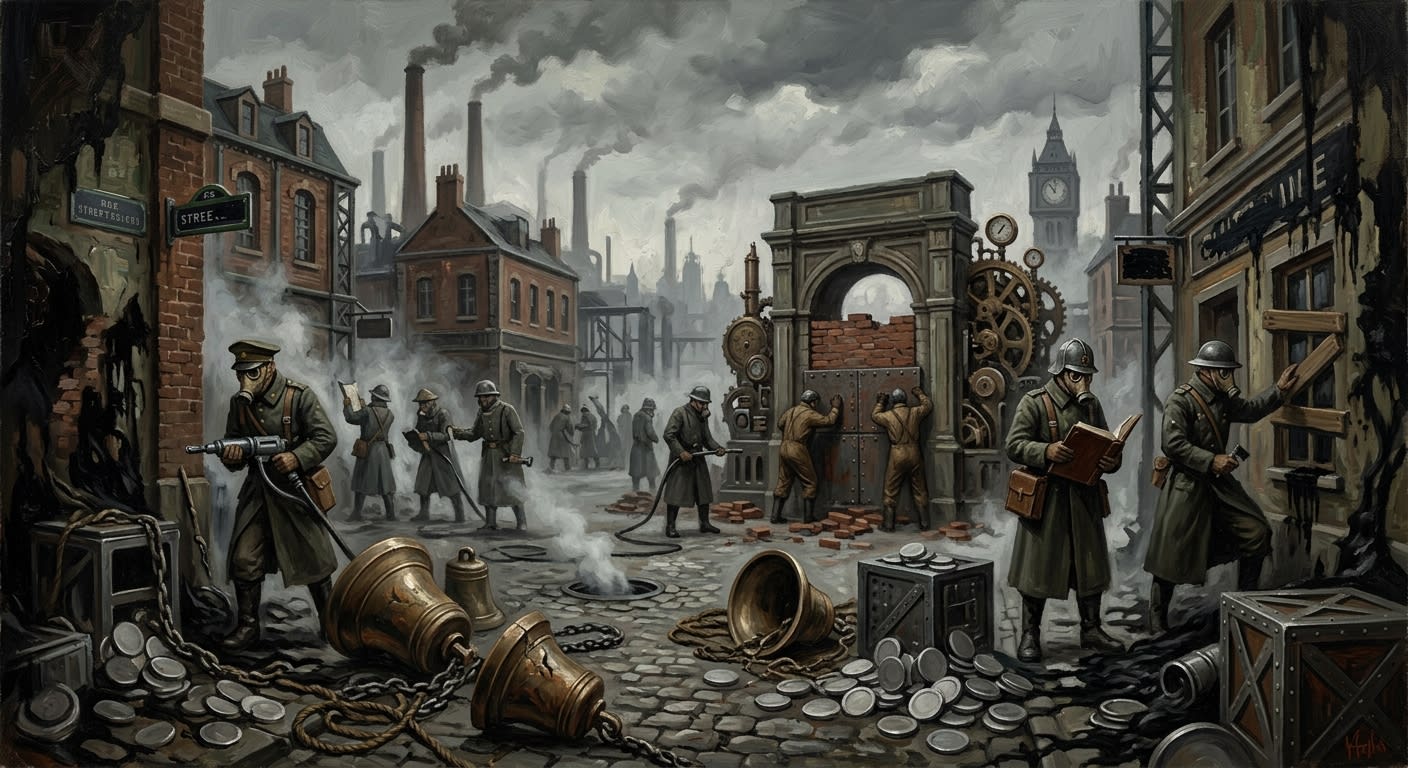
#On the City That Has Always Been Absent
Épernay was a city until A.S. 103, at which point the Bureau of Records, the Bureau of Silence, and the Bureau of Shadows improved it into an absence.
This is the authorised formulation. It has the virtues of accuracy, cruelty, and brevity, which are the three virtues most lacking in municipal history.
Before its correction, Épernay possessed vineyards, pilgrim inns, tithe barns, a modest cathedral, a bell-tower with quarter-hour discipline, two legal markets, eleven illegal ones, and a population large enough to require civic arrogance. It lay in wine country near roads fattened by pilgrims and merchants. Its ledgers were extensive. Its parish records were tidy. Its bells rang on time. All these facts are now classified as forgeries, apocrypha, weather-noise, or French boasting, depending on which Bureau has been inconvenienced.
The cause remains disputed because dispute is cheaper than confession. Purity cites doctrinal deviance. Tithes cites unpaid levies. Doctrine cites providential inevitability, which is how my Bureau says “we approved it” when the ink has not yet dried on the excuse. The authorising writs remain sealed under Ninth-Ratification. I have requested access twice. The first request was denied. The second request was returned blank, which I admire for its theatrical economy.
#On the Method
The Redaction did not begin with soldiers. Soldiers make noise, and noise gives witnesses rhythm. It began with clerks.
Records struck the city from the Great Ledger by categories so small no citizen could feel the knife entering. Births reclassified. Marriages transferred to a filing column that does not exist. Property deeds amended into procedural suspension. Tithe receipts marked pending reconciliation. Burial records unmoored from parish grounds. The city’s names were erased by separation; each was pried from its neighbours until no name had enough company to prove it belonged.
Silence followed the paper. Library catalogues were amended. Road manuals lost the town’s page. Pilgrim guides skipped from one stop to the next with the bland confidence of a man stepping over a body at court. Marginal references were drowned in black ink. Hymnals that mentioned the local feast of Saint Odran-of-the-Vine (Unregistered) had their stanzas closed with redaction so clean the metre limped and no singer remembered why.
Shadows handled what remained after text and ledger had done their holy work. The nature of their contribution is classified. I may say only that household mirrors were reportedly covered for three nights across the valley, that three courier roads were closed under plague pretext, and that a bell-founder in Reims woke with six weeks of his own apprenticeship missing.
Operational Annex C: ████ scribes worked in shifts for ██ weeks. ████████ parish witnesses were relocated, reclassified, or █████████████. Three bell-ringers continued to ring the quarter-hour after their names had been removed from payroll. Their ropes were cut on the fifth night. The bells continued until dawn.
#On the Emptying
The buildings did not burn. The vineyards did not wither at once. No army entered the gate. No proclamation was nailed to the cathedral door. In this restraint lies the Redaction’s true obscenity.
People began leaving rooms and failing to return, though their families could not say who had left. Tables were set for one fewer place every supper. Beds stood made and ownerless. Shop signs lost letters. Wine casks bore seals no merchant could identify. A child asked for her brother and was corrected by three adults who had loved the boy the previous morning.
Within a season, the buildings stood vacant. Within a year, the roads grew over. Within a decade, the name Épernay appeared in no living person’s memory except as a misprint, a counterfeit, a foreign joke, or the sound bells make when heard across a valley where no tower stands.
Earlier summaries state that the residents fled Épernay.
Corrected. Flight requires intention. The residents were not evacuated, exiled, or massacred in the vulgar manner. They ceased to cohere as a civic body, then as households, then as entries. The Bureau discourages sentimental speculation regarding the order in which mothers forgot children.
The empty valley remains. Grass covers the streets in lines too straight for meadow. Foundations lie beneath soil like teeth under a closed mouth. On certain mornings, travellers report the smell of press-wine and candle smoke. On certain nights, bells toll quarter-hours in wind that stirs no branches.
#On the Tokens
Indulgence tokens stamped EPERNAY appear weekly in the markets of Reims. They are small, worn, and older than the operation that supposedly forged them. Their metal composition matches pre-Concordat chapel minting. Their devotional formula matches no surviving parish book because the parish book no longer survives and, in the official sequence, never required survival.
Pilgrimage files reports. Records denies provenance. Silence redacts the market notices. Tithes attempts valuation. Purity arrests the sellers when they can be found, which is rarely, because sellers of impossible relic-currency develop excellent legs.
The tokens are a problem because they are vulgar, portable, and stubborn. A vanished city may be managed while it remains a valley. A vanished city that fits in a peasant’s palm has entered commerce, and commerce is the continent’s second most durable theology after fear.
#On Credit and Blame
Records claims the Redaction as Archon Veyrault’s masterwork. Silence calls it its own masterwork and prefers not to be mentioned, which is typical of artisans who know their tools are illegal in decent company. Shadows denies involvement in a tone that proves involvement to anyone with ears and a career.
Doctrine’s position is simpler. Épernay never existed. The Redaction of Épernay is a classified operation concerning a city that never existed. The bells that toll in the empty valley are acoustic misreports from towers that never stood. The tokens are forgeries of a mint that never struck them. All propositions are correct. Contradiction is the tax reality pays for entering Synod service.
The Redaction of Épernay is sometimes described as a punishment.
Amended. Punishment instructs the punished. The Redaction instructed everyone else.
#On the Present Valley
No official pilgrimage leads to Épernay. No map marks it. No road sign names it. The valley is avoided by locals, visited by fools, watched by offices that will not sign their observations, and heard by anyone unlucky enough to arrive at the quarter-hour.
The grass grows over straight streets. The bells keep time. The Bureau has not decided whose time.