

#On the Reedhouse Chain
"Fog writes; stone remembers." — Proverb of the Salt-Vigil Causeways
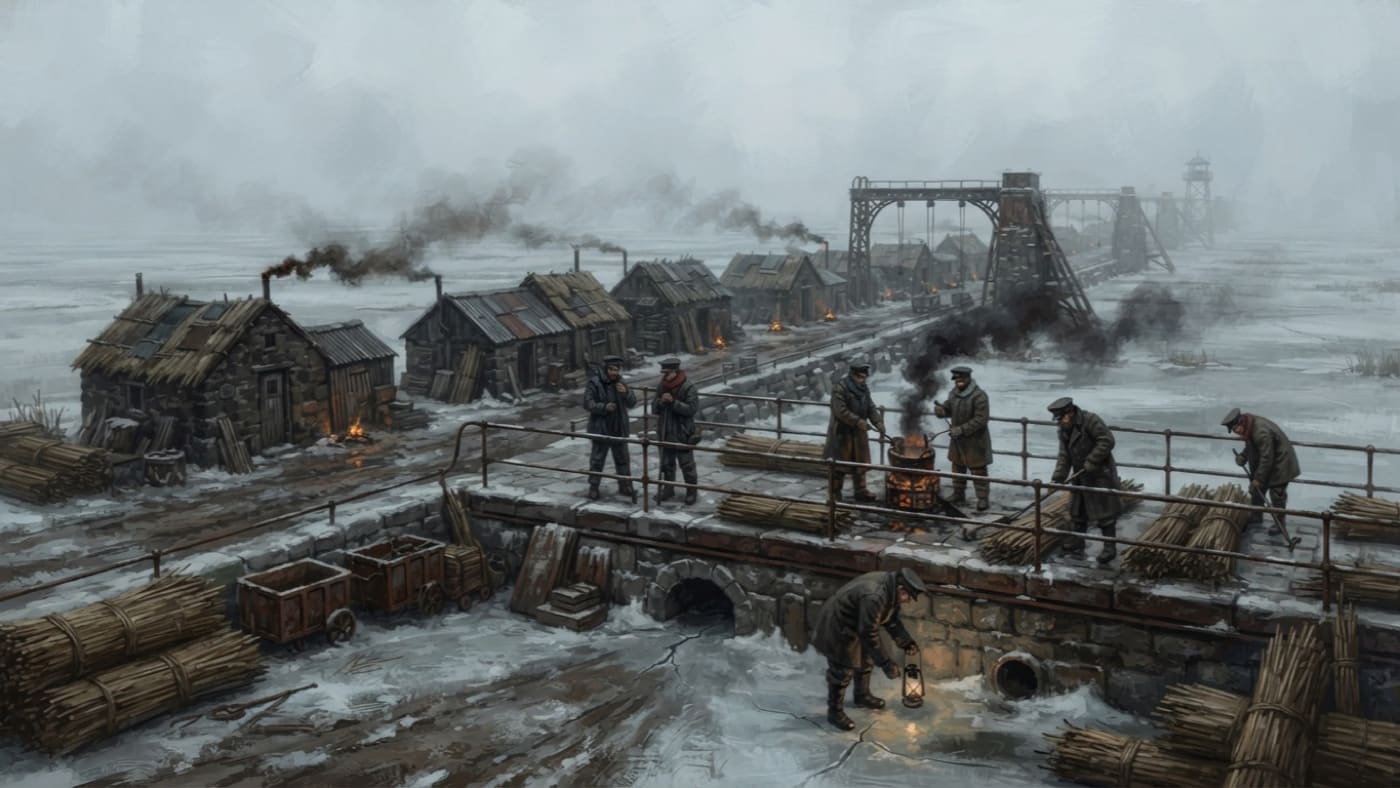
You smell Reedhouse before you see it: wet reed and pitch, carried along the road on wind that has crossed several miles of nothing. Then come the huts, low and black-seamed, set close to the stone they keep, with smoke lying flat over the frozen shallows. That is all of it. Reedhouse has no square, no hall, no bell tower and no council. It is a chain of maintenance huts and spanwright camps strung along the Salt-Vigil Causeways, and the Causeways are honest about what they are. They are a linear network of spans, gates and stations. They have nodes. They have no towns.
The Chain's materials are the road's materials. Salt-stone blocks, bone-lime mortar, rust-iron handrails and reed-thatch wind baffles all wear out on a winter road, and all of them pass through Reedhouse hands before they fail or after. The reed is cut, bundled and stacked wet. The pitch is heated and laid over seams and fascines where the brine wants in. Neither material is beautiful. Both have kept more convoys alive than any sermon preached at the Brine Fork.
The repair fires are where people gather. The Causeways' own record lists them with the Ash-Kitchens, the First Gate queues and the wick stalls of the Lantern Mile as the places where a person on the road can stand near other people without paying for it in tears. Workers come in off the span, warm their hands and go back out, and the fires never quite go cold.
Where the Chain came from is a different matter. The road's own account says engineers raised stone ribs to keep winter grain moving. Salt-hermits were guiding refugees across the flats by A.S. 52, seven years after the Sundering, and in A.S. 82 the records office of Archon Veyrault's growing administration chartered the Salt-Vigil, eight years before the Concordat of Strasbourg gave the Synod its formal existence. None of these dates says when the first hut went up beside the first broken stone. I decline to invent one.
#On the Work of Keeping Stone
On the Causeways the stone is judged before the traveller. At dawn come the span inspection and the salt sweep, and only then does the pass line open. Pilgrims stamp and shiver at the gates while the crews walk out ahead of them along the ribs, pressing, sounding and looking for the hairline that a night of frost has widened into a mouth.
Who walks out there varies. The Causeways' maintenance labor is drawn from debt, penance shifts, confession penalties and conscription during storm emergencies. A traveller who cannot pay the toll can find the toll converted into hours on the spans, and repeat offenders are collared into convoy service. The road keeps its own class order, with Synod auditors and convoy commanders at the top, wardens and vial clerks below them, then traders and pilgrims with means. Span crews and runners come fourth. The local summary says they die young. The ledger has never argued the point.
A debtor sentenced to the spans and a spanwright of Reedhouse do share a fire, and both have frostbitten hands. The difference between them is knowledge. The debtor carries the stone he is told to carry. The spanwright knows which stone. Masons on the Causeways call unsafe stone span-cold, and the archetype of their trade is said to hear stones talk before they fall. I record the saying without endorsing it, and I note that no one who lives on the road laughs at it.
That knowledge has physical form in the camps' maps of weak points: where the ribs have settled, where thaw undercuts the mortar, where the marsh has been patient. Tools can be confiscated and labor can be conscripted. A map in a spanwright's head can only be asked for, and the asking has a price.
#On Helk and the Unsafe Span
In the Causeways' own reckoning the Spanwright Camps are a guild, or a union, depending on who is paying the scribe. Their public purpose is to keep the stones set. Their ambition is to turn repairs into autonomy. Their methods are the slowdown and the unsafe declaration. Their resources are labor, tools and the weak-point maps. Their territory is the Reedhouse Chain and the Drift Cut. What provokes them is forced conscription, which is reasonable: a camp whose only leverage is skill has nothing left to bargain with once its skilled people can be pressed onto the spans.
Span-Master Helk of Reedhouse is listed among the three people who actually run the Causeways. The other two are worth setting beside Helk. Mother-Warden Sile Mourn-Lit controls the Vial Vault allocations, and so who sleeps indoors in a storm. Road-Auditor Varro, called Cold Ink, can void a pass in the middle of a span and leave a traveller unpapered on open road. Helk knows which stones are safe, and works on the road's fear of collapse.
So one power holds the door, one holds the paper and one holds the stone. The first two are chartered. Formal authority over the road belongs to the toll-ascetic chapters and the Road Tribunal, and Helk holds no seal from either that the record mentions. Everyone who crosses still relies on Helk's judgment of the stone.
The camp's own entry in the record lists frostbite and "unsafe span" extortion side by side, and the Bureau would like readers to remember the second and forget the first. A declaration of unsafe stone can be sold. One plot circulating on the road has the spanwrights calling the Long Span unsafe until they are paid in vials. That is a story, not a dated incident, and I file it as a story. A declaration can also be true. The Drift Cut does collapse. Thaw does open sinkholes under the ribs. Most warnings from Reedhouse are made in good faith, and the trouble is that a fraudulent warning looks exactly like an honest one until somebody walks out to check.
Maera Nail-Cold appears in the camp record beside Helk. The record gives no office, deed or description for her, and I see no reason to supply them.
#On the Fourth Post Secondment
According to the published account of the Fourth Causeway Anomaly, the Fourth Post's ordinary winter staff numbered eleven. Among them was "one spanwright seconded from Reedhouse." The post kept the Brielle Spur, seven miles of salt-hardened timber, reed fascine and crushed shell running from the Brine Fork to the Brielle salt-panning station. The eleven belonged to the Fourth Post, and the spanwright was lent to it. The account gives no name, and neither will I.
The secondment shows what Reedhouse ordinarily does. A modest spur still needs a person who can read its surface every morning, and the Chain supplies one, as it presumably supplies other posts. That presumption is mine. The record confirms only this posting.
In the winter of A.S. 199 the Brielle Spur failed to freeze. The Bureau of Engineering arrived with thermometers and sounding rods. The Causeway was closed, and convoys were sent round by the Third Causeway and the western gatehouse of the Queue Road. In autumn A.S. 200 the water froze again and traffic resumed. The phials, the weight and the open water at the eel bend are covered in the parent article, and anyone who wants them can go and be unsettled there.
The account does not say the Reedhouse spanwright diagnosed the failure, explained it, or ended it. Among the ordinary meanings of the report "surface incomplete," it lists "a spanwright too drunk to distinguish mud from theology." That is a general category and not a charge against the secondee. I note it because the account gives the Chain's representative in the affair one line, and that line is a joke about spanwrights.
For one hundred and fifty-four recorded freeze seasons, the pattern held.
Corrected. The figure in the published Fourth Causeway account has not been reconciled with the documented salt-hermit crossings of A.S. 52 or the charter of A.S. 82. Counted back from A.S. 199, it lands seven years before the first documented crossing. It dates nothing at Reedhouse and should not be used to try.
#On the Present Work
Winter traffic on the Causeways depends on repair labor, and repair labor has no flock in the ecclesiastical sense. Grain convoys, prisoner transfers, ration columns and pilgrims too poor for a safer spur all cross stone that was judged at dawn by people in the fourth class of the road's hierarchy. The Synod wants more throughput. The toll-ascetics want autonomy. The spanwrights want autonomy as well, and pursue it with the only argument the road cannot overrule: a span that goes unrepaired carries nobody.
The Drift Cut is where that argument costs most. It collapses often. Thaw sinkholes open under it, and in spring the culverts beneath it carry contraband and unpapered people. A weak-point map of the Drift Cut is useful to a mason, to a provost planning an escort and to a culvert diver, and the map itself does not care who reads it. No record I have seen says Reedhouse runs the smugglers or brings down the spans it is paid to keep up. Plenty of people in authority have wondered.
At dawn the repair fires are lit before the gates open. The crews go out onto the ribs with poles and pitch, the pass line waits, and somewhere on the road a warden, an auditor and a span-master are each sure they are the one keeping it open.