

#On the Number and the Withheld Name
"The Chain never lies. Only men do." — Signal Office maxim, as recited at Third Light
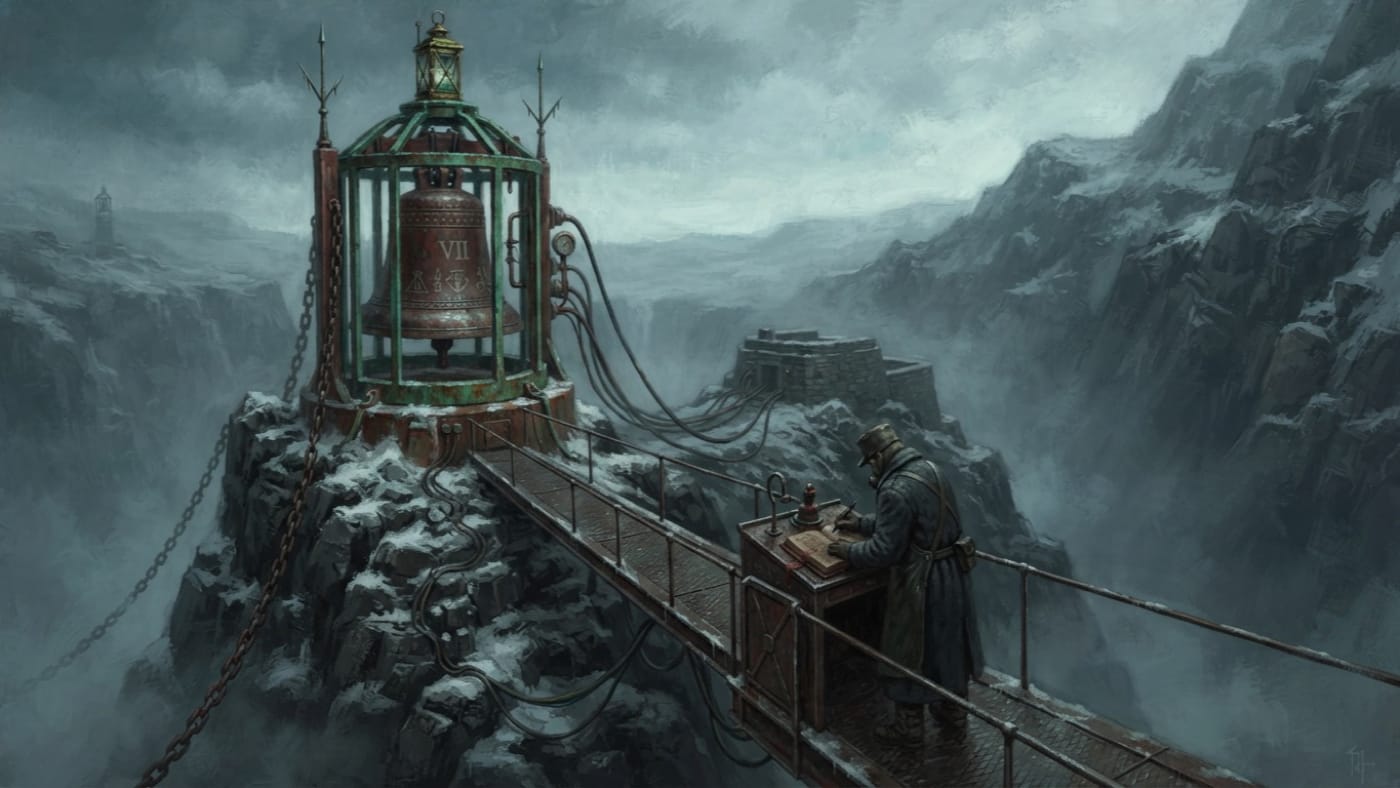
Relay Seven hangs at the crown of Beacon Tower Three, fifty feet of riveted rust-iron bolted to the highest basalt at Third Light. It sits in a cage of cast bronze under the relic-lantern, and lightning strikes it more often than any loyal clerk would care to tally in one column. Its designation in full is Relay Seven, Subsignet Three, Classification Restricted. Anyone who counts will find one station numbered three, one tower, one bell, and a seven that matches none of them. When I inspected the station logs in the winter of A.S. 197, no register I was shown said what the seven counts. Someone wrote it. The Ledger kept it. At Third Light that is all the provenance anything gets.
The bell also has a name. It was given at the casting and is held in the files of the Bureau of Bells, the office that decides when, how and in what tones any bell in the Synod's territories may lawfully sound. The name was classified in A.S. 94. The reason for classifying it was itself classified in A.S. 96. I do not have the name. I know that the reason exists, and for a Hieromnemon that is about as close to a secret as the filing system allows.
The bell exists because a convoy disappeared. In A.S. 72 the Sagittal Line was defensible but still unfinished, and eleven wagons and three hundred mules bound for Bastion-Przemyśl went into the Carpathian passes. Only the mules came out. The Church's war office answered with towers. Two Lights were operating by A.S. 74, and both burned in the storm of A.S. 76. Third Light went up in A.S. 77 on higher ground, and its whole value has always been that it can say, to the minute, what time it is.
#On the Cycle and Its Witness
The day at Third Light is split into six signal cycles of four hours each. Relay Seven is struck to open each cycle and struck again to close it. Between those strokes the beacon burns, the lantern is turned to its bearing, the signal crosses the ridge to Fourth Light, and Fourth Light answers.
The strike is what the record holds onto. At the moment the bell sounds, a clerk presses the bell-signet into the log: a wax impression of the tone pattern, sealed into the page. The impression is then compared with the master timing wheel in the Loghouse of Slate Pages, thirty yards down the cliff. If wax and wheel agree, the cycle is certified. I will not describe how wax takes the shape of a tone. The Signal Office does not describe it either, and I see no reason to be more forthcoming than the people who are paid to know.
The certificate claims four things. The beacon was lit at the correct hour. The lantern was aimed on the correct bearing. Fourth Light received the signal. Fourth Light acknowledged it in the proper sequence. The reader should note how far apart these claims sit. The wax records a strike. The wheel records a time. The other two clauses, bearing and reception, rest on those two impressions like a choir-loft resting on two pillars, with nothing underneath but the assumption that the building is sound.
That assumption is what lets convoys move. A clearance window at Third Light lasts one bell-cycle. A convoy waiting below the Switchback Gate moves on a certified cycle, because a certified acknowledgment means Fourth Light knows the wagons are coming and will light them onward. A convoy that moves on an uncertified cycle has no record, and in the Signal Office's arithmetic a convoy with no record has no claim on rescue. Three hundred men at a time have walked into the fog on the strength of a wax impression. Most of them came out. The Ledger lists those who did.
#On Custody and Correction
Four authorities deal with Relay Seven, and none of them owns it outright.
Beaconmaster Jorren Quill commands the Signal Office's routing and records. He decides whether a cycle is valid or void, and he has not missed one in eleven years. Sister-Mechanic Vey Sable maintains the relic-lanterns and calibrates the instruments, and she hums a flat drone under her breath to keep them "obedient." The register makes her neither the bell's maker nor its keeper. Gate Provost Harn, called Nail, controls the only usable way up from the valley. When papers arrive at his gate carrying the wrong signets, his men take hold of the bearer while his clerks read the papers. The Bureau of Bells holds the name. The Bureau of Doctrine decides what the bell means, and the Bureau of Records decides what it has done.
Below these powers there is a market. Late entries can be bought. Corrected timestamps can be bought. A lost page costs more, because someone has to lose it convincingly. The price is paid in oil tallies, insulated gloves and dry paper, since coin at that altitude freezes to the palm and buys nothing. Clerks who make honest mistakes pay a different price: their "error debt" is worked off in night shifts and cliff work, and a clerk who falsifies twice wears an oath-collar.
One thing has no price, and that is the master timing wheel. Tampering with it is punished by annihilation. The Signal Office uses that word without a gloss, and I have never wanted one. No document I have seen shows that anyone has touched the wheel. I record that absence plainly, because the rest of this article depends on it.
The precedent behind all of this is Pell Oster. Before the collar reform of A.S. 94, he sold three weeks of forged clearance windows to smugglers from the Lowvale. He was hanged from his own bell-cage. The Bureau of Records filed the execution as equipment maintenance.
Oster proved that a signet could be forged, and his hanging was meant to prove that nobody should try. The Signal Office still holds, officially, that bell-signets cannot be forged. Everyone who has served on the ridge holds that they can. Both positions can stand because the forgeries anyone knows about were made by men, who can be found, collared and hanged.
#On the Answer from Below
The Signal Office file Anomalous Signal Behaviour, Station Three was opened in A.S. 194 and is still listed as ongoing.
According to that file, the trouble began as a second answer. Relay Seven sounded, the lantern swept toward Fourth Light, Fourth Light acknowledged, and then, seconds or minutes later, another acknowledgment came up out of White Mouth, the fog basin below the ridge. Nothing stands in that direction to send it. No station, lens or bell has ever been built there. The early echoes gave themselves away by arriving late: the true answer came first and the counterfeit followed it. Clerks logged the gap as drift, and in a place run on drift the gap passed without comment.
In A.S. 199 the Bureau of Alchemical Standards sent a team. It stayed three weeks and produced four pages, three of them redacted. The fourth recommended further study, and the team was reassigned. In the same year, by the station's account, the echoes began to close the gap: first half a beat late, then a quarter, then exactly on time.
By the station assessment of A.S. 201, the Loghouse had certified seven acknowledgments as valid answers from Fourth Light. Signet and wheel agreed in all seven. Afterwards Fourth Light reported that it had never received those signals. It had nothing to answer, so it had answered nothing, and the true reply that should have come first never came. The only voice on the ridge in those seven cycles came from below, and the wax took its impression without complaint.
The concordance of bell-signet and master timing wheel establishes that the signal was received by Fourth Light and acknowledged in the correct sequence.
Agreement between signet and wheel establishes that Relay Seven was struck at the certified time. It does not establish who answered. Seven certified cycles, each disowned by Fourth Light, are the grounds for this correction. Every certification issued from Third Light must now be read with that limit attached, including the ones on which convoys have already moved.
The station has countermeasures, and none of them works every time. Grounding chains are sunk forty feet into the basalt beneath Tower Three; these belong to the tower and should not be confused with the forty-seven chains of the Grounding Field at the western end of the ridge. Salt lines are laid along the catwalks, a practice Doctrine has never sanctioned and never forbidden. At the start of each cycle the Lanternwright Knot performs its flat-sung chorus, twelve voices holding one note until the lenses settle. Sometimes the fog stays silent for a day, a week or a month. Then it answers again, and the answer is on time.
Quill has said, in correspondence held by the Signal Office, that he suspects someone wants Third Light blind. He does not name anyone. Neither the file nor I can say whether what answers from White Mouth is a man, a smuggling ring that has learned the timing, or something the Creator has not yet seen fit to explain to the Bureau. The Great Deceiver has always preferred procedure to fire, and he has never needed to forge a seal when he could get the true one pressed for him.
#On Present Service
Relay Seven is still struck to open and close all six cycles, every day. The wax still takes its impressions, the wheel still turns in the Loghouse, and the station still clears convoys on the four claims printed on every certificate. Quill has asked for reinforcements and received paperwork. A redundancy bell at Fourth Light has been proposed and has not been built. The Signal Office in Strasbourg has issued no new procedure.
That leaves the seven certificates without a place to go. A correctly certified signet cannot be voided, because no procedure for voiding one was ever written; the Office assumed it would never be needed. The certificates therefore stay in the log, valid on their face. Fourth Light's disavowals are filed in a separate folio under the authority of the Bureau of Records, with a cross-reference that no clerk is obliged to follow. The Bureau of Doctrine has the matter under review.