

#On the Republican Batteries
The clerks of the Bureau of War file them as the Republican Artillery. No Rationalist charter I have seen uses that title, and nobody else has produced one. The thing itself was the gun arm of the Rationalists during the Atheist Wars. Its batteries were attached to their armies and served by men trained in the Paris artillery schools. They drew on the same commissaries that fed the infantry and buried it. "Republican" is a name applied after the fact. The Republic as a formal thing begins at Regensburg in A.S. 30 / 1740 CE, and the guns were firing long before anyone signed there. We name the dog after the house it died in.
By A.S. 15 / 1725 CE, Lucien Artois commanded the western batteries. Only the western ones. Other Rationalist guns answered to other officers, and the Stacks keep their names less carefully because they were less interesting and killed fewer saints. Artois left the fullest record, so the institution wears his face whether it deserves to or not.
It must be said plainly, because the catechism plates prefer otherwise: these batteries were good. They broke walls, and they broke the men behind the walls. A great many faithful parishes first learned the Rationalist creed as a sound coming off a hillside at regular intervals.
#On the Measured Crew
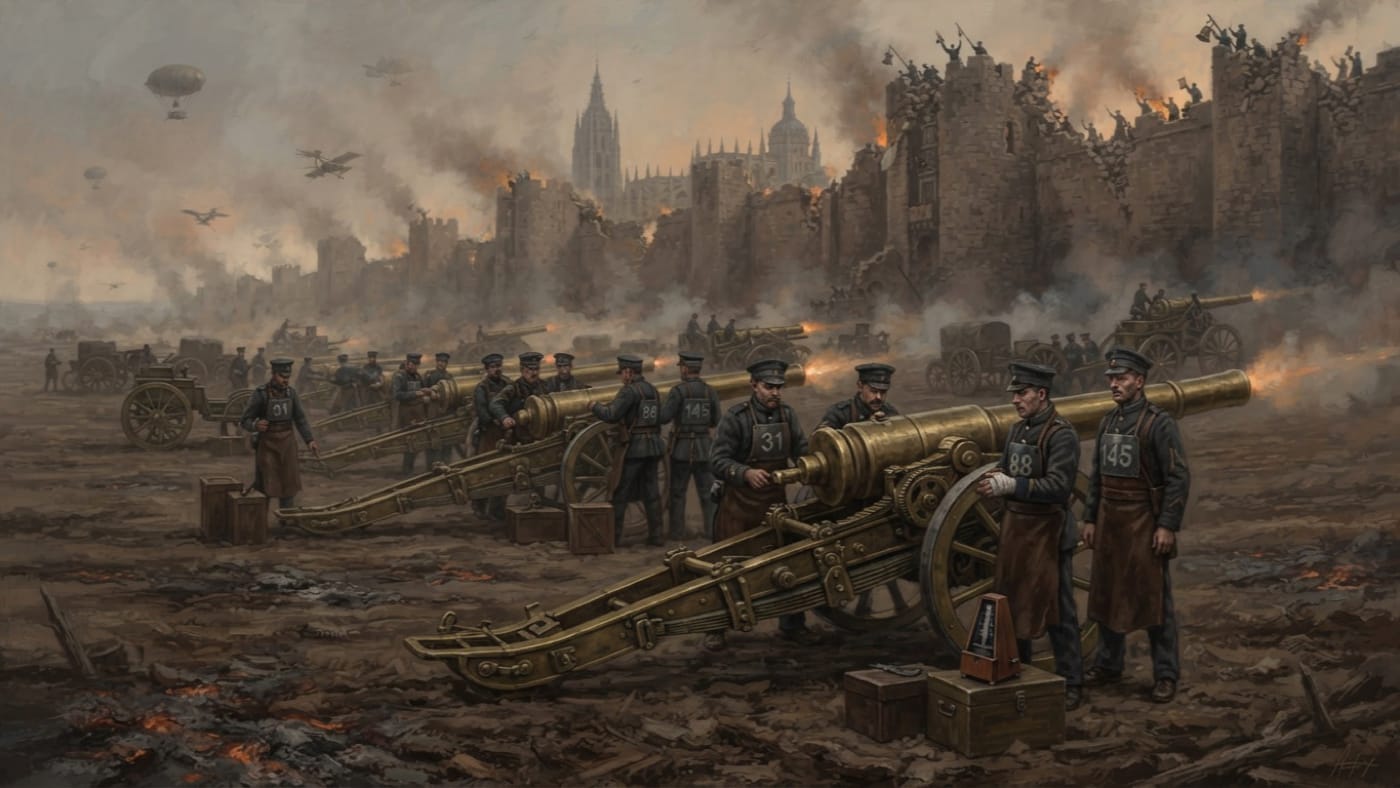
The gun crew was an ancient congregation of deaf men and bad tempers. Artois made it legible to a ledger. His crews drilled to the metronome. A wooden case ticking on an ammunition box set the tempo for sponge, charge, ram and run-up. If a crew fell behind the tick, its deficiency could be written down in figures and corrected by the next morning. Older batteries kept time by a sergeant's shout and fragments of hymn. Artois considered both unreliable. A sergeant tires. A metronome only needs winding.
The ammunition workers wore slates across the chest, each bearing a number. When a man fell between caisson and gun, the next man took up the slate, and the battery's arithmetic carried on without pausing for anything so wasteful as a name. I have handled one of these slates. It reads 31. Something chipped the edge, and nobody recorded what.
Captured chapels became calibration halls. The Rationalists liked vaulted stone for range trials and charge testing. The acoustics were excellent, the floors level and the congregations conveniently absent. Altars made serviceable workbenches. The Bureau of Engineering has studied that fact with more interest than it admits.
Here the institution's whole character can be read. Fire was to be continuous, men were to be interchangeable, and an injury was a delay in a column of figures. Rationalist pamphleteers admired the barrage, and it was paid for in hands. Loaders lost fingers to the returning carriage. Powder-men burned. Men with numbers on their chests carried shot through counter-battery fire because the tick did not pause. The battery's honour, such as it was, consisted of keeping the interval.
#On the Clockwork Battery
The weapon deserves its own paragraph. Artois's clockwork battery set brass-barrelled cannon on spring-loaded carriages. In an honest gun, recoil throws the piece backward and obliges the crew to haul it forward again. Here the carriage caught the recoil, ratcheted it and returned the piece into alignment. The gun came back roughly where it had been aimed, so the crew loaded without relaying. The interval between shots shrank, and a wall that once rested between blows got no rest at all.
The reports give four rounds per minute in dry weather and three in mud. They give two when the carriage teeth had stripped and the loaders were hurt. These figures belong to Artois's batteries in service, under conditions somebody bothered to write down. They are no law of the Rationalist arm as a whole, and they certainly describe no machine that served itself. Men still sponged, rammed, fetched, bled and were replaced. The clockwork took away one labour and multiplied the rest.
I have no affection for the man's creed. I have a good deal for his springs.
#On the Walls It Broke
Montreval came first in fame. It lies in the southern approaches between Avignon and Lyon, and there Artois faced Cardinal-Marshal Severin of Avignon through the campaigns of A.S. 15 to 18 / 1725–1728 CE. Three winters. At Montreval Artois refined his carriage assemblies and widened the track so the pieces would survive stony ground that cracked lesser axles. His firing tables tightened, and his intervals shortened.
Severin answered with parishes. He raised companies village by village and held each together with its bell, its sermon and its ration. He moved them into the gun galleries and onto the walls, and the bells kept sounding among them. A bell does not stop a shell, and a falling round does not consult the hour. The bells kept men at their posts who would otherwise have run, and men at their posts repair breaches. Artois measured the cadence of his crews. Severin measured nothing, and each morning his walls still stood with someone on them. The Montreval firing tables, captured later, carry Artois's own note that bells altered crew behaviour. He was right, and he drew the wrong conclusion from being right. That is the Rationalist speciality.
At the Siege of Toledo in A.S. 15 / 1725 CE, twelve clockwork cannon built to Artois's designs went into the line under Colonel-Prefect Étienne Grimal. Grimal commanded and Artois drew. The distinction matters to anyone who has had to sign for a disaster. The guns hammered the cathedral walls while the faithful held them with relics raised above the battlements, and fire came down on the artillery lines. Three ammunition caissons burned. The Bureau of Engineering credits relic-shot from the company later numbered the fourth Orison. Other accounts give the fire to Father Clemente and the Relic of Saint Iago. Both claim the same three caissons, and the Ledger has not chosen.
Artois read the report afterward and blamed the spacing between the wagons.
The Siege of Toledo, A.S. 71.
Struck. Grimal's battery and the cathedral's defenders were exchanging fire at Toledo in A.S. 15 / 1725 CE. The older date has been withdrawn from instruction. The copyist responsible has been reassigned to arithmetic, where error is easier to see.
#On the Iron Plains
The Rationalists won their war, and the batteries earned a share of the victory. In A.S. 45 / 1755 CE they discovered the share had been on loan.
The Battle of the Iron Plains was fought on the Hungarian plain in the year of the Sundering. There Rationalist divisions were consumed by fire falling from a cloudless sky, and the ground became glass and slag. Brass carriages ran into shining puddles. Springs fused into solid coils. Ammunition cooked off in its limbers, one load after the next. Gun crews who had laughed at relic-smoke died beside pieces that had obeyed every rule they were built to obey.
The firing table assumes an enemy who stands on the ground and can be ranged. It assumes powder that ignites when told to and not before. It assumes the sky is empty. These assumptions had served the batteries for thirty years and more. On the Iron Plains none of them held. The arm had no drill for that condition, because its whole method was to eliminate conditions it could not count.
The Bureau of Doctrine teaches that the Plains were a judgment on the pride of calculation. That reading belongs to Doctrine, and Doctrine can defend it. I record only that the metronomes stopped.
Artois survived. Searchers found him walking in circles across the vitrified ground, reciting equations, and his condition was classified as terminal clarity. He died afterward in Prague. The batteries did not need him to die. They were already finished.
#On the Brass Retained
The faithful who came into the open after 45 had walls to hold and little time to cast new guns. They did what poor men do with a dead rich man's tools. They took up the Rationalist pieces, cleaned them, argued over them and fired them. In time the Bureau of War adopted the clockwork battery as the Ordained Repeater. It put chrism on the barrel and a psalm along the breech, and the same sprung carriage underneath. I have seen no adoption date I would sign. Whatever route ran from Artois's workshops to ours, his crews took no part in it. The brass came over and the men did not.
The division of the corpse is settled. The Bureau of War keeps the carriage mathematics and teaches them to the gunners of the Sagittal Line. The Bureau of Purity keeps the ideology in a locked drawer and teaches it as a disease. The Bureau of Doctrine keeps the Iron Plains, which it finds endlessly instructive. The Bureau of Engineering keeps the caisson reports and does not discuss them.
The guns on the Line still return to alignment after every round. The loaders still lose fingers. They have names now, and the names go on the proper forms.