

#On the Designation
Rhineland Ninth: the name of a province and a number. Those two words are everything the Ledger will say about this regiment on its own authority. Everything else has to be borrowed from one man.
The man is Corporal Aldric Voss. He appears under this designation in the caption to First Sighting, the charcoal sheet I placed in my survey of the Seven Sin-Generals, and the dossier the Codex later opened on him calls the Ninth his regiment. That is the whole attestation: a corporal names the regiment, and the regiment is known only because he was in it. Canon law asks for two witnesses before it will hang a man. The Codex will accept one witness for a regiment, provided he holds a rank.
This entry is a survey of that record, made in the two hundred and first year of the Synod. The year applies to the survey and to nothing else. I was given no date for the Ninth's raising, its breach or its loss of a corporal, and I have not supplied any.
Voss is the only member of the Ninth whose name I have found. That tells us something about which names survived. It tells us nothing about who else served. A regiment, by every definition the Bureau of War has ever printed, consists of more than one corporal. The others must have had names, pay-numbers and boots of the usual poor quality. None of those reached my desk. One name shows that a roll existed. It does not show that the roll ended with him, and I will not make him the last of the Ninth just because he is the only one I can find.
#On Regiments and Their Paper
The Sagittal Line eats paper almost as fast as powder. Every regiment that holds a stretch of it turns up in a dozen ledgers before it is ever seen in a trench. There are orders of march, ration returns, casualty returns, chaplain rotations, bell schedules and the lists of the dead that the Bureau of Records keeps with a care it never spent on the living. If a regiment of the Covenant was never written down, as far as the Synod is concerned it never marched.
So the Ninth ought to be easy to find, and it is not. I have no charter, colonel, barracks, muster book, posting or assigned stretch of the Line for it. That is not a gap left by a slack clerk. It is the condition of the file as I received it. Because of my office I can see the outline of everything a regiment ought to leave behind, and I can only report that the Ninth's papers have not been filed where I can open them.
The province in its name proves less than it seems to. The Rhineland does not sit on the Line. It supplies it, sending sons east with their district papers in oilskin and their ancestors' tithe-stamps against their ribs. That is the province's habit. Nothing on record says whether the Ninth was raised there, drew its levies there, or simply took the name from a War clerk who liked the Rhine and needed a label before supper. Over the centuries the Bureau has named formations after rivers, saints, victories that did not happen and in one case a quartermaster's dog. A geographical name is a heading. It is not a pedigree.
Nor will I let the province carry the regiment off to any bastion that once used the same word as a refugee's nickname. Two things sharing a name does not put one inside the other. The Bureau of Doctrine has been explaining this about the Creator and the Great Deceiver for two hundred years, and so far nobody has listened.
#On the Sector Fourteen Attestation
The only military action on record for the Rhineland Ninth is that one of its corporals survived.
The caption puts the events in order, and so do I. There was a breach-assault near Sector Fourteen. Voss lived through it. Afterwards he drew, from memory, in charcoal on cartridge paper, the thing he had seen above the smoke. He then described it in two phrases. The figure stood "taller than the bell-towers of Mainz." It smelled of "iron and something older than iron." The drawing was not made under fire, and its scale was not measured in the field. It is a man's recollection, put down on paper once the noise had stopped.
The regiment's part in the breach goes no further than that. The record does not say whether the whole Ninth was engaged or only Voss's section. It does not say which way the assault came, whether the position held, or how many fell beside him. Sector Fourteen is not on any map in my keeping. Wherever it lay, it was close enough to the corporal to send him back with charcoal on his hands. Mainz appears in his testimony as a yardstick. It gives no birthplace, no recruiting district and no battlefield, and a city should not be mistaken for a grid reference simply because it has tall bells.
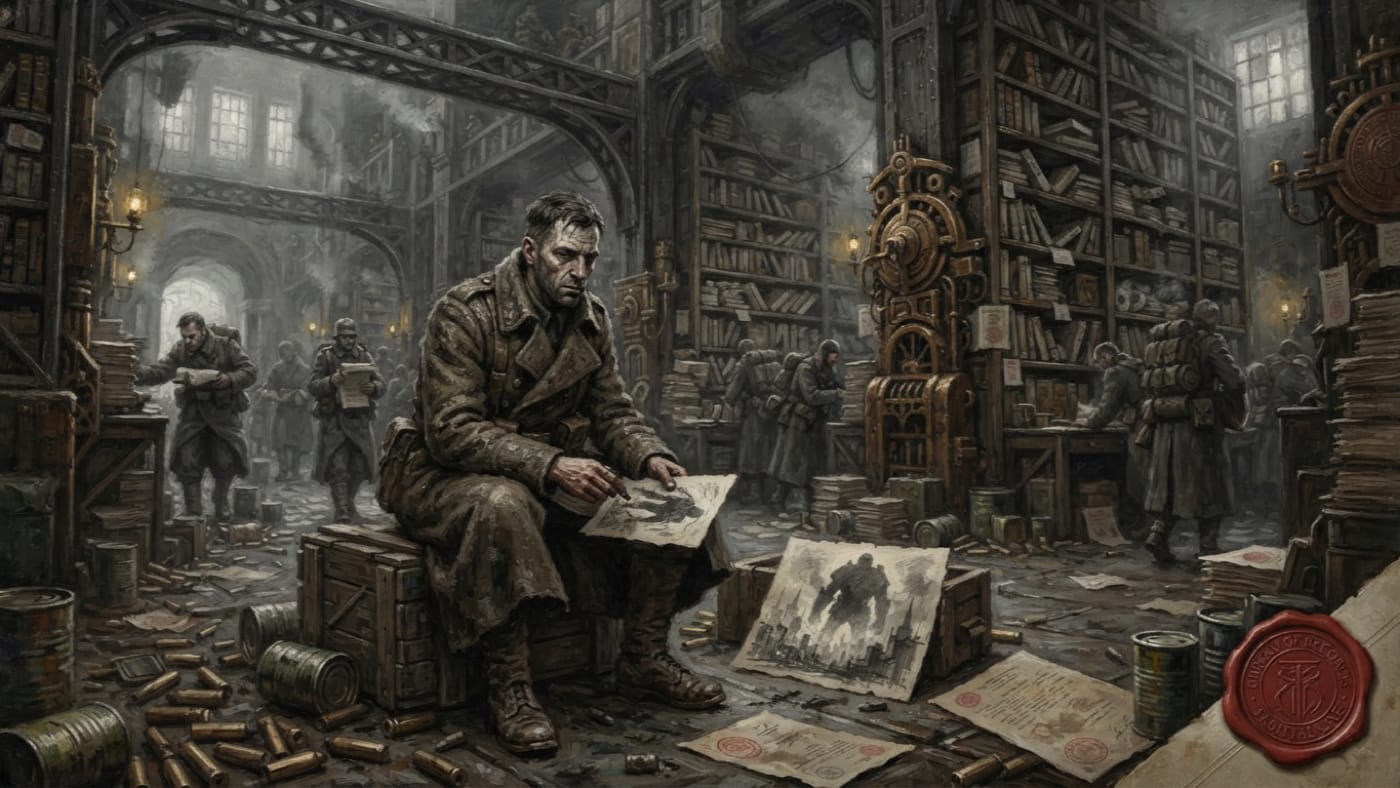
The figure has no name. I filed the sheet among the Seven because the cabinet needed a place for it, and that filing identifies nothing. The title First Sighting is his own and records his own first sight. It does not claim the first sighting by the Church, the Line or anyone else. The man crouching in the greatcoat may be Voss or may be any soldier, since half the Line wears that coat.
#On the Witness and His Removal
The Bureau of Purity read the corporal's testimony and judged it too vivid for general circulation. Within the week he was reassigned to the Paper Mines, and the caption records that this was "not as punishment." I quote the Bureau's phrase exactly and leave it in quotation marks, where its owner put it. I have no tribunal, charge or conviction on file that contradicts it, and I will not make one up to suit my temper.
Seen from the regiment's side, the effect is plain. The Ninth had one voice on record, and Purity moved that voice to another post by means of a form. The regiment did not lose a corporal in battle. It lost him to a judgment about what his sentences might do to readers. No casualty return covers this, because nobody was hurt in a way the returns can count.
The testimony itself was kept. It sits, quoted word for word, in an entry sealed at Bureau-level clearance. The sergeants and chaplains it was withheld from have still not read it, and the assessors who withheld it have read it many times. Keeping something from general circulation and keeping it in the archive are compatible. Purity does both before breakfast.
The Paper Mines of Ulm are the Church's punitive paper-works outside that city. Archival stock, sermon paper and redaction-grade vellum all come from the labour of people without names. The caption shortens the destination to Paper Mines and does not name the site. I cannot say which road he took, which shed received him or what work he was given. I record only that a soldier who drew on paper was sent to make it, and I leave the arrangement to speak for its authors.
#On the Limits of the Register
I can certify a designation, a regiment, a corporal, a breach near Sector Fourteen, a sheet of cartridge paper, two phrases and a reassignment. That is seven items, and the Bureau of Doctrine will no doubt find the number edifying.
I cannot certify anything about the Ninth's later service or its losses, whether it was dissolved, merged into another formation or renumbered, or whether it is still on the Line under its own name. War has not answered my enquiries. Records sent me a receipt for them.
If the Ninth still stands to arms, it does so somewhere outside my folio and has one corporal fewer than its roll shows. If it does not, it ended without its passing being entered anywhere I am permitted to look. Neither possibility will be written in under my seal so that the page can end neatly.