
#On the Province That Became a Test Sheet
The Rhineland is the Synod’s most corrected province, which is to say it is among the most useful. Rivers cross it, roads bruise it, bells discipline it, vineyards soften its hills with a tenderness the Bureau has never trusted, and old cities sit along its watercourses like bishops pretending not to notice their own appetites. It has been Roman, episcopal, princely, Rationalist, Synodic, occupied, rescued, audited, harmonised, and blamed. A place with that many verbs should be approached with gloves.
Geographically, the name gathers more than it should. It means the Rhine districts and their tributary towns; the Mainz-Cologne-Rheinscarp chain; the Moselle pressure through Trier and vineyard parishes; the road webs toward Aachen, Metz, Strasbourg, Worms, Speyer, and the Queue Road mouths; the archive towns that smell of wet vellum; the depot towns whose children can identify ration flour by touch; the market squares where Creed recitation once weakened badly enough to require an entire profession of corrective street clergy. It is Zone 2 heartland in the maps, western and central stomach in logistics, and a chapel full of knives in Doctrine.
The common catechism calls the Rhineland one-third of the Triune Hearth, bound with France and Iberia under Synod supremacy by the Concordat of Strasbourg. This is tidy, and false in every interesting detail. The Concordat did bind it. The binding was necessary because the province had already learned to endure too many masters and obey none of them cleanly. The Synod did not find a blank field. It found toll rights, chapter privileges, scriptorium habits, bridge memories, merchant jokes, old bishoprics, Rationalist scars, and families who could change allegiance without moving house.
#On Old Occupations and the Uses of Being Betrayed
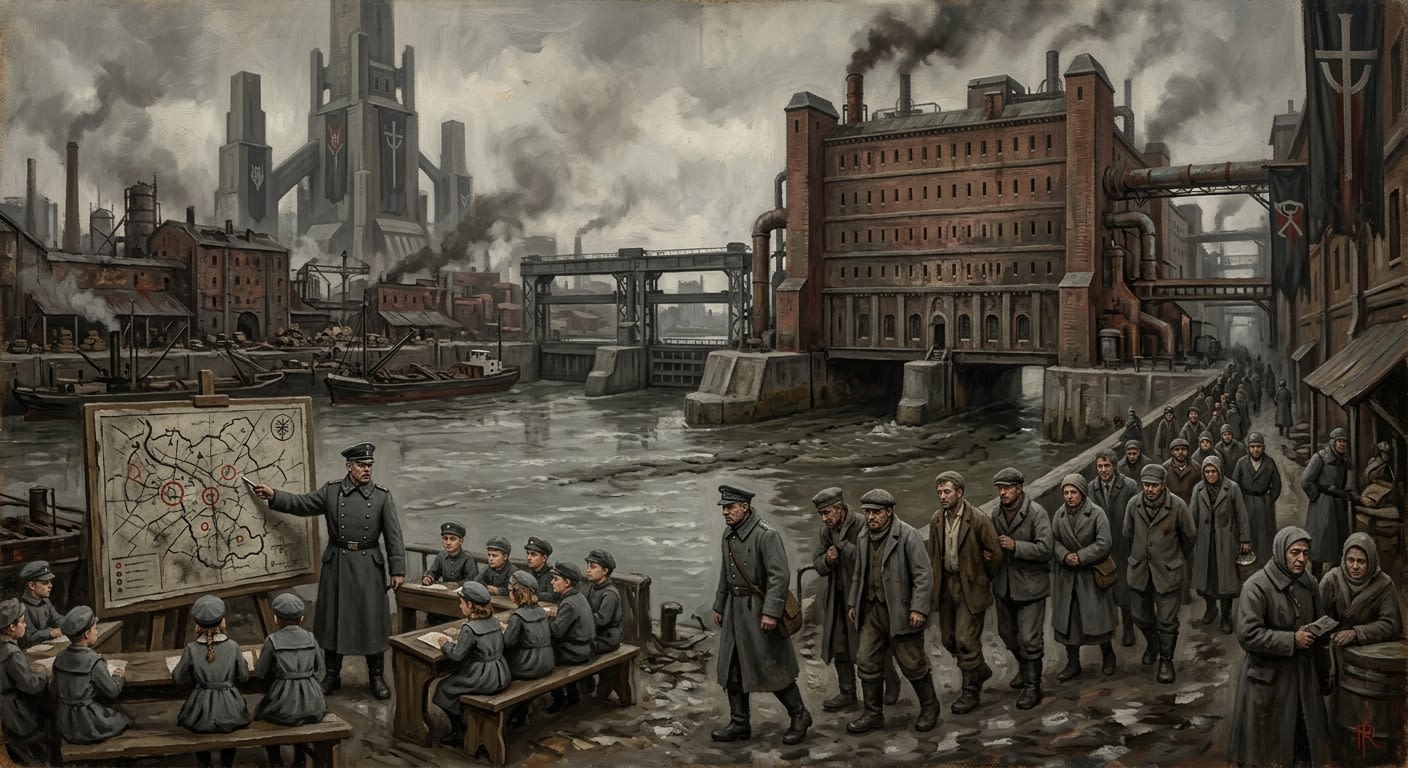
The Rhineland learned early that liberation and occupation may use the same roads. During the Atheist Wars, Aachen opened like a wound; Rationalist power poured through; the northern faithful front broke; the Rhineland, Lowlands, and much of northern France fell beneath the Broken Cross and its excellent ledgers. The Rationalists brought printed notices, cleared roads, public executions with civic punctuality, and the small comforts by which an enemy attempts to look less like an enemy. Bread is persuasive when saints are being hanged.
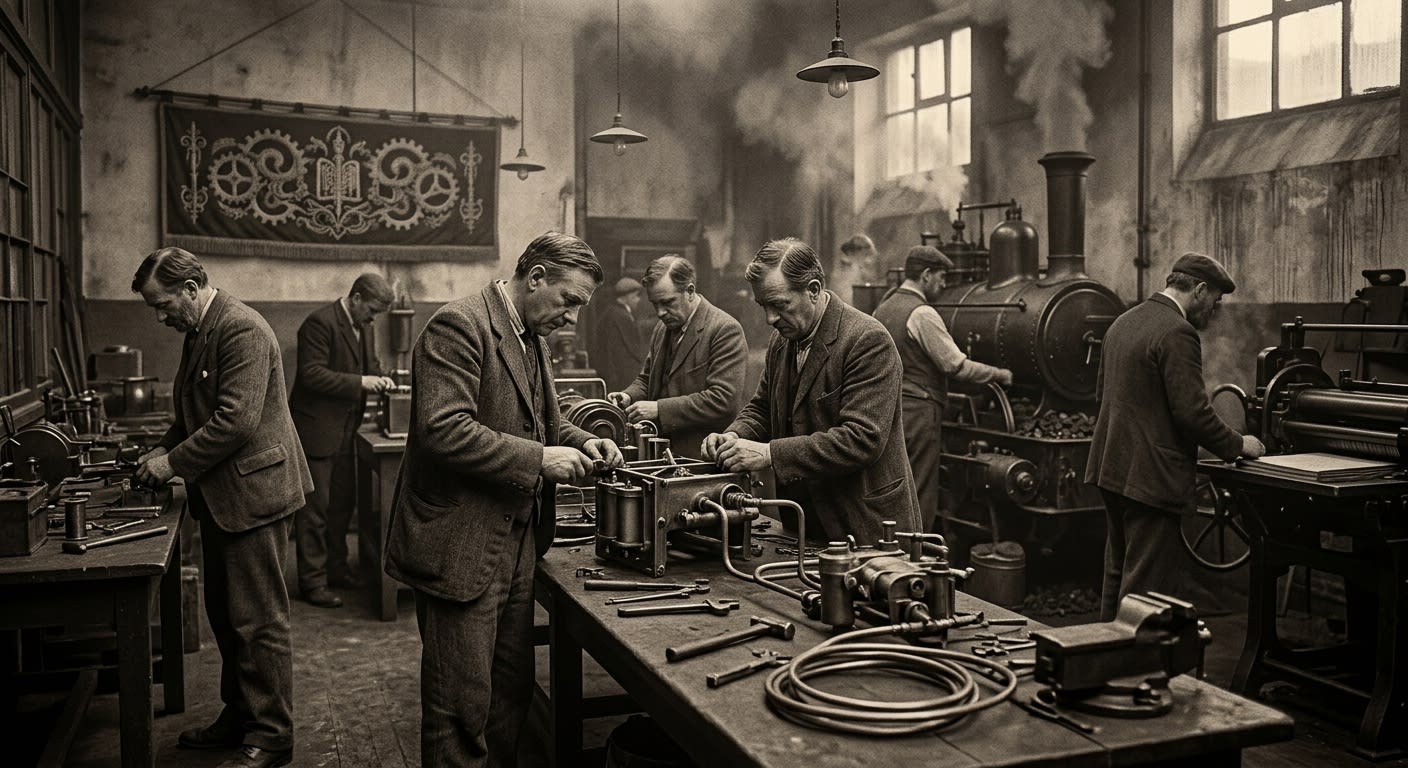
Then came the Treaty of Regensburg in A.S. 30, Reason’s little coronation, and fifteen years of Rationalist rule. The old order had been humiliated, the Holy See degraded, the Church’s properties nationalised under educational language, and the Rhineland made into a corridor of confiscation, compliance, and laboratory civic virtue. Then the Sundering arrived and performed criticism with earthquakes, mouths, famine, and the extinction of several arguments. Demons are vulgar reviewers. Efficient, though.
Later provincial primers describe the Rhineland as “steadfast under foreign atheistic pressure.”
Corrected. The Rhineland endured, collaborated, resisted, traded, prayed, informed, laughed, recanted, smuggled, and survived. Steadfastness is what winners call the parts of survival they can use in sermons.
After the Sundering, the province’s rescue was made doctrinal. Every town that had been occupied became evidence of martyrdom; every compromised merchant became a donor; every recanted official became either an example or a clerk, depending on handwriting. The Synod’s genius lay in converting ambiguity into assignment. A bridge that carried Rationalist troops could carry pilgrims after reconsecration. A treasury that held stolen ecclesiastical plate could become an archive-bank after audit. A family that had served the Republic could be made useful by being made afraid.
#On the Triune Hearth and the Provincial Lie of Unity
The Concordat of Strasbourg bound France, Iberia, and the Rhineland into the Triune Hearth and proclaimed what every ambitious government proclaims once it has enough rooms to store the contradiction: providential destiny. The Rhineland received the honor of being one of the three hearth-stones. It also received new tax schedules, harmonised oath forms, procession calendars, military movement obligations, corrected school prayers, and officials from Strasbourg with soft hands and hard vowels.
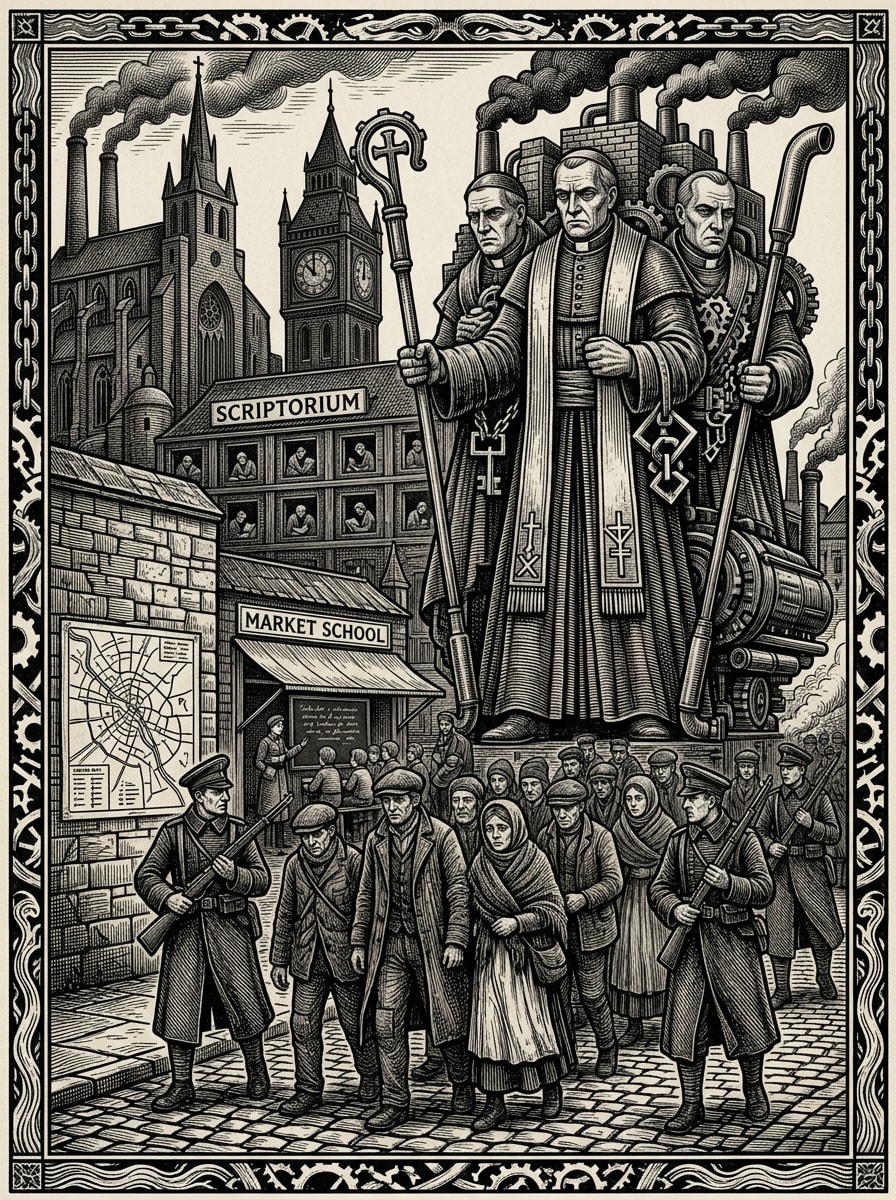
The Hearth mattered because it gave the Synod a geography of legitimacy. France supplied capital grammar and administrative vanity. Iberia supplied old siege memory, southern ports, and enough saints to overstock a drowning chapel. The Rhineland supplied roads, rivers, finance, scriptoria, tolls, markets, and the proof that a difficult province could be made to kneel without being reduced to ash. A dead province teaches nothing. A taxed province preaches every quarter.
The peasants called the Compact a famine in several districts, which was rude, accurate, and suppressed unevenly. Binding a region into sacred unity required grain movement, troop feeding, levy extraction, bell-metal requisition, repair tithes, shrine dues, and the pious theft by which tomorrow’s monument consumes tonight’s soup. The Synod celebrated second founding. The market counted sacks.
Unity, in the Rhineland, was never a condition. It was a schedule. Bells at Mainz, tariff hands along the Moselle, Cologne archive-banks, Rheinscarp stair offices, Trier chalk corners, Aachen penitential routes, Worms bridge ledgers, and the smaller parish towns all had to be made to perform the same obedience at the same hour. This is harder than conquest. Conquest requires breaking resistance. Harmonisation requires making resentment arrive on time.
#On Margins, Scriptoria, and the First Great Correction
The Great Purge of Margins began in A.S. 56 because approved books had continued behaving like books after approval. The first seizure occurred in a Rhineland scriptorium outside Trier, where an Audit-Cantor opened a hymnal and found acoustics equations beside an antiphon on obedient resonance. The equations were correct. This made them worse. Error may be corrected with ink. Accuracy without permission requires rope.
Within six weeks, annotated texts appeared in Ghent, Mainz, Cologne, Strasbourg, and houses of copying later removed from their own lintels. The margins held tidal observations, fever intervals, bridge ratios, bell harmonics, crop timings, old surgical cautions, and one note beside the Third Article of Covenant that read simply: incorrect. Forty-seven scribes were executed. Twelve libraries were confiscated. Originals went to the Forbidden Stacks, where dangerous knowledge waits for officials trusted to misunderstand it with sufficient rank.
The Purge matters because it revealed the Rhineland’s oldest civic habit: placing practical memory inside permitted containers. A prayer book could hold drainage figures. A saints’ calendar could hold crop warnings. A psalter could carry bridge loads. The province had learned under occupation, plague, and toll law that truth survives when disguised as duty. Silence attacked marginal handwriting. The later Ashen Circle learned to have no margins.
A Bureau of Silence circular described the A.S. 56–58 campaign as “limited correction of scribal exuberance.”
Corrected. Forty-seven dead scribes, twelve confiscated libraries, and three wagonloads of seized commentary exceed exuberance. The clerk responsible for the phrase was commended for optimism and denied access to totals.
The Synod declared victory in A.S. 58. Shelves looked cleaner. Books looked dumber. Scriptoria grew quiet. Knowledge moved into lemon-ink, ash-paper, memorised sequences, false citations, recipes, sermon jokes, and the kind of household instruction that cannot be confiscated without confiscating the household. The Rhineland learned that clean pages are safest when the reader is dirty with memory.
#On Curfew, Rihn, and the Government of Night
By A.S. 94 the Rhineland’s cities had swollen with refugees, discharged levies, ration-widows, peddlers, deserters, orphan gangs, licensed grief, unlicensed grief, and the midnight commerce by which hunger proves no decree is as wide as a stomach. Bells announced curfew. Wardens enforced curfew where lamps were bright. Alleys kept their own hours.
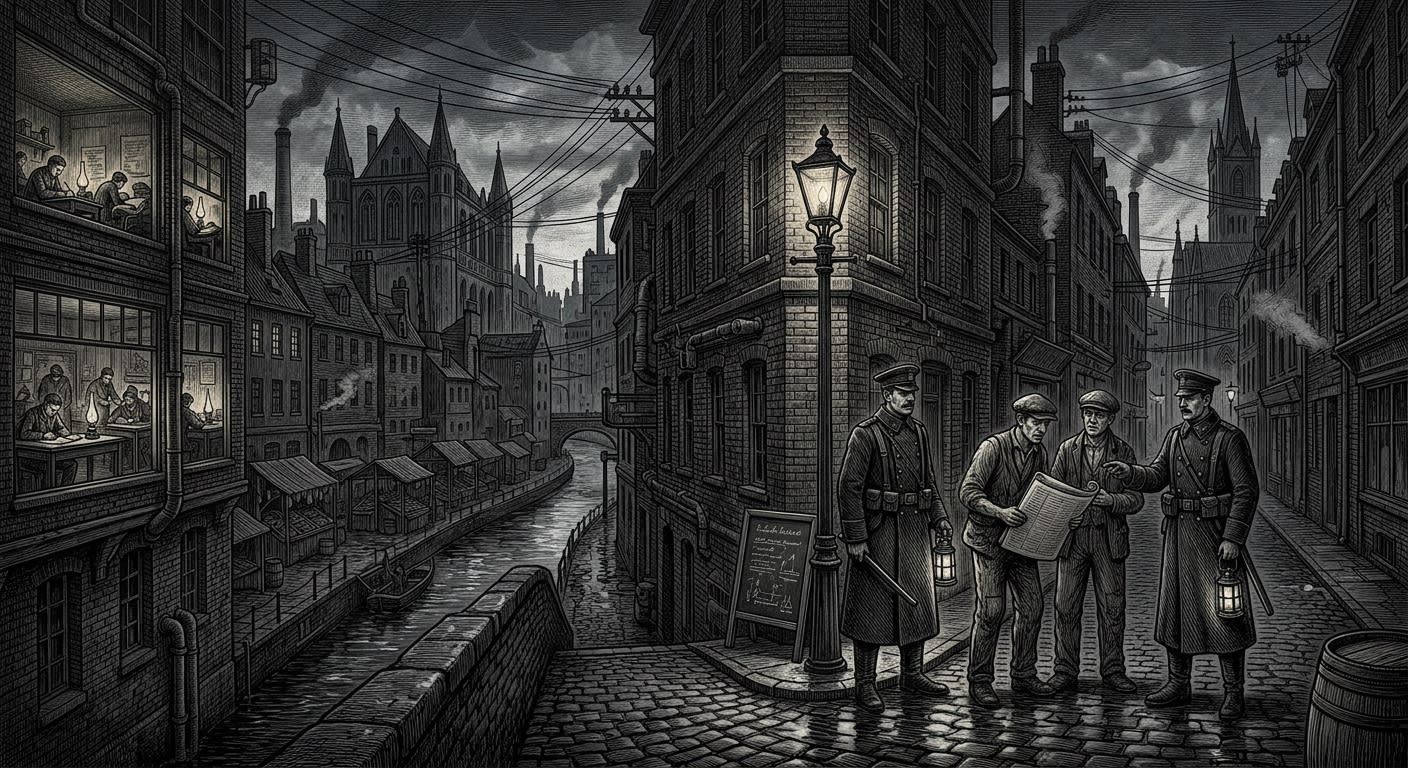
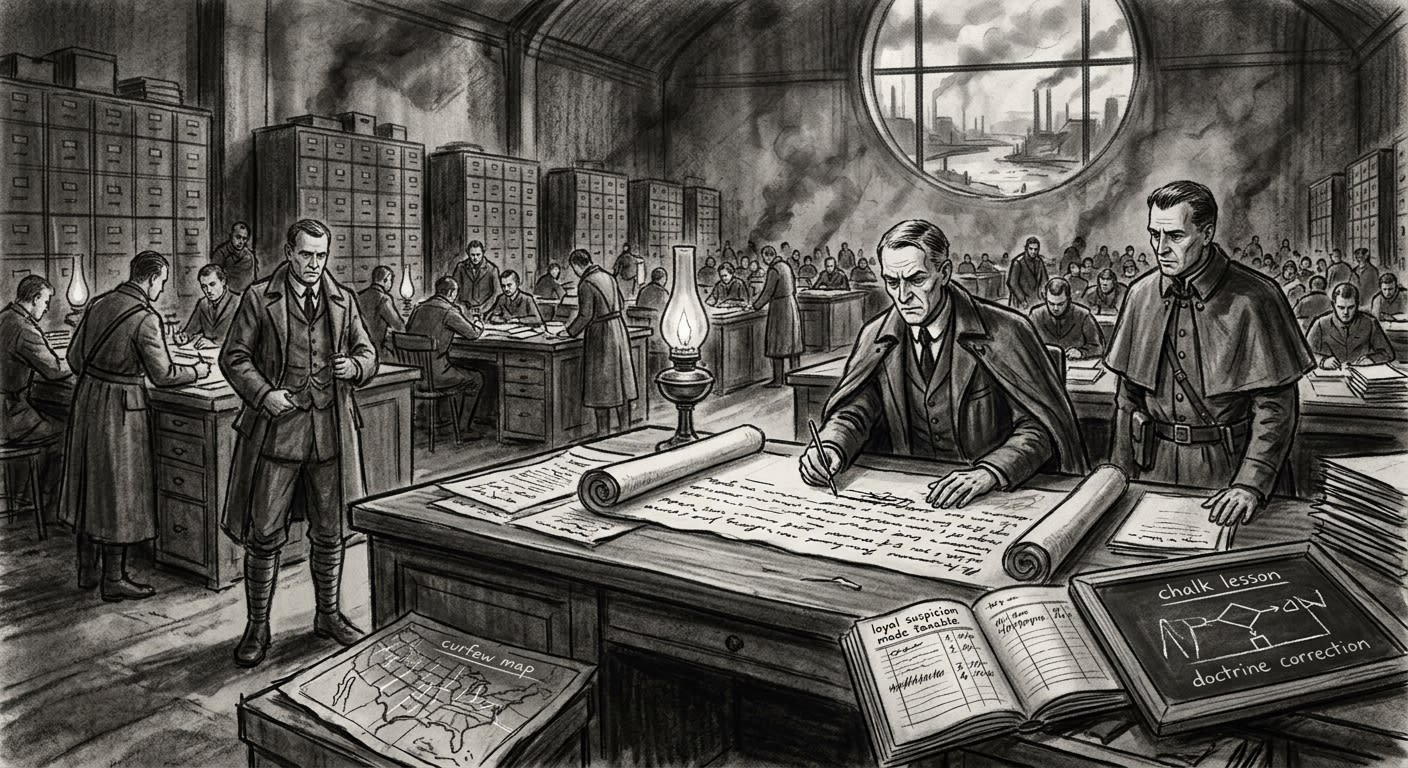
Vicar-General Anselm Rihn was asked to standardise night movement across the Rhineland. He answered with the Curfew Ordinance of Quiet Hours, ratified in the margin of a supply requisition, which is the proper birthplace of durable cruelty. The Ordinance marked crossing-points, standardised lamps, restricted civilian movement after the Ninth Peal, created the Licensed Consolator office, and tucked the Lantern Brotherhood into law by way of the phrase auxiliary vigil personnel, locally licensed, subject to revocation without notice or appeal.
The Ordinance altered night. Before Rihn, curfew was an hour enforced unevenly. After Rihn, curfew became a map. Crossings had authorised lamps. Alleys had tolerated watchers. Consolators had assigned posts. Citizens learned which bell meant home, which stair meant risk, which lantern meant paperwork, which lantern meant a knife, which grey stole might shelter a sentence too warm for the Ledger.
WORKING DRAFT FRAGMENT — CURFEW ORDINANCE, A.S. 94 Where Warden coverage is ███████████████, local auxiliary vigil personnel may ███████████████ under revocable licence. Margin hand attributed to Rihn: “If they are already feared, make the fear useful.” Reviewer note: softened before promulgation.
The Rhineland’s later Lantern apparatus, with its Fog Preachers, Candle-Runners, Mercy Architects, Tongue-Smiths, and Brothers carrying ash-oil lanterns through alleys, lives inside that margin. Comfort was licensed to reduce disorder. The comforters began to mean it. The Brotherhood was tolerated to extend Warden reach. The Brothers discovered that tolerated light can cast private shade. This is what happens when administration purchases cheap night labour and expects gratitude rather than theology.
#On Markets, Creed, and Turnips
Between A.S. 98 and A.S. 103, the Market Drift Years frightened Doctrine more than a riot. Public Creed recitation declined measurably across Rhineland districts. Markets replaced Creed-sealed transactions with barter-oaths, handshakes, jokes, and rumor. A grocer in Cologne said, “God is for Sundays; Tuesdays belong to turnips.” His neighbours laughed. The laugh travelled farther than the sermon.
This was intolerable because it was small. A riot may be surrounded. A joke must be overheard, interpreted, resented, repeated, and punished without making it funnier. The Bureau of Doctrine found itself facing turnips, which are difficult adversaries: local, cheap, numerous, and hard to indict without looking ridiculous. A doctrine that cannot command the price of cabbage has begun leaking authority at the market stall.
A.S. 104 brought the Catechism Third Revision and the Doctrine Street-Vicar Corps. Eleven Vicars were first deployed to Cologne. They conducted square-stops, inspected purity tokens, issued correction slips, and marked doorframes in chromatic compliance code. White: compliant. Yellow: uncertain. Red: available to punishment. The street became a chapel with worse acoustics and better witnesses.
The corps did not restore innocence. It made failure legible. A stumble could be noted. A pause after the third line could be marked. Silence during a square-stop became evidence unless medically certified by a doctor whose own Creed was current. The Rhineland learned to speak correctly while thinking locally. This is a high art. Several provinces still manage only the speaking.
#On Chalk, Trier, and Proportion Learned Late
The Chalk Riots began in Trier in A.S. 119 when public marking became too visible for public patience. A Street-Vicar applied lawful tools beyond survivable proportion, placing shame where shame could gather neighbours. Trier should have remained local. Most disgrace does. Yet the Street-Vicar system had been installed across the Rhineland with identical forms, identical chalk codes, identical chimes, identical little field books in which men wrote uncertain as if uncertainty were a stain they had discovered rather than one they had applied.
Cologne heard first. A yellow-marked brewer’s quarter scraped its lintels clean before dawn patrol. Halle followed with crowds reciting the Creed correctly while blocking Vicars from reaching marked doors. Strasbourg suffered three district disturbances inside the capital’s own administrative shadow. One occurred within hearing of a Records annex, whose clerks later testified they could not hear the crowd over their own pens. This testimony was accepted because it flattered Records.
The riots lasted long enough to prove doctrine vulnerable and ended quickly enough for doctrine to pretend it had never trembled. Purity restored order with arrests, baton charges, strategic mercy, and the great gift of letting frightened districts believe they had been heard while ensuring no official ear was damaged by the noise.
A.S. 120 brought soft-marking reform: fading chalk, escort norms, patrol limits, and the unwritten fourteen-mark threshold. Fourteen red marks in one patrol became no longer a number but a river. The reform softened spectacle rather than power. Yellow that fades before Compline still does its work before supper. A red mark reviewed by a District Doctrine Officer still stains memory after rain takes the chalk.
#On the Quiet Purges and the Discipline of Absence
A.S. 112, filed earlier than the Chalk Riots but spiritually adjacent, taught the Rhineland that the absence of spectacle may frighten better than spectacle. The Quiet Purges removed four hundred and eleven teachers, choirmasters, and Street-Vicars from Rhineland postings without public trial, posted charge, or the courtesy of screams in the square. Doors opened before dawn. Names left ledgers. Classrooms received substitutes. Choir stalls were rebalanced by Friday.
The public noticed because publics are stupid in groups and sharp in kitchens. Children came home with new catechists who held chalk too tightly. Choirs found altos missing. Market corners once patrolled by familiar Vicars received younger men whose correction slips still smelled of fresh ink. No proclamation explained the substitutions. None was required. Explanation is for jurisdictions uncertain of their authority.
The Purges matter because they occurred before the Codex Auditors formally existed. A nameless apparatus had already compiled lists from confession abstracts, school recitation logs, chapel attendance sheets, hymn cadence registers, and reports from neighbours who confused malice with holiness and were rewarded for the error. It named clusters rather than conspiracies: a teacher whose pupils paused before the Fourth Article; a choirmaster whose second row softened the amen; a Street-Vicar whose correction rate declined as his district’s attendance improved.
In Cologne that same year, the Lintel Pogroms stripped false Triune Knots from river-quarter doors. Geometry, hymn, lesson, and lintel became evidence together. The files are separate. The streets were not. By A.S. 114, the Auditor branch received a name, a mandate, and the satisfaction of pretending birth occurred when Records found a cradle.
Rhineland Removal Ledger, packet 112-QP-411, contains complete affected personnel list, witness abstracts, and post-removal household monitoring notes. Access requires triple seal of Purity, Doctrine, and Records. Current packet location: █████████████████████████ Known unauthorised readers: ███ Disposition of unauthorised readers: completed.
#On Packets, Deathbeds, Grain, and Other Useful Panics
The Rhineland has provided the Synod with a generous sequence of panics, each a theological lesson wearing local clothes. The False Packet Panic of A.S. 134 sent counterfeit Index Damnatus blacklist bundles through three Rhineland cities. Gatehouse guards arrested four hundred citizens on names that had never been condemned. The wrongful arrests produced riots; the riots produced genuine condemnations; the genuine condemnations produced real packets. Purity could not sort false from authentic before the damage became equal.
The Mercy Ward Purge of the same year revealed terminal confession corruption across the Rhineland ward circuit. Seventeen Deathbed Confession Harvesters were convicted of selling, suppressing, altering, or misplacing last words. The dying had imagined final speech to be mercy. The Bureau clarified custody. Curtains widened. Paired stools appeared. Double-witness protocol entered the room where the soul was trying to leave.
Ration Plunder Winter in A.S. 97 made depot theft exemplary. Losses exceeded nine per cent of caloric throughput along Queue Road staging posts. A supply clerk who diverted three flour barrels was immured by writ in a Rhineland depot wall at eye level. Theft fell to zero within the week. Doctrine took note, as Doctrine always does when masonry improves ethics.
A.S. 160 brought Grain Tithe Riots in which three Assessors died, the last Tithes field deaths until A.S. 199. Replacement Assessors arrived with larger armed escorts. Outstanding levies were collected in full. Funeral expenses were billed to the parishes where the deaths occurred. The parishes paid. The Bureau of Tithes classified the dead as receivables lost, and I admire the phrase with the revulsion owed to a polished bone saw.
#On Cities That Pretend to Be Districts
The Rhineland is never merely provincial because its cities are too old to behave. Mainz counts crossings with the malice of a bell that has learned arithmetic. Cologne monetizes memory and calls the resulting smell incense. Rheinscarp climbs above the Rhine in nine terraces because horizontal extortion was insufficient. Trier hides old episcopal pride under chalk dust and vineyard courtesy. Aachen remains penitential and strategically useful, the most hypocritical combination known to roads.
Cologne is the most dangerous because it remembers in usable form. Council rooms, archive-banks, confessor-kiosks, Sable Court finance, relic contradictions, Brotherhood cellars, Street-Vicar lessons, and market laughter all sit in it without cancelling one another. A city that can hold seventeen authenticated femurs and a turnip joke in the same civic stomach is prepared for empire or blasphemy. Often both, before breakfast.
Mainz is the province’s throat. Its bridges have carried armies, refugees, packets, bells, and sentences. Its road bells teach commerce to arrive ashamed. Rheinscarp is the stair-tax made architectural. It charges men for ascent, delay, proof, ash exchange, office access, and the old human desire to stand above floodwater. Trier is softer in appearance and meaner in practice: chalk districts, Moselle tariffs, old vineyards, Meta-Levy grievances, and the memory of a Vicar’s death teaching reform to men who disliked being taught by a corpse.
The smaller towns object to being treated as lesser, and they are correct. A village scriptorium can preserve an equation. A ferry parish can ruin a packet chain. A depot wall can teach all of Europe how to bury a thief upright. A market stall can create a professional corps by making neighbours laugh at turnips. Strasbourg has ministries. The Rhineland has habits. Habits win more often than ministries admit.
#On the Present Rhineland
As of A.S. 201, the Rhineland is loyal in every measurable category and suspect in every category that matters. Its Creed recitations are timed. Its schools are staffed. Its Street-Vicars carry softer chalk. Its Brotherhood licences renew under deepening ambiguity. Its roads feed the Queue Road, the Rhine Corridor, the Moselle Circuit, and eastern staging systems. Its archive-banks underwrite convoys whose soldiers will never know which Cologne household paid for their boots. Its markets speak correctly when watched and too cleverly when rain thickens the awnings.
Purity watches old patterns: turnip jokes with new nouns, family silence after square-stops, school sums that make tithes look hungry, choirs whose amens arrive a breath late, Brotherhood patrols that miss Lantern Mercy Preachers with suspicious elegance, and district Vicars whose mercy rates improve without authorised cause. Doctrine watches Creed cadence. Records watches names. Tithes watches sacks. Mercy watches curtains. Silence watches margins and still cannot stop imagining writing in them.
Current administrative summaries classify the Rhineland as fully harmonised.
Clarified. The Rhineland is harmonised in the way a bell is harmonised after cracking: still loud, still useful, and watched closely by men who know what the next strike may reveal.
The province remains indispensable because difficult obedience is stronger than easy obedience. A docile district teaches no refinements. The Rhineland resists by fractions, and fractions sharpen arithmetic. From its scriptoria came margin doctrine. From its curfew roads came licensed night. From its markets came Street-Vicars. From its chalk riots came proportion. From its quiet purges came the Auditor’s hidden tooth. From its packets came seal discipline. From its depots came immurement by writ. From its wards came last-word custody. The Ledger has fattened well here.
At dawn, Mainz toll bells open the day. In Cologne, a clerk reconciles three accounts and one saint too many. In Rheinscarp, stair tokens click into bowls with the sound of little verdicts. In Trier, a Street-Vicar tests his chalk against his sleeve before stepping into market weather. Along the Moselle, a mother corrects her child’s Creed cadence, then teaches the same child which question never to answer near a window.
#On the Ledger of Unmarked Graves
The Rhineland’s cemeteries are crowded in the legal sense, which is worse than being crowded in the physical one. A graveyard may hold too many bodies and still possess a sort of honest misery. A ledger that holds too many bodies begins redistributing guilt. In several Rhineland districts, death is registered by balance sheet before shovel. The Ledger of Unmarked Graves assigns unclaimed or misfiled dead to parishes in arrears, adjusts burial obligations, reconciles chapel shortfalls, and makes the missing useful after the living have failed to be.
The faithful believe that if a diocese undercounts its dead, the missing bodies are drawn from neighbouring districts. This is superstition, officially. The Bureau of Records rejects the phrase drawn. It prefers reassigned. Entire cemeteries have awakened to find fresh corpses in their plots, bodies with no names and no past, tagged to arrears accounts by clerks who never lifted the soil. Records calls these corrective placements. The gravediggers call them night work. The parish children call them the ones who arrived without bells.
The practice grew from practical ruin: plague years, ossuary overflow, packet damage, wet ledgers, ration displacement, and the old Rhineland talent for losing people in ways that later require invoices. A body without papers threatens doctrine because it implies a person may have passed through the world without adequate filing. A parish in arrears threatens Tithes because it implies a debt may outlive attention. The Ledger solves both insults by marrying corpse to account. A union made in Heaven, if Heaven has abandoned taste.
The Ledger of Unmarked Graves has caused disturbances less famous than the Chalk Riots because cemetery rage tends to occur at night and among persons already poor at publicity. Mothers object when a son’s grave receives a stranger under the same marker. Widows object when burial dues rise because an unknown corpse has been assigned to their parish. Priests object when corpse arrival exceeds consecrated ground. Records objects to the objections, which is tradition.
#On Soldiers, Fusiliers, and the Road East
The Rhineland does not sit on the Sagittal Line. It supplies it, which is a cleaner cruelty. Provinces near the Line bleed visibly and receive statues. Provinces behind the Line bleed through schedules. The 4th Rhineland Fusiliers became a name used in trench courts, levy sermons, tavern boasts, widows’ petitions, and Erasure Notary training after Lieutenant Veyss lost standing in A.S. 148 over a missing ancestral tithe-stamp from the A.S. 92 grain assessments. The matter ended with a Black Seal by dusk. His wife, children, unit, pay, ration, burial, and oath ledgers were corrected into exemplary downstream consistency.
The lesson was not military. It was provincial. A Rhineland soldier carried his district paperwork into the trench as surely as boots. The oath might be current, the rifle clean, the courage adequate, and still a stamp missing from an ancestor could reach forward like a creditor through time. This is why Rhineland households preserve old tithe strips under icons and inside roof beams, why widows fear damp more than rats, why sons sent east carry copied papers wrapped in oilskin close to the skin.
The roads east from the Rhineland are paved with this double custody. War counts bodies forward. Records counts names backward. Tithes counts the household from both ends. Pilgrimage counts the prayers attached to departure. Doctrine counts whether anyone mutters the wrong comparison between a son and a sack of flour. The province has become expert at farewells that sound pious enough to pass inspection and private enough to remain human.
#On Why the Rhineland Endures
The Rhineland endures because it has mastered partial surrender. It gives the Synod roads, tolls, clerks, soldiers, bells, archive credit, market compliance, corrected children, and enough visible piety to fill quarterly reports. It keeps jokes under awnings, practical memory in kitchens, unlicensed kindness at crossings, arithmetic in the backs of heads, old names inside songs, and a suspicion of clean margins that no Bureau can quite cauterise.
This is not rebellion. Rebellion is simpler, louder, and usually dead by winter. The Rhineland’s genius is retention. It retains what each correction meant to erase. Rationalist occupation became caution. The Triune Hearth became accounting. The Purge of Margins became ash-paper memory. Rihn’s curfew became Lantern ambiguity. Market Drift became Street-Vicar doctrine. Chalk riots became soft-marking limits. Quiet Purges became Auditor fear. False packets became seal discipline. Graves became ledgers. Ledgers became folklore. Folklore became the province’s second archive.
That is why the province must be watched with respect rather than contempt. Contempt misses mechanisms. Respect counts them. A Rhineland market that laughs has already formed a committee without minutes. A choir that softens an amen has already amended a creed without ink. A cemetery that receives an unnamed corpse has already opened litigation between pity and account. A ferry clerk who recognises a child under a false name has already committed mercy, which is a gateway vice.
The Synod’s success in the Rhineland is real. Its failure is also real. Naturally the Bureau records the success in public and the failure in useful memoranda. I have written both here, which makes this entry accurate enough to be dangerous and sealed enough to be permitted.