

#On the Name
"Every power that wanted the river had to ask the rock first."
The Romans were a people of the Italian peninsula. Over several centuries, and by methods the Church would now file under at least four separate headings of sin, they made themselves masters of most of the known world, and they spent the rest of their history trying to keep it. They began as a city, became a republic, and ended as an empire. The Codex has no use for the founding legends, the wolf or the brothers, or the long parade of emperors that schoolboys recite in order of assassination. It records one thing the Romans did well. They knew where a frontier had to be held.
The entry on Bastion-Irongate puts them first among the powers that understood the Danube gorge, ahead of the Ottomans and the Rationalists. I wrote that sentence and I stand by it, so the reader is owed the evidence. At the Iron Gates the Romans were a frontier power. For long stretches the edge of their empire ran along the river itself, and their soldiers, carters and boatmen had to move supplies through a passage where the mountain leaves almost no bank to stand on. They faced the same question the Sagittal Line faces now: how do you keep a door that the Creator built too narrow?
#On the Danube Works
"A road is a sermon the mountain is forced to hear."
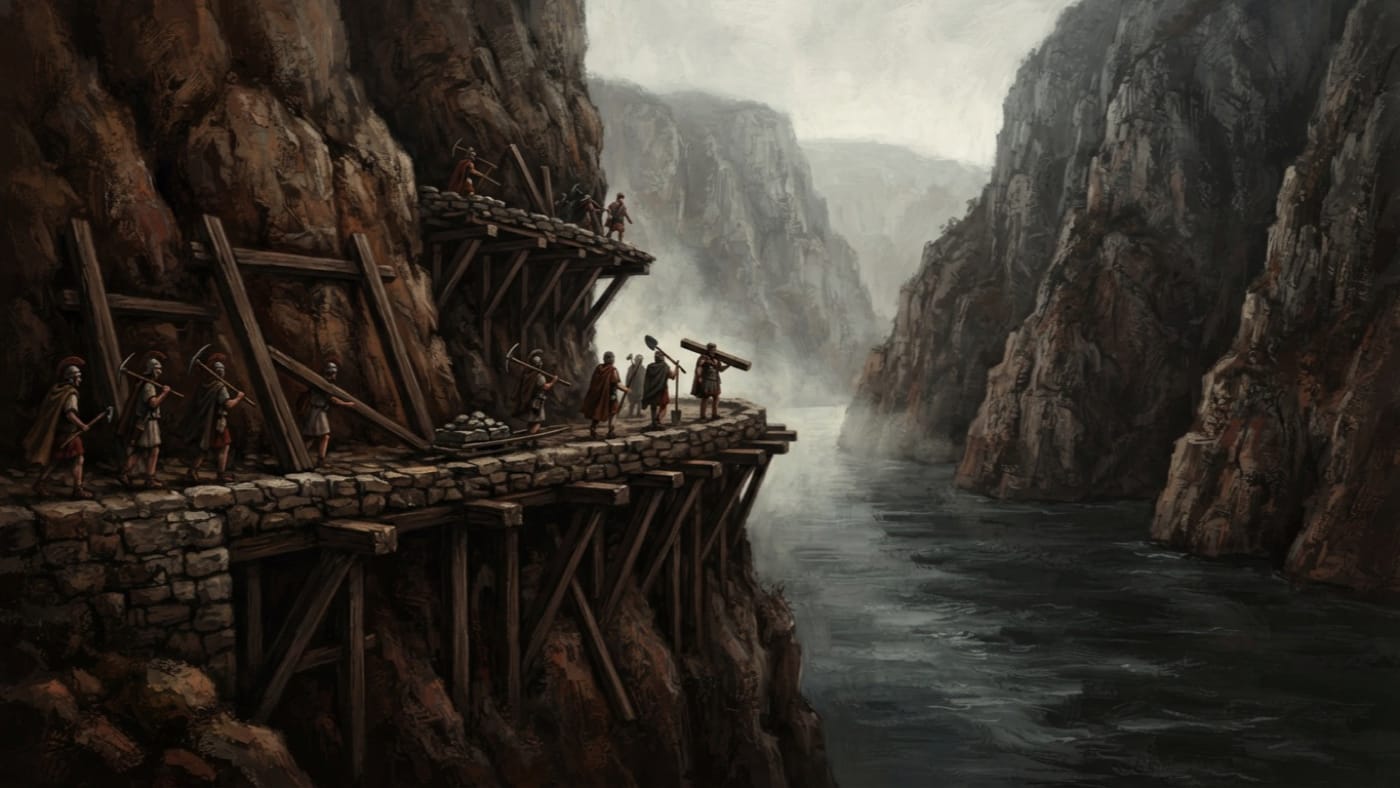
In the tightest reaches of the gorge the cliffs drop so steeply to the water that there is no room for a towpath, a wagon track or a marching column. The Romans did not accept this. Their builders began under the emperor Tiberius, in the years 33 and 34 of the old reckoning. That is A.S. −1677 and −1676, if the reader insists on running our calendar backward across seventeen centuries, which the calendar permits and which I find faintly vulgar. They cut a route into the face of the rock. Where the stone would not give enough width, they carried the way out over the river on timber supports. Men walked a ledge that was half quarried and half carpentered, with the Danube running beneath them at the speed of a grievance.
The road served the whole frontier: the forts along the river and the roads that linked them. In the gorge the military posts were small, because the gorge has no room for anything large. Some stretches were used to haul boats upstream. Men and animals worked the ledge, ropes ran down to the hulls, and the cargo crept against the current a few yards at a time. The empire moved by water where it could, and where the water would not carry it, it dragged.
The work took generations. The hardest section was finished under Trajan in the year 100 of the old reckoning, as he prepared his campaign against the Dacians across the river. A tablet was cut into the cliff to announce the completion and the emperor's titles, at length, because emperors cannot be brief on stone. The reader will not confuse 100 CE, the year of Trajan's road, with A.S. 100, which is 1810 and the year of the later Council of Cologne. I make no claim about whether the tablet survives above the present river. I have not seen it, and I do not certify what I have not seen.
I will say this for the Romans once. Any army can occupy a height. A height is a place to sit and look important. The builders at the Iron Gates did the harder and humbler work: they made the approach usable, and taught a passage that defeated transport to carry freight. That is engineering. It is also a kind of obedience to the nature of a place, and I have known bishops who were less obedient.
What I resent is everything that came after. For centuries scholars have taken the account book of a road crew and bound it in purple. Beams and chisels did the work, the emperor's name went on the tablet, and every government since has wanted that name on its own letterhead.
#On What Remained
"Stone does not care who signs for it."
Roman masonry survives in our setting, and the Codex must say exactly where. At the Carpathian Gates the fortifications lie in layers. Roman stones are worn down by medieval shrines, ossuary bastions are mortared with plague-bones, and the concrete and reliquary chain of the present age sit on top. That describes the Carpathian Gates. It describes no chamber, foundation or tunnel-mouth at the Irongate. A reader who carries those stones south to the gorge for a tidier story will find the cartographers waiting with a correction slip.
The layers teach a distinction the Church has every reason to keep sharp. A material advantage can be inherited. A wall still stands, a cut course still takes a load, and an old road still follows the only practical line through the rock, because the rock has not changed its opinions. A later garrison may use all of this and owe the dead builders nothing more than a nod.
Authority is another matter. It cannot be dug out of a hillside, and it does not pass with the masonry. A man who buys an old house does not inherit the previous owner's title.
It is my own reading, offered as such, that every government which finds old stones on its land is tempted to find an old crown among them. Few resist. The Romans themselves liked to dress their innovations as ancestral custom, and they had a fondness for the trick that I recognise professionally and cannot quite condemn.
#On the New Rome
"The Rome That Did Not Fall."
Strasbourg is called the New Rome, and its propagandists go further and call it the Rome That Did Not Fall. I have used both phrases in print and will use them again. They are good phrases. They describe a capital that roads lead to, that decrees come from, and where the business of a continent is written down and stamped. But they describe a resemblance, and neither one is a deed of succession. No canonist who wants to keep his post will tell you that the Synod holds its authority because Trajan once held his.
The Synod's title comes through a different chain. The hidden Church came into public view after the Sundering of A.S. 45. Provisional councils governed through the war years. The Common Allegiance of A.S. 55 put a common obedience into writing. The Concordat of A.S. 90 formally constituted the Synod at Strasbourg. That is the title. It is recorded, sealed and argued over in the proper places, and no link in it runs through the Roman senate.
Rome itself, the actual city, is something else again. It is the Old Chair: an Italian patrimony administered by the Synod and a restricted site of ecclesiastical memory, watched by observers from Doctrine, Records and half a dozen other offices. Its old papal apparatus was stripped during the Atheist Wars, and the Allegiance and the Concordat superseded its political claims. Its custodians keep the Roman roads and gates under supervision, as one keeps any old thing that pilgrims touch too much. The ancient empire, the later Chair and the present Synod are three separate things. I leave the papalist nostalgics who blur them to the Bureau of Doctrine, which has the patience for it.
#On the Gorge Afterward
"Same river. Different sin."
Seventeen centuries after Tiberius's road crews, the gorge had the same shape and a new enemy. Around A.S. 65 to 68 the Line hardened from desperate entrenchments into a frontier that could be defended, though it was not yet complete. Its builders came to the Iron Gates for the same reason the Romans had: here a small force could deny the river to a large one. The southern cliff received its permanent garrison in A.S. 67, the northern cliff six months later, and the position was ratified in A.S. 72.
This Codex has described the builders who established the Irongate garrison in A.S. 67 as "the Synod's engineers."
They worked under the provisional authorities of the Church, more than twenty years before the Concordat of A.S. 90 formally constituted the Synod. The later Bureau titles attached to their memoranda were applied afterward, for filing. The memoranda have not objected.
The resemblance ends at the waterline. The Romans needed the gorge to carry cargo, and the garrison needs it to stop an army. The Romans built their ledge outward over the water. The Church bored inward into the cliffs, until after the Great Hush of A.S. 94 the tunnels needed a choir singing day and night to keep their seals from failing. No Roman ever had to sing to a gasket.
Morwen is the other difference. The Weeping Host, Sin-General of Envy, does not want the gorge as a passage. She attacks the garrison from inside, by wearing the faces of its own men. The empire's enemies came across the river, where a sentry could see them. Morwen's come through the mess queue, answering to the right names.
The Romans are therefore entered in the Codex as competent road-builders and as a warning in the matter of letterheads. Their road, wherever it now lies, may go on bearing whatever weight it can. Their file is closed.