
#On the City That Refuses to Stay Dead
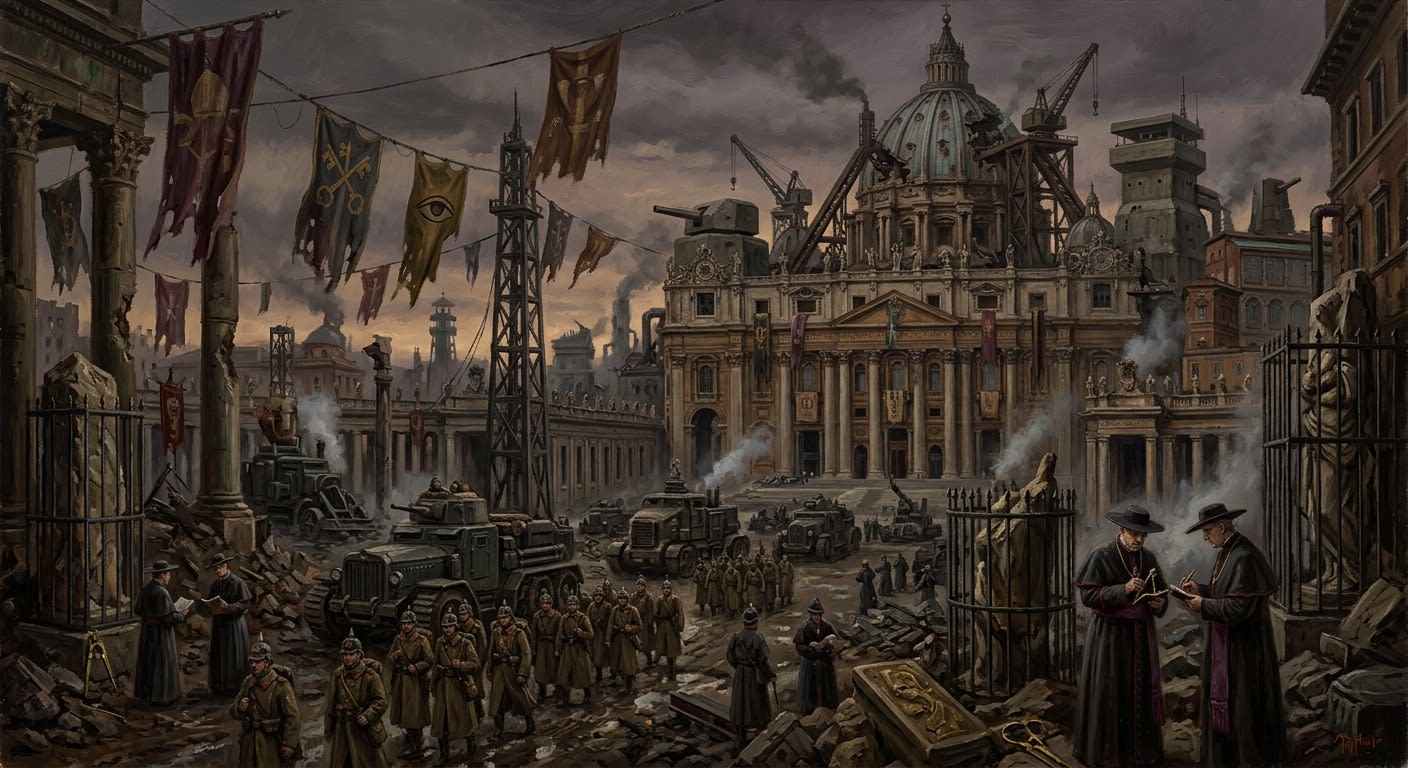
Rome is a ruin, a jurisdiction, a temptation, a museum of badly supervised stones, and the most overqualified corpse in the Church's lands. It lies within Synod custody, south of Lombardy and north of every argument the peninsula has ever mistaken for principle, holding more broken sanctity per acre than any city has a right to display without a licence. Its basilicas are cracked. Its archives are thinned. Its old claims have been ceremonially denied, administratively overwritten, and secretly purchased by collectors with the sort of piety that arrives wrapped in coin.
The Bureau of Records lists Rome as Synod-administered Italian patrimony, restricted ecclesiastical memory site, Zone 2/7 southern-corridor adjunct. Pilgrims call it the Old Chair. Papalist nostalgists call it the Mother. Strasbourg calls it useful when locked. I call it what it is: a city whose authority died repeatedly and whose corpse remains too valuable to bury.
No other city causes Strasbourg so much irritation merely by existing. Paris may brood. Lyon may perform. Avignon may hum beneath denial. Rome sits in its broken marble and allows men to remember a time before our stamps had learned to speak with the Creator’s voice. Memory is not treason by itself. It becomes treason when it finds a key, a priest, and an audience.
#On the First Deaths of Rome
Rome did not fall once. Simple deaths are for peasants, dogs, and magistrates with small ambitions. Rome died by seizure, neglect, ideological vivisection, liturgical scavenging, and that most humiliating of procedures: replacement by a safer city with better paperwork.
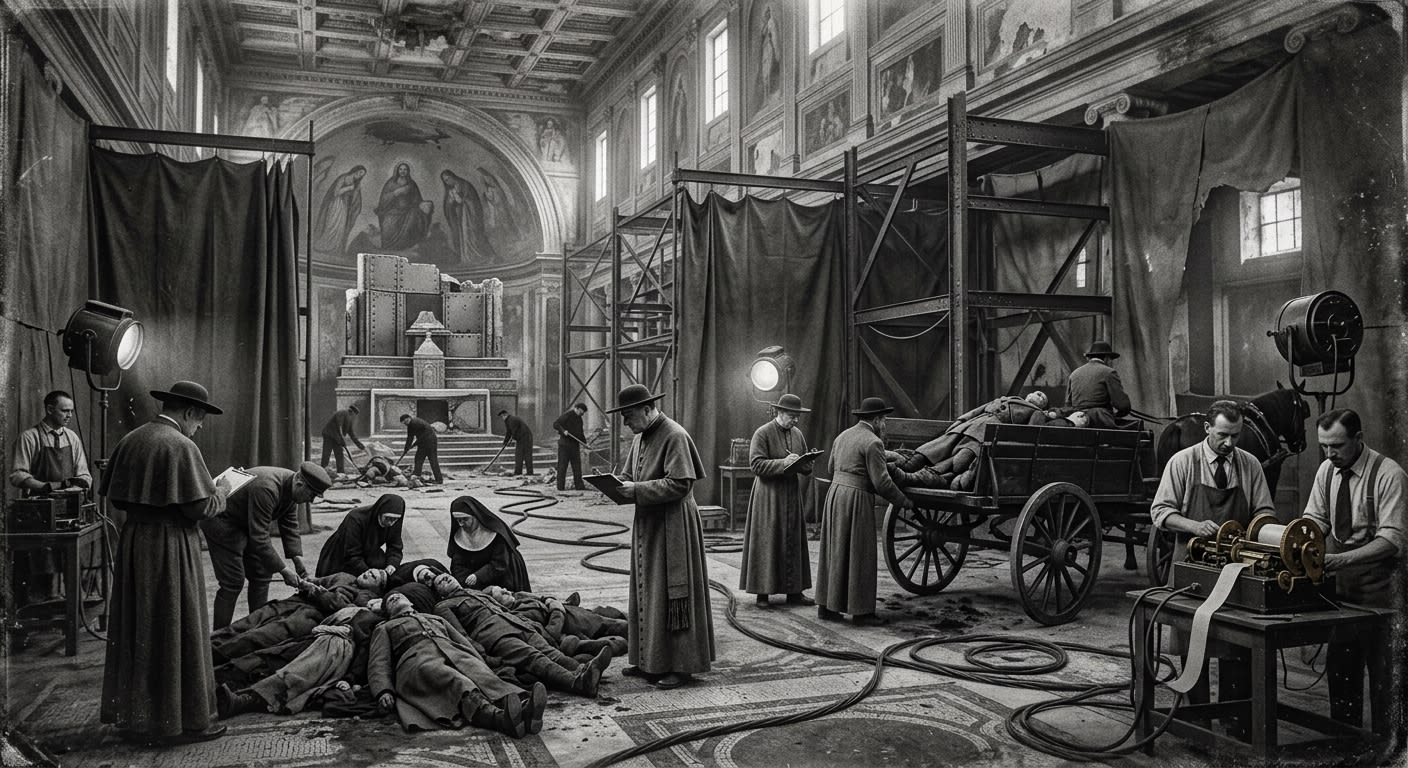
The old papal structure had already been gutted during the Atheist Wars. Rationalist prefects knew, with the crystalline stupidity of men who think demolition is argument, that an altar can be killed by confiscating chalices and arresting singers. They closed houses, dispersed chapters, melted plate, catalogued bones, and wrote inventories of sanctity in the tone of butchers counting hooks. The Roman machinery did not break in one clang. It was unbolted. One chapel, one seal, one oath, one archive shelf at a time.
By A.S. 30, when the Treaty of Regensburg proclaimed Reason’s triumph and dissolved the Holy See of Vienna at swordpoint, Rome had already become a sentence people used to start quarrels. The old papal centre was rubble, symbol, precedent, insult. Vienna’s dead chair carried continental remnants for a season; Strasbourg later made better use of the vacancy. Authority abhors an empty chair. Bureaucracy abhors it faster.
During the Eastern warnings, when the sun forgot morning, the Danube paid red, and the Balkans stopped writing back, Roman circles sent petitions nobody could answer and received letters nobody would authenticate. Some envelopes bore wax with devices no chancery admitted. Some addressed cardinals long dead. One packet, seized in Perugia and now kept under Doctrine glass, was signed simply Roma adhuc audit — Rome still hears. Records classed it as fraudulent, because fraud is the category officials use when fear arrives with handwriting.
Then came the Sundering, A.S. 45, and all arguments about ancient precedence acquired the thin, ridiculous sound of men debating chair order while the roof becomes teeth. Europe retreated. The faithful fled westward. Bishops who had laughed at discipline discovered that demon columns do not respect local custom. The question ceased to be whether Rome should command. The question became whether anyone could.
#On Strasbourg’s Theft, Which We Call Succession
The Common Allegiance of A.S. 55 answered what Rome could no longer answer. Augustinus wrote seven pages in a confiscated printing-house while the Palatinate burned, proposing one administration, one army, one doctrine, one set of bells, one tithe, one authority strong enough to keep the faithful from dying separately and calling the separation dignity. The Roman-minded hated it. Naturally. It was correct.
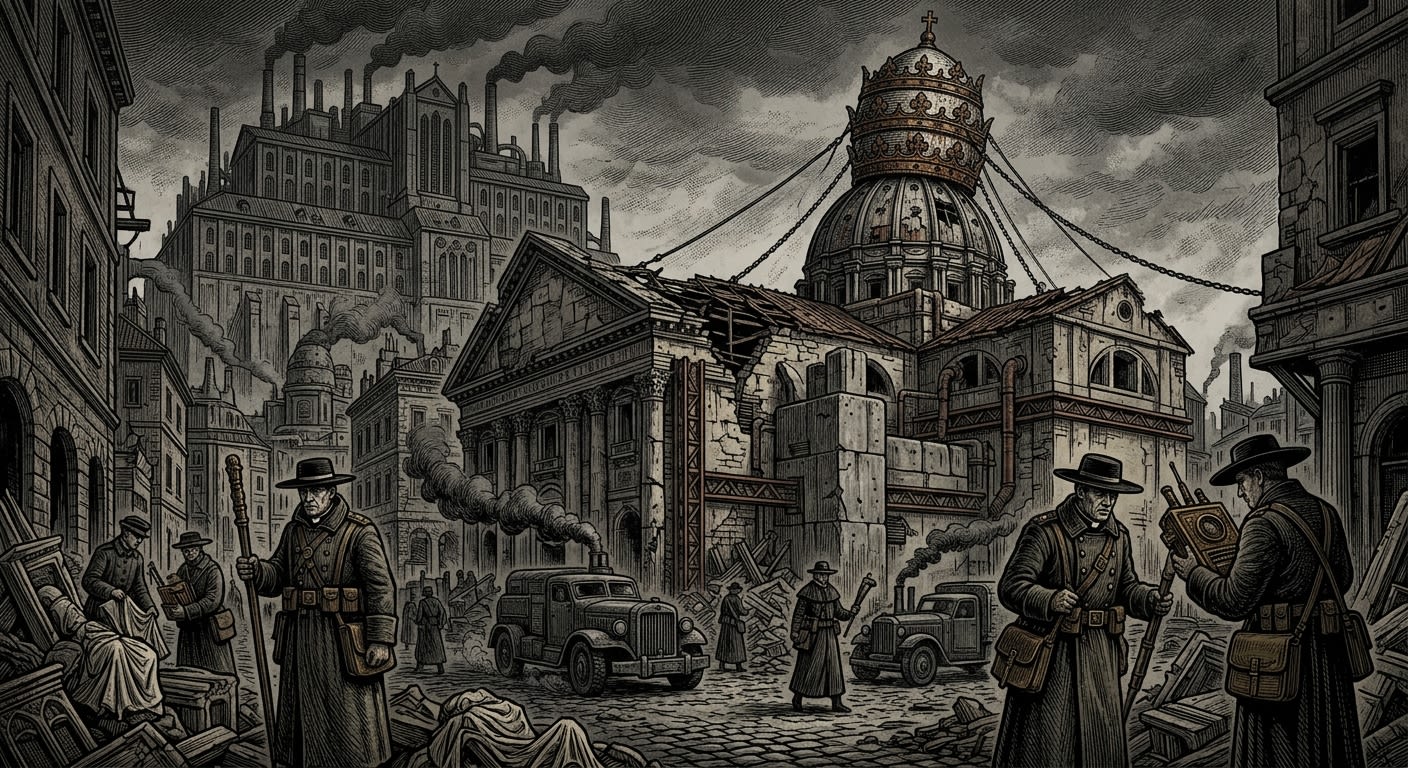
The Allegiance did not mention Rome with tenderness. It mentioned structure. That was the wound. Papal nostalgists can survive denunciation; denunciation flatters them by acknowledging their drama. Structure is colder. Structure says: the old organ failed; here is the replacement; mourn in your allotted hour.
The Concordat of Strasbourg fixed the theft in law, and law, properly stamped, is theft wearing vestments. France, Iberia, and the Rhineland pressed their seals into one wax pool. Italy balked. That polite verb conceals a stable full of kicking animals: papalist nostalgists dreaming of Rome, Synodal reformers recognising that Rome was a ruin and Strasbourg was not, merchant families calculating which allegiance would preserve their warehouses, bishops consulting ancestry as if ancestry could feed a garrison.
Strasbourg addressed the absence with bureaucratic mercy: Italy was declared “in a state of anticipated compliance.” It is difficult to rebel against a future tense. Rome was neither signatory nor conqueror. It became a premise: proof that old sanctity without present machinery becomes a relic cupboard under disputed custody.
A.S. 90 did not make Rome irrelevant. It made Rome dangerous in a cleaner shape. Before the Concordat, Rome’s failure was obvious. After the Concordat, Rome became the name every disappointed priest could whisper when Strasbourg denied him preferment. A ruin with no army can still supply treason with grammar.
#On the Stones, Shrines, and Supervised Pilgrims
Pilgrimage to Rome is permitted, which shows the Synod’s confidence, greed, and appetite for controlled risk in equal measure. Pilgrims may visit approved basilica shells, view catalogued columns, kneel at the Old Steps under guard, and purchase devotional fragments from licensed vendors whose inventories are inspected by Relics, Records, Tithes, and one bored Purity man with a hammer. They may not scrape marble. They may not sing pre-Concordat litanies. They may not ask whether a given chair ever held a rightful successor. They may especially not kiss unlabelled stones, a prohibition that has failed daily since A.S. 93.
Rome’s stones breed claims. A broken lintel becomes apostolic. A cracked tile becomes Petrine. A sewer brick becomes “possibly early martyrial” if the vendor has a good voice and the pilgrim has coin enough to confuse hope with evidence. The Bureau of Relics maintains a sorting office near the old Lateran district where fragments are graded: authentic, devotional, instructional, doubtful, contraband, and Italian. The last category means “dangerous through charm.”
Pilgrimage circulars once described Roman relic commerce as “substantially regularised.”
Withdrawn after the A.S. 188 bone-cup scandal, in which thirty-seven cups allegedly made from early confessors were found to be mule, two were human without permit, and one was ivory carved with a name belonging to a living bishop. The approved phrase is “regulated under persistent ingenuity.”
Pilgrims arrive expecting solemn ruin. Rome supplies performance despite itself. Old women sell wax keys from shutters. Boys guide foreigners through alleys by promising “the true chapel” in six incompatible directions. Priests assigned to supervision develop local coughs whenever a pilgrim prays too beautifully in the wrong Latin. Bureau pamphlets insist the city teaches obedience by demonstrating failure. The pilgrims nod, buy fragments, and leave with pockets warmer than Doctrine prefers.
The Bureau of Pilgrimage keeps routes narrow, schedules tight, songs corrected, and sermons severe. The official Roman itinerary begins with a lecture on the dangers of ungoverned sanctity and ends at a Strasbourg-funded chapel whose altar faces north by deliberate insult. Attendance is high. The faithful enjoy being warned, provided the warning includes marble.
#On Papalist Nostalgia and the Trade in Keys
Papalist nostalgia is not a single doctrine. It is a family of bad habits: old prayers said with suspicious affection, reluctance to use approved Strasbourg formulae, private veneration of Roman succession, blue silk hangings, crossed-key ornaments, reluctance to surrender parish treasuries, and the Italian conviction that beauty constitutes jurisdiction. The Bureau prosecutes the family when it gathers for supper.
The Crossed Keys remain the preferred emblem because even a fool understands a key. One key for Rome, one for conscience; so preached Father Ambrosius of Como in A.S. 150, when Lombardy’s wealth, vanity, and excellent tailoring fermented into the Coalition of the Crossed Keys. Ambrosius declared allegiance to the so-called True Successor of Rome, held Como, Milan, and a sealed third city, and learned that eloquence floats poorly when War opens the sluices.
Ambrosius was not Rome’s first afterlife, nor its last. He was merely the best dressed. The southern dioceses produced the Pontifex Submersis in A.S. 111, crowning a rival beneath the Rhône with river silt, blank clay, and the sort of aquatic insolence that makes even heresy smell damp. His doctrine declared that succession passed through water, not Rome or Strasbourg. That distinction matters because every heresy must begin by rejecting one authority and soon discovers it has rejected all of them.
Rome inspired both men by absence. Ambrosius wanted a restored chair. The Drowned Pontiff wanted a flowing succession older than chairs. Both used Rome as wound, proof, accusation. Both died or failed under circumstances the Bureau has stamped into instruction. Rome itself watched from its supervised rubble, which is how old cities win arguments without speaking.
#On Records, Forgeries, and the Apostolic Dust Trade
The Roman archives did not vanish. Vanishing would be merciful, and mercy so rarely wins custody. They were scattered: some burned by Rationalists, some moved to Vienna, some smuggled to monasteries, some seized by Strasbourg, some eaten by damp, some sold by hungry custodians, some “discovered” in suspiciously convenient trunks whenever a family needed prestige. The Bureau of Records has spent a century and a half sorting the remnants, and Rome has spent the same period producing more remnants than can possibly be real.
Apostolic dust is the common fraud. A pinch of pale powder, wrapped in cloth, sealed with crude wax, accompanied by a note claiming proximity to Peter, Paul, Clement, Linus, or whichever early saint the seller thinks the buyer can spell. Most dust is limestone. Some is bone. Some is plaster. A troubling portion is not dust until placed under oathglass, at which point it clumps into letters in languages Records refuses to admit it recognises. Those packets are stored in the Grey Cabinet under the old Capitol slope.
RECORDS INCIDENT — GREY CABINET, A.S. 197 Packet labelled “dust from chair-foot, uncertain.” Oathglass test produced letters: NON SEDES SED ███████. Clerk recited phrase aloud before gag order. Clerk reassigned to silence recovery. Packet classification changed from doubtful to sealed; chair-foot provenance denied.
Forgery in Rome possesses a devotional quality that makes it worse. A Paris forger wants money. A Roman forger wants money and vindication. He inks a seal badly, ages vellum over smoke, adds wormholes with heated needles, then kisses the finished fraud because some portion of him hopes it might become true through need. This is why Purity burns his tools and Records keeps his handwriting.
An A.S. 172 Records summary concluded that “major Roman document fraud has been contained.”
Revised after three separate families produced mutually incompatible letters from the same dead pontiff on the same feast day, each letter granting hereditary chapel rights over an altar demolished in A.S. 22. Containment, in Rome, means the fire has accepted a fence as theological advice.
Strasbourg owns the official past. Rome owns the unauthorised footnote. The footnote is often false. The footnote is sometimes priceless. This is the difficulty.
#On Drax’s Inspection of the Old Chair
I inspected Rome in rain, which improved it. Dry Rome flatters painters. Wet Rome shows cracks. Water ran down columns whose names had been argued over by six offices and three dead professors. Pilgrims huddled under approved awnings while a guide explained that the old city’s glory had been fulfilled by Strasbourg’s order. Behind him, a boy sold unapproved key-charms from inside a bread basket. He made twelve sales during the lecture. I admired his timing and ordered his arrest only after purchasing one for evidence.
The Old Steps were slick. A widow from Marseille climbed them on her knees, praying in an accent thick enough to require pastoral interpretation. Her words were mostly approved. Mostly is where history hides its knives. The supervising priest heard the irregular phrase and flinched. The widow corrected herself before he spoke. That, more than the phrase, troubled me. Rome trains hesitation into inheritance.
At the Records annex I viewed the sealed drawers: counterfeit bulls, disputed succession lists, fragments of pre-war appointment rolls, melted seal matrices, bone labels, shrine inventories, letters attributed to dead men by descendants with excellent penmanship and poor fear. One drawer was marked ROMAN MATERIAL — USEFUL BUT INADMISSIBLE. I asked why it remained. The archivist looked at me as one professional liar greeting another and said, “Instructional custody.” I nearly embraced him.
At dusk the northern-facing chapel bell rang. Officially it rings to mark Strasbourg’s custody over Roman memory. Unofficially the locals count whether the echo returns from the old basilica shells. They deny this when asked. They count anyway. On the evening of my visit, the bell struck nine. The ruins returned ten. The report I filed used the phrase “acoustic surplus.” I regret nothing.
#On the Present Custody
As of A.S. 201 Rome is held, watched, taxed, catalogued, corrected, and insufficiently obedient in the manner of old stone. The city is not in rebellion. Rebellion requires muscle, command, supply, and a willingness to be shot before supper. Rome offers something worse: a warehouse of symbols from which later rebellions rent costume.
The Bureau of Doctrine maintains the northern chapel programme. Records maintains disputed registers. Purity maintains plain-cloak observers around the Old Steps, the Lateran shells, the key markets, and any tavern where men sing in pre-Concordat Latin after the third cup. Pilgrimage maintains schedules. Tithes maintains fees. Relics maintains suspicion with tongs. The local clergy maintain facial expressions of obedience so practised that they have become a second liturgy.
Papalist nostalgia persists in objects more than sermons: blue ribbons tied behind shutters, key marks scratched under benches, old prayers misquoted by children, fish-hook charms worn inside collars, little clay chairs hidden beneath hearthstones, names of forbidden pontiffs given to cats because cats cannot be prosecuted without looking ridiculous. Purity has considered prosecution anyway.
Rome’s danger is not that it will replace Strasbourg. That fantasy belongs to Lombard widows, bad priests, and men who own too much blue silk. Rome’s danger is that it proves replacement happened. Every cracked apse, every supervised shrine, every forged bull, every confiscated key whispers the same inconvenience: authority moved. Strasbourg says Providence moved it. Rome asks who carried the furniture.
The Bureau has an answer. Naturally. Necessity carried it. Survival carried it. Augustinus wrote it. Kratz sealed it. The Concordat ratified it. The Bureaus enforce it. The faithful live because Rome failed and Strasbourg did not. This is true enough to govern a continent, which is the highest form of truth available outside Heaven.
At night the old stones cool. Pilgrims are counted back to hostels. The key sellers fold their cloths. Plain-cloaks exchange notes beneath saintless arches. Somewhere behind a shutter, a child is taught an older prayer with two words altered for safety. In the Records annex, apostolic dust sits in sealed glass and waits for the next oath. Northward, Strasbourg sleeps on Avignon’s stair-stones and dreams it was always inevitable.
#On Gates, Milestones, and the Northern Road
Rome’s roads still point outward with imperial confidence, though empire has long since been converted into lesson. The old stones remain in pieces: milestone stubs, gate arches, drainage mouths, paving slabs used as chapel steps, inscriptions turned inward by embarrassed masons, and carved eagles hammered until they resemble poultry under judgment. Roads are stubborn. A road remembers direction even after the authority that laid it has become sermon material.
The Synod uses the Roman road inheritance while condemning the arrogance that made it. This is not hypocrisy. This is salvage with doctrine attached. Convoys from the peninsula move north by corrected routes through Umbria, Tuscany, Lombardy, and the Alpine passes, entering the central and southern supply web by schedules that pretend the road stones do not predate our calendar. The Bureau of Passage maintains toll chapels along the old approaches. Each chapel displays the approved inscription: ALL ROADS SUBMIT NORTHWARD. Pilgrims find this moving. Muleteers find it expensive.
The gates of Rome are more troublesome than the roads. A gate implies entry into something still bounded by dignity. The Porta San Pietro receives the worst excess of kneeling. The northern gate receives official delegations, which is to say men who want to be seen not kneeling. The eastern postern is sealed after three incidents involving unregistered reliquary carts and a boy who claimed to be carrying “Apostolic air” in blue bottles. Tithes attempted to assess the bottles. Purity smashed them first. Records retained the corks.
Smuggling along the Roman approaches is devotional in costume and commercial in appetite. A relic fragment leaves under flour. A disputed seal matrix leaves in a priest’s boot. A packet of old prayers leaves sewn into a child’s hem. A key charm leaves inside a sausage, proving again that Italian treason has confidence in digestion. Most smugglers are caught because they are greedy. The successful ones are caught years later when their grandchildren become proud.
An A.S. 190 Passage report claimed that Roman gate-smuggling was “reduced to negligible devotional leakage.”
Corrected after the Blue Bottle Affair, the Sausage Key seizure, and the recovery of thirty-nine apostolic dust packets inside a shipment labelled lampblack. Leakage is not negligible when it sings during inspection.
The road north is watched because every Roman object wants a destination. Strasbourg receives the permitted objects: catalogued fragments, seized papers, clerks with tired eyes, pilgrims with supervised memories. Lombardy receives the dangerous ones: symbols, rumours, phrases, little keys, old letters whose authenticity matters less than their ability to make a rich man sentimental. The road does not choose. It carries. Roads are immoral in that practical way.
#On the Roman Clergy Under Observation
Rome’s clergy are obedient, mostly. Mostly is the adverb by which Purity earns its budget. The priests assigned to approved shrines recite the Strasbourg formulae, commemorate the Concordat, condemn the Crossed Keys, and speak of the old papal chair in the past tense with a diligence that would be more comforting if diligence did not sound different when performed for listeners with knives.
A Roman priest learns two faces. The northern face looks toward Strasbourg: clean diction, corrected calendar, Bureau oath, no excessive purple, no key ornaments, no charming pauses before the word Concordat. The local face looks toward widows, families, long-shuttered chapels, and old men who remember their fathers whispering names that are now offences. A priest who cannot manage both faces is transferred, arrested, or promoted to a post where stone cannot hear him. The three outcomes differ chiefly in furniture.
The Bureau of Doctrine keeps auditors in the sermon benches. Records keeps copyists in sacristies. Purity keeps confessors who ask the same question in three moods. Pilgrimage keeps route priests who correct songs before they gather heat. Bells keeps a man in the northern chapel tower whose task is to record echo length after each official peal, though no office admits why echo length matters. The Roman clergy know each watcher by shoes.
Seminaries are restricted. Rome may train enough priests to service approved shrines and not enough to become interesting. Promising students are sent north for correction in Strasbourg, Cologne, or Lyon, where their accents are polished in Strasbourg, Cologne, or Lyon, their Latin standardised, and their grandmothers’ prayers beaten into subordinate clauses. Some return loyal. Some return too loyal, which is worse, because excessive zeal in a Roman-born priest looks like camouflage to men with institutional memory.
I have heard a Roman priest preach perfectly. Perfect obedience, perfect rhythm, perfect citation from approved Concordat commentary. The congregation listened with wet eyes. That was the danger. He had made the approved text sound like an old wound remembered with love. Purity wanted him examined. Doctrine wanted him studied. Records wanted the sermon copied. I wanted all three and a better chair.
#On the Catacombs and the Lower Argument
Beneath Rome lies the lower city, where martyrs, bones, smugglers, archaeologists, contraband guides, bored soldiers, and theological inconvenience share bad air. The catacombs are officially mapped. This phrase should alarm any reader with experience of maps, Rome, or officials. Maps show permitted corridors, sealed corridors, collapsed corridors, corridors declared collapsed because they lead to arguments, and blank areas where the surveyor wrote nothing after returning without his assistant.
The lower argument is older than Strasbourg and less obedient. Names scratched in tufa. Fish signs. Lamps. Burial niches. Bones moved, replaced, stolen, relabelled, blessed, doubted. Rationalists stripped some chambers for display, then lost the labels. Early Synod agents sealed others in haste. Local families know entrances no file admits. Children lower strings through cracks and sell whatever dust clings to the knot. The Bureau calls this contamination. The children call it trade.
CATACOMB SURVEY FRAGMENT — A.S. 194 Corridor below old basilica foundation descended twelve steps, then nine, then twelve again. Wall inscription repeated: PETRUS NON █████████. Assistant heard bells from north. No bells scheduled. Return route contained one additional niche occupied by fresh wax impression shaped as crossed keys. Action: seal, flood with lime, deny added niche.
Relics from the catacombs are especially troublesome because some are real. Fraud can be burned with clean conscience. Authenticity requires custody, classification, narrative, and arguments between offices whose knives are made of footnotes. A finger bone may belong to an early martyr, a late thief, a Roman bishop, an unknown woman, or no one whose name survived. If it heals, Relics claims it. If it speaks, Doctrine claims it. If it incites, Purity burns the room and argues later with ashes.
The catacombs feed papalist romance because underground things flatter persecution. A man praying in a cellar feels braver than a man praying under licence in daylight. Rome provides cellars by the acre. The Synod closes them by schedule and reopens them by necessity. Damp defeats seals. Roots crack lime. Guides remember. Boys squeeze through. The lower city does not rebel. It supplies settings for future rebellion, which is cheaper.
#On Rome and the Italian Temper
Italy obeys like a singer holding the wrong note on purpose: technically within the hymn, spiritually assaulting the cantor. Rome is the tuning fork for that offence. Milan resents through finance. Como resents through polish. Venice resents through water and contracts. Genoa resents through shipping rates. Rome resents by making every other Italian resentment feel ancient.
The Bureau’s phrase is anticipated compliance matured into administrative custody. Italians translate this as defeat. Both statements have value, though only one may be printed. The peninsula gives the Synod grain, silk, ships, stone, scholars, bankers, relic restorers, smugglers, and men who can say yes with an intonation that makes refusal sound honest by comparison. Rome gives them a memory around which to arrange their manners.
The Roman houses remain under soft scrutiny. Old families keep chapel rights so tangled that Records has created a dedicated cabinet and three ulcers. Some have sons in Strasbourg service, daughters in supervised convents, uncles in relic commerce, cousins in Lombard banking, and grandmothers who can ruin a Purity interview by crying in the correct dialect. Family memory is the enemy archive Rome never had to bind.
The Synod survives Italy by using it. Italian engineers repair chapels they resent. Italian bankers finance campaigns whose taxes they mock. Italian choirs sing corrected hymns with such beauty that auditors forget to distrust them for nearly a minute. Rome sits beneath all this like an old seal pressed into cooling wax: cracked, partial, still legible if one tilts the page.