

#On the Guild in the Brest Record
The Rope-Guild enters the Codex through a strongbox. I hold no charter for it, no roll of members, no seal impression, no founding year, and no account of who sat at the head of its table. What survives is the Brest dossier, which this office surveyed in A.S. 201. In that dossier the guild appears three times. It appears in Master Havel Tor, recorded as treasurer of the uprising at Bastion-Brest. It appears in a strike fund carried out of a bonded warehouse under seal. It appears last in the "Rope-Guild intermediaries" entered among fourteen names on a custody chain bound for a road court north of Warsaw.
That is the whole corporate body as the record presents it: a treasurer, a box and some go-betweens. Guilds across the Theocracy trade under Synodal charter, and this one must once have held papers, because nothing on the Bug moves a bale without them. Those papers are not in my keeping. I will not draft them from imagination and then cite myself.
Whether the guild still meets, still collects dues, or still exists in any form, the survey cannot say. I file it as I found it, on the losing side of a property hearing.
#On the Common Fund
The rebel treasury occupied three bonded warehouses beneath the riverward viaduct, and stevedores guarded it. The court's inventory lists coin kegs, promissory sacks, grain warrants, private tallies, militia-pay ledgers, three foreign bills and one strongbox holding the Rope-Guild's strike fund.
Clerks who summarize this list as "the guild's treasury" commit an error of property, and in my office errors of property are the only kind that get punished promptly. The record attaches the guild's name to one object in that inventory. The kegs, sacks, warrants, tallies and bills belonged to the uprising at large, or to persons the file declines to name. The warehouses were bonded, so their title already sat in the levy books before any rebel shouldered a door. Tor kept the mixed pile as the uprising's treasurer. The strongbox belonged to the guild. None of it was his own purse.
A strike fund is a plain instrument. Men pay into it while they are working so that they can afford to stop. The dossier gives no dues, no contributors and no total. I can say what such a box meant at Brest, where wages arrive as ration chits and toll arrears bind a man to the decking for years. A dock gang had no lender but itself, and the common box was the only credit it could extend to its own members. Beside the grain warrants it made a rough commissariat, with coin to keep idle men paid and warrants to keep them fed. That reading is mine. The court never set it down.
#On the Dock Grievances
The recorded causes are hunger, disputed ledgers and unpaid dock gangs. A ledger becomes disputed when two parties keep it and only one is permitted to read it aloud. On a bridge that taxes every crossing in coin and chits, a man left unpaid has also been left unable to pay what he already owes. The dockside knows that arithmetic by heart.
Nothing else of the guild's case survives. No speech, manifesto, petition or list of demands reached the docket. When Tor stood to answer, he spoke of hunger, of arrears and of the widows of the eastern cranes. The account preserves those three subjects as a bare list. Not one of his sentences survives with them.
The disturbance had many hands. Stevedores held the warehouses, crane gangs held their hooks, and dock gangs barricaded the salt stairs. Somebody stripped two Records clerks and smeared them with lampblack, and somebody fired a tithe cart at the eastern lock. The dossier never says which of these men paid into the strongbox. A port riot is no guild procession, and I decline to turn the whole quay into a membership roll so that one faction can be blamed for everything it held.
#On the Warehouse Hearing
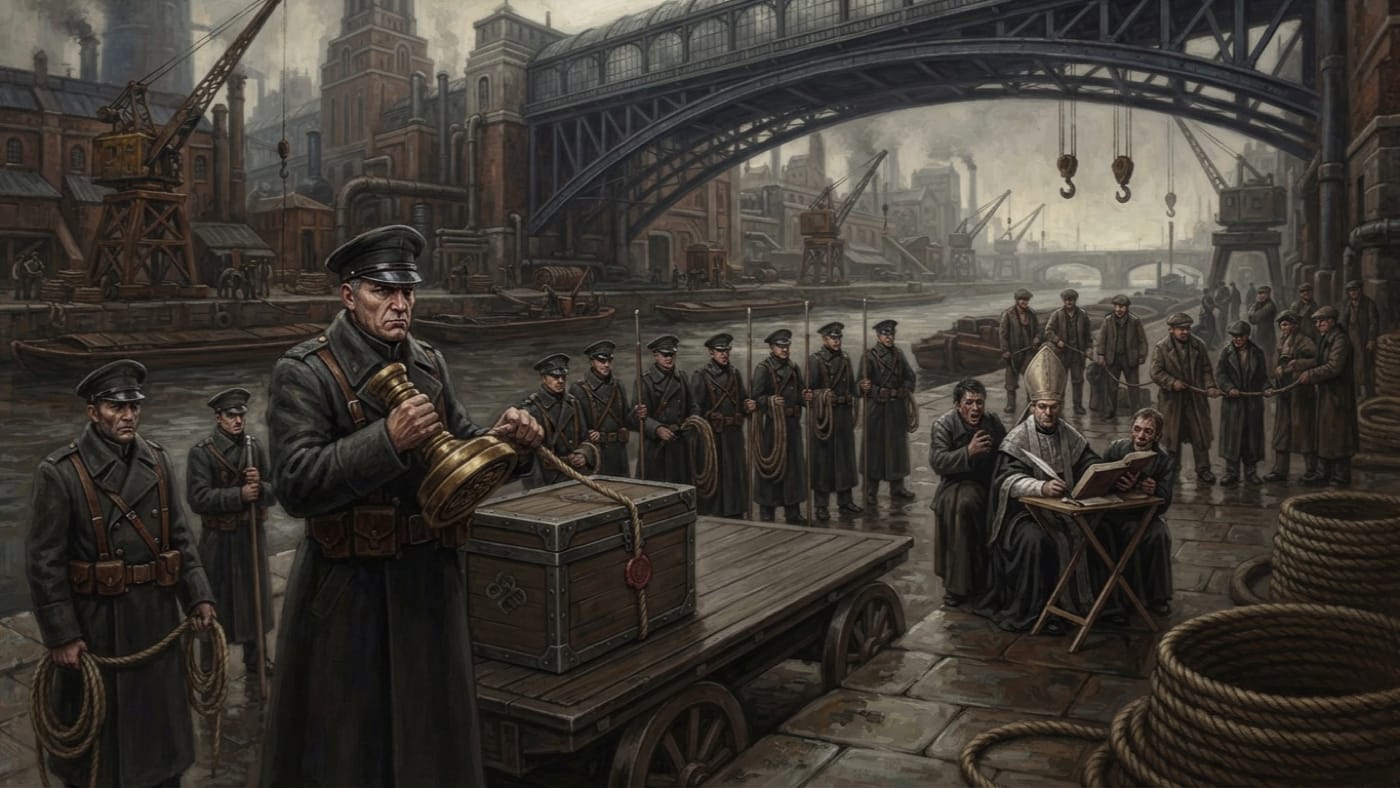
Bailiff-Captain Sable Rook arrived with a Judge, six Circuit Bailiffs, twelve Court Ropes, a seal chest and one hymn-chime. He chalked a court perimeter across the warehouse threshold. Then he announced that the court would decide who owned the bonded warehouses.
Tor's own men brought him forward. The record gives the act and withholds the motive, and I am content to leave it there.
The hearing ran one standard creed-hymn under the four marks of Judicial Circular 4.12, an instrument of the Hymn-Length Reforms of A.S. 141. At the opening, Rook read the seizure writ while the Judge held the seal above the ledger chest. In testimony, two dock accountants, one terrified and one bleeding, identified the treasury as illegally shielded from levy. At rebuttal, Tor reached the widows and got no further, because Rook rang the third mark. The ruling ordered seizure for arrears, conspiracy and obstruction of licensed movement. At the final chime the warehouses passed to the Synod.
Note the division of labour, which the academy blurs. The Judge's seal carried the authority, while Rook carried the clock and the writ. The bailiff's art governs time, bodies and seals, and it makes no claim to govern the truth. The court found the treasury shielded from levy on the testimony of two men under visible strain. That finding settles the warehouses. It does not settle whether the dock gangs were hungry, and the court never asked.
The guild was tried as property. The record holds no sentence against Tor and no judgment against the Rope-Guild by name. The strongbox stood in front of the court, so the court ruled on the strongbox.
#On Seizure and Surety
Rook had the doors opened under seal while the crowd still stood on the quay, and he made the clerks count aloud. I admire this as I admire a clean seal impression: entirely, and from a safe distance. Every item received a Court Rope's seizure tag and a witness mark. A thing tagged in public cannot afterwards be called looted, and a thing counted in a stranger's voice cannot afterwards be claimed as one's own.
The quay emptied in the order of the count. When the strongbox was carried out, the stevedores began leaving by the western alley. When the grain warrants were read, the crane gangs lowered their hooks. Then Tor's deputy, whom the record leaves unnamed, signed the acknowledgment under guard. A signature taken under guard proves the guard was there, and it proves no more than that. I read in it no betrayal, no bargain and no change of heart. It made the seizure legally complete.
Once the strongbox was gone, the guild had no fund. Men who had paid in against the day they stopped work now had nothing to draw on, and the warrants that might have fed them carried the Synod's name. The quay had not broken at rifles. It broke at receipts.
Academy lectures described the Brest seizure as "bloodless suppression."
Corrected: three men died at the salt stairs before the hearing convened. One clerk died two days later. Twenty-seven families lost ration credit under collective surety. These are three separate entries and are not to be added together.
The deaths at the salt stairs came before the court sat, and the file names neither the dead nor their killers. The record does not identify the clerk who died afterward as either of the clerks smeared with lampblack. The Bureau of Records cancelled the twenty-seven households' credit in a single ledger entry, without hearing any family on its own. Whether any of those households had paid into the guild's box, the dossier does not say. Some of them may have watched it carried away.
No decree dissolved the Rope-Guild. The record shows only that the guild was stripped of its fund, its members dispersed and its treasurer silenced at the mark. It never shows the guild abolished.
#On the Names Left in Custody
After Brest, fourteen names entered Rook's chain for transfer from the port circuit to the road court north of Warsaw. The list mixes treasury witnesses, two suspected courier-boys, a widow who had signed a warehouse tally in her husband's name, several men whose occupations are illegible, and the Rope-Guild's intermediaries. No clerk wrote down how many intermediaries there were, or what each had carried between whom.
The chain marks are clean at departure and clean at the first two halts. At the third halt, entries 4, 9 and 12 acquire brackets in a different ink. Eleven people answered at discharge. The record attaches no trade, no name and no guild to the three bracketed entries. Tor is not named among the fourteen, the eleven or the three, and readers who want to place him there may apply to Records for permission to be wrong in ink. The seizure survey notes that the docket lists no surviving witness to the transfer. That describes the docket. It does not tell us whether anyone died.
Of the Rope-Guild after the road court, I hold nothing at all: no new treasurer, no refilled box and no later appearance before any bench I can find.