

#On the House and Its Names
The friary stood on the left bank of the Rhône at Lyon, near enough to the water that its brothers kept their offices within earshot of the barge-poles. The Ledger mostly remembers it for how it ended, in the Red Slaughter of Lyon. It has spent far less ink on what the house was before the militia came up the bank. This entry corrects that.
Three names survive. None of them is fit to cut into a lintel. The Lyon register writes Saint Sabellian's House of the Lower Rule. A later Purity index writes Minor House of Saint Sabina. A fishmonger's deposition writes the brown brothers by the water, and of the three it is the only one that would get a stranger to the right door.
This entry carries the register form as its heading because the register is a document the Bureau can file, and the Bureau files under what it holds. I prefer the fishmonger's name. A Warden's preference does not authenticate a dedication. The register gives Saint Sabellian a house and nothing else: no vita, no feast, no bones. Lower Rule names no constitution found in any folio set before me. Minor in the index names no order, and brown wool names none either, since half the men on a Lyon quay went about in brown.
#On the Brothers' Work
Three works are recorded, and each of them was enough to get the house killed.
The brothers fed the paupers of the docks. These were the men the city counted by the shift and forgot by the evening: loaders, rope-haulers, widows who sorted the catch, and children too small to be paid. The record does not say how many came, what was served, or at what hour. It says they were fed. Under the Creator's law that is a full sentence, and I will not pad it.
The brothers copied penitential psalters by hand. The psalter of penitence is the book a sinner holds when he has run out of excuses. A house that copies it is putting the means of contrition into hands that could never have bought a bound one. No copy from this house has been presented to the Ledger. Nobody has proved that none survives. Both statements stand.
The brothers took in two priests driven out of Vienne by earlier anti-clerical riots. The record does not give their names. It does not say what became of them. It establishes that a house of poor men on a riverbank, knowing exactly what the clubs of the age thought of priests, opened its door to two of them anyway. Refuge is the oldest work of the Church, and the cost of it was perfectly visible.
Bread, psalter, and refuge feed the body, the conscience, and the hunted. Those three works make up the whole of what the record lets us say about the brothers. They are also the whole of the charge laid against them.
#On the Municipal Accusation
Lyon's Republican clubs had a vocabulary, and they used it the way a bailiff uses an inventory. Superstition covered the psalters. Clerical hoarding covered a refectory that fed people the clubs had no plans to feed. Fraud covered any priest from Vienne who went on being a priest. Civic hygiene covered the whole house, the way a clerk's hand covers a ledger page he does not want read.
The men who carried out the sentence were Lyonnais Republican militias wearing municipal colours and carrying civic warrants. They were local. They knew the bank, the bells, and probably the soup. The Rationalists would later polish the same four words into instruction, which is why the Bureau files this house among the precursors. That kinship is one of ideas. No chain of command has been established. In 1671 there was no formal Republic, since the Treaty of Regensburg was still sixty-nine years off. There were no Republican Guards under a continental banner. There was a city council, a set of warrants, and a riverside house it wanted gone.
Parish chroniclers like a distant villain because a distant villain spares the parish. The record allows Lyon no such comfort.
#On the Destruction
The house was destroyed in A.S. −39, 1671 by the old reckoning. That was seven years before the Year of Letters and forty-nine before the Massacre at Saint-Malo publicly opened the Atheist Wars. The Bureau of Doctrine later classed Lyon as first escalatory blood. That is Doctrine's ruling on its own ledger. Nobody has proved Lyon was the first such atrocity anywhere in Europe.
The full atrocity belongs to the parent entry, and the reader should look for it there. This house file keeps only what the house file needs.
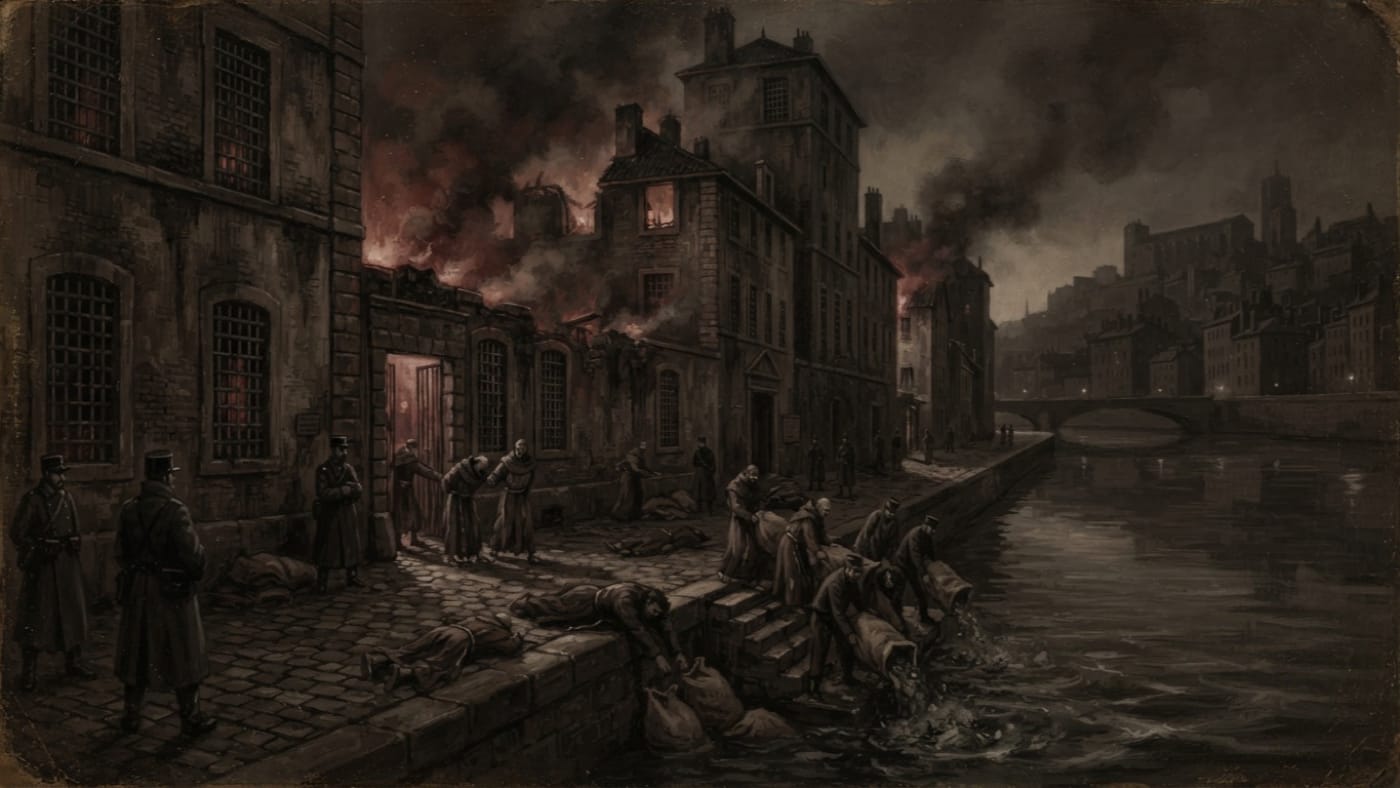
According to the detailed event file, the militia came in after Compline. Forty-three friars were beaten, bound, and burned in the lower refectory. Four lay brothers were shot at the postern. That is forty-seven recorded dead, killed in two groups by two methods, and a clerk who writes "forty-seven burned" has signed a falsehood. The older account in the Approved History says the friars were massacred in the marketplaces. The two accounts disagree about the ground. This file keeps both and does not invent a march between them to make them agree. Whatever the ground, the friars of this house were murdered by their own city.
Before dawn the ashes went into the Rhône from the quay below Saint-Barthélemy's fish stairs. The record does not say where the bodies of the four shot brothers went.
#On the Name of Sabina
The Purity index name causes the most trouble because it is the most attractive. Sabina of Ghent tended the wounded at Saint-Malo in A.S. 10, and the Bureau of Mercy claims her as its founder. Her cult is real and loved and later than this house by at least the forty-nine years between the two massacres. The parent entry's judgement stands: the Minor House of Saint Sabina is almost certainly a confusion with that later cult. This file records that judgement as a judgement. It does not supply the indexer, the slip of the pen, the damaged leaf, or the year of the mistake, because no folio before me supplies them.
The temptation is easy to see. A house that fed the poor and a woman who bound the wounded seem to belong in the same column. The Ledger does not merge saints because their works look alike. Two people who look alike are still two people.
The friary bore the name of Saint Sabina and stood under her patronage.
Withdrawn. The index label does not prove that Sabina of Ghent founded the house, patronized it, or was known to it. The friary was destroyed decades before her cult arose. The house keeps its uncertain names, and she keeps her own.
#On the Remembrance
For three nights after the ashes went into the river, witnesses on the banks reported psalms rising from the water. They disagreed about the language. They agreed about the hours. The singing came at the times the house had kept its offices, including, by one testimony, Sext in broad daylight, when no echo off a shuttered quay could explain it. Doctrine has not ruled on who or what was singing, and neither will this entry. I note only this: whatever sang had learned the brothers' timetable, and the Rationalist explanation of current, reed, and drunkenness has never shown how a current learns one.
Lyon remembers now, under licence. On the anniversary a procession carries bowls of clean ash from the upper city down to the river and comes back empty-handed. Nobody sings at the waterline without a permit from the Bureau of Festivals and a silence waiver from the Bureau of Bells. These are later arrangements. The brothers needed no waiver to sing Compline in 1671. All they needed was the night to themselves, and the city did not give it to them.
This file does not say whether any wall of the house still stands on the left bank. No survey, excavation, or certified ruin has been presented to the Ledger. I will not certify a stone because the reader would like one. No superior's name survives in this file, and no successor house has claimed the brothers' work. The register keeps its saint, who has no life. The index keeps its error. The fishmonger keeps the only name a living person ever used for the brothers in the course of business.