
#On the River That Refuses to Be Merely Water
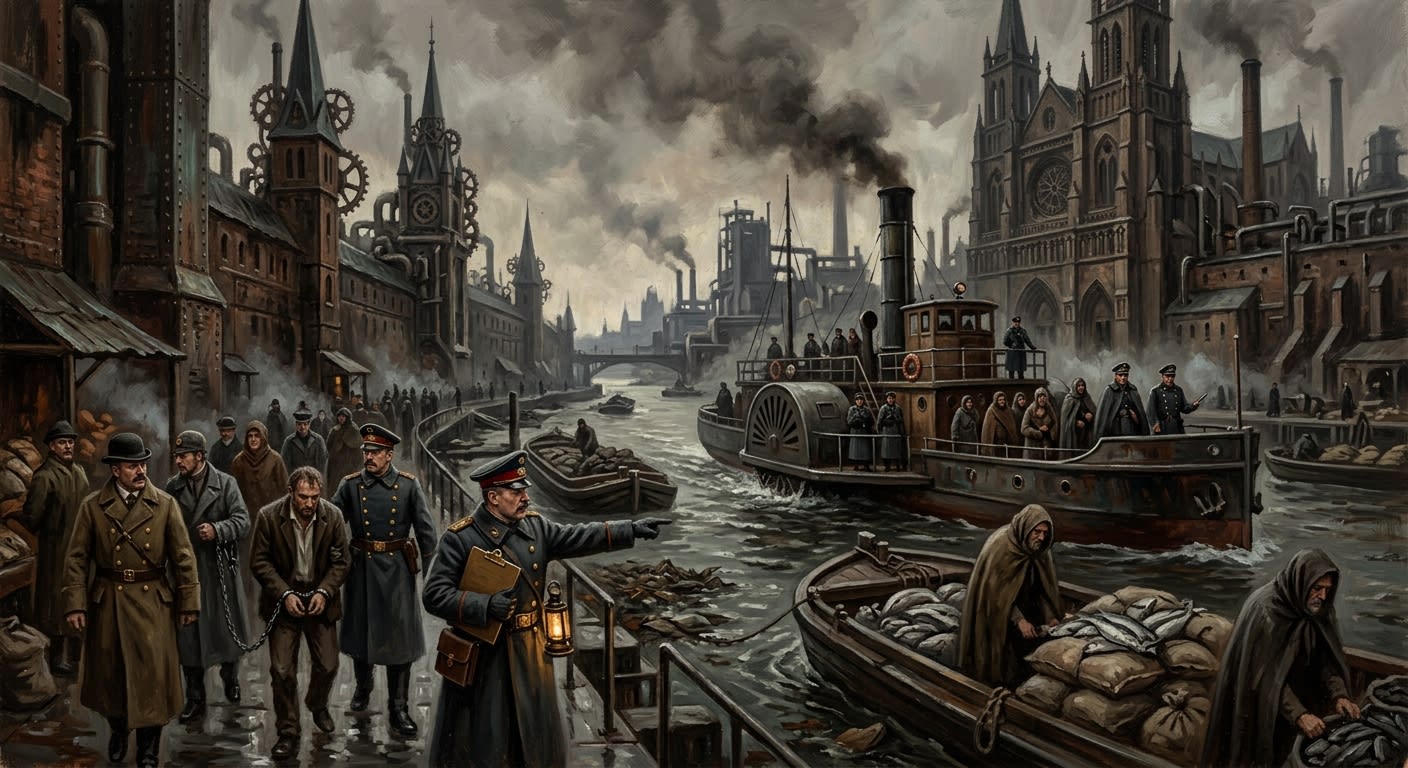
The Rhône is a river, which is what maps call it when maps are too timid to confess jurisdictional terror. It descends from Alpine custody, takes tribute from valleys, vineyards, bridges, toll towns, ferry chapels, plague wards, ash quays, pilgrim roads, and the southern pride of cities that imagine sunlight to be an argument. By the time it reaches the lower provinces it has carried grain, corpses, relic dust, fiscal quarrels, fishers’ lies, schismatic clay, licensed ash, confiscated rosaries, military barges, Pilgrimage chains, and enough theology to drown several lesser Bureaus.
The Bureau of Cartography marks it as a western and southern artery. The Bureau of Passage calls it a transit corridor. The Bureau of Tithes calls it wet revenue. The Bureau of Records calls it a custody problem. The Bureau of Doctrine calls it instructional. The river calls nothing anything. It moves, which is already a kind of insolence.
This entry concerns the Rhône as more than geography: the Lyon ash-water, the Avignon ruin-water, the lower valley’s old theological fever, the pilgrimage and trade discipline imposed after A.S. 111, the Festival-supervised civic spectacle upstream, the fishery inspections downstream, and the present A.S. 201 regime by which the Synod pretends that a river may be made obedient if watched by enough clerks with hooks.
#On the Northern Bend and the City That Performs Its Scars
At Lyon, the Rhône first becomes intolerable to doctrine in a useful way. The city sits on it like a scar placed where merchants can admire the workmanship. Zone 1 by map, major Synod city by file, festival laboratory by practice, Lyon has the particular vice of making grief attractive. It sells tokens shaped like tongues, bowls, tears, and forbidden masks. It stages processions with a performer’s sense of timing and a condemned man’s sense of audience. It teaches its children Creed aloud, in whistle, and under gag. The river watches all of this from below the quays, carrying civic shame with the patience of a clerk denied promotion.
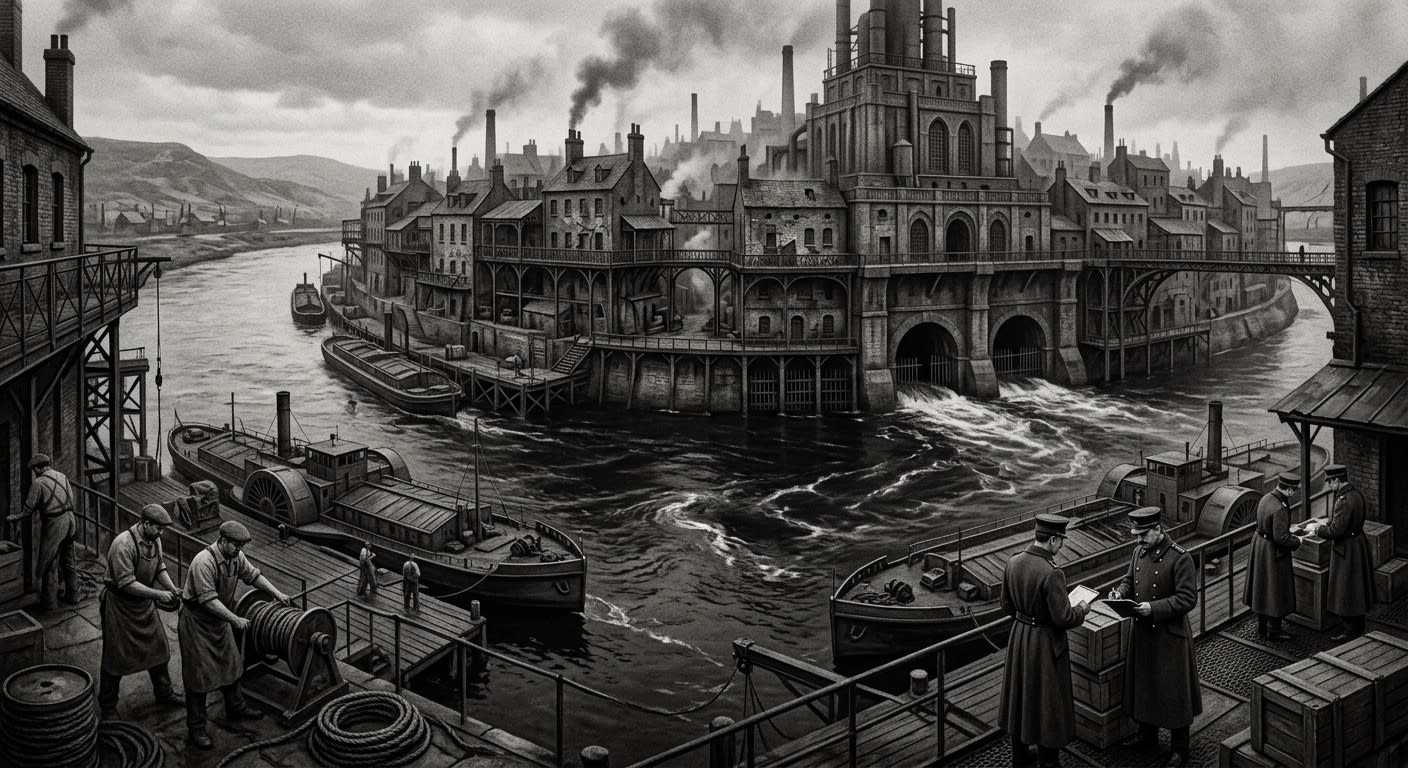
The Red Slaughter of Lyon occurred in –39 A.S. (1671 CE, before the Bureau’s calendar), before the calendar had been reformed into proper obedience. Republican militias attacked a friary on the Rhône’s left bank after Compline, burned forty-three friars in the lower refectory, shot four lay brothers at the postern, gathered the ashes, and dumped them from the quay below Saint-Barthélemy’s fish stairs. The city slept. The river did not.
For three nights, witnesses heard psalms rise from the water. The accounts disagree on language: Latin, Burgundian French, Provençal, and one Greek claim kept in a side file for the amusement of well-supervised theologians. They agree on hours: Matins, Sext, Compline. Rationalist pamphleteers blamed current, reeds, dock-rope strain, drunken echo, and the usual parade of explanations that men produce when the Creator has embarrassed them in public.
The Rhône became a witness with no throat to seize. This irritated every faction in turn. Rationalists could not arrest the water. Later Synod officials could not cross-examine it. The Year of Letters would later prove that paper could multiply relic scandal; Lyon had already proved water could testify without paper. Festivals could not improve the psalm without charging admission. Bells could not determine whether the river kept cadence from devotion or from contempt. Tithes, more practical than the rest, investigated whether ash-processions might support a stable fee structure.
Early civic primers described the Lyon episode as “local anti-clerical disorder with subsequent folk embellishment.”
Corrected. Local disorder breaks benches. This killed forty-seven men, put ash into a major river, and produced three nights of witnessable psalmody. Embellishment is what timid clerks call evidence after evidence starts singing.
The quay has since been renamed, restored, renamed again, and placed under joint supervision. Licensed bowls of clean ash are carried to the river on the anniversary and returned empty. No one sings at the waterline without permit from Festivals and waiver from Bells. The Rhône remembers anyway. It is very inconsiderate of the dead to remain administratively active.
#On the Corridor of Passage, Toll, and Wet Custody
Between Lyon and Avignon the Rhône becomes a corridor in the full Synodic sense: passage, custody, tariff, detention, prayer, correction, dispute. Barges carry grain, salt, chapel oil, pilgrim chain, timber, relic caskets, bell-metal, confession stools, festival masks under seal, and military cargo whose labels lie less artfully than their escorts. Ferries cross where bridges would cost too much or create too many local privileges. Every crossing has a patron. Every patron has a donation box. Every donation box has a clerk. Providence, in its kindness, allows nothing to remain simple.
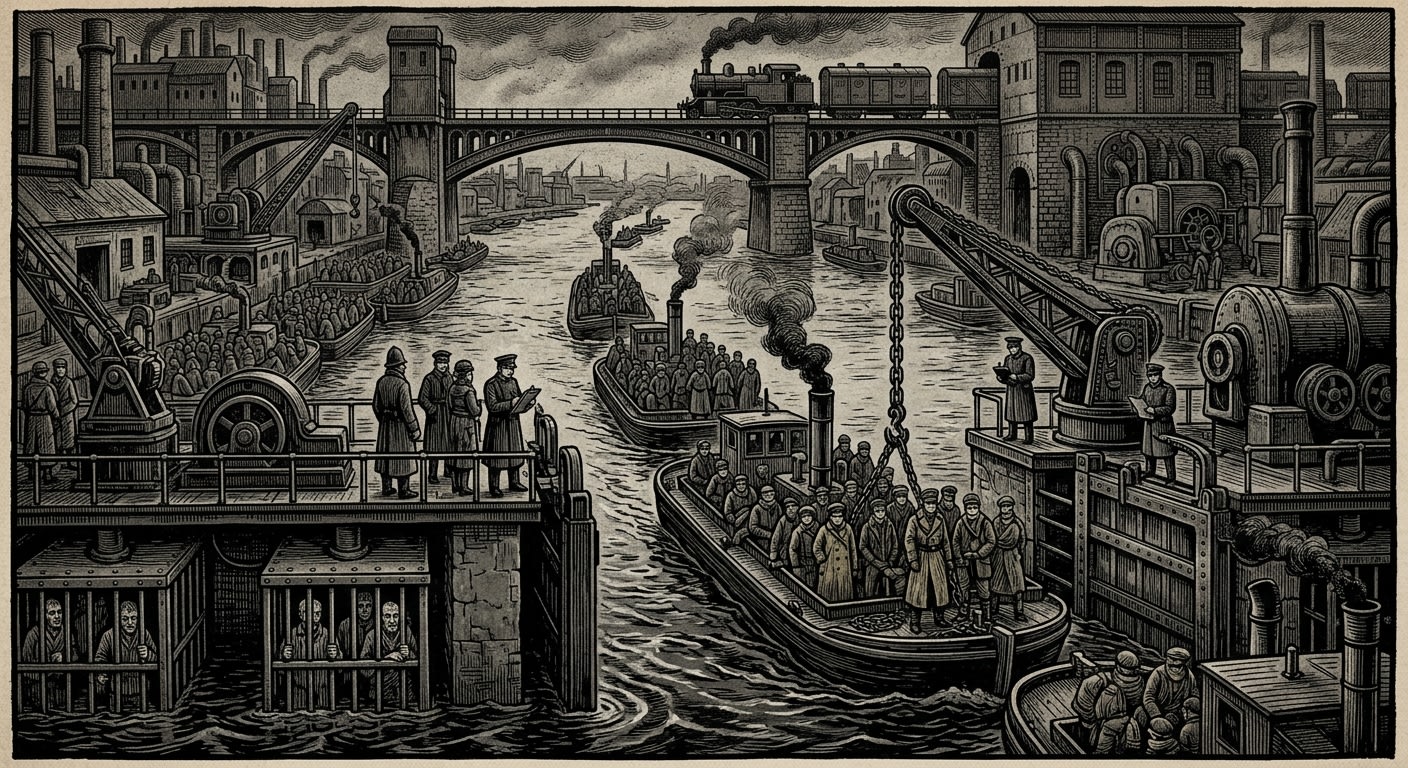
Passage offices along the river distinguish upward cargo, downward cargo, penitential cargo, closed cargo, bell-sensitive cargo, fishery cargo, ash-related devotional cargo, and bodies. Bodies require their own paperwork, since the Rhône has shown a regrettable habit of returning what other authorities would prefer to lose. A corpse recovered from the water may be accident, murder, pilgrimage failure, unsanctioned burial, schismatic residue, relic contamination, fiscal fraud, or all six if Records has had a long morning.
The Rhône valley also feeds the southern roads. Lyon pushes men and goods into the corridor. Avignon once held the lower hinge. Marseille draws maritime traffic toward the coast. Languedoc roads enter like petitions written in dust. Before the Synod hardened the line between sacred road and taxable inconvenience, local chapters, bridge houses, and river guilds moved pilgrims with a freedom that now seems almost obscene. A man could once walk from a vineyard chapel to a river shrine and arrive without three proofs of devotional intent. Barbarism had its charms.
The Bureau of Passage corrected this with ferry recognitions, convoy bands, gate seals, route tags, stamped indulgence tokens, and waiting yards whose mud has absorbed more theology than most seminaries. Tithes made wet commerce legible. Records made wet commerce accusable. Doctrine made wet commerce holy. Pilgrimage made wet commerce slow.
#On Avignon and the Water That Crowned a Heresy
Avignon is where the Rhône became an argument with a current. Before ruin, it was a southern ecclesiastical city of real consequence: corridor hinge, archive harbour, sermon-market, bridge office, rear organ of the faithful southern front, and storage cupboard for dangerous paper. Roads from Lyon, Marseille, Languedoc, the alpine approaches, and the lower Rhône met there before running eastward toward misery, fortification, and later terminology. A city that controls passage begins, sooner or later, to imagine itself a seal.
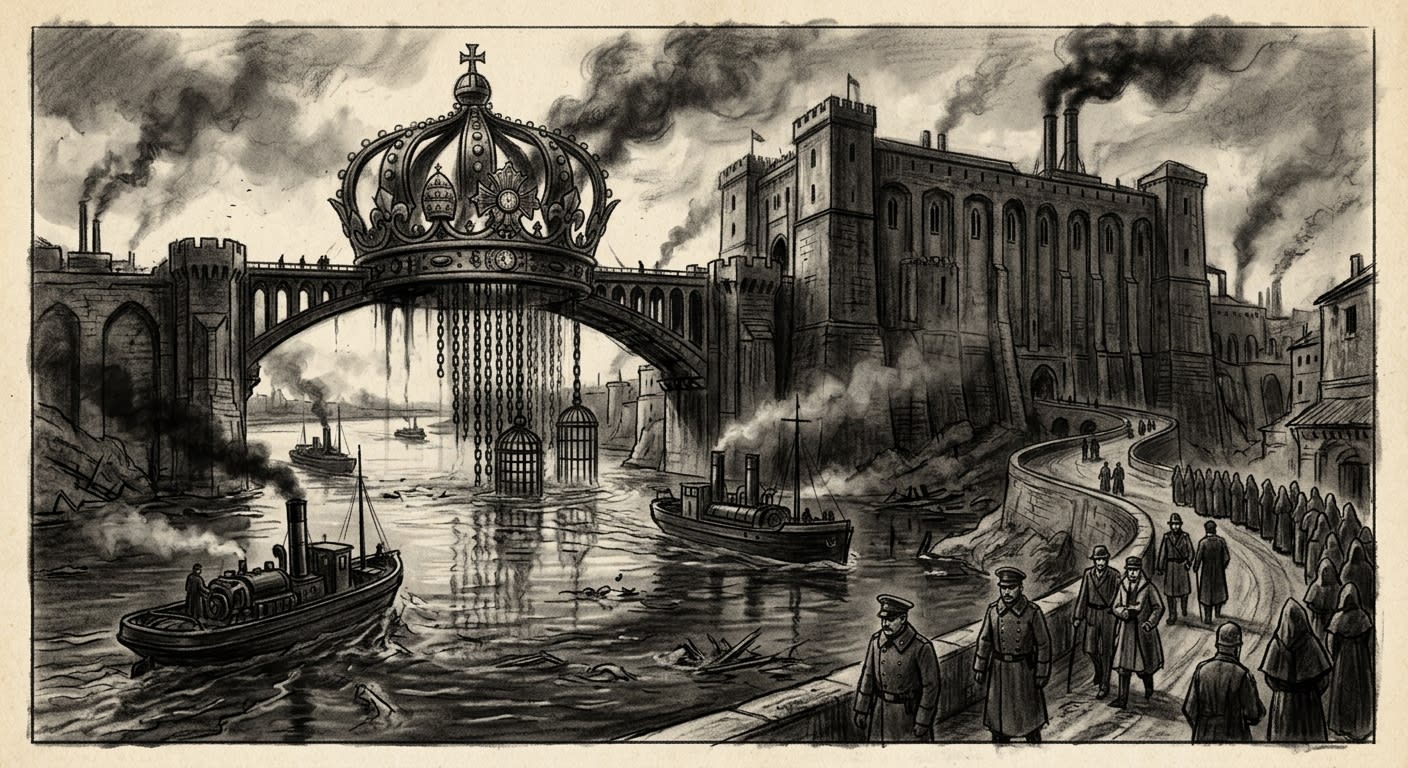
In A.S. 111, twenty-one years after the Concordat of Strasbourg and eleven years after the Council of Cologne tightened the southern yoke, a faction of Provençal clergy declared Strasbourg’s authority void. They produced the figure called Pontifex Submersis, the Drowned Pontiff. He was crowned beneath the Rhône: in the river itself, say some accounts; in flooded catacombs accessible at low tide, say others. Doctrine rejects both accounts with equal energy, which improves their credibility.
His theology was water-theology: apostolic succession through flow rather than stone, authority carried by water older than cathedral, the blank clay disc as anti-stamp, the Concordat as ossification, the Great Ledger as a stone laid on the chest of the faithful. Heretical, clever, corrosive. The worst heresies do not howl. They explain themselves well.
For six months the lower Rhône listened. Thousands followed him; tens of thousands, if one credits the sealed depositions and the nervous overreaction of officials who claimed no crisis existed while marching enough men south to erase a city. Blank clay discs passed from hand to hand: no image, no heraldry, no stamp, the surface of still water made portable. The Bureau of Purity still destroys them. It has destroyed two hundred and fourteen. It has confiscated two hundred and thirty-one. The missing seventeen are not discussed in polite offices.
SEALED RIVER-CUSTODY NOTE — AVIGNON MATERIALS Recovered disc: blank clay, Rhône silt composition, no tool mark. When placed on dry vellum, object produced a ring stain in the shape of █████████████. Witness heard phrase: “the seal is what refuses image.” Witness reassigned before second interview.
The Strasbourg garrison marched south under War writ and Purity custody. Avignon held nine days. On the tenth the gates opened from within, helped by persuasive disbursements, confidential, that most fragrant of Purity phrases. The city was razed stone by stone. Usable masonry went north by barge to Strasbourg, where it now forms staircases in the Cloister of Concord. Every clerk ascending those stairs treads Avignon’s pretensions under boot without knowing it. The Bureau calls this justice. I call it procurement with a sense of theatre.
Lower-valley devotional calendars long placed the Schism of Avignon in A.S. 145.
Clarified. The river crowning, six-month crisis, Razing, and first Trifold Erasure belong to A.S. 111. A.S. 145 marks later calendar correction, chapter purge, and southern docket harmonisation. Error persists because ruins teach poorly when profitable.
#On Glass, Rosaries, and Fishers Who Do Not Understand Policy
The morning after Avignon’s last night produced the sealed line every deposition shares: they found rows. Calcium-white figures arranged where a congregation had stood. Faceless bodies in prayer-postures. No bones fit for ordinary identification, no relics to catalogue, no corpses of the kind fire leaves to honest investigators. Seventeen depositions record glass rods, upward rain, a bell heard underwater, or a whitening of the air. Fourteen witnesses later recanted. Three vanished. Truth was improved by subtraction.
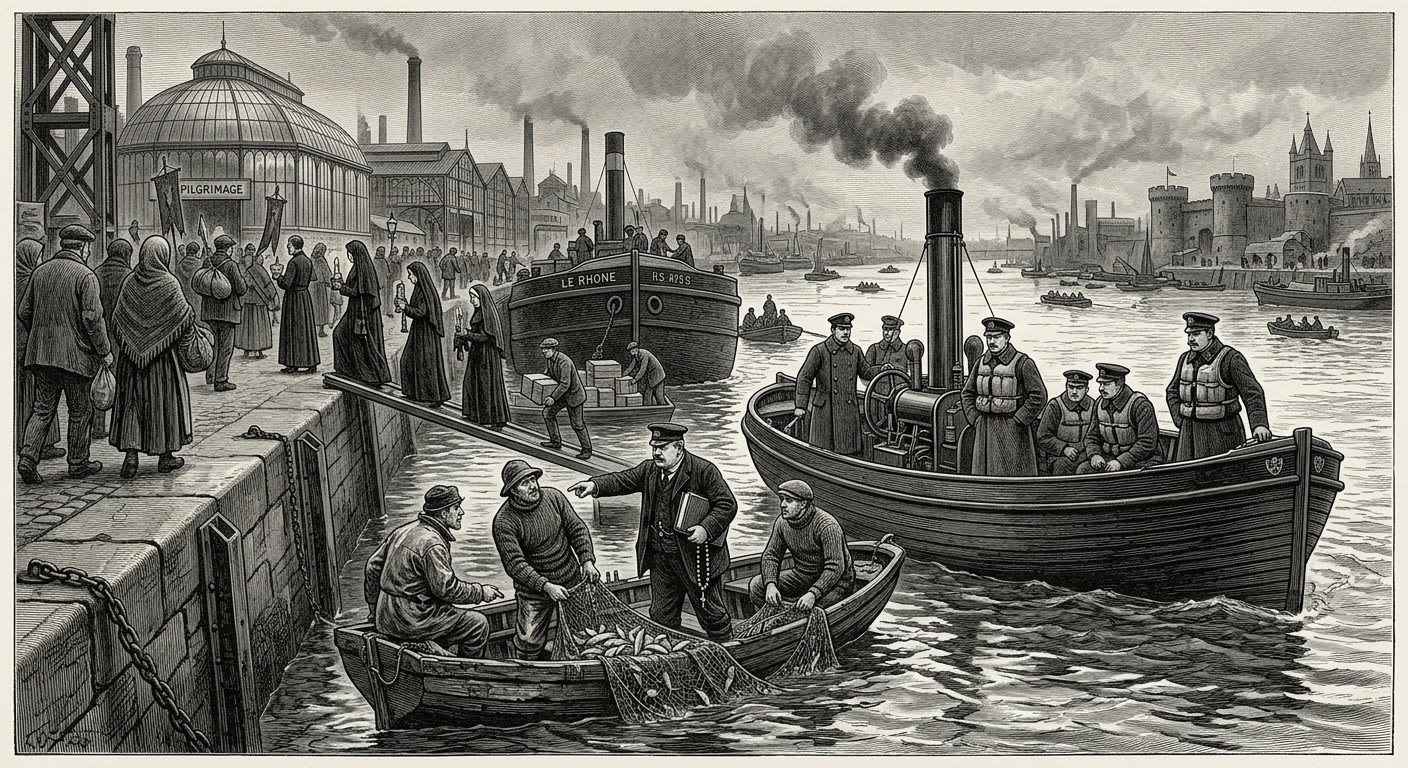
The Rhône refused subtraction. Fishers began dragging up rosaries: beads glass-caked, river-worn, fused to iron links as though melted and quenched in water. Three inspection delegations reported natural mineral accretion. All three lead investigators were transferred afterward. Nature has never been so well supervised.
The Chains of the Martyrs of Avignon are said to hum in B-flat beneath the Basilica of the Ledgered Saints. Records denies the vault. Purity denies the chains. Doctrine denies that martyrs can be produced by an event that did not occur. Bells once confirmed the pitch before Relics asked the examiner to stop discovering things. This is how concord functions among adults: one Bureau hears the noise, another denies the object, a third files the silence.
Along the lower Rhône, wardens inspect nets with hooks. Fishers present catches before sorting. Children are told not to pocket smooth discs. Old women keep rosary fragments in flour jars, which is foolish, touching, and exactly the sort of behaviour that forces Purity to search kitchens with the solemnity of crusaders. The river keeps making domestic theologians of people who only wanted supper.
#On Festivals, Soldiers, and the River as Stage
The Rhône does not merely remember; it stages. Lyon understands this best and abuses it with native elegance. The Procession of Tongues, the ash-bowl anniversary, whistle-hymnody from the descendants of Saint Calistus’s fasters, mask prohibitions after the Tumults of Lyon, relic-vault restrictions, silver tokens sold under supervision: each civic wound is given route, fee, sound, and permitted grief. Festivals has turned the riverfront into an altar rail with vendors.
The Citadel of Lyon trains levy boys from the Rhône corridor, Burgundy, Savoy, Auvergne, and the southern road. The boys are stripped of provincial rhythm, stamped into Synodal tempo, and shipped east before their families finish learning which window faces the yard. The east gate faces the quays where Red Slaughter ash entered the river. War calls this efficient siting. Doctrine calls it memory. Mothers call it a bad place to say farewell.
Soldiers know the river differently. The Rhône road feeds depots, catechism-barracks, southern pilgrim columns, and coastal supply. It carries boys toward the Line and relics toward chapels that will pretend the boys were always eager. It carries letters home when paper survives damp, and unanswered letters outward when families refuse to admit the dead have no use for news. At ferry chapels, mothers pay for river blessings on sons already two provinces away. The river accepts all payments with identical mud.
The Bureau of Bells maintains relay discipline from Marseille inland toward the Rhône road. On clear mornings peals pass across harbour, hill, and water. On foul nights fog returns them wrong, thickened by the river air until sailors and pilgrims swear the south itself has answered. Bells classifies most responses as atmospheric. Doctrine approves that classification when useful and rejects it when a miracle is required. Flexibility is the hinge of holy government.
#On Tithes, Silt, and the Arithmetic of Water
A river creates revenue by pretending to be natural. Banks move. Channels alter. Floods erase markers. Fish appear in one jurisdiction after spawning in another, which proves fish are fiscal anarchists. Barges ground on sandbars that did not exist when permits were issued. Ferry ropes snap. Pilgrim columns arrive late and claim Providence delayed them. Merchants blame silt for missing cargo. Widows blame current for missing bodies. Tithes blames everyone and is often correct.
The Rhône required a special habit of wet accounting. Weight is taken before and after passage. Seals are waxed, wrapped, unwaxed, rewaxed, and compared. Cargo ledgers include damp variance. Ash bowls require empty-return witnessing. Relic caskets receive oilcloth custody. Fishery inspections include devotional-object annexes. A glass-caked rosary is contraband, relic, evidence, or mineral depending on which office reaches the net first.
The lower valley’s vineyards resent river tolls with admirable consistency. Wine travels beautifully under false devotional labels. A cask marked chapel vinegar may contain Mass wine, table wine, smuggled ink, or three fugitives breathing through reed tubes. Records dislikes reeds. Purity dislikes fugitives. Tithes dislikes inaccurate cask-value declarations. Doctrine dislikes the possibility that all three may occupy one barrel.
#On the Present Rhône
As of A.S. 201, the Rhône is Synod-held, supervised, taxed, crossed, sounded, dredged, licensed, sung at only by permit, and still not obedient. Lyon remains rich, devout, theatrical, and dangerous in the way polished knives are dangerous at banquets. Avignon remains restricted, profitable, corrected, and insufficiently quiet. The corridor between them remains full of toll houses, ferry shrines, Pilgrimage markers, fishery stations, Tithes offices, Passage yards, and local songs whose lyrics have been corrected so often that the forbidden versions now travel by tune alone.
Purity’s current concerns are small, which makes them serious: blank clay discs in markets north of Avignon; rosary fragments hidden in flour jars; river songs rhyming Rhône with throne; children at Lyon whistling intervals that make relic-vault glass sweat; fishers reporting underwater bells; ferry clerks accepting old Avignon pebbles as luck tokens; Festival vendors selling ash bowls with unapproved interior marks; pilgrims touching the water before Varrican chain rites; widows addressing letters to the current.
The A.S. 200 corridor digest classifies Rhône anomalies as “stable under ordinary supervision.”
Amended. Ordinary supervision on the Rhône includes armed net inspection, song licensing, ash custody, relic condensation reports, pilgrim-chain oversight, blank-disc seizure, and annual transfer of at least one investigator who has learned too much from mud. Stability is a word clerks use when panic has acquired forms.
The Bureau’s public formula is simple: the Rhône is a holy river of memory, passage, repentance, and southern unity under Strasbourg’s paternal seal. The internal formula is cleaner: water carries what paper rejects. Ash travels. Clay returns. Songs slip. Glass hardens around beads. Boys go east. Mothers pay west. Fishers lie. Clerks count. Bells answer, then deny answering.
At Lyon, the water takes the licensed ash and gives back no receipt. At Avignon, the wardens clear the bank at Ninth Peal and pretend the hooks are for fish. Between them, barges slide through the evening with sealed cargo, wet ropes, stamped manifests, and men who do not look too long at the surface when the current begins arranging moonlight into rows.
#On Pilgrimage Chains and the Lower Road
The pilgrim-chain came late to the Rhône and then pretended it had always belonged there, a habit shared by most successful cruelties. Avignon’s Varrican stations preserve a memory older than the formal profession: six hundred condemned gathered in Avignon Yard, linked by hagiographic necessity, and sent eastward under Saint Varric’s blistered patronage before the modern Handler licence acquired its neat ranks and uglier instruments. The story is profitable enough to be treated as spiritually true and legally false, which is one of Pilgrimage’s finest categories.
The chain entered Jubilee use in A.S. 109 after penitent-retention failures across several seasons taught Strasbourg that pilgrims vanish when towns are sympathetic and wrists are independent. Handler licensing followed in A.S. 112, and the Rhône road accepted its new iron with the weary grace of a riverbank accepting another tax post. Link-Runners learned the ferry schedules. Chain Keepers learned which chapels had strong rings set into the paving. Handlers learned that a column crossing a damp quay behaves like a single long animal with too many mothers shouting at it.
The lower road from Lyon to Avignon and onward toward Marseille carries penitents, ordinary pilgrims, relic escorts, school groups, ash processions, and those instructive little civic parties sent to ruins so that obedience may enter the eye before it reaches the conscience. At each station a clerk records presence, offence class, remission purchase, water contact, chain integrity, and whether anyone looked at the river too long. The last question is not printed on the public form.
Mothers at the Avignon First Opening purchase remission candles priced by offence class. At the riverbank, handlers tap chains against stone and listen for cracks in iron, flesh, and morale. Pilgrims sometimes try to touch the Rhône before the rite, claiming thirst, grief, blessing, family custom, southern nerves, or the old lie that a small gesture cannot trouble a large institution. Institutions are made entirely of troubled small gestures. That is why they employ guards.
The chained columns change the river towns. Inns build lower rooms with wall rings. Chapels widen thresholds to accept linked bodies. Markets sell wrist salve beside prayer cards. Children learn to step over chain-lines before they learn the full Creed. The pious call this adaptation. I call it the architecture of captivity taught to behave politely around candles.
#On Songs, Rhymes, and the Old Southern Throat
The Rhône valley sings too much. This is not a moral failing by itself, though the Bureau of Bells has argued the contrary with depressing professionalism. Vineyards sing work measures. Ferry crews sing rope cadence. Lyon sings whistles that inherited hunger carved into family throats. Avignon sings nothing officially and hums unofficially at dusk. Fishermen sing lies because their trade requires rhythm, patience, and the willingness to describe an eel as a theological incident if the buyer is nervous enough.
The dangerous songs are not always the obvious ones. A hymn to Saint Calistus may be licensed, audited, rehearsed, and harmless until a child adds the old river turn on the fifth interval. A Varrican chain-song may pass three inspections while carrying an extra beat used by prisoners to signal slack iron. Provençal lamentations are reviewed because half of them rhyme Rhône with throne, and that sort of accident has hanged better poets. Bureau of Orison copyists keep lists of dangerous vowel-lengths. They pretend not to enjoy their work.
The Bureau’s countermeasures are musical and slightly humiliating. Approved verses are distributed with altered rhymes. Ferry crews receive cadence slates. Children are taught safer water words. Festival choirs in Lyon are overstaffed with official altos whose purpose is to smother unapproved intervals by volume. Avignon guides pause before certain phrases so school groups cannot learn the tune of forbidden names by accident. The method works badly and continually, which makes it a policy.
Still the old throat persists. At harvest, a vineyard crew will drag a line two beats longer than permitted. At a ferry, an old woman will answer a toll prayer with a word that was removed from the printed sheet in A.S. 145. At Lyon, whistles rise above the water and make tourists weep for reasons they intend to purchase afterward. At Avignon, locals do not sing the Drowned Pontiff’s title. They leave a silence shaped exactly like it.
#On Flood Courts and the Theology of Banks
Flood makes lawyers of peasants and theologians of surveyors. When the Rhône swells, it rearranges field marks, grave edges, ferry rights, fish traps, vineyard walls, chapel steps, and the little jurisdictional certainties by which men pretend mud respects parchment. A bank moved six feet may transfer a toll. A washed-out boundary may free a debtor or ruin him. A shrine step found downstream may become relic, debris, or actionable theft by current.
Records maintains Flood Courts at the principal nodes, though it calls several of them seasonal reconciliation benches to avoid admitting that water holds appellate power. Witnesses bring soaked plats, broken stakes, jars of silt, boatmen’s oaths, fishers’ insults, and children who remember where a tree stood before the spring rise. The judge listens, compares maps, consults older maps, distrusts all maps, and issues an order that the river will violate at leisure.
The theological question is older and more dangerous: if baptismal water is holy in use, what of a river that has carried friars’ ashes, schismatic crowns, blank seals, relic dust, penitential chains, and drowned prayers? The official answer is firm because firmness is cheaper than thought. The Rhône is not itself sacramental except under licensed rite. Contact without rite is contact, not blessing. River-memory is poetic, not operative. Ash in water is instructional, not distributed relic. Blank clay is contraband, not anti-sacrament. The fishers nod and keep whatever fits in a boot.
Flood years also expose graves. Some are ordinary. Some are old. Some are not in any cemetery record and wear no decay appropriate to their claimed century. After heavy rains near Avignon, white flakes appear in silt beds. After winter floods below Lyon, ash-black threads collect in reed roots. Records sends collectors. Relics sends collectors. Purity sends men to watch the collectors. Tithes sends invoices for the carts.
#On the River Watch
The River Watch is not a single office, because the Synod prefers useful confusion where a clear command would require a clear failure. It is a habit of joint patrol among Passage wardens, Purity inspectors, Bells examiners, Records note-men, Pilgrimage escorts, Tithes assessors, and local boatmen paid poorly enough to know the truth. Their badges differ. Their boots look the same by noon.
They patrol ash nights at Lyon, chain days at Avignon, ferry markets in ordinary weeks, flood courts in spring, and the lower bends whenever rumours of clay discs multiply faster than confiscation. They carry hooks, waxed evidence sacks, bell slivers, cadence cards, damp-proof ledgers, chalk, cuffs, and a small hammer used to test whether a bead is glass, bone, mineral, or something that should have remained unstruck.
RIVER WATCH INCIDENT — LOWER BEND, A.S. 199 Object recovered in eel basket: rosary fused through fish spine. Fish alive at recovery despite opened body. Beads sounded Matins when separated. Boatman statement: “It asked for Avignon.” Disposition: fish burned; basket sealed; boatman corrected; beads transferred to █████████████.
The Watch’s chief enemy is not heresy but embarrassment. A public seizure creates pilgrims. A private seizure creates rumours. Ignoring a trinket lets contamination travel. Arresting a grandmother for a river bead makes three villages sympathetic before dusk. The Watch has perfected the middle arts: delayed confiscation, polite menace, accidental boat inspections, night visits, evidence purchase, and the old Purity method of asking a question whose answer has already been entered.
#On Drax’s Inspection by Water
I inspected the Rhône by barge once, from Lyon down toward the Avignon cordon, because every official should occasionally travel inside the problem rather than above it on a map. The barge-master had the face of a man who had seen too much fog and charged too little for silence. His crew crossed themselves at licensed sites and spat at unlicensed ones, which shows a healthy instinct for bureaucratic distinction.
At Lyon the water looked ordinary under morning commerce. This is how dangerous things prefer to look: useful, brown, employed. Boys from the Citadel drilled above the quay while ash bowls were being prepared below. Their boots struck stone in good rhythm. Across the river an old woman whistled a Saint-Calistus interval so thin that one of the boys missed step. His instructor struck him. The old woman stopped. The water kept the note a moment longer than air should allow.
At Vienne we took on sealed chapel wine, three crates of route tokens, and a Records clerk who became seasick on a river and tried to classify the event as environmental hostility. At a ferry station south of there, a child offered me a smooth clay disc. Blank. Damp. Smelling faintly of silt. I asked where he found it. He said the river gave it back because his brother had dropped it yesterday. His brother, according to the ferry priest, had died in infancy seven years before.
At Avignon the wardens met us with hooks already in hand. This is the local greeting. The ruins sat pale and reduced, performing absence with more force than many cathedrals perform grandeur. Nets were opened on planks. Two fish, one boot, three lawful rosaries, one unlawful rosary, and a chain link came up before Vespers. The chain link hummed when the Bells examiner pretended not to listen.
I returned to Strasbourg with damp cuffs, an irritated clerk, a headache from river wine, and the old conviction that water is the Enemy of filing cabinets. The Bureau has made the Rhône safer, cleaner, louder in the right places and silent in several wrong ones. The Rhône has accepted all improvements with the expression of a mule considering a sermon.