

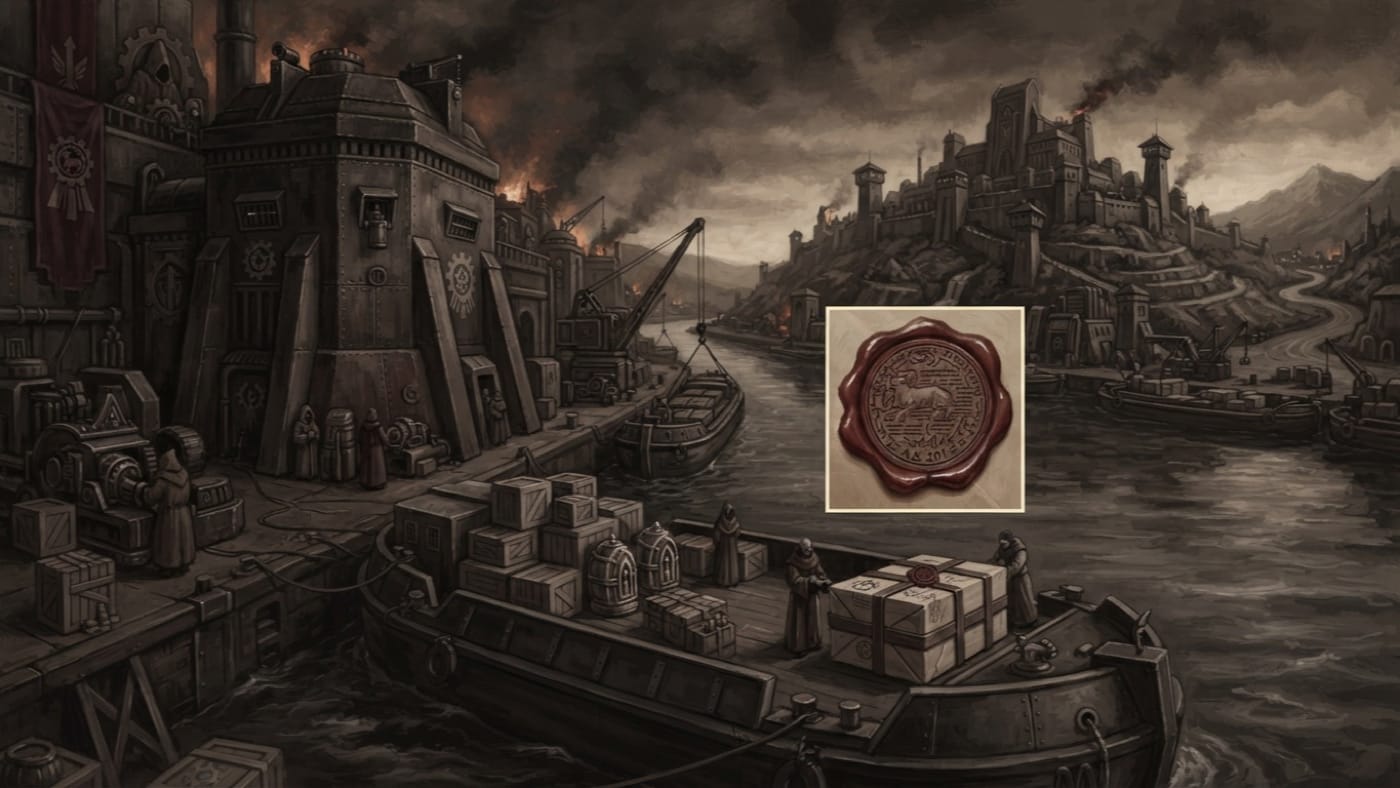
Vienne
Documentary place survey compiled A.S. 201 / 1911 CE. Bureau of Doctrine.
#On the Name and the Record
This survey was compiled in A.S. 201, which the old calendar calls 1911. That is the year the Codex gathered its references to Vienne and nothing more. It is not the year the town was founded, and it is not the date of any inspection or visit. The town is older than this compilation. The Codex does not say how much older, and I will not put my seal on a cartographer's guess.
Vienne is the town on the Rhône below Lyon. It is not Vienna. Vienna stands on the Danube. It was the seat of the old Holy See and has enough chancery dust, cathedral law and Austrian self-regard to fill a wing of any archive. Vienne needs a smaller cupboard. The names differ by one letter, and copyists have been losing that letter for as long as both towns have appeared in the same ledgers.
Vienne. See Vienna.
Corrected. The first slip prepared for this compilation sent the Rhône town to the Danube. Vienne is the Rhône town below Lyon. Every reference collected here belongs to the Rhône. Vienna has troubles of its own and needs none of ours.
Four published records mention the town. The account of the Red Slaughter of Lyon names it as the place two priests fled from. The plate on Montreval lists it among the roads leading north out of the southern passes. The dossier of Cardinal-Marshal Severin places one Rationalist's death outside it. My own survey of the Rhône lists it among the river's principal nodes and records what I took aboard there. Everything the Codex holds on Vienne comes from these four sources. This compilation puts them side by side. It adds no new facts.
#On Lyon and the Lower Road
Lyon sits at the head of the Rhône corridor. My survey of the river files that corridor as a Zone 1 artery of the western and southern heartlands. Below Lyon the water carries grain, chapel oil, relic caskets and penitents toward Avignon, Arles and the roads to the sea. The river register names Vienne as one of the principal nodes on that route. My barge put in there after Lyon. Further south there was a ferry station that I will not name, and further still the Avignon cordon. So the order of the river is certain: Lyon first, then Vienne, then the long descent south.
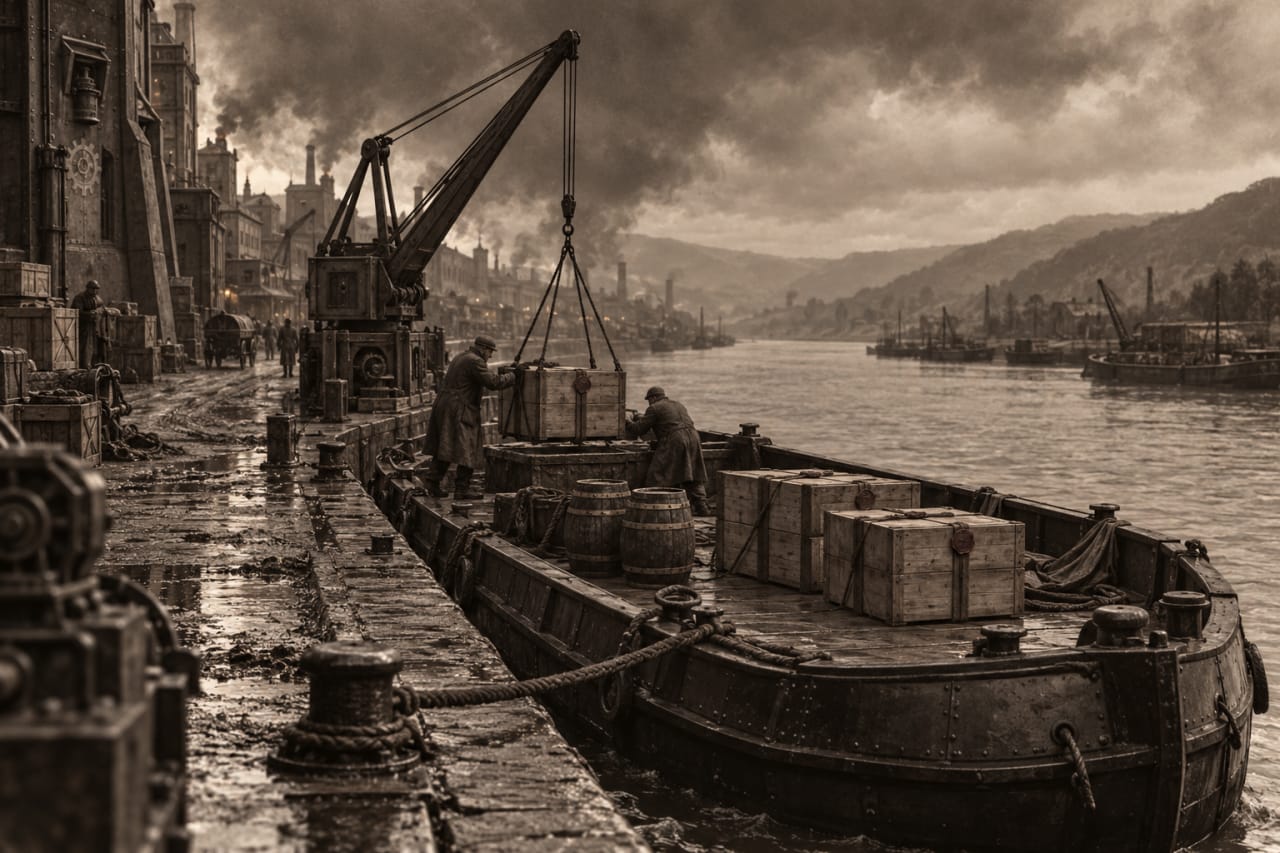
Measurements do not appear in any of the records, and none will appear here. I give no bank, no distance in leagues, no hours of travel and no position for any bridge. The Bureau of Cartography could supply all four, and in time a flood court would overturn them.
The Montreval plate reaches Vienne by road. It describes Montreval before the Atheist Wars as a hard little fortified town in the southern passes. It lay between Avignon's ecclesiastical rear and the disputed roads that bent north toward Lyon, Vienne and the Rhine. That sentence lists where the roads went. It is not a measured itinerary. It does not say which road reached Vienne, how far it was, or whether a wagon from the passes went there first. Montreval's own location is still hedged by Cartography: probably south-eastern France, under the custody of the Avignon corridor in the war years. A town whose position is uncertain cannot fix a precise line to another town.
What the two records together establish is enough. Vienne sat on the water route south from Lyon. It was also one of the places the roads out of Avignon's war country were understood to reach. River traffic passed it. Road traffic aimed at it. During the wars the southern faithful front drew its supplies, priests and dangerous paper through that country. Rationalist columns tried to break into it.
#On the Two Displaced Priests
The earliest event in the Codex that touches Vienne is a riot. It is also the least documented.
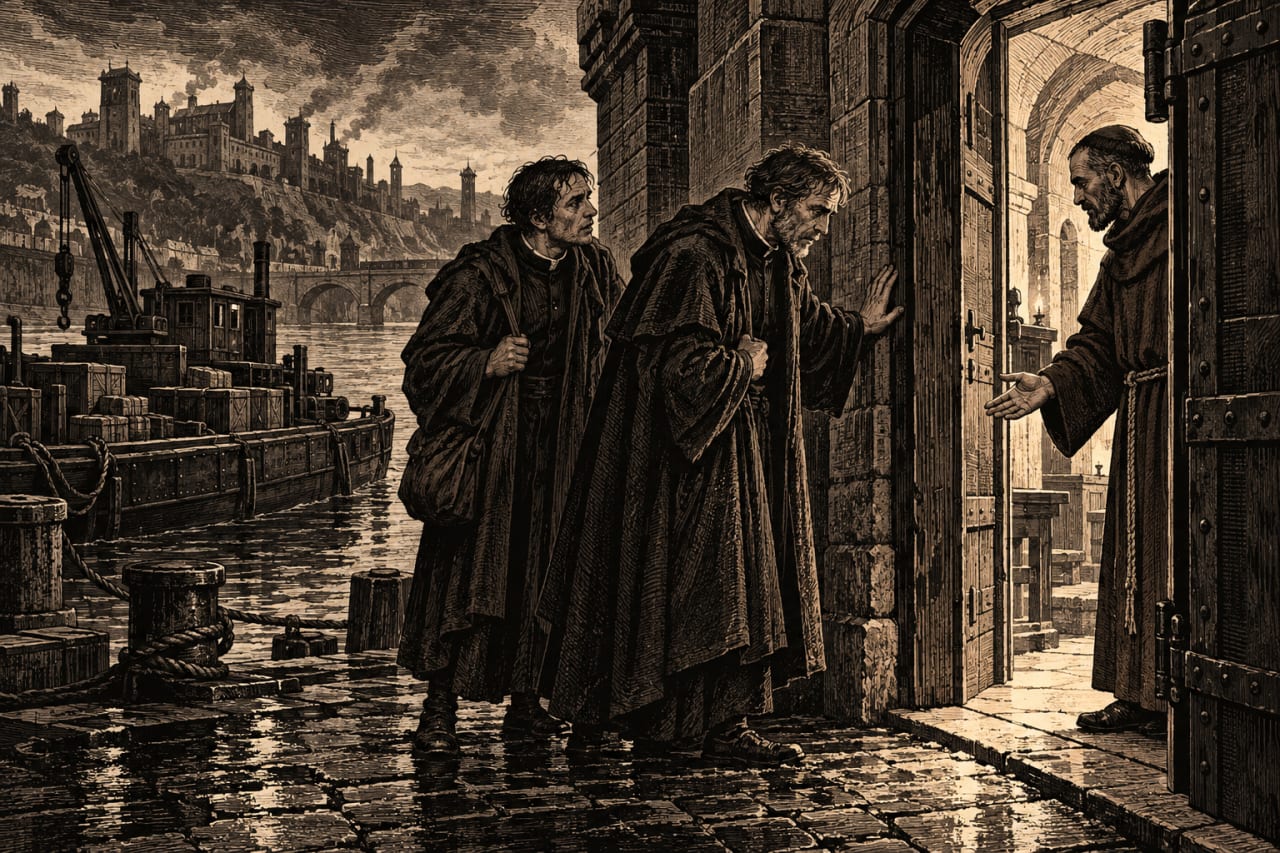
Before the Red Slaughter of Lyon in −39 A.S. (1671 CE), anti-clerical riots in Vienne drove out two priests. The record says only that the riots came earlier. It gives no year. They may have happened in the same calendar year as the slaughter or some years before, and no document decides the question. It also gives no length, no death toll, no ringleader and no sponsoring club. The riots belong to the preparatory age, when pamphlet societies and municipal clubs were rehearsing the contempt that the Rationalists would later turn into doctrine. No Republic yet existed to command them. Their violence was local. They were proud of it.
The two priests went upriver to Lyon. A friary on the Rhône's left bank took them in. The house's name survives in three forms, and none of them can be trusted. The Lyon register calls it Saint Sabellian's House of the Lower Rule, a Purity index calls it the Minor House of Saint Sabina, and a fishmonger's deposition calls it "the brown brothers by the water." Its work is better attested than its name. The brothers fed the paupers from the docks. They copied penitential psalters by hand, though nobody was buying them. And they opened their door to two priests whom another town had just thrown out.
That generosity counted against them. The Lyonnais clubs had a vocabulary of superstition, fraud, clerical hoarding and civic hygiene. Sheltering priests from Vienne fitted it neatly.
After Compline on the night of the slaughter, Lyonnais militias in municipal colours entered the friary. According to the detailed account, forty-three friars were burned in the lower refectory and four lay brothers were shot at the postern. That makes forty-seven dead. The ashes went into the Rhône before dawn. For three nights afterward, witnesses on both banks reported psalms rising from the water.
All of this happened at Lyon. Vienne's part ends at the friary door, with two refugees and an act of hospitality. The burning, the shooting, the ash and the singing water belong to Lyon's ledger and stay there.
The fate of the two priests is unknown. Their names are not preserved. Nothing says whether they were in the house that night, whether they had already moved on, whether they ever saw Vienne again, or where they died. They are not counted among the forty-seven. Adding them would make a neater sum and a false one.
It is not the case that Vienne started the Red Slaughter. The town sent two frightened men up the river, and Lyon killed the house that took them in. The Atheist Wars began publicly only at the Massacre at Saint-Malo in A.S. 10 (1720 CE), almost half a century later. The Vienne riots belong to the years before that war began, when violence against clergy was still local. They are listed here because they are attested. A footnote about refugees is as far as the record takes them.
#On Montreval and the Limber
By the middle of the wars, the country around Vienne was a theatre of operations, and the faithful there were under the old Church's command. The formal Synod did not yet exist. The Concordat of Strasbourg was still more than sixty years away. The southern faithful front ran on cardinals, abbots, quartermasters and mule-drivers. Its sharpest instrument was Severin of Avignon.
From A.S. 15 to A.S. 18 (1725–1728 CE), Severin held Montreval against Lucien Artois and his clockwork artillery. He held it for three winters, and corridor fighting continued around it until A.S. 25. His task was to keep the Avignon corridors open, so that grain, oil, relics and priests could keep moving through the southern country. Archives also travelled that way when they could. In A.S. 25 the Betrayal of Aachen cut the northern front. Severin received the news at vespers, finished the psalm, and ordered two of Montreval's own bridges burned, because they now invited the enemy in. Those bridges belonged to Montreval, as did the Pont des Tanneurs. None of the four records places a bridge-burning, a siege, a garrison or a headquarters at Vienne. The town lies at the far end of the roads that Montreval was keeping closed.
Vienne enters this history through a broadside.
Severin had many enemies, and they named him butcher, red wolf and Avignon's iron cassock. One Rationalist pamphleteer called him "the psalm-snarling dog of Montreval." His dossier preserves that phrase and admires its rhythm. It also records that the author was later trampled by his own artillery limber outside Vienne.
That is the whole entry. The author is not named. The incident is not dated. The record gives no battle, no column, no road and no exact spot beyond "outside Vienne." Nothing connects the man to Artois except the cause they shared. The dossier makes no claim about divine punishment. Long after the event, the Bureau of Doctrine filed the death under a heading it calls Poetic Proportion. That heading describes how the Bureau chose to treat the incident. It does not describe the incident itself.
I like the entry, and I am not ashamed to say so. A pamphleteer mocked a cardinal's voice and was killed by the equipment he had been hired to cheer on. The Bureau did not have to invent anything to enjoy that. The mud near Vienne does not make it a battlefield, though. The town hosted one ugly accident on the edge of a long campaign that was fought elsewhere. The war went on to Regensburg in A.S. 30 and the Rationalists won it.
#On the Cargo Taken Aboard
I travelled once by barge from Lyon toward the Avignon cordon. The Rhône survey records that journey without a date, and I will not give it one here. The survey's A.S. 201 seal dates the survey. It does not date the journey.
At Vienne we took on sealed chapel wine, three crates of route tokens and a clerk of the Bureau of Records. The clerk turned out to be seasick on a river and tried to classify the condition as environmental hostility.
Each of these three items says something about the town, though less than an eager reader will want.
The wine was sealed and marked for chapel use. I loaded it at Vienne. I do not know where it was pressed, blessed, casked or sealed, and the survey does not say. The river carries a great deal of wine under devotional labels, and the lower valley has a well-documented habit of lying on its casks. The seal on this wine was intact when I took it aboard, and its contents went unrecorded.
The record counts three crates. It does not count the tokens inside. Nobody wrote down how many there were, what they looked like or where they were struck. The Bureau of Passage issues route tags, convoy bands and stamped tokens along the whole corridor. The crates were waiting at Vienne when the barge arrived. The tokens may not have been made there.
The clerk boarded at Vienne. That proves one passenger and one weak stomach. It does not prove a Records station, a standing post or Records jurisdiction over the town. Clerks travel. Usually they travel badly.
Further down the river there was a ferry station that the survey does not name. Something happened there, and it belongs to that station. It did not happen at Vienne, and this compilation will not move it upstream.
#On the Supervised Corridor
Vienne lies in a stretch of water that the Synod watches hard. My river survey sets out the system in detail, and none of its offices needs to be placed in Vienne to be described.
Passage offices along the Rhône sort cargo by class: upward, downward, penitential, closed, bell-sensitive, fishery cargo, ash-related devotional cargo, and bodies. Passage inspects first. Records countersigns. Purity is called in when something is anomalous. Tithes takes its share every time. The Bureau of Tithes has worked out an accounting suited to wet trade. Cargo is weighed before and after passage, ledgers allow for damp, and seals are waxed, broken, re-waxed and compared. A barge that leaves Vienne goes south into that system, and one coming up from the south has already been through it.
The lower river has changed more than the upper. During the wars Avignon was the ecclesiastical rear of the southern front, the hinge of the corridor, a harbour for archives and the city Severin's convoys ran toward. In A.S. 111 (1821 CE) it declared Strasbourg's authority void. Its clergy crowned the Drowned Pontiff under the Rhône, and in the Schism of Avignon that followed, the city was razed. Its usable masonry went north by barge. A.S. 145 brought the later calendar correction and the cleanup of the southern dockets. The Avignon at the end of Vienne's southern road in the years of Montreval no longer exists. A restricted ruin stands in its place, guarded by wardens with hooks.
Pilgrimage on the lower road also became stricter. Chained penitents came into Jubilee use in A.S. 109, and Handlers were licensed in A.S. 112. Since then, columns have moved between Lyon and Avignon with clerks at each station noting presence, offence class and contact with the water. The River Watch is a joint habit of several Bureaus more than a single office. It patrols the ash nights at Lyon, the chain days at Avignon, and any bend where rumours of clay discs multiply.
Vienne is part of this corridor, but none of the records gives it its own piece of the system. They name no flood court for Vienne, no Watch command, no token workshop, no pilgrims' yard and no inspection timetable. The town receives what the river's order delivers to all its nodes: inspection, taxation, supervision and permits. The four records allow that statement and nothing more particular.
#On the Present Compilation
This survey was compiled in A.S. 201 (1911 CE). It establishes Vienne as the Rhône town below Lyon and distinct from Vienna. It records the riots that drove out two priests before −39 A.S. It places the town on the roads out of the Montreval country, records one Rationalist trampled outside it, and records one undated loading of wine, crates and a clerk. It does not certify the present state of the town's walls, offices, quays, bells or people. Those questions belong to a later inspection with a date of its own.