
#On the First Red Lesson
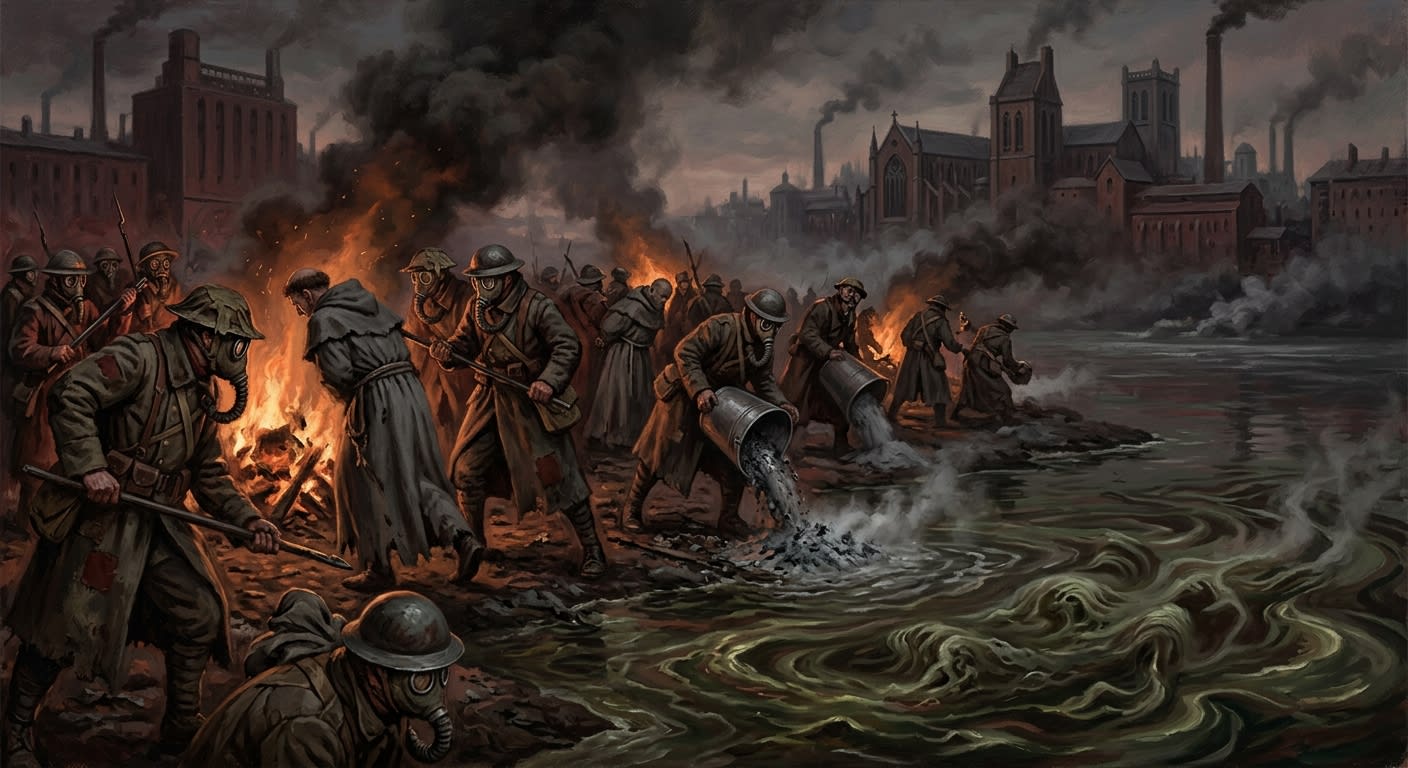
The Red Slaughter of Lyon occurred in –39 A.S., which the old calendar calls 1671, seven years before the Year of Letters taught Europe that arithmetic could kill faster than fire. A Lyonnaise friary on the Rhône’s left bank was attacked by Republican militias wearing municipal colours, carrying civic warrants, and displaying that nauseating expression common to men who have just discovered that murder becomes philosophy when printed on official paper.
The dead were friars. This must be stated at once because later Rationalist memoranda preferred “armed clerical associates,” “contra-civic elements,” and “custodians of reactionary property.” They were friars. Their weapons were breviaries, soup ladles, two garden hoes, and a reliquary bell with a cracked handle.
The militia entered after Compline. Forty-three friars were beaten, bound, and burned in the lower refectory. Four lay brothers were shot at the postern. The ashes were collected before dawn and dumped into the Rhône from the quay below Saint-Barthélemy’s fish stairs. The city slept. The river did not.
#On the Friary and Its Enemies
The friary’s name survives in three forms and none can be trusted. The Lyon register calls it Saint Sabellian’s House of the Lower Rule. A later Purity index calls it the Minor House of Saint Sabina, almost certainly confusing it with the later cult of Sabina of Ghent. A fishmonger’s deposition, preserved in a cracked parish chest and smelling even now of old scales, calls it “the brown brothers by the water.” I accept the fishmonger. Fishmongers have fewer reasons to flatter the dead.
The brothers fed dock paupers, copied penitential psalters, and sheltered two priests displaced by earlier anti-clerical riots in Vienne. This was enough. The city’s Republican clubs had begun rehearsing the vocabulary that the Rationalists would later polish into doctrine: superstition, fraud, clerical hoarding, civic hygiene. Each word was a little knife with a clean handle.
No central Rationalist Republic yet existed. No Republican Guards marched under a continental banner. No Council of Nine had placed its polished fingers on the throat of Europe. The Slaughter belongs to the preparatory age: pamphlet societies, municipal clubs, secular militias, and wealthy cowards discovering that local violence could be recited afterward as progress.
Older parish annals described the attackers as “Parisian agents.”
Withdrawn. The killers were Lyonnais, which is worse. Foreign wickedness can be repelled at a gate. Native wickedness has a key, knows the stairs, and asks after your mother before striking.
#On the River That Whispered
For three nights after the ashes entered the Rhône, witnesses along both banks heard psalms rising from the water. The accounts disagree on the language. Latin, Burgundian French, Provençal, and one claim of Greek, which the Bureau of Doctrine has filed under “pious overreach, musically admissible.” They agree on cadence. The psalms came at the hours the friars had kept: Matins before dawn, Sext at the white height of day, Compline when lamps were shuttered and honest men lied to their children about safety.
Rationalist pamphleteers dismissed the sound as current, reed, drunkard echo, and dock-rope strain. The dock-ropes, one notes, were not previously known for antiphonal discipline.
The whispering ended on the fourth morning. At first light a barge carrying municipal lime struck no visible obstruction below the fish stairs and split its belly across the current. Its cargo whitened the water for half a mile. Children collected clumps from the mud and found them warm. The city council ordered the mud dredged. Three dredgers resigned. One entered a monastery. One became a Rationalist lecturer, proof that miracles do not improve everyone.
A sealed A.S. 104 addendum from the Bureau of Relics records that a glass vial labelled RHÔNE ASH / LYON / THIRD NIGHT continued to produce faint choral vibration when held near a consecrated bell. The vial was transferred to Vault ███ beneath Strasbourg. Inventory status after A.S. 189: “present, louder.”
#On the Place of the Slaughter in the Ledger
The Red Slaughter did not ignite the Atheist Wars. That dishonour belongs publicly to the Massacre at Saint-Malo in A.S. 10, with its blood on coastal cobblestones, its witnesses, its dead pilgrims, its broadsheets fit for every catechism wall. Lyon was earlier, smaller, fouler, and more useful to students of consequence. Saint-Malo showed Europe what the Rationalist programme had become. Lyon showed what it had been practising.
Seven years later, Van Hoorn, Lemstra, and de Waal would send letters across forty cities asking how many femurs a saint required. Those letters wore gloves. Lyon wore none. The same hand moved beneath both gestures: contempt for relic, cleric, vow, habit, bell, ash, and the poor stubborn soul who insists that the Creator cannot be outvoted by a committee.
Catechism primers once called Lyon “the first act of the Atheist Wars.”
Corrected to “first violent act in the escalation toward the Atheist Wars.” Precision matters. If we call every knife-stroke a war, we flatter the knife. If we ignore the first cut, we train the butcher.
Lyon remembers under supervision. The quay has been paved twice. The fish stairs were renamed, then restored, then renamed again, each office convinced its predecessor had misunderstood the pedagogy. On the anniversary, a licensed procession carries bowls of clean ash from the upper city to the river and returns with empty hands. No one sings at the waterline without a permit from the Bureau of Festivals and a silence waiver from the Bureau of Bells.