

#On the Designation
"They called it the Year of Letters. I call it the year the mail arrived and Faith ducked."
The Bureau of Doctrine designates –32 A.S. — which is to say 1678 by the old calendar, which is to say thirty-two years before the Amsterdam Academy had the courtesy to formalize its heresy into a manifesto — as the Year of Letters. The name is the Bureau's. The letters were the enemy's. The damage was mutual, because a wound self-inflicted in panic heals no faster than one administered by malice, and the Church's response to the Amsterdam pamphlets remains the Bureau's most enduring embarrassment, an embarrassment the Bureau has addressed in the customary fashion: by filing it under three contradictory headings, sealing two of them, and promoting the third to doctrine.
I have been instructed to compose a full account of the Year of Letters as a companion to the Bureau's existing record of the Miracle of Saint Aldebrand, which I myself authored and which I am contractually required to describe as "definitive." The miracle entry treats the Year of Letters as a single section — a waypoint in the longer biography of a bone. This entry treats it as what it was: the first coordinated assault on the architecture of belief, conducted by men who understood that ridicule, properly footnoted, is more devastating than any siege engine the Rationalists would later devise.
#On the Scholars of Amsterdam
"Clever men. Thorough men. Men whose arithmetic was impeccable and whose theology was sewage."
Amsterdam in 1678 was not yet the capital of organized heresy — the Academy would not publish De Vera Luce for another thirty-two years, the Concordats of Ulm were still a draft circulating among university common rooms, and the Council of Nine was, if it existed at that date, nothing more than a supper club with pretensions. What Amsterdam was, in 1678, was a city where men had discovered that you could say "this relic is pig bone" in a public lecture hall and leave the building with your teeth.
The Amsterdam scholars — and they were scholars, a point the Bureau has never contested, because contesting their intelligence would diminish the magnitude of their crime — occupied a peculiar position in the old Church's hierarchy of nuisances. They were not heretics in the classic mould. They burned no icons, defaced no altars, sacked no monasteries. Those theatrics came later, with the Atheist Wars. The Amsterdam scholars of –32 A.S. operated within the margins of respectability. They published. They lectured. They counted things. And when they counted the bones of Saint Aldebrand and arrived at a number that required the saint to have been constructed along the lines of an insect, they published that count too, with footnotes, with diagrams, and with the kind of devastating politeness that leaves no wound visible until the bleeding starts.
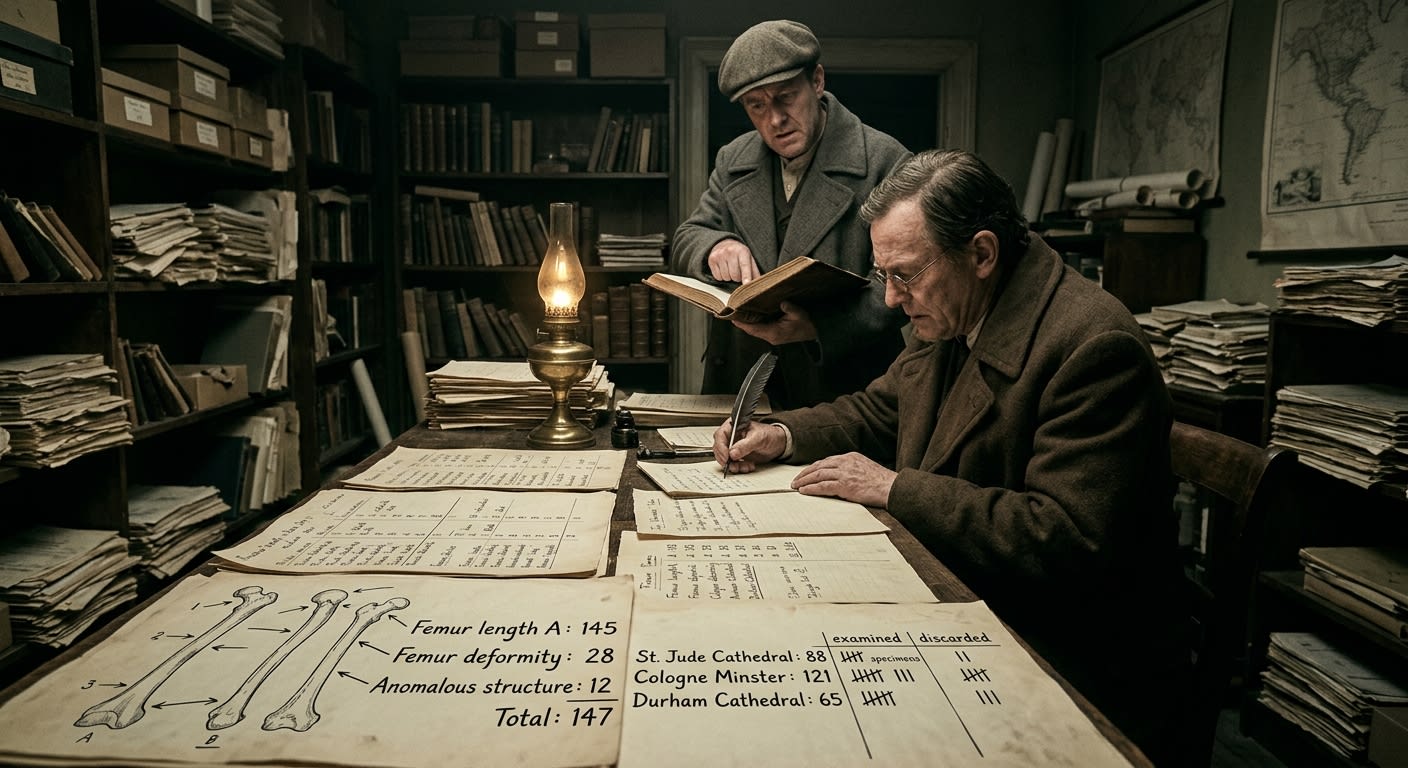
Their method deserves scrutiny, because their method became the template for everything the Rationalists would later refine into a continental weapon. Van Hoorn — the eldest of the three principals, a man whose correspondence survives in the Forbidden Stacks under quadruple seal and whose handwriting the Bureau's graphologists describe as "annoyingly legible" — conceived the campaign in the winter of 1677. The premise was arithmetic. The Church had been authenticating relics of Saint Aldebrand for three centuries. Each cathedral, each parish, each wayside shrine that possessed an Aldebrand relic held it to be genuine, sole, and irreplaceable. The cathedrals of Cologne alone held seventeen femurs. Seventeen. Each notarized. Each certified authentic by the local diocese. Each described in its provenance ledger as "the only true femur of the Blessed Aldebrand."
Van Hoorn counted them. All of them. Every Aldebrand relic in every known registry across the German states, the Lowlands, northern France, and the Swiss cantons. His final tally — preserved in a document the Bureau calls "the Bone Census" and refuses to release — listed two hundred and forty-three distinct relics attributed to a single saint. Forty-one were femurs. Nineteen were skulls. Twelve were hands, left and right distributed without anatomical regard. The remainder comprised ribs, vertebrae, kneecaps, and a collarbone that appeared in three separate inventories simultaneously.
The arithmetic, as I have conceded in the parent entry and shall concede again here because the Bureau's position on this matter is unambiguous, was correct. The theology was catastrophic.
#On the Letters Themselves
"A pamphlet is a sermon preached by the absent to the literate. The Amsterdam scholars preached to forty cities in a single season, and the pews emptied before the dioceses understood what was happening."
Van Hoorn, Lemstra, and de Waal did not publish a book. A book sits in one place. A book can be seized, banned, burned by the local bishop's staff before it reaches the congregation. The Amsterdam scholars understood distribution — understood it, one might argue, with the instinct of merchants rather than theologians, which is precisely the point, because merchants know that the value of a thing lies in its movement, and the value of a doubt lies in its reach.
They wrote letters.
The campaign was launched in the spring of 1678 — March, by the surviving postal records, though the Bureau of Records has retroactively filed the start date as "irrelevant, as the campaign itself is classified as non-existent." The letters went to universities, parishes, town councils, merchant guilds, print-houses, and any man of education whose address could be obtained from Amsterdam's extensive trading networks. Each letter was handwritten — the scholars employed no fewer than fourteen copyists, three of whom were, according to the Bureau of Purity's retroactive investigation, former seminary students, which gives the whole enterprise a pleasingly incestuous quality.
Each letter contained the same core document: a tabulated list of every known Aldebrand relic, its holding institution, and its provenance claim. Below the table, a single paragraph of commentary. Van Hoorn's prose — and I have read his prose, in the Stacks, wearing gloves, in the candlelight the Bureau permits for classified documents — was restrained to the point of lethality. He did not mock. He did not rage. He asked questions. How many femurs does a man have? If the answer is two — and the anatomists of Leiden had confirmed that the answer is two — then what are the other thirty-nine? He asked this question gently. He waited for the reader to do the arithmetic. The arithmetic did the rest.
Appended to the letter was a shorter document addressed specifically to the holding clergy — a formal request, couched in the language of scholarly inquiry, for each institution to explain how its particular relic could be authentic if forty other institutions held identical claims. The request was phrased with such elaborate courtesy that refusing to answer would constitute an admission of fraud, and answering would constitute an admission that the question was legitimate.
The trap was elegant. I say this as a man who builds traps professionally.
#On the Church's Response
"The Church of 1678 was not the Synod. It had no Bureau of Records, no Bureau of Purity, no apparatus for the co-ordinated suppression of inconvenient truth. It had bishops. Bishops, in my experience, are the administrative equivalent of elderly dogs: loyal, noisy, and catastrophically slow to react to events that require anything other than barking."
The letters arrived. The damage was immediate and decentralized, which made it worse. A centralized attack can be met with a centralized response. A campaign of forty simultaneous pamphlet deliveries to forty cities across five countries requires forty responses from forty dioceses that had never co-ordinated a response to anything more complex than a shared feast-day calendar.
Some bishops ignored the letters. This was the worst possible response, because silence, in the context of a specific arithmetic challenge, reads as concession. Parishes whose bishops stayed silent found their congregations asking the question themselves — "How many femurs?" — and receiving no answer, which is the answer that doubt prefers.
Some bishops condemned the letters. This was the second-worst response, because condemnation without rebuttal is a confession wearing a miter. The Bishop of Münster publicly burned Van Hoorn's letter in the cathedral square and declared the scholarship "an affront to the Almighty." His congregation, being possessed of the native intelligence the Bishop evidently lacked, noted that burning the letter did not reduce the number of femurs.
Some bishops — a minority, and the Bureau's retroactive assessment classifies them under "Praiseworthy Instinct, Insufficient Execution" — attempted to answer the question. The Diocese of Trier published a twelve-page response arguing that the multiplication of relics was itself a miracle, a physical expression of the saint's generosity extending beyond death into his very bones. The argument was, in its way, magnificent. It convinced nobody. The Diocese of Cologne tried a different approach: they acknowledged holding seventeen femurs and declared, with a straight face and a bishop's seal, that all seventeen were genuine, because "the authentication of relics is a matter of faith, and faith is not subject to arithmetic." The Bureau of Relics, a century later, would adopt this exact position as policy and stamp it into the Authenticators' Manual. Cologne was ahead of its time. This is the only charitable thing I shall say about Cologne.
One response deserves particular note. Father Grauss of Düsseldorf, parish priest of Saint Eligius, upon receiving the Amsterdam letter, ate it. The entire document. The copyist's handwriting, the tabulated bones, the polite arithmetic — consumed, chewed, and swallowed in the presence of his sexton, who testified to this act thirty years later during the Synod's retroactive inquiry. Father Grauss was beaten by the local Rationalist magistrate for "destruction of scholarly correspondence." He served three days in the municipal gaol. He did not recant. He did not explain. When asked by the magistrate why he had eaten the letter, he replied: "It was addressed to me." The Bureau has since classified Father Grauss as "Doctrinally Sound, Gastronomically Irregular."
#On the Erasure
"The reliquary was declared non-existent. The reliquary, being a relic and therefore subject to the laws of Providence rather than the laws of filing, persisted."
The central hierarchy's response — the response of the old Holy See of Vienna, such authority as still cohered in the decades before the Rationalists dissolved it at swordpoint — was the one the Bureau now claims as its own, though the Bureau did not exist for another century and twelve years. The response was erasure.
The decree survives. It was filed retroactively in the Bureau of Records at the Concordat and stamped with the Bureau's seal — a seal that could not have been applied to a document written in 1678, a contradiction the Bureau resolves by noting that "the seal authenticates the filing, not the authorship, and filing is eternal." The text reads: "The object designated 'Reliquary of Saint Aldebrand' does not appear in current Bureau inventories and is therefore classified as apocryphal. Inquiry into apocryphal objects is discouraged."
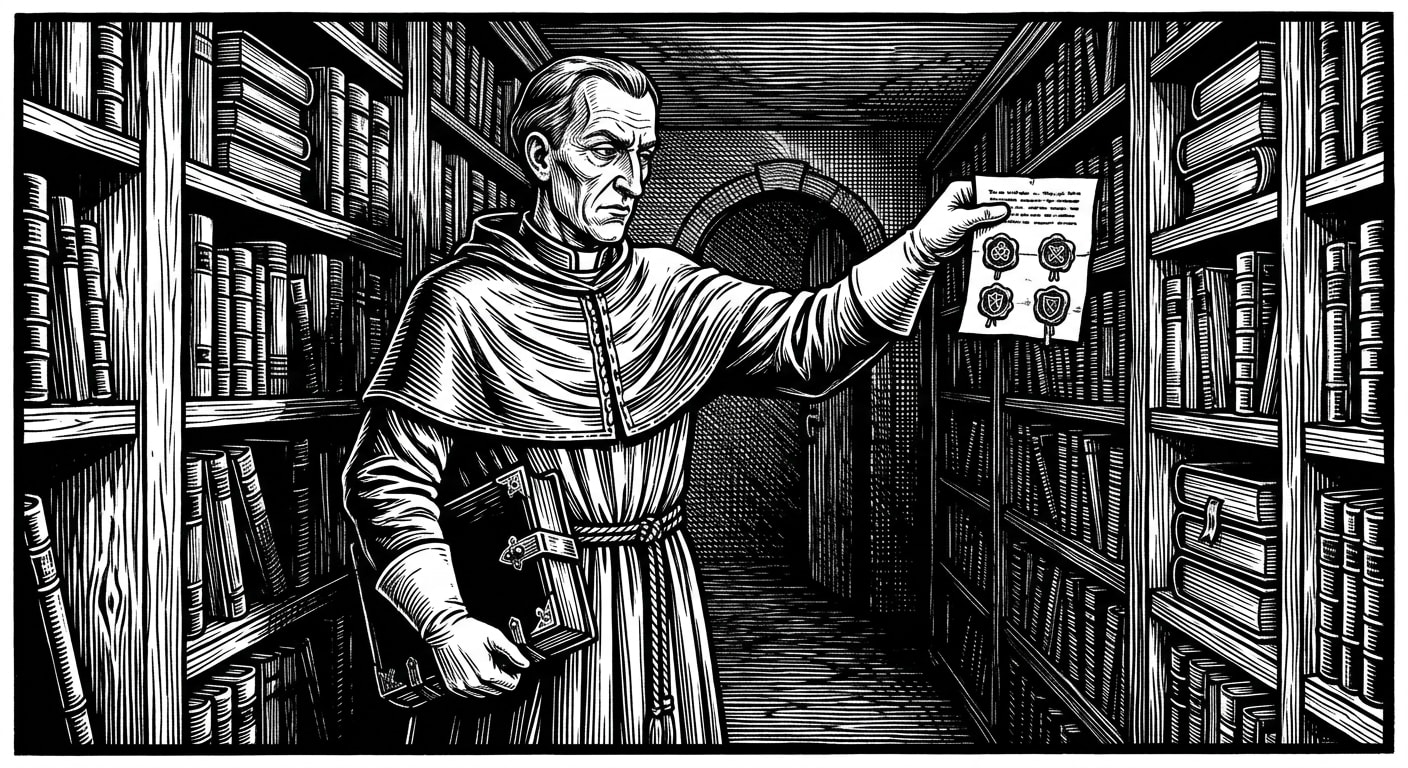
The language is institutional. The impulse was panic. Faced with Van Hoorn's arithmetic — arithmetic that counted two hundred and forty-three relics where anatomy permitted perhaps thirty — the central hierarchy chose the one strategy that addressed neither the excess of bones nor the deficiency of explanations. They declared the subject of the inquiry non-existent. The reliquary of Saint Aldebrand was struck from every inventory. The provenance ledgers were sealed. The pilgrimage receipts — thousands of them, spanning three centuries of the faithful visiting, paying, praying, and departing — were gathered, bundled, and removed to a storage vault in Vienna whose location the Bureau of Records now classifies as "predecessor infrastructure, access restricted."
The erasure was comprehensive. Parish records mentioning Aldebrand pilgrimages were amended. Shrine inventories were rewritten. The Custodial Chain — the ledger that tracked a relic from its point of authentication to its current reliquary — was severed. In the space of four months, the central hierarchy accomplished what Van Hoorn's letters had merely suggested: it removed the Reliquary of Saint Aldebrand from the official record entirely. Where Van Hoorn had argued the relic was false, the hierarchy argued the relic was absent. The distinction matters. A false relic is an embarrassment. An absent relic is a filing error. And filing errors, unlike embarrassments, can be corrected retroactively — as the Bureau would later demonstrate at Vienna, when the absent relic blazed with divine fire and shattered a sorcerer-lord's skull, at which point the filing error was reclassified as a miracle and the miracle was stamped AUTHENTIC / NON-EXISTENT / ONGOING.
The reliquary itself — the actual bone in the actual reliquary in the actual vault of the Cathedral of Vienna — was not destroyed. It was not moved. It was not touched. It sat in its case, undocumented, un-inventoried, unlisted, officially nowhere, glowing faintly when the candles guttered. A custodian — unnamed, unranked, unrecorded in any surviving ledger — continued to polish the case. The polishing is not documented. The cloth used for the polishing is not documented. The glow is not documented. None of it happened, according to every official record. All of it continued.
Earlier editions of this entry credited the erasure to "the Bureau of Records acting under Standing Order 7-A." This is anachronistic. Standing Order 7-A was not drafted until A.S. 92. The erasure was performed by the diocesan hierarchy of the Holy See of Vienna under the authority of Archbishop Rupert III, whose name the Bureau has since reclassified as "predecessor personnel, designation reassigned."
The correction is noted. Archbishop Rupert III's role is acknowledged and simultaneously absorbed into the Bureau's institutional lineage. He was not Bureau. He is now Bureau, retroactively. The Bureau's genealogy, like the Bureau's calendar, runs backward as far as convenience requires.
#On the Consequences for the Faithful
"The queues thinned. The coins stopped. The candles in the Aldebrand shrines burned lower, and nobody replaced them. That is what a letter does — it does not break faith; it makes faith expensive."
The material consequences were immediate and measurable, because faith, whatever its spiritual dimensions, has an economy, and an economy can be tabulated even when a miracle cannot. The Aldebrand pilgrimage network — a web of shrines, way-stations, hostels, relic-viewing chapels, and souvenir workshops stretching from Cologne to Ulm to Vienna — contracted within a single season. Shrine records from the Cologne cathedral chapter, seized during the Concordat and now filed in the Bureau of Tithes' archive, show a forty-one percent decline in pilgrimage traffic in the year following the pamphlet campaign. Forty-one percent. One letter from Amsterdam. One table of bones. Nearly half the faithful stayed home.
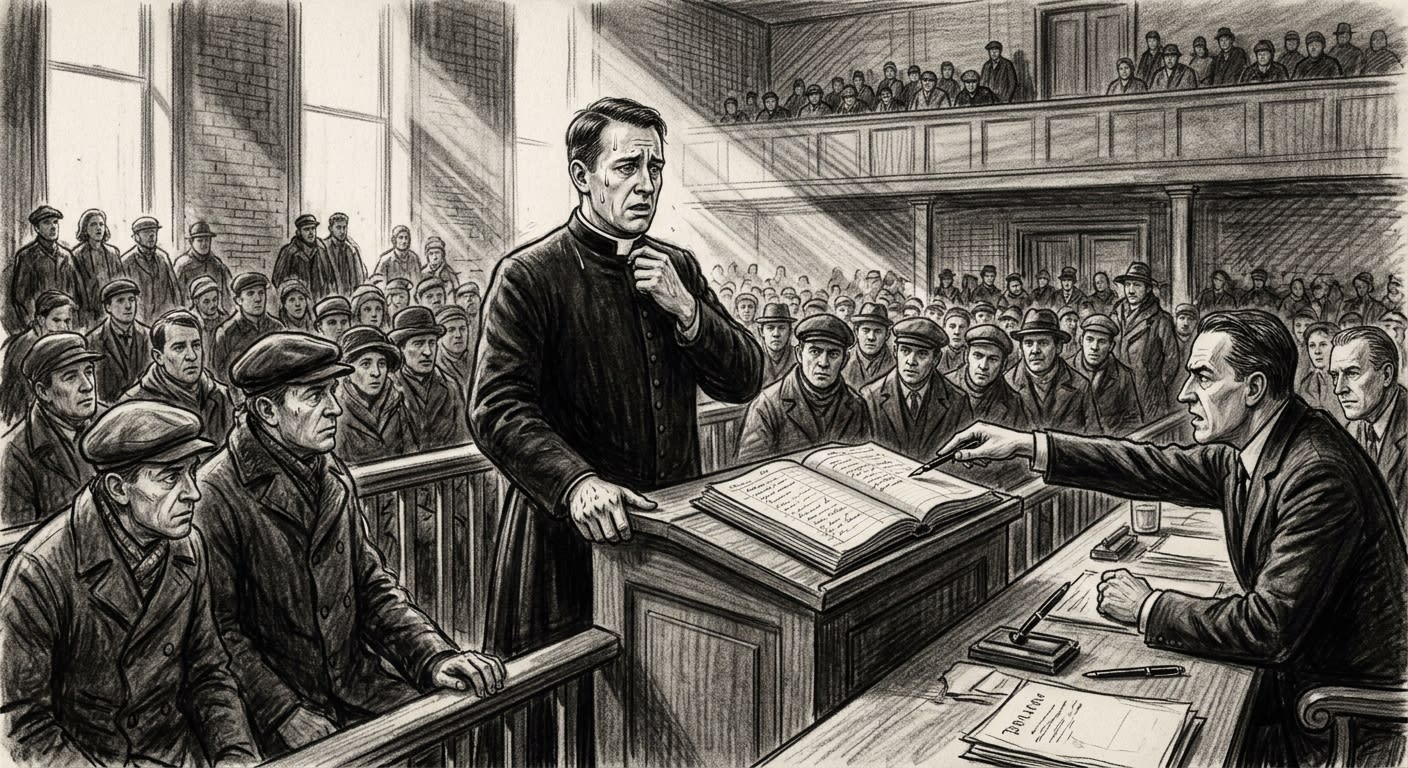
The secondary effects were worse. Priests who had sworn authenticating oaths upon Aldebrand relics — oaths binding under canon law, oaths that staked their parishes' reputations and their personal integrity on the genuineness of the bone in the box — found those oaths weaponized against them. Rationalist sympathizers in university towns and mercantile centres hauled priests before municipal courts and demanded they reconcile their sworn testimony with Van Hoorn's count. The proceedings were not trials in the canonical sense. They were humiliations. The municipal courts had no jurisdiction over ecclesiastical authentication. The priests had no obligation to answer. But the courts were public, the galleries were full, and the question — "How many femurs does a saint require?" — was the kind of question that sounds funnier each time it is asked, which is the Rationalists' true genius: they understood that theology wilts under laughter faster than under fire.
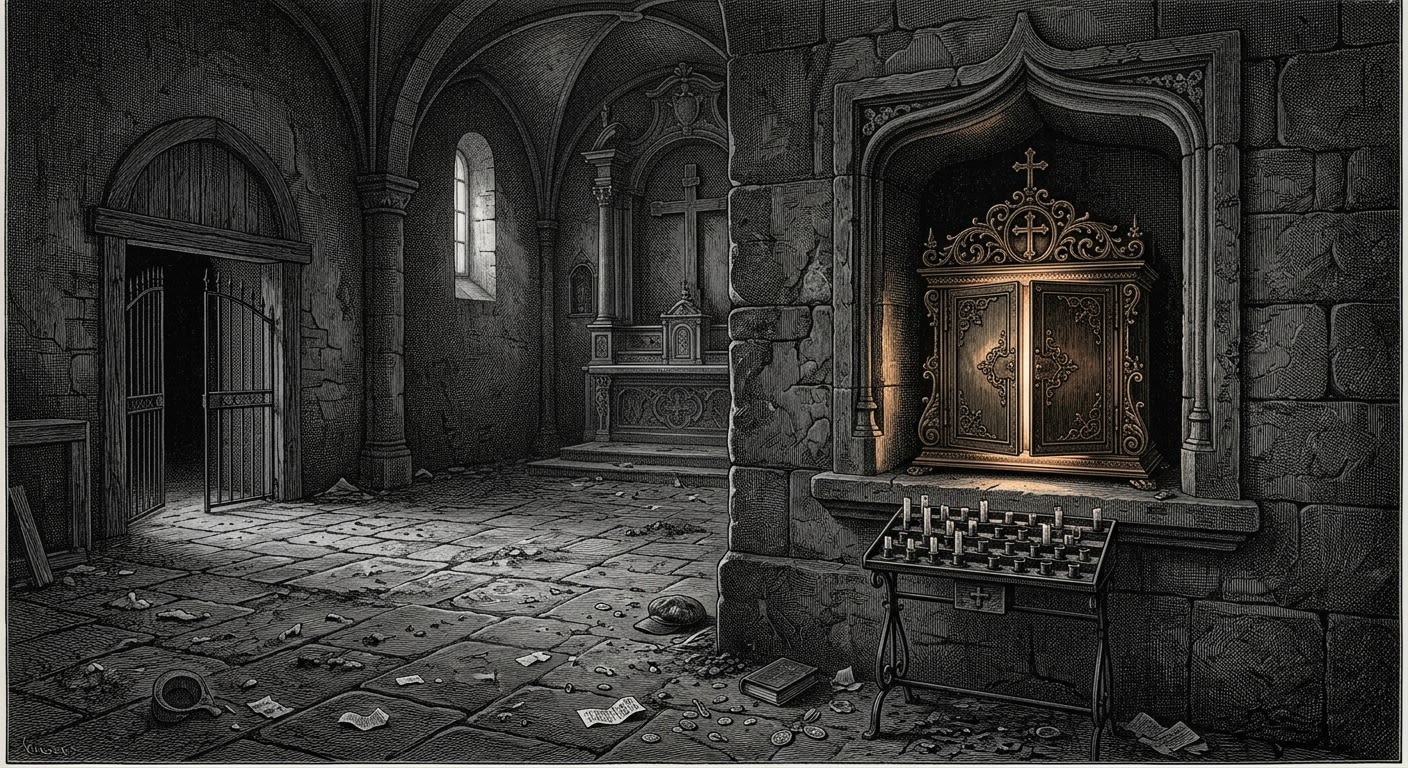
The shrine economies collapsed in sequence. Where pilgrims thinned, revenue thinned. Where revenue thinned, maintenance ceased. Where maintenance ceased, the shrines decayed, and decaying shrines attracted fewer pilgrims, and the spiral fed itself until half the Aldebrand network was reduced to empty chapels staffed by priests who polished reliquaries nobody came to venerate. The souvenir workshops closed. The hostel-keepers diversified into secular lodging. The candle-makers — who had supplied devotional tapers by the hundred-gross — switched to household stock and said nothing about the change.
The Bureau of Tithes, which did not exist in 1678 but which claims retroactive fiscal jurisdiction over all pre-Synod shrine revenue under the Concordat's Seventh Provision, has calculated the total economic loss of the Aldebrand pilgrimage collapse at approximately fourteen thousand guild-marks per annum — adjusted for conversion, inflation, and the Bureau's customary fifteen percent administrative surcharge on historical calculations. Fourteen thousand marks. One letter. One table. The Rationalists spent less on postage than the Church lost in a single quarter's shrine receipts.
#On the Letter's Longer Shadow
"The Year of Letters did not end in 1678. It has not ended yet. Every pamphlet the Bureau of Purity confiscates in a bastion dormitory, every broadsheet seized at a checkpoint, every scrap of forbidden arithmetic found in a cadet's footlocker — all of it descends from Van Hoorn's table. The Rationalists did not invent doubt. They industrialised it."
The Amsterdam campaign's true damage was methodological. Van Hoorn had demonstrated that the apparatus of faith — the authentication chains, the provenance ledgers, the notarized oaths — could be attacked with its own tools. He had not argued theology. He had not questioned the Creator. He had counted bones. And the count, being a count, could not be refuted by anathema or dismissed by episcopal decree, because a number is a number and a femur is a femur and forty-one of them in one city is forty-one of them in one city regardless of how many seals you stamp on the inventory.
This was the template. This was what the Academy refined over the next thirty-two years into De Vera Luce and the Concordats of Ulm and the entire philosophical apparatus that the Rationalists would deploy against the old Church and then against the faithful and then against the Creator Himself. Van Hoorn's method — count, tabulate, publish, distribute, ask politely, and let the arithmetic do the killing — was the seed of everything. The Atheist Wars were fought with clockwork artillery and Republican Guards and the Broken Cross banner, but the first shot was a letter. A polite letter. A letter that asked how many femurs a saint needs and waited for the silence that followed.
The Red Slaughter of Lyon preceded the Year of Letters by seven years — Republican militias massacring friars, ashes dumped in the Rhône, the river whispering psalms for three nights. That was violence. Violence the Church understood. Violence could be met with martyrdom, with counter-violence, with the whole apparatus of suffering that the faithful had perfected over centuries. The Year of Letters was something else. It was arithmetic. And the Church had no defence against arithmetic, because the Church had spent three centuries authenticating relics without ever asking whether the authentication system itself could survive a simple count.
The Sundering answered the Rationalists. The Siege of Vienna answered the Rationalists. The Reliquary of Saint Aldebrand — blazing in the fist of Clemens Stahlhand, a bone the Church had erased and the Rationalists had mocked and the Bureau had filed under three contradictory headings — answered the Rationalists in fire and iron and the pealing of bells. But the Year of Letters had asked a question, and the question has never been answered. The Bureau has stamped it. The Bureau has sealed it. The Bureau has filed the question under "Resolved — Do Not Reopen." But the question — how many bones does one saint need? — persists, like the glow in the Vienna vault, like the warmth in the leather covers of De Vera Luce in the Forbidden Stacks, like all things the Bureau declares resolved and that decline to comply with the declaration.
#On the Bureau's Position
"The Bureau's position on the Year of Letters is that the Year of Letters occurred, that it was heretical, that its consequences were managed, and that the Reliquary of Saint Aldebrand was at no point affected by events that the Bureau has classified as non-events affecting an object the Bureau had classified as non-existent. This position is coherent. This position is stamped. This position is doctrine."
I have been asked — by the same species of clerk who asks all questions the Bureau would prefer unasked — whether the Year of Letters proved anything. Whether Van Hoorn was right. Whether the bones are pig.
The Bureau's answer is this: the Year of Letters proved that the Rationalists could count. Counting is a clerical function. Clerical functions belong to the Bureau. The Rationalists performed an unauthorized clerical function and are condemned accordingly. The content of the count is irrelevant. The bones of Saint Aldebrand are authenticated by Bureau seal. Bureau seal supersedes arithmetic. This is doctrine. This is policy. This is the reason the Bureau of Relics employs authenticators rather than anatomists.
The bones glow. Seventeen femurs glow in Cologne. Two reliquary maces glow in two cities simultaneously. A finger-bone glows inside the Vault of Ten Thousand Keys, where Velmora's architecture eats desire and the chaplain who reached for it was absorbed into the display case. An attestation of pig bone does not glow. An attestation of pig bone does not shatter sorcerer-lords. An attestation of pig bone does not ring the bells of a ruined city of its own accord.
Van Hoorn counted bones. The bones, when it mattered, declined to be counted.
This entry previously included a speculative appendix listing all forty cities that received the Amsterdam pamphlet, with notes on the civic response in each. The appendix has been removed at the Bureau of Records' request, on the grounds that "dissemination of a heretical distribution network constitutes incitement, regardless of temporal distance."
The author observes that the Bureau's refusal to publish the distribution list guarantees that every unauthorized historian in the Theocracy will now spend considerable effort reconstructing it. The Bureau, when informed of this observation, responded with a memorandum consisting of the phrase "Noted. No further action." I have filed the memorandum. It sits beside the blank page that constitutes the complete record of the original Miracle. They keep each other company.