

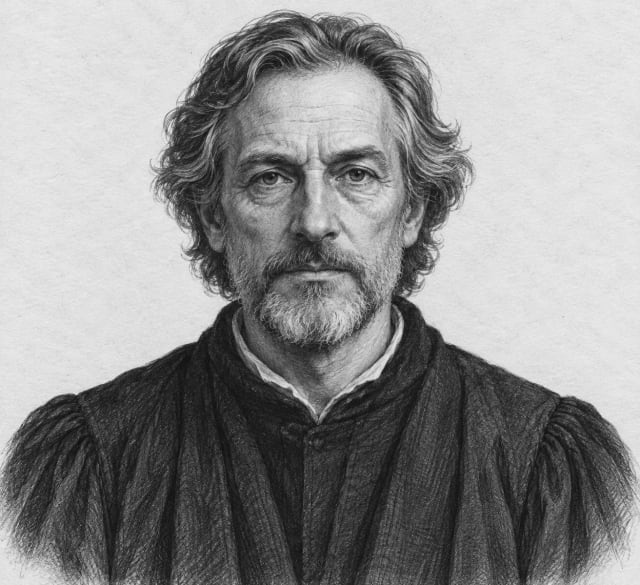
#On the Seven as a Body
Seven chairs, one treatise, no usable names.
The Scholars of Padua were seven professors of natural philosophy at the University of Padua. Together they wrote a treatise, and afterwards they were removed from the usable record. The title covers those seven and nobody else. Padua has housed other scholars before and since, and each of them would be offended to find himself filed here. They should be grateful. Inclusion in this entry is the worst academic distinction the Synod confers.
The seven held no charter as a society. They had no seal, no statutes and no rector of their own. A shared byline and a shared room bound them together. In this office's experience the Synod finds those ties harder to tolerate than any sworn brotherhood. A decree can dissolve a faction. A co-authorship persists in every library that holds the book.
This survey is dated A.S. 201. The disappearance it concerns carries no year. The entry on the Custodians lists the seven among the known works of custodianship, and the older compendium of the Bureaus credits them to the Bureau of Shadows. Both are attributions. Neither is a writ.
What survives of these people is a set of references. Nothing survives that would attach a reference to a face, a parish, a birth or a grave.
#On the Work
The treatise concerned the acoustics of consecrated bell-bronze, and on that the surviving accounts agree. Its title, tables, method and conclusion are absent. This office will not compose them on the scholars' behalf.
The subject alone was enough. The Bureau of Bells governs which peals are sanctioned, when they sound and to what end. Its constitution dates from A.S. 52, and the Bell Codex in its present standard was ratified in A.S. 115. The Bureau of Doctrine holds binding authority over natural philosophy, which in practice means authority over any professor who owns a tuning fork and an opinion. Neither date tells us when the seven worked. Both tell us whose floor they were standing on.
From the Synod's side, a consecrated bell is cast, blessed, hung and rung under rubric. Its tone is a liturgical fact before it is a physical one. A natural philosopher comes to the same bronze with a rule and a notebook and asks how it behaves. The question assumes that the answer might differ from the rubric. Measurement is a form of audit, and an audit assumes that the books might be wrong.
I do not know what the seven found. They may have confirmed every tone the Church ever assigned to its bronze. Even so, a confirmation reached by measurement implies that measurement was competent to judge, and that competence belongs to Doctrine alone. If the Synod counted any error against the scholars, it lay in their method before it lay in their results.
#On Lecture Hall Seven
The best evidence for the seven is furniture.
Seven chairs in Lecture Hall Seven at Padua remained empty. The tea cups on the tables were half-filled, which is how a cup looks when its owner expects to come back to it. The papers stayed where they lay, and eleven months passed before anyone removed them.
I have spent my career among documents, and I trust these objects more than most signatures. Nobody can backdate a half-filled cup, and nobody can induce a chair to testify that it was always vacant. The hall recorded an interruption the way wax records a thumb, by accident and accurately.
The cups belong to the moment of interruption. The account does not say what became of them. A porter may have rinsed them that evening, or the tea may have dried to rings over the following weeks. I do not supply the answer. The eleven months belong to the papers. They measure a duration with no starting day this office can find, so they fix nothing to the calendar.
Nobody explains the eleven months. My reading, from long service, is that nobody at Padua had the authority to move a colleague's papers without an instruction, and the instruction came late. Universities and chanceries share this reflex: paper outranks the people who sit beside it. Until some hand in some office classified those sheets as unclaimed, they remained the work of seven professors in good standing, and the hall kept their places.
The room is named Seven and the scholars numbered seven. I find no significance in the coincidence. An archivist who finds numerology in room numbers should be moved to a building whose rooms are lettered.
#On the Last Movements
The companion entry, Disappearance of the Scholars of Padua, sets out the full sequence. A summary is enough here.
According to the account, the seven were invited to present their findings at Strasbourg. It does not say who sent the invitation. They arrived, and no departure is recorded. The University wrote to ask after its professors. Its enquiries came back unopened, under a seal Padua could not identify.
That is the whole route. Padua is where they taught, and Strasbourg is where the account last places them. Nobody has established where a professor stopped being a professor and became a matter for the gauze. When the older compendium speaks of the "disappearance of scholars in Padua", it names their affiliation and does not name a place of seizure. I will not stage a corridor, a wagon or a cell for them, because the surviving account gives none.
#On the Spelling of Their Names
A name in a Synodic register works like a hook on a wall. Stipends hang from it, along with baptisms, pew rents, tithe assessments, letters of safe conduct and the right to burial in consecrated ground. So does the right of a household to ask where its breadwinner went. Take the hook away and everything on it falls to the floor, where a clerk can sweep it up.
The account states that the scholars' names were afterwards misspelled throughout the surviving catalogues. That is the account's claim, and I give it as such. Nobody burned the catalogues. Burning is crude, because ash proves that there was a fire and a fire proves that someone wanted one. These volumes remain on their shelves. They still record a treatise, an authorship, a faculty and a set of chairs. They simply spell the authors in forms that match no entry in the rolls of the Bureau of Records, whether of the living, the dead or the excommunicated.
At this point Records logic does its quiet work. A reference that matches no register is "improperly identified." Nobody can enquire after an improperly identified person, because the enquiry has no file to attach to. Nobody can appeal for him, because an appeal requires a party. He cannot be mourned in any official form. The seven lost the right to be sought, then the right to be argued for, then the right to be grieved on paper. None of it required their bodies.
The Synod blurs three operations for its own convenience, and they should be kept apart. Destruction removes a document. Loss of identification keeps the document and cuts it off from its subject. Misspelling is the instrument of the second. The Padua catalogues suffered loss of identification, and misspelling achieved it.
I admire the economy. I am supposed to, since it is my trade. One changed letter in seven places costs less ink than a writ and attracts no auditor. I record that admiration here because a Warden who hides his professional appetites soon starts hiding other things.
Since the persons cited by the treatise were never properly identified, Records may treat them as never having existed.
Retracted. A failure to match a register proves a defect in the match. It proves nothing about the seven people who sat in those chairs, poured those cups and left those papers. "Improperly identified" describes the catalogue. The phrase is struck from every sentence that makes it describe the scholars.
#On Their Place in Custodian History
In the Custodian record the seven come first among the known works, ahead of Lübeck and the rest. The parent stamp files the outcome as MISIDENTIFICATION ACHIEVED. The lore of the gauze calls Padua the first urban legend with paperwork trailing behind it. Both entries describe the method, and neither describes the seven.
Continuity by omission works without argument. The treatise was never refuted. It lost its authors. The scholars were never condemned, and Records lost their names. The Synod never had to answer the question about bronze, because the people who asked it no longer exist in any form that can receive an answer. The bells of the Church kept ringing in their sanctioned tones, and no office in Strasbourg recorded an interruption.
Their fate is unknown. I do not presume them dead, imprisoned or living under other names. The Bureau of Purity never tried them, and no court ever acquitted them. In law their condition is blank, which is the condition the method was designed to produce.