

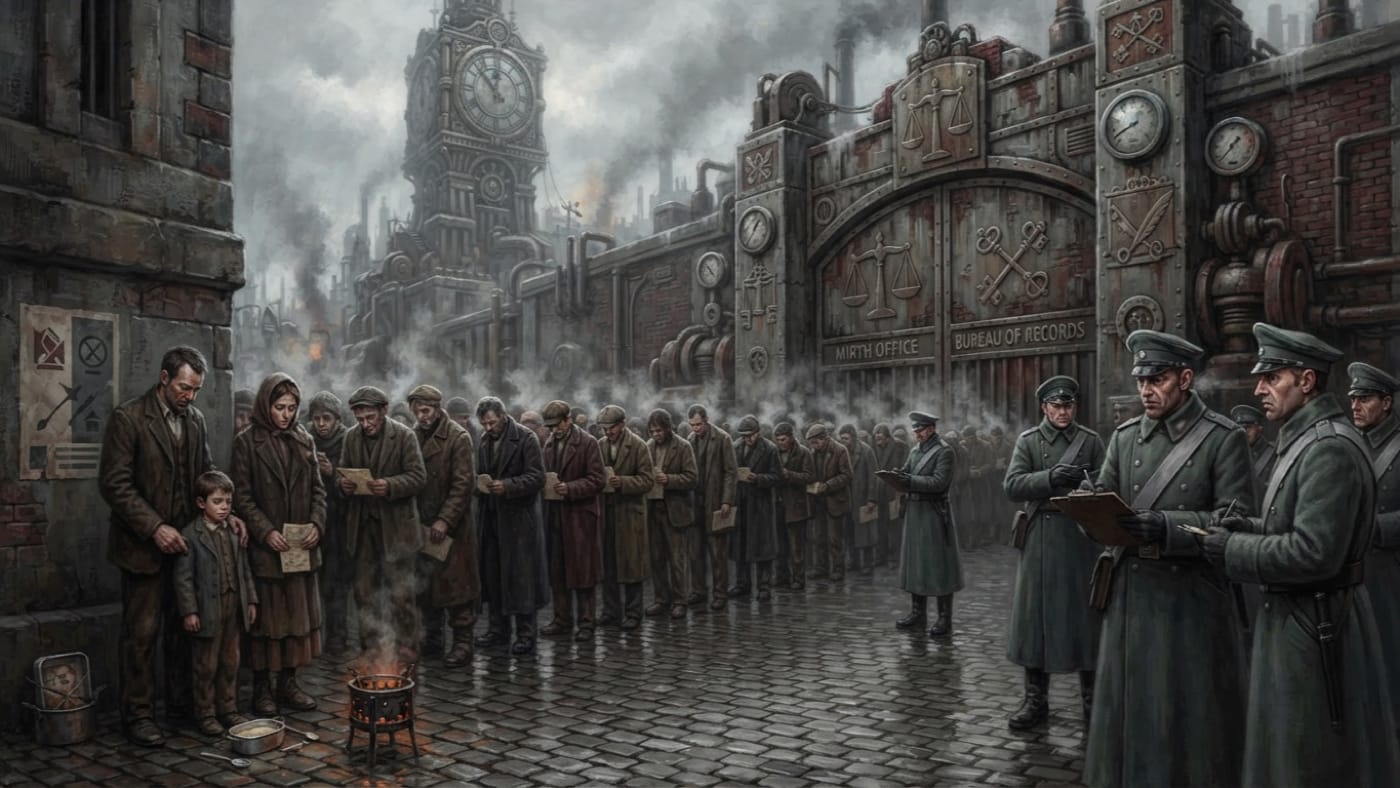
#On the Minute Before the Meal
"A smile is a receipt." — Wexel proverb
In the Grain-Gray Ration Parliament of Wexel, food waits. Before each meal comes the Silence Minute. Spoons rest, mouths close, and the people at the table listen for unlawful laughter, their own included. The porridge loses a minute of warmth. In a ration town that is a cost, and it is borne without complaint, since complaint is assessed separately.
That is the household form. Joy Discipline places it at the family table, between the measured portion and the first mouthful, and the household form keeps no record of its own. A family that hears nothing eats. A family that hears something has been handed exactly the problem the Minute exists to create: it must now decide whether to remember.
The public form keeps records. Before the noon ration at the Scale Gate, the line stands with chits held out in both hands and eyes lowered to the iron, and an inspector of the Mirth Office listens on the town's behalf. At home the household listens to itself. At the Gate an officer listens to the household. The difference is a grey sash and a pen.
Wexel speaks of the observance as devotion. Its documented function is surveillance. No surviving instrument dedicates it to the dead of the Dust Fire, and I will not supply one. The Minute has been put to enough uses already without my lending it a piety it never filed for.
#On the Emergency That Remained
"A joke can burn a house." — Wexel proverb
Wexel was founded in A.S. 98 (1808 CE), after a Hessian famine killed eleven thousand and the Bureau of Records resolved to build a town whose whole purpose was counting food. In A.S. 112 (1822 CE) the Dust Fire went through the wooden silos and killed three hundred and forty people. Records counted them. The Bureau of Doctrine explained them: the catastrophe arose, it held, from "reckless behaviour," and within weeks the phrase had grown to cover singing and running near the bins. No surviving finding shows that a song ever lit a single mote of flour. Doctrine never asked for one.
The Ration Prefecture was constituted within the month. Joy discipline was declared temporary. Eighty-nine years on, it is still temporary, with the stamina that only a convenient emergency has.
The Minute is the quiet half of that discipline. The other half talks. Every week at Mirth Rollcall each household reports its gratitudes aloud, and the Office marks the ones delivered too flatly. A host must serve each portion measured, and a guest must praise it. Wexel requires the mouth at one hour, forbids it at another, and charges either failure to the same account.
The smile gauge, that hinged brass spoon laid against the corners of a face, belongs to the same apparatus. It measures width in millimetres. It cannot hear a laugh, time one or say whose it was. For that the Office relies on the ear, the one instrument in its service that no auditor can calibrate.
The rite first appears in use six weeks after the fire. That is when a surviving file first mentions it, and a surviving file is the only kind of birth Records recognises. When it was actually instituted, by whom and in what words, the archive does not say.
#On Three Breaths of Evidence
The earliest attestation is Case 112-MO-44. A mill hand named Orven Tesch was charged with laughing during the Silence Minute before the noon ration. The inspector assigned to the Scale Gate entered his finding in a single line, and it has been quoted ever since because it is the only sentence in the case that sounds like a measurement.
Read it the way Records reads anything that will later be used against a household. "From subject direction" gives a bearing, and at the Gate a bearing runs through the accused, through whoever stood behind him, through the chains and the sacks, and out over a basin. "Duration three breaths" is a count taken by an official who was, it follows, breathing through the Silence Minute. "Tonal quality: genuine" is a verdict on the inner life of a noise, entered in the column where a number belongs.
Against that line stand thirteen denials. Tesch said he did not laugh. Twelve witnesses said they did not hear him laugh. Their statements are narrower than they look. They vouch for thirteen pairs of ears, and none of them can vouch for the whole noon. Neither do they name anyone else. The file establishes an allegation and a disagreement, and the inspector's version is the one carrying a seal.
Tesch paid in labour-hours. The record does not give the number. Payment is no confession; in Wexel a man settles a citation for the same reason he presents his chit with both hands, because the alternative is to be examined at length. His household allotment was cut for two weeks. The record does not say by how much, or how many mouths the ledger counted, only that every one of them ate less.
Within the year the Office was citing "airborne mirth." Records objected that air keeps no household ledger and cannot be summoned to tribunal. The objection lasted eleven days. Parliament then approved an amended schedule of fines that ranked wind-borne laughter with open flame near grain dust, which in that year needed no argument. Records accepted the fee structure, Doctrine endorsed it, and Tesch's fine was upheld retroactively. The question of who owned the sound had been the household's only defence. Parliament settled it by declaring that it did not matter.
A Ration Prefecture bulletin of A.S. 113 states that citations for wind-borne mirth began only after the Mirth Office received formal authorization.
Incorrect. The citations came four months before the authorization, which was then backdated to stand in front of them. The bulletin's date belongs to the bulletin. The instrument's true date remains under the Bureau's care, where it has been made to agree with everything.
#On the Minute That Lasts Three
Wexel has weather that listens back. The Chaff-Winds, which the Bureau of Rites classifies as a Category One Localized Atmospheric-Acoustic Disturbance, carry laughter across the basin and return speech with its parts rearranged. A cellar joke in Canalback may come back across Parliament Square from the wrong side. A clerk's "six" may arrive at the line as "seven." The parent account reports that the wind answers genuine amusement in particular. The Bureau has not determined whether that is so, and nor have I.
Among the countermeasures recorded against it is this one: after harvest, Silence Minutes are lengthened to three minutes.
The rite keeps its name. No surviving document records who ordered the extension, in what year, or by what reckoning the end of harvest is declared. What the record does establish is the result, which sits on the same list as salt lines at cellar doors and wax plugs in keyholes, under the heading of things that did not work.
The arithmetic deserves a moment of professional admiration. A sound that crosses the basin does not wait for the interval. It arrives when it arrives, from whichever direction the gust prefers, and it lands on whoever happens to be standing still with closed lips and lowered eyes in the place an inspector is facing. Three minutes of listening give the wind three times the opportunity and the inspector three times the bearings. They add nothing to attribution. An honest line at the Gate is a row of mouths shut on command, and in that row the wind can pick any of them.
The ledgers took their own view. Beside Tesch's citation the ink dried into a loop curved like a mouth. The next seventeen entries in sequence carry similar loops. Who stood in those entries, and for what, belongs to other files. In that historical ledger the loops sat beside the text and left the figures alone. They were never a remission, and nobody at Wexel has been able to rely on them as one.
#On Present Observance
"The ledger eats last." — Canalback proverb
The Minute ends where everything in Wexel ends, in the household account. An allotment is one figure in one book, sealed in tallow-wax at the Chit Anointing, and that figure does not know which mouth at the table was accused. The machinery that reaches it is divided among three offices, each lawful on its own. Sister-Lector Neme Varr's inspectors write the mirth mark. Prefect Marwen Kile's Ration Prefecture holds the grain and decides whether it is entered as provision or as clemency. Speaker Huld Bex keeps the audit lists. A laugh alleged at noon can therefore become a lighter sack and a debt of labour-hours without any of the three needing the others' consent.
Wexel's wider regime goes further. Unpaid fines become debt, and debt can become a foreclosure writ under flame seal. That road belongs to the town's system in general. The surviving record ties no particular Silence Minute to a burned house, and I will not do it on the record's behalf.
The wind gained no standing as a witness. The Mirth Office advisory revised in A.S. 199 (1909 CE) puts the matter in four lines, the first of which is the one that matters at the Gate: wind-borne laughter is not exculpatory. I examined the Office's citation ledgers that year. The loops were still there, and the Minute was still being kept.
As of A.S. 201 (1911 CE), the household falls silent over its porridge before each meal, the noon line at the Scale Gate falls silent over its chits, and after harvest the silence runs to three minutes. The Chaff-Winds remain Category One. Unlicensed laughter remains actionable, wherever it came from.
Then the household eats, and the portion is whatever the ledger left.