

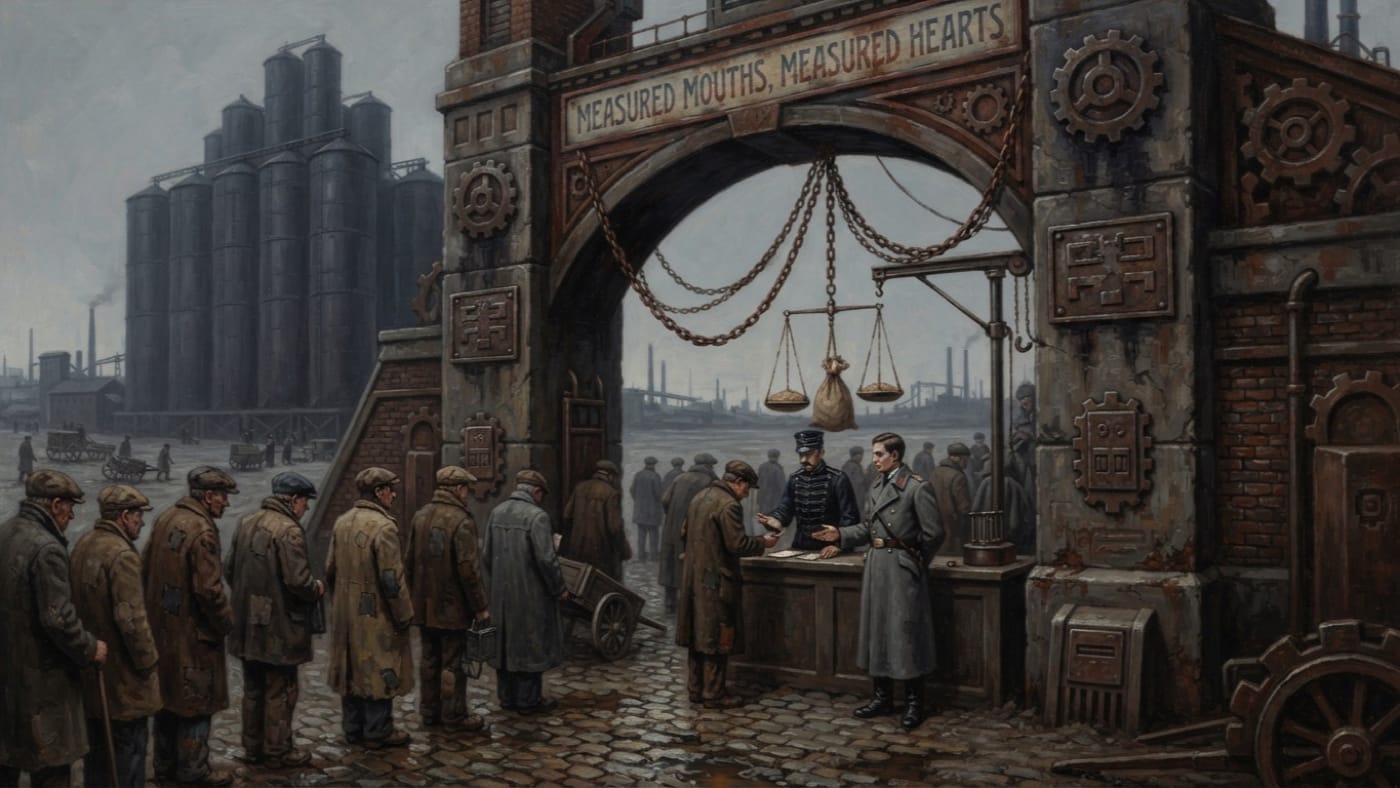
#On the Gate and Its Approaches
"Measured mouths, measured hearts." (Inscription above the Scale Gate, paint renewed quarterly by civic mandate)
The basin around Wexel is so flat that a cart can be seen long before it is legal. There is wheat, then irrigation canal, then windbreak, then wheat again. Over the civic centre stand the fourteen steel silos of the Silo Crown, like a choir that has been told to hold still. Travellers from the west come in by the Queue Road. Grain moving to and from Lorn goes by the rail spur. Anyone who arrives on foot or with a handcart, and wants to eat lawfully afterwards, has to pass one of two road chokepoints. One is the Chit Bridge over the irrigation canal. The other is the Scale Gate.
The town has given one name to four separate things, and the records keep them apart. The Gate is the checkpoint: the opening, its inscription, its guards and its chains. Scale Gate Ward is the district of pale brick, weigh-stations and inspection tables that surrounds it. The Scale Gate Weighline is the worksite where every sack entering or leaving Wexel goes across the iron. The Scale Gate Authority owns the scales, the seals and the guards, and it would like the other three to be thought of as its furniture.
The inscription over the opening is repainted every quarter. Iron chains hang below it. None of the papers I was allowed to read says how many chains there are, how long they are, or what they were first hung to hold. They catch the wind, and on most mornings that is all they do. When there is disorder, the Gate becomes the town's defensive choke, and the guards who keep the passage open are the same guards who shut it.
Nobody recorded when the Gate was built, and nobody recorded the warrant under which the Authority first took its place behind it. Wexel was founded in A.S. 98 / 1808 CE, after the Hessian famine killed eleven thousand people across three provinces. The Dust Fire of A.S. 112 / 1822 CE left the town with steel silos and a regime of discipline. No one with a seal has attached either date to the Gate, and I will not be the first to do it.
#On Passage and Inspection
"Hunger teaches holiness." (Ration Prefecture broadsheet, distributed at every Scale Gate checkpoint)
The Gate opens with the Weighline, at dawn, when the hymn bell rings. The Scale Benediction is sung over the iron before anyone lifts the first sack. Then the line begins to move.
The approach has an etiquette, and the etiquette has reasons behind it. At the Gate the eyes stay lowered. Household papers and ration chits are held out with both hands. A clerk of the Authority reads the papers. Next to the clerk stands an inspector of the Mirth Office, in a grey sash and holding a brass smile-gauge, and the inspector reads the face. The sack goes up on hemp rope, the balance clanks, and the stylus presses the quantity into wax. A citizen is read three times in about a minute. The papers, the face and the grain each report to a different master.
It matters which master owns which reading, because in Wexel the division of labour is what makes the system work. The Authority weighs, seals, confiscates and controls the passage. Sister-Lector Neme Varr's Office issues citations for expressions. Prefect Marwen Kile sets the household allotment that a mark made at the Gate will later cut. Speaker Huld Bex presides over the Parliament and its name lists, from which audits are drawn. The Ash-Fine Marshals work elsewhere, in the Ash Fines District, with writs and torches. They are not Gate guards. The Gate has never needed them at the threshold, because all it has to do is begin the entry.
Some goods may not cross in either direction: unregistered grain, blank chits, unauthorized joke sheets, unsealed ink, mirth stimulants, and religious texts the Synod has not approved. Some goods may be offered in their place: extra flour, clean paper, or another person's name put forward "for review." The Authority accepts all three. No record states what any of them buys on a given morning, and in A.S. 194 no clerk would quote me a rate. Passage costs whatever keeps a mark off your papers today. The name you paid with stays in the apparatus, and tomorrow it may be traded for yours.
If a face looks too pleased with its grain, the household can lose part of its allotment for "suspect abundance." The reasoning is simple: anyone who looks fed has been fed too much.
#On the Certified Measure
The Authority's placards promise honest weights. The dedicated survey of Wexel records that the weights are tuned for favoured families. A tuned iron gives a favoured household's grain one reading and an unfavoured household's grain another, and the Gate stamps both with the same seal.
The Authority calibrates its scales every week. It carries out the calibration and certifies it too. When I toured the Gate in A.S. 194, the Bureau of Alchemical Standards had asked for independent verification nine times. Each request had been filed as "received." I read the receipts, and they were properly sealed. A receipt is a clerk's note that paper arrived, and no one has ever mistaken one for a weight. The sources open to me record no independent audit after that tour.
So the seal at the Gate certifies the Authority's account of a sack, a chit and a household. That account goes on to the Bureau of Records and the Ration Prefecture, and it becomes the household's history. The citizen at the iron holds other evidence: how heavy the sack felt on the walk in, how light the ration felt on the walk out, and the neighbour whose sack looked the same and was entered differently. None of this is admissible. All of it is remembered.
There is pressure on the threshold from below as well. The Grain Keepers keep false-bottom bins, altered spoilage accounts and forged chits, and each of these contradicts the Gate's arithmetic. The record does not show any Keeper route through this particular opening. The Authority searches as if one ran through it anyway, and a search made on that assumption always turns up something to confiscate.
#On the Citation at the Gate
The oldest incident preserved from the Gate concerns a sound.
Case 112-MO-44 was filed six weeks after the Dust Fire. Orven Tesch, a mill hand, was charged with laughing during the Silence Minute before the noon ration. Tesch denied laughing. Twelve witnesses denied hearing him laugh. The Mirth inspector assigned to the Scale Gate recorded "audible mirth from subject direction, duration three breaths, tonal quality: genuine." Tesch paid in labour-hours, and his household allotment was cut for two weeks.
Read the finding exactly as it was written. "From subject direction" puts the sound near Tesch without putting it in his mouth. Twelve citizens swore they heard nothing from him, and none of them named anyone else. The inspector's ear and the witnesses' oaths cannot both be a complete account of the same minute. The file sided with the ear, as files do. The record does not establish who laughed. It establishes exactly who paid.
The citation is also older than the authority it was issued under.
A Ration Prefecture bulletin of A.S. 113 records that citations for unlawful mirth began only after formal Mirth Office authorization.
Incorrect. Citations came four months before authorization, and the authorization was backdated afterwards. The Bureau of Records has certified the resulting sequence as "administratively continuous." Case 112-MO-44 remains upheld.
The regime introduced in A.S. 112 was temporary. It has now been temporary for eighty-nine years.
#On the Chains and the Present Passage
"If the wind laughs first, don't answer with yours." (Wexel superstition, officially discouraged and privately obeyed)
The Chaff-Winds blow across the basin all year. They carry chaff, grain dust and the clatter of silo metal, and along the Gate's chains they carry more. The testimony gathered in Wexel agrees on three points. Laughter travels along the chains. A grain order spoken at the Scale Gate can come back from the Silo Crown as a question. A child stifling a laugh at the Chit Market has heard it come out of the Gate chain as a bright metallic titter, well away from the child and well within an inspector's hearing.
At the iron, a laughing chain is a problem of procedure. The citizen must not look up. The clerk must not stop writing. The inspector has to decide whose face to read, and every face in reach is turned down.
The Bureaus have given the effect names without explaining it. The Bureau of Rites calls the rearranged speech acoustic refraction. The Bureau of Doctrine calls it non-doctrinal echo. Rites classifies the Chaff-Winds as a Category One Localized Atmospheric-Acoustic Disturbance. That classification applies to the wind. It has never been extended to the chains or the balances, which on paper are still plain iron. No office has settled whether the chains carry the sound, shape it, or simply hang where the wind goes past. The inspectors record it, triangulate it and fail to place it. A laugh that comes out of a chain has no household to cite, so the citation goes to the nearest face.
The present account rests on Wexel's sealed assessment of A.S. 201 and on the Mirth Office's current notices. It is not based on any new visit of mine. According to those papers, the Gate opens at the hymn bell. The Benediction is still sung over the iron, the inscription is still repainted on schedule, the inspectors still stand beside the clerks with their gauges, and the Silence Minute is still kept before the noon ration. The Bureau of Alchemical Standards' requests are still on file as received. Citizens still come in along the Queue Road with their eyes down and their chits in both hands. Above them, on some mornings, the chains repeat what someone in town said where they thought no one could hear.