

#On a Name That Lies Twice
"Victims call it by shorter names when safely below." — Codex tract on the Silent Steps
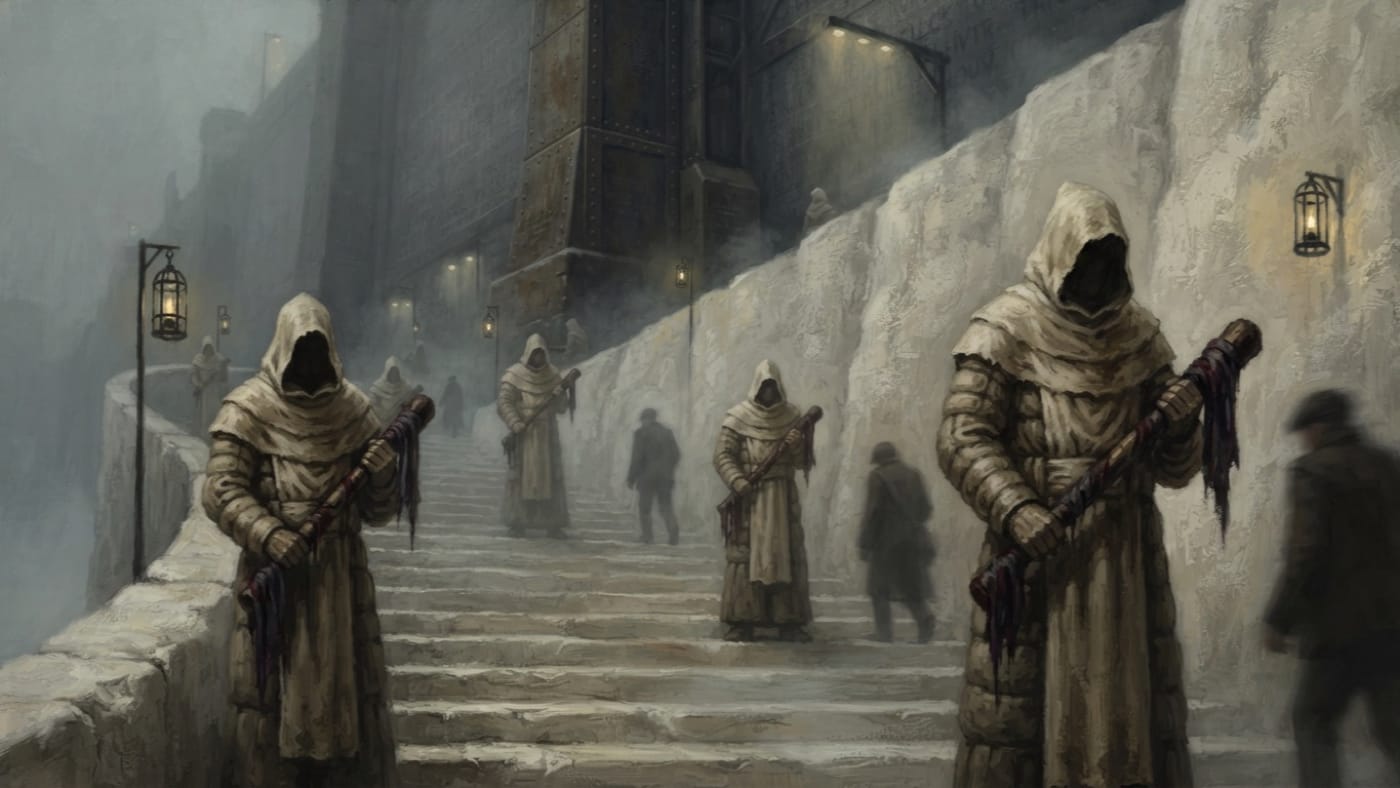
A Silent-Step Monk is a lay enforcer posted on the no-speech approaches near the Script Wall at the Chalk Redoubt of Calais. He wears candlecloth wraps. He carries a cudgel wound with waxed cloth. He corrects anyone who speaks where speech is forbidden, and the correction is called quieting. The title promises more than this, and the rest of the promise is not kept.
The name lies twice. "Monk" promises a house, a rule, a vow, and an abbot to complain to, plus a refectory where the complaint can be ignored over soup. The Codex has none of these on file. It holds no founder, no profession rite, no chapter, no habit and no superior of the order, because there is no order. "Silent-Step" promises that the man keeps silence himself. The record says only that he enforces it on others. The files do not say whether he speaks on the Steps, to whom, or under what licence, and I will not say it for them.
What remains is an occupation. The tract on the Silent Steps called these men "neither monastic enough for piety nor honest enough for police work." I stand by the sentence because it describes a gap, and a gap is all the Codex can show. The Church has many offices that wear borrowed cloth. This one borrowed a word.
#On Candlecloth and the Wound Cudgel
The kit on record is short. Candlecloth wraps the man and waxed cloth wraps the cudgel. The Calais survey lore gives him a candle as well, and stops there. So the Codex adds nothing more: no colour, no badge, no number stitched at the shoulder, no count of men in service, no paymaster.
The published tract states plainly what the wound cudgel is for. The cloth makes blows land dully and leaves less blood on the white stone. Read that clause twice, because it holds the whole moral arithmetic of the corridor. The wax does not spare the struck man his bruise. It spares the stair his blood, and it spares the corridor the crack of a hard blow, which on a no-speech stair would embarrass the jurisdiction. Wood cracking on bone is noise. A dull blow is administration.
The correction is called quieting. That is the official term and the only one the Codex will print. The tract records that the people corrected use shorter words for it once they are safely below. Below means the Chalk Warrens under the Redoubt, where a man may say what he likes about a cudgel as long as he says it in chalk dust and among friends. The Codex has not collected those words. They are not the kind it collects.
The record does not say how a quieting proceeds, how many blows it allows, where they fall, or who decides when the offence has been answered. The verb is fixed. The procedure is unpublished, and an unpublished procedure has the great administrative virtue that nobody can be accused of departing from it.
The Codex's tract on the Silent Steps stated that at Calais "monks with candlecloth cudgels strike offenders below the ribs to preserve reading voice when useful and remove it when convenient."
Corrected. The record supports a cudgel wound with waxed cloth, dull blows, and less blood on the white stone. It does not establish where the blows fall, or that the monks aim them with any reader's voice in mind. The earlier sentence gave the cudgel a doctrine. All the cudgel has on file is its wrapping.
#On the Calais Approaches
The monk's post makes sense only beside the wall he guards. The Script Wall writes names in fog, and those names must be read aloud. The reading is compulsory. Speech is the rite's fuel and its proof. A few paces off, on the approaches, speech is forbidden.
According to the Codex's published account, these approaches were declared no-speech corridors after the Unread Uprising of A.S. 187, when organised refusal of the night readings was broken. Records puts the beginning of the post-Uprising quiet in that year and books its continuance under every year since. That date belongs to the corridors. The file does not say whether the first man in candlecloth took his post that year, the next, or ten years on. The Codex will not lend him the Uprising's date to tidy his record.
The wardens call a violation acoustic disturbance. The Warrens call the corridors traps. Both words describe the same stair, and each is accurate in its own register. The Calais lore lists speaking a name on the Silent Steps among the forbidden things, and its local rule adds that this includes your own name. At the Wall a reader pronounces a stranger's name because he is commanded to. On the approach a passer-by may not pronounce his own. If he does, the man in candlecloth answers him.
The Unread made the corridors necessary in the Bureau's eyes, and they keep them awkward. A heretic who refuses to read falls silent. A monk who forbids speech enforces silence. The law files the first as refusal and the second as custody. Down in the Warrens they observe that from below the two silences sound alike. Both observations are on file. Only one of them carries a cudgel.
#On the Mountain, Where the Batons Are Different
The Reliquary Switchbacks have their own stretch of Silent Steps. It runs between the fourth turn and the fifth, on the path from the Shrine-Court of Seven Nails up toward the Switchback Inns. The Court licenses the segment. It is enforced by Warden-Captain Bronn's wardens, whose recorded instruments are nail-batons and slates. Speech there is fined. A protest against the fine is more speech, so it is fined again, and the second fine leads to a confession. The method is on file under the Court's name, and the Bureau of Records receives the paper.
Nothing on file calls those wardens Silent-Step Monks. No record puts candlecloth on the mountain or waxed cudgels in the Court's stores. No record joins Bronn's men and the Calais enforcers into one body under one command. The two corridors share an idea, and they share what happens to people who break it. Their batons differ, and no record wraps cloth around a nail. Readers who want to merge both forces into a single silent brotherhood stretching from the Channel to the passes may do so in their own pamphlets. The Codex does not stock that pamphlet.
The mountain's dates need the same care as the coast's. The Shrine-Court's special dispensation of A.S. 178, granted after the Counterfeit Crisis, gave it power over relic-adjacent offences without appeal to the Registry. The doctrine of the licensed no-speech corridor came later, from Calais after 187, and the mountain copied it. The Name-Drift storms of A.S. 199 gave the Switchbacks Registry fresh reason to care which names are spoken on its turns. None of these years founded the Silent-Step Monks, and none of those events happened on the Calais stair where the monks are recorded.
The Codex's tract on the Silent Steps ended with "a monk" lifting "his candle-wrapped cudgel" over a crying child, in the paragraph straight after the Switchbacks and Bronn's men.
Clarified. The candlecloth enforcers are recorded at Calais. The Switchbacks segment is enforced by the Shrine-Court's wardens with nail-batons. The earlier passage put the two corridors side by side, and a careless reader could carry the monk up the mountain in the space between two sentences. He has been returned to the coast.
#On the Present Survey
This entry is dated A.S. 201, the year of the survey. That date belongs to the survey alone. It founds no order, marks no incident, and says nothing about when the first wrapped cudgel was carried, which remains unknown.
At the time of this survey, the Bureau of Doctrine holds Silent-Step practice authorised under Amber discipline wherever acoustic hazard, relic custody, unstable names or crowd discipline call for it. The Calais approaches are maintained, and the monks are on them. According to the parent tract, the Bureau of Bells, which regards every sound in the Synod as its parish, is often asked to certify a corridor's acoustics after the cudgels have already been ordered. Bells resents this. The cudgels do not care.
Across a few paces of chalk, the Wall demands names and the stair forbids them. The man between them was never a monk. He holds a stick wound in wax so the stone stays white, and no file records whose idea that was.