

#On the Ribbon Line
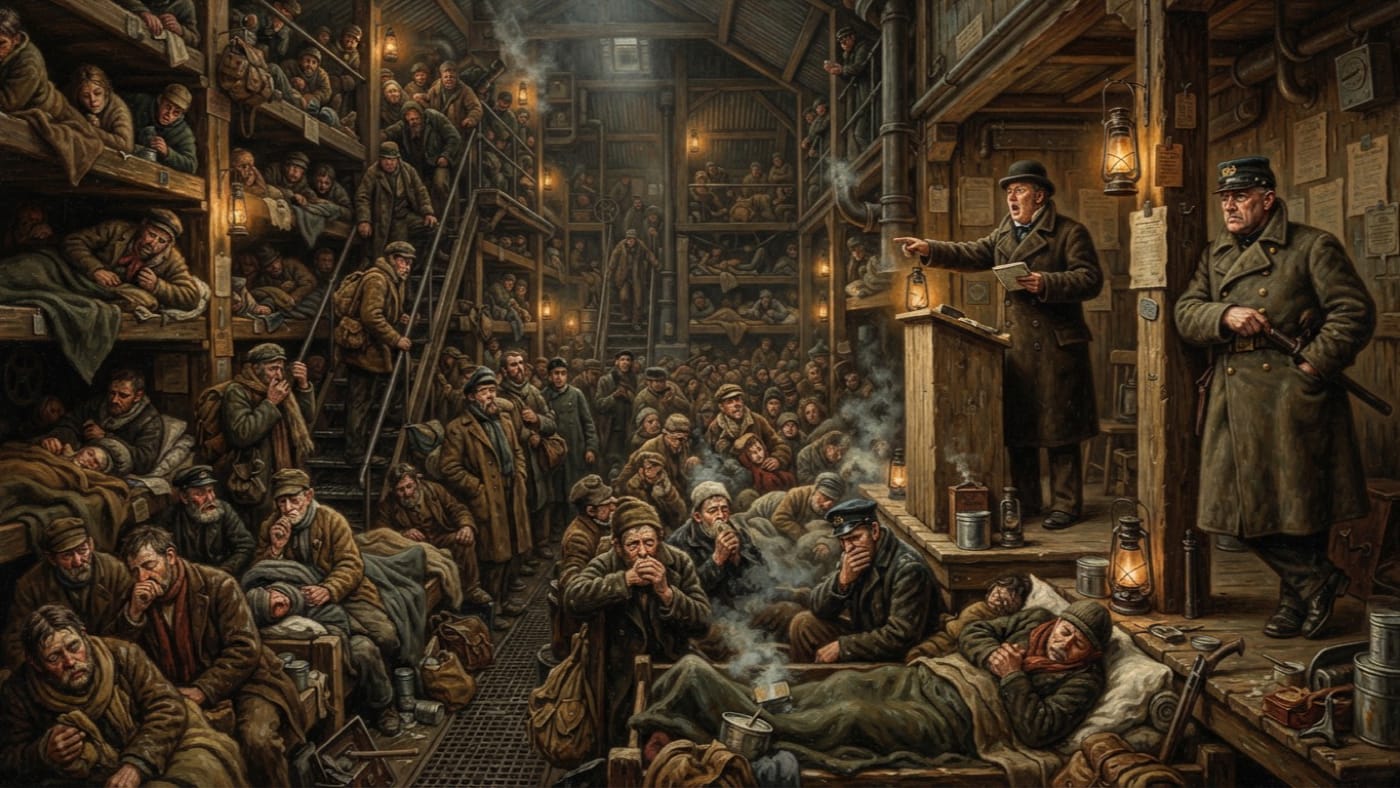
The fifth district of the Reliquary Switchbacks sells the one commodity a mountain refuses to give away. Below it stands the Shrine-Court of Seven Nails, with its licences and its batons. Above it lies the Cairnfield Terrace, where the dead are kept in heaps. Between the two, in a run of crowded bunkhouses that the corridor's registers carry as the Ribbon Line, every pilgrim, porter and freight-hand still short of the summit at curfew must find a roof. Those who cannot will have to make their arrangements with the Creator in the open air.
The Inns shelter every soul the summit refuses.
The approach climbs through the Silent Steps, the fined segment between the fourth and fifth turns. Travellers therefore arrive at the Ribbon Line having already paid for the privilege of keeping their mouths shut. Damp straw is the first thing they smell, then broth, then wet wool steaming off every back in the room. Tallow-wax lanterns hang in the stairwells, and the stairwells are where the corridor gathers when it has nowhere better to stand, which on this mountain means most evenings.
#On the Auction of Warmth
At curfew the catwalk locks close above, the Silent Steps fall under enforcement below, and the inns auction their bunks. Inn auctioneer is a recognised trade on the Switchbacks. Porters say its practitioners price a bunk the way a butcher prices cuts, and porters, who are carried to their graves by the same trade they practise, know something about cuts.
The price moves with altitude access and with the weather. A doubtful morning makes a costly night. When the sky closes, the street adds whiteout rent to the bill, a storm surcharge that falls on everyone, and the innfolk pay the warmth tax, the tallow dues that keep the lanterns lit. The bunk itself is sold by breath. A breath-bunk is a space priced by body heat, with the buyer's own warmth reckoned into the bargain. How that reckoning is done stays between the auctioneer and the body. The Bureau holds no posted tariff, and I decline to invent one to make the arithmetic look civilised.
Warm corners go to the highest bidder. Draughty ones go to whoever is left. Payment arrives in coin, ration chits, stamped papers, bone tokens, oath-notes and Martyr-Credits of varying honesty, and a spare pair of gloves has settled more than one dispute that coin could not.
The rations are blessed before they are ladled. Marrow-thickened broth, hard bread and pine tea feed the room. Warmed wine, cured meat and real sugar feed whoever can afford them, usually where everyone else can watch. The blessing is the same for both bowls, and the Creator has not been asked whether He minds.
The corridor's oldest courtesy holds that a host shares heat first and never promises clear weather. The courtesy survives in the stairwells, where elders are offered glove-warmth and nobody sends a bill. Inside the auction room the rule is kept to the letter: heat is shared first, and payment is taken first of all.
#On the Closed Summit
The Summit Gate seals. The corridor's calendar even keeps a feast for it, the First Snow Seal, on which the summit closes and the debt conversions begin. No other festival on the mountain is so punctual.
Once the top is shut, emergency doctrine on the Switchbacks keeps the climb one-way and locks the inns. Pilgrims cannot go up. Freight stands in the yards. Porters earn nothing while their loads sit idle, and the mules go on eating with the serene indifference of animals who have never signed anything. Every night of closure is a fresh curfew, and every curfew brings a fresh auction. Shelter that cost a chit on the first night costs a pledge by the fifth. The local saying runs that warmth is a currency that spends itself. On the Ribbon Line it spends the lodger along with it.
What cannot be paid is pledged, and the pledge becomes winter debt. Winter debt converts to porter conscription or to shrine service, and repayment takes the forms the corridor always needs: hauling crates, scraping marrow, copying ledgers, repairing the catwalk chains of the Hanging Mile. Defaulters may be nailed to the work-rail until paid. The inns own no rail. They have no need of one, because the debt walks there of its own accord.
The dedicated survey of the corridor puts it bluntly: when the summit closes, the Switchbacks become an altitude prison. Nobody needs a warrant or a cell. A locked gate above and a locked door below do the work, and the wind does the rest.
The Inns shelter every soul the summit refuses.
Corrected. The Inns shelter those who win the curfew auction and can hold their bunks against whiteout rent. The rest take the stairwells. During a summit sealing in a purge, on an occasion the record leaves undated, hundreds died inside the inns of cold and hunger. On the Ribbon Line, shelter is a lease on the room one dies in.
#On Tags and Wardens
The bunk tag is one of the corridor's common documents, filed in the same humble class as the confession slate, the mule health paper and the shrine donation receipt. It ties a body to a bunk on a given night. That is all it does, and it is enough. A tag can prove who slept where, beside whom, and when that person swore to have been somewhere else. On the Switchbacks bunk tags are used for blackmail. Anyone who doubts the trade has never seen a licensed relic dealer go pale at the sight of a scrap of stamped wood.
Three authorities press on these rooms, and the reader should keep them apart, because they are careful to keep themselves apart whenever blame is being handed out. Registrar-Mother Elske Vane's Relic Registry Office governs licences and authenticity, which means it decides whose papers make them real. Warden-Captain Bronn's Shrine-Court governs enforcement. The Porter Guild, directed from the Porter Yards, counts the inns as part of its territory and controls the labour that every winter debt eventually becomes. None of them is on record as owning the Ribbon Line. All of them collect from it.
Inn wardens keep the doors. The corridor's catalogue of institutional violence includes night raids on the inns, and its catalogue of ordinary crime includes ration skimming and kidnapping into porter debt. The second list differs from the first mainly in who signs the paperwork. A pilgrim fined on the Silent Steps may not climb on until the fine is paid or secured against a martyr-credit. That pilgrim arrives at the auction already in arrears, which the auctioneers can smell through the wet wool.
Lung rot breeds in the crowded bunkhouses, and the survey lists plague among the district's hazards. Neither needs a name to be lethal. Straw, breath and the shut door are sufficient. Fasting ought to have wrecked the trade by now, yet it has not, since the room fills again at every curfew.
#On the Ground Beneath
Under the inns lie buried staircases, old shepherd tunnels and unmarked pits beneath the foundations, left by a mountain that was carrying traffic long before the Registry taught it to charge. The corridor's black market works partly down there. It sells forged shrine marks, swapped relic tags and routes the porters call quiet turns. There is one thing it cannot sell, and that is a true summit seal.
The Blank Saints use the crawlspaces under the inns, as they use the backs of the cairns above. Their purpose, according to the files, is to prove the martyr list fabricated and to break the Registry's control of names. Their methods are swapped turn-names and forged Registry slates. The smugglers of the Quiet Turn use the inn basements for another purpose: moving relics and fugitives through the corridor's undersides. The two share ground because the mountain offers little of it. Nothing on file shows a common leader, a common purpose or an alliance. The cartel's own leader remains unknown, and I will not supply one for the sake of a tidier paragraph.
The storms complete the arrangement. When a whiteout pins the corridor shut, the inns fill with people who have nothing to do but listen. The Name-Drift comes in the gusts: a martyr-name carried on the wind that appears on no registry list. Those who repeat it are later called before the shrine courts for crimes they have not committed. The corridor's superstition advises that if the turn speaks first, one should not answer. Its countermeasures include wax-sealing the tongue and walking with a witness who repeats one's true name. A full bunkhouse in a storm is a poor place to practise either, because somebody always repeats what the wind said.
After the storm passes, the Registry enters the name, with a marker and a toll. The Blank Saints accuse it of fabricating such names and of exploiting, or engineering, the storms that justify them. That accusation belongs to them. The Registry certified its martyrological integrity in A.S. 200. The two positions face each other across a floor that both sides have heard creak.
#On the Present Condition
As of A.S. 201 the Bureau of War rates the corridor Amber. It is operational, and the inns are full whenever the weather wants them full, which is more often each season. The storms are growing heavier and the Summit Gate seals more often and earlier. The Porter Guild grows restive, because each early closure converts more winter debt to conscription and turns more of the Ribbon Line into what the porters already call death-houses.
Every turn on this mountain is paid twice, once in coin and once in breath. The fifth turn simply keeps the second payment overnight.