

#On His Station
"Seven keys, and not one of them opens a door." — said of the Warden-Captain in the Porter Yards
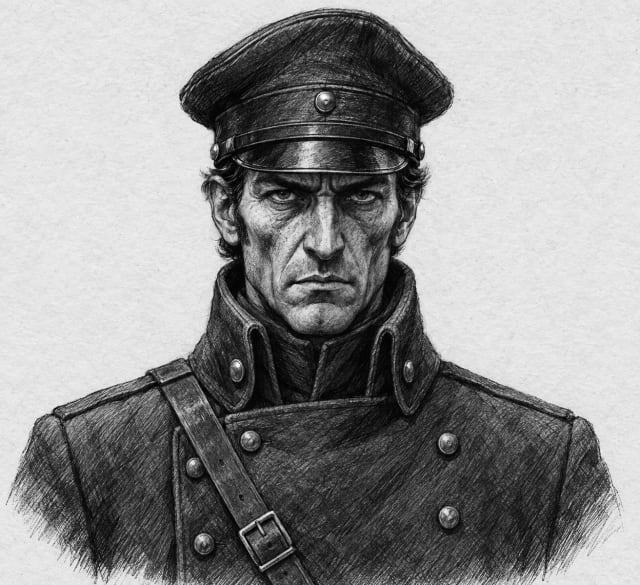
Warden-Captain Bronn commands the Shrine-Court of Seven Nails, and the Shrine-Court commands the middle of a mountain. Its seat is the fourth of the eight districts of the Reliquary Switchbacks, above the Porter Yards and below the Switchback Inns, on a knife-ridge in the Carpathian highlands between the forty-seventh and forty-eighth parallels. The district smells of hot wax and cold iron.
Every relic that climbs from the Turn of Saint Odrin to the Summit Gate comes under his jurisdiction twice. The first time is in the fourth district, where his wardens read its papers. The second is on the Hanging Mile, where his keys decide whether the iron is open. In between, his men walk every turn. On a corridor with one road, whoever polices the road polices the population. Roughly eleven thousand registered souls answer to his batons, whether or not they ever have business before his court.
He carries seven nail-keys on an iron ring at his belt, one for each of the seven locking points on the Hanging Mile. They are the only regalia the files allow him, and he needs no others. A bishop wears his authority on a chain at the breast. Bronn wears his at the hip, where his hand can find it without looking.
What the files do not allow him is a past. I have looked for an age, a birthplace, a regiment, a year of appointment and a predecessor, and found none of them. Nobody has written down whether he came up the mountain as a warden or was sent up it as a punishment. A dossier ought to open with its subject's origins. This one opens with his equipment, because that is where the record opens.
Two more facts are entered against him, and neither is explained. He hates laughter. He fears a crowd panicking on the Hanging Mile. The first is a matter of temperament. The second is a fair reading of a three-foot catwalk over a thousand-foot drop. The record does not say whether the two grow from one root, and I will not invent a root for them.
Carriers, pilgrims, clerks and mules feel his office in their wages, their ribs and their waiting. In the Codex's sense, that makes him a person: someone whose decisions leave both bodies and paperwork behind.
The Codex's survey of the Reliquary Switchbacks stated that Warden-Captain Bronn "hates laughter with a specificity that suggests laughter once cost him something he has not recovered."
The hatred is on record. The suggestion was mine, and no file supports it. No document gives a cause for the Warden-Captain's hatred of laughter or ties it to any loss, incident or year. Readers who repeated the suggestion as biography are asked to repeat it as the Hieromnemon's insinuation. It remains a very good insinuation.
#On the Dispensation
Bronn's power comes in two layers, and the lower one is the duller.
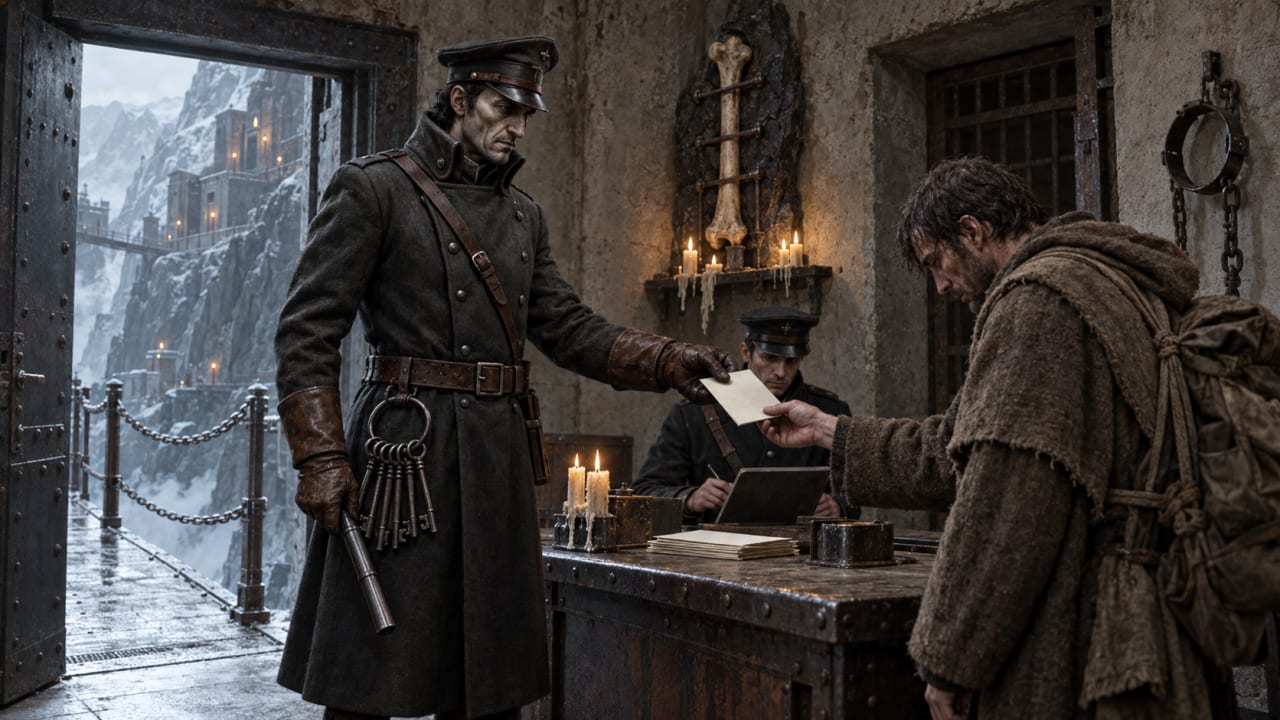
His instruments are older than any record of him. In the winter of A.S. 72 a convoy bound for Przemyśl was lost in the passes. Two years later, in A.S. 74, the wartime logistics offices whose papers now sit under the Bureau of War conducted the Sixth Carpathian Route Audit and widened a shepherd's track into a road. In A.S. 76 an avalanche on what was then the Third Turn killed forty-seven porters and fourteen mules, and the first femur was driven into the shale. By A.S. 82 all eight principal turns had a name, a marker and a toll. The Synod received its constitution at Strasbourg in A.S. 90. The Registry formalised passage licensing in A.S. 92, and in A.S. 94 the Bureau of Doctrine certified the nail-baton as a pastoral correction instrument. None of these dates puts Bronn on the mountain. They give the age of the ring he wears, not of the man wearing it.
In the ordinary course, the Court enforces the paper of the Relic Registry Office. Under the Registry's charter, no relic moves without a Turn License, a Relic Handling Certificate and a confession at each shrine station. The Registry writes those instruments. The Court checks them, and it can revoke them from anyone found abusing them. Revoking a licence and issuing one are different acts. Bronn can tear a licence out of a porter's hand. He cannot write one into it. No warden at the fourth turn has ever stamped a Certificate of authenticity, because those stamps are kept at the Turn of Saint Odrin under the hand of Registrar-Mother Elske Vane.
The upper layer is the special dispensation of A.S. 178. It was granted after the Counterfeit Crisis, a wave of false relics whose beginning and length the files decline to fix. It lets the Court punish "relic-adjacent" offences summarily, with no appeal to the Registry. A carrier convicted of such an offence in the fourth district has no higher desk on the mountain to take it to, and sentence follows judgment the same afternoon. The instrument does not say whether any remedy exists beyond the mountain, in Strasbourg or in a Bureau's correspondence. No porter has made the journey to find out, and a porter who left would have nobody to carry him.
The grant gives the power a date. It gives the man none. Nothing shows that Bronn held the ring in A.S. 178, and nothing shows that he did not. The Court existed before the dispensation and has outlived every annual review of it. The instrument names no person.
Relic-adjacent once meant what a reasonable canonist would expect: theft, mishandling, false seals, putting one bone in place of another. Every annual review since ratification has enlarged the category. It now covers speech violations, unlicensed songs, mispronouncing a martyr's name, giving too little at a shrine, carrying untagged bones, and "demeanour inconsistent with the sanctity of the corridor." That last provision comes with no list. Bronn interprets it at his discretion, and there is no Registry desk where his interpretation can be questioned.
Consider what adjacency means here. Every turn on this corridor carries a martyr's name, a femur and a toll, so every stone on it lies next to a relic. A porter who swears at a strap is speaking beside a bone. A pilgrim who gives too little at a shrine has underpaid a saint. A child who laughs at a mule is displaying demeanour. The dispensation had no need to enlarge the Court's territory. It redefined the ground the Court already held.
The sanctions are listed just as briefly: cells in the fourth district, collars, licence revocation and public nailing.
#On the Seven Keys
The Hanging Mile is the seventh district of the eight. It runs from Cairnfield Terrace to the approach to the Summit Gate Reliquary: a catwalk of iron bolted to a cliff, one mile long and three feet wide, with a thousand feet of air beneath it. A chain rail runs along it. Femur markers are nailed into the rock at intervals of ten paces, and in frost they creak like rigging. Traffic moves in single file because there is no other way to move on it. A porter with a crate takes up the whole width, and a mule takes up more than that.

The rail is locked at seven points, and Bronn holds the seven keys. With them he can seal a section of the Mile at his discretion: in storms, during audits, in purity seasons and under curfew. The Court has not published where the locks are or how a lock closes a section. The Quiet Turn reads the Codex, so I will not guess. It is enough that a section he has sealed stays sealed, however many papers are frozen in the satchels of the people waiting at its chain.
The keys open seven locks and nothing else. The Summit Gate's master seal is not on his ring. The resident custodian of the gate has no name in any file I have been allowed to keep, and I will not hand Bronn the title just because his wardens can walk up to the threshold. The inns keep their own keys. The Cairn Wardens keep theirs hidden on the Terrace and bless every stone above them. Bronn's enforcement reaches the gate. His locks govern only the part of the mountain that hangs from the cliff.
Ordinary speech is allowed on the Mile, and a porter may recite Saint Odrin's name at every marker if he finds it steadies his feet. Song is another matter. Unlicensed singing is an offence in its own right, and it is pursued here on the iron, where nobody can be arrested gently. A warden who wants to stop a hymn on the Mile has to reach the singer first. Everyone between them has to press against the rail while he goes past.
That is where Bronn's recorded fear makes sense. On three feet of iron, a crowd that panics has nowhere to turn. Those at the back push forward, those at the front have no room ahead of them, and the rail is all that holds the line to the cliff. A man who fears that outcome is reading the deck correctly. Nothing on file says he has caused such a panic, survived one or watched one. The fear is entered against his name with no event beside it.
So a closure can be the cautious choice, and it still has a price that gets paid below the lock. The queue stops at the chain and backs down onto Cairnfield Terrace. Porters earn nothing while their loads stand still, and the mules keep eating. The Guild's ration pool is drawn on against wages that are not being earned. The surplus goes down to the Inns, where bunks are auctioned by body heat and a warm corner rises in price with every hour of delay. Whiteout rent falls on everyone and hardest on the porters, who cannot leave without their loads. Each day the key stays on the ring adds a line to the winter debt. When the debt outgrows the wages it converts, into porter conscription or into shrine service.
No document says Bronn owns a bunk, takes a share of the auction or profits from the inns. The ledgers do not need him to. His lock closes, and the price rises lower down the mountain without his touching it.
The corridor has seen worse closures than his. Its history records that the summit gate was sealed during a purge and that hundreds died in the inns of cold and hunger. The history gives no year and no length for the sealing, and it names nobody who ordered it. It was the gate that was sealed, not a section of the rail. I attach none of it to the Warden-Captain, and none of it to the dispensation of A.S. 178. I mention it because every porter on the Terrace knows the story, and they watch the ring at Bronn's belt with that story in mind.
#On the Silent Steps
"Which turn eats the loud?" — "The Silent Steps." — Switchbacks catechism

Between the fourth turn and the fifth, on the stretch of path from the Court up to the Inns, speech is fined. This segment is the Switchbacks' share of the Silent Steps. Bone pins nail its markers into the shale. Its stated purpose is devotional silence. Its working parts are behind the shrine walls on either side, where wardens stand at vents cut into bone-lime mortar and listen. The Marrow Makers render the mortar from bone. The wardens use it to hear through.
The method is on record, and I will set it out once, in order.
A man coughs on the Steps. A cough is sound, the Court counts sound as speech, and speech is fined. He protests the fine, and he is entitled to protest. But a protest has to be spoken, and spoken words on the Steps are a second violation, so they earn a second fine. The second fine calls for a confession. The confession is taken on slate, and the slate is copied to paper. Once copied, the paper goes to the Bureau of Records, which now holds a file on a man whose only voluntary sound on the mountain was a cough. By the time the matter closes he has been fined, has confessed, and has shown by protesting that he understood the boundary. In the Court's reading, understanding the boundary makes the original offence worse.
A canonist will say such a matter belongs before the Registry. It cannot go there. Under the annual reviews, speech on the Steps is relic-adjacent, and the dispensation removed Registry appeal from relic-adjacent judgments. What the cougher has left is a complaint to the Court, and he can only make it out loud, in the one district where anything said out loud is evidence. Bronn calls this procedural efficiency. As a description, I cannot fault it.
On this segment the speech fine is tied to the altitude toll. A pilgrim fined at the lower marker may not go on until the fine is either paid or secured against a martyr-credit. The Court's word is secured, and it chose the word carefully. Paying a debt ends it. Securing a debt only pledges something against it. The published rules do not say whether a secured fine is ever discharged, whether the file is cancelled, or whether the pledged credit ever goes back to its owner. A credit lets its bearer keep climbing in silence. It buys no immunity from the Court. It does not turn a lock on the Mile, and it is no substitute for the Summit Gate Seal. All it does is soften the arithmetic of one fine. The file stays where it was.
The Registry denies that credits are sold, and they are sold. That decides who climbs past the Steps and who stops on them. The rich come up with credits and hired silence guides and pass the lower marker without slowing. The poor learn the rule from their first fine. Porters have worked out their own grammar of hand-signs, boot taps, mule-breath timings and knot codes hidden under their cuffs. The Court has not yet listed any of these as speech. I raise the possibility here so that someone at the next annual review can take credit for it.
Calais is cited in every argument about the Steps, so the chronology needs care. The Calais Silent Steps were set up on the approaches to the Script Wall after the Unread Uprising of A.S. 187, and they gave the device its name and its doctrine. The Switchbacks segment is said to have grown harsher after the dispensation of A.S. 178. These two claims do not conflict. They describe different things. The legal power to punish speech without Registry appeal came first, on the mountain, in a grant about counterfeit bones. The doctrine of the licensed no-speech corridor came later, from the coast, and spread. Nobody has published when the Switchbacks segment was first marked out, and I will not hand it a year from either source. Calais punishes names spoken near a wall that demands names. The Switchbacks punish coughs near a court that collects confessions. The two share an idea, and each spends the revenue on its own.
#On His Character
My sources on Bronn's mind are his habits, his rules and what others say of him. Everything below is my assessment, and I sign it as mine.

He applies pressure. Every instrument I can attach to his name presses on something. The key presses on the queue, the baton presses on the ribs, the fine presses on the purse, and the Steps press speech into confession. He has no recorded gift for persuasion, no sermon on file and no public statement of his reasons apart from the two words he uses for the Steps. When the files describe him, they describe him doing something to somebody.
He is literal. Procedural efficiency is an accurate phrase. The cough really is speech under the rule. The protest really is a second offence. The confession really does follow from the second fine. Nothing in the sequence is improvised, and that makes it worse than improvised cruelty. An improvising warden can be bribed, tired or moved to pity. A procedure carries on without any of those. Bronn has not been recorded explaining himself at all.
He hates laughter. On the Switchbacks laughter is close to a demeanour offence already, and under a commander who interprets demeanour as he likes, the step from close to charged is a short one. The record does not say whether he has had anyone charged for laughing. It does not have to. A corridor where the commander hates laughter learns to stop laughing before the nearest warden can hear, and where laughter stops, the Court has one less thing to fine and the porters have one less thing to keep them warm.
He fears panic on the Mile. Here I have to be fair to him, and I do not enjoy it. The fear is correct. Three feet of iron over a thousand feet of air will not tolerate a crowd losing its head, and a commander who did not fear that would be a fool with keys. A man can be right about a real danger and cruel in the way he guards against it. The two facts do not cancel each other, and I will not let either one excuse the other. Readers may set the fear of panic beside the hatred of laughter and find one dread of uncontrolled crowds beneath both. The guess is reasonable and remains a guess. The files give no causal link, and I have already had to correct myself once in this dossier for supplying one.
He has no recorded childhood, so I will not invent one to account for him. The Court accounts for him well enough.
The Codex's tract on the Silent Steps stated: "Bronn knows nothing beyond pressure."
The Hieromnemon has no access to what the Warden-Captain knows. The record shows him using nothing except pressure: keys, batons, fines, collars, cells, revocation and the nail. The earlier sentence presented a judgment of his conduct as a survey of his mind. It is corrected to a judgment of his conduct, which is harsher, because conduct is on file.
#On the Other Seals
The clearest way to see where Bronn's power begins and ends is to follow a crate up the mountain.
A relic crate arrives at the Turn of Saint Odrin. There, under Registrar-Mother Vane's stamp, it receives its Turn License, its carrier receives a Relic Handling Certificate, and the bones inside are authenticated or refused. Bronn has nothing to do with this stage. Any bone Vane refuses becomes contraband, and his wardens will treat it as contraband on every turn above. He cannot authenticate anything. He can only enforce the absence of a stamp.
The crate then needs a back. Backs are allocated in the Porter Yards by Porter-Master Jaro "Knot" Ilwyn, who assigns the Porter Guild's labour, mules and pooled rations. No porter works without a knot-mark card, and no card is issued without a winter debt pledge. The mules come from the Mulewright Compact, which breeds them in the lower hamlets and keeps the stables and harness shops. Ilwyn allocates the animals and the Compact owns where they came from. Here too Bronn has no place. His key cannot produce a trained carrier, and there is no one to arrest a strike into hauling. If the Guild stops work, the Court's seven keys stand guard over an empty catwalk.
The crate climbs into the fourth district, where the wardens read its papers. It crosses the Silent Steps, where everyone with it keeps quiet. It passes the Inns and Cairnfield Terrace and arrives at the Mile, where it waits for a lock to open or crosses if the lock is already open. At the top it needs the Summit Gate Seal, the final clearance off the mountain, which belongs to the gate and to whoever keeps it.
At each stage one power stops and another takes over. A relic can be authentic on Vane's paper and still sit at the bottom of the mountain because Ilwyn has no porters for it. It can have the paper and the porters and still stand at a lock. A valid licence cannot turn Bronn's key. His key cannot supply a back. No document joins these offices into a council, and I have found no meeting of all three, no treaty and no feud on record. They are three seals on one road, and none of them can move a crate without the other two.
Bronn's reach into the other two jurisdictions runs through punishment. Revoking a licence takes away a porter's Certificate and with it the only work his knot-mark allows. Collars and cells take the porter himself out of the yards. Public nailing is the Court's sanction, and the porters call the display at the work-rail a nail sermon. They mean it as a bitter joke. The Court does not treat it as one. When a winter debt goes unpaid and a carrier is nailed to the work in front of everyone, the debt belongs to the Guild and the nail belongs to the Court. Two offices take part in that act. Neither of them has been required to admit it on paper.
#On the Present Pursuit
The Blank Saints are the heresy cell of the Switchbacks, and the Court's survey gives breaking heresy cells as one of its working purposes. Bronn commands the pursuit. That is the only campaign the file credits to him, and it has not ended.
The cell's methods are clerical. Its members chalk over turn-marks, reverse shrine tags and scratch new names onto femurs during the night. They forge Registry slates with seals stolen from the Registry and wait to see whether the invented entries are accepted. They move when the mountain is closed, because they have learned that a closure holds the wardens at their posts as firmly as it holds pilgrims in their bunks. They work out of the crawlspaces beneath the Inns and from behind the cairns on the Terrace. Their claim is that the martyr list is manufactured and that the Registry exploits the storms, or engineers them, to justify new tolls. That claim is theirs. I report it and do not endorse it, and nothing in my office's files proves it.
Their evidence is the trap Bronn works with. A forger who shows that the Registry accepts forgeries has first shown that he is a forger. Any slate the cell produces might have been written by the cell. The Court does not have to answer the accusation. It reads the seal and charges the hand that held it. The disposition is routine: seized slates go to Records and seized seals go back to the Registry. The dispensation's widened categories do the rest. A suspected Blank Saint can be charged for holding an untagged bone, for saying a saint's name wrongly, or for asking aloud which name he was meant to say. If he asks it on the Steps, the question is entered as a confession.
The names themselves are still open. The Name-Drift was classified, or acknowledged, in A.S. 199. After storms, the Registry enters names that were not on its list before, with a ledger line, a marker and a toll. In A.S. 200 the Registry certified its martyrological integrity, and Records countersigned. The certificate confirms that the ledger agrees with its copies and that the seals belong to the Registry. It does not establish where any bone came from, where any name first came from, or what the wind is doing. Vane has filed a report on the subject. It is conclusive and it is classified, and I have not read it. Nothing on file shows that Bronn has read it either. Whether the Warden-Captain knows how the names arrive, the record does not say. He enforces the list as written.
No capture of the cell's leaders is recorded, and no decisive raid, no public exposure and no final confession. The cell is still active, it has grown bolder, and it is still referred to the Shrine-Court.
Under the iron, a different trade operates. The Quiet Turn runs braided rope and anchor bolts along the underside of the Hanging Mile and uses culverts and inn basements to move relics, fugitives and contraband. When it suits them, its people pass as licensed porters. Its leader is unknown. Its listed methods include bribed wardens, forged marks and false martyr-credits. That some wardens take money is established. No document I know of says the Warden-Captain does. I record that absence exactly as it is. It does not prove him innocent, and I will not turn it into a secret either. His seven locks close the deck and nothing beneath it.
The mountain has few crawlspaces, so heretics, smugglers and porters sometimes end up in the same ones. Sharing a hiding place proves only that the mountain is short of hiding places. No alliance among the Blank Saints, the Quiet Turn and the Guild is on file, and the Cairn Wardens keep their own keys and their own counsel. Bronn pursues the cell along the surface of the mountain with batons and slates. Most of what moves on it is moving underneath.
#On the Present Condition
It is A.S. 201. The Bureau of War Logistics Command rates the Switchbacks Amber, meaning the corridor works, the relic traffic moves, and the deaths stay below a threshold the Bureau raises each year. The rating applies to the corridor. It grades neither the Court nor the Warden-Captain.
The storms are getting worse. The Summit Gate seals earlier in the season and more often. Each new toll-turn that follows a storm is one more stop a porter pays for out of wages he has already pledged. The Inns fill, whiteout rent goes up, and winter debts turn into conscription and shrine service on schedule. The Guild is restive. It has asked for higher pay, and it resists every new levy the moment it is announced. The Altitude Safety Levy, which the Court ratified in A.S. 199, is still current, and the Guild's demand has stood beside it ever since, unanswered, in the same cold yard.
The Court has grown harsher. The category of relic-adjacent offences grows at each review, the Silent Steps go on fining coughs, and the seven keys go on deciding which part of the Mile is passable on a given day. The Blank Saints are still active. The Quiet Turn still sells passage under the deck. The names still come in on the wind, and the Registry keeps entering them.
Bronn walks the Mile with his ring. The record gives him no history before the keys, and it records no reform, no fall and no successor after them. Nothing in his file explains him. All of it describes what he does to other people.