

#On the Shore at the Narrows
Every barrel leaves by the water. The water is kept by other people.
This entry is a documentary compilation prepared in A.S. 201 / 1911 CE for the northern files of the Bureau of Doctrine. It draws on my nine-day compliance inspection at Hrafnvik in A.S. 197 and on the published Codex accounts of the settlement, its Clan Moot, its oil and its lamp. I have not returned to the fjord since that inspection. The year on this page is the year of the compilation. It is not the year anything on the shore was built, inspected or set on fire.
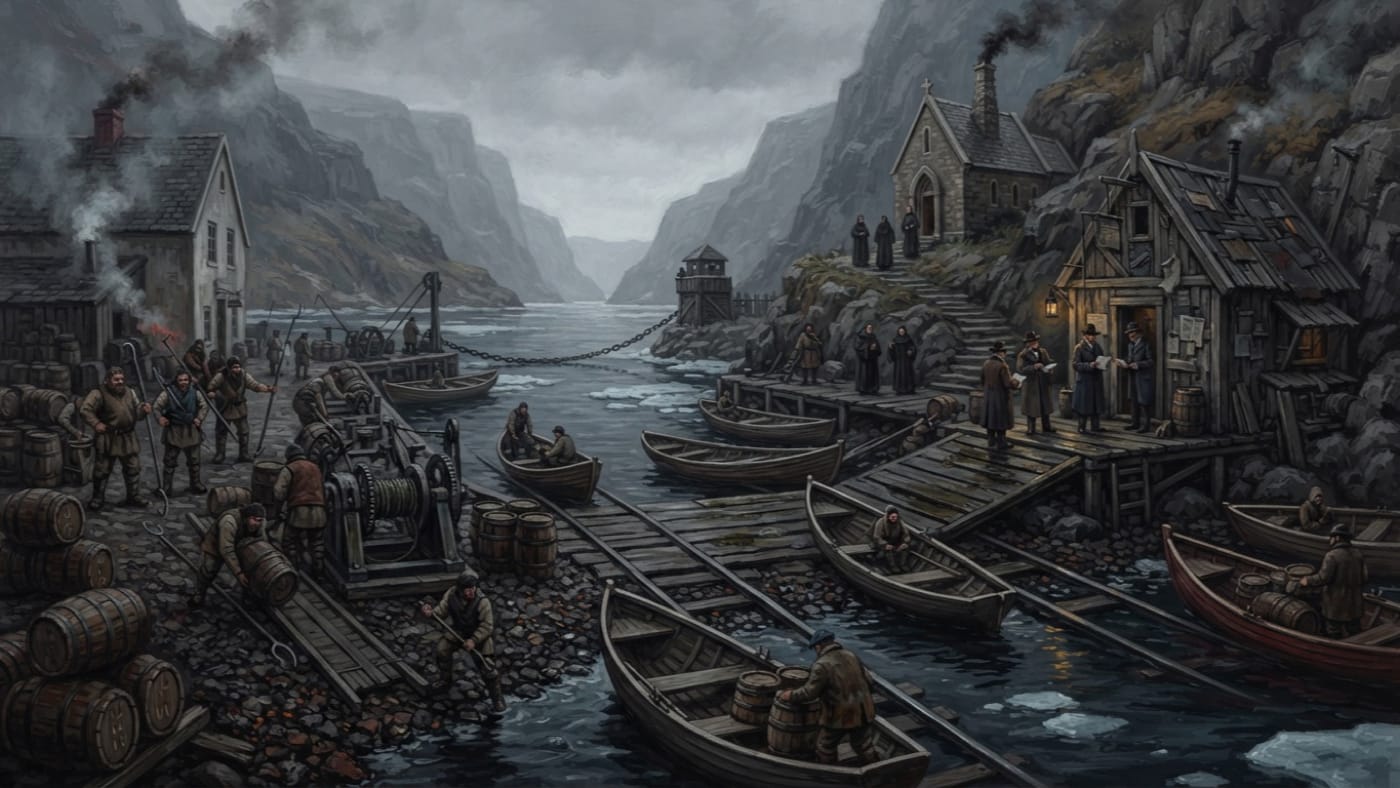
The Slipways are the working shore at the narrows, where Hrafnvik hauls its skiffs out of the water on lines and lets them down again. The settlement's own description gives them two nouns and a smell: skiffs, haul lines, tar and brine. I can add shingle, cold, and the grease that gets onto everything in a fjord whose only industry is boiled fat. I cannot add a plan. Nobody showed me one, I did not draw one, and the Bureau of Records will receive none from me. Nobody has established who first worked this shore for boats, when, or how far the hauling ground runs along the water. A clerk who supplies those particulars has made them up himself.
What the shore does is plainer. Hrafnvik is reached by skiff in summer, by the ice road in deep winter, and by cliff paths with clan guides when neither will serve. The nearest coastal port is a day or two away by skiff, weather permitting, and in the north the weather permits nothing for long. A boat that comes in must be got out of the water before the ice or the sea takes it. A boat that goes out must be got into the water when the narrows allow. That work happens on the Slipways: hauling, tarring hulls and lines, loading, unloading, and a great deal of waiting.
#On the Chain, the Ice and the Escort
The narrows is the settlement's one bottleneck, and every shipment passes through it. Ice closes it. Tide closes it. Men can close it too, because a chain lies across the narrows that can be drawn with a single pull.
Authority over that chain is the most exactly divided thing in Hrafnvik, and it should be written down exactly. The Clan Moot keeps the chain and oils it twice a year. By the Moot's published account, Watch Captain Rauk One-Eye orders it drawn. In living memory it has been drawn four times: twice against southern tax-boats, once against a vessel flying no flag, and once, on Rauk's word, against a tide that came in wrong. I recorded his account in A.S. 197. I record it again here and add nothing.
The Winter Watch counts the narrows and the passes as its ground, and the Watch decides escorts. A skiff with a tarred hull and stowed cargo still cannot leave until someone agrees to see it through the ice, or agrees that it does not need seeing. Prior Malthus holds a different key. The Shrine Chapter of the Blessed Wick issues passage papers and fast exemptions, so a passenger can stand on the Slipways with a seat in a skiff and no permission to sit in it.
The settlement's description names clan gatekeepers and shrine bead-clerks as its controls on movement. It also lists the bribes that soften them: salt, needles, warm paper and spare wicks. Nobody else in Hrafnvik has ever written down a tariff.
#On Oil Going Down to the Water
Hrafnvik sends seal-oil, wicks and cured hides south. It takes in grain, iron tools, medicines and documents. Anything that leaves or arrives by water crosses the narrows, and the shore at the narrows is where cargo meets boat.
Nobody south of Königsberg would care about the Slipways without the barrels. They come out of the Render Yards at the fjord's south end with the count cut into their staves, because paper rots in that damp and ink runs in the first sleet. The seal-oil register notes that a notch-code survives being dropped on shingle, rained on, frozen and rolled down a slipway. I set that list beside this entry because it is the nearest thing the shore has to a certificate. I do not claim that every barrel goes this way. Some go to the Frost Pits. Some go to the Shrine Rings. By local reckoning, some go nowhere any ledger records.
Elder Sigrun Half-Wick's render schedule decides which households load the shipments south. The carriers smell of fat for a week and are suspected of everything the storers are not. A loading assignment is part of a household's standing in the count. A household left off the schedule entirely has lost its place at the vats, and its place on the shore along with it.
Every barrel that leaves costs the fjord warmth. A barrel rolled toward a skiff will not burn in a longhouse in January, and the Doctrine of the Lamp counts that warmth as grace. The Chapter blesses the oil and the Moot allocates it. Once it reaches the Slipways it is freight.
#On the Paper Hut
The Warm Paper Brokers keep a single timber hut at the Slipways. The published account says southern brokers maintain it and gives it the smell of ink and fear. Its builder, its date, its owner of record and the layout of its interior are not established. The settlement's description counts the Hut within the Shrine Chapter's ground, alongside the Shrine Rings. The Prior's paper and the brokers' paper sit closer together than either party would like written down.
Warm papers are what the south calls documents: identity proofs, passage permits, fast exemptions and ration stamps. The Chapter issues the genuine ones. The brokers trade in genuine and forged alike, for barrels and for lamp-time, and in public they call the service legal assistance. Whether a given paper is genuine is the buyer's problem, and the buyer seldom finds out before spring.
The Hut's location is its sales pitch. A passage permit is worth most where the boat is. A man buying a writ at the Slipways can see the skiff he means to board, the chain he hopes will stay slack and the escort he still needs.
The Moot tolerates the trade. A stamped exemption can carry a mother past an impossible fast, and a passage writ can carry a son past a bad draft. Each paper bought with oil is also a barrel the Render Yards must replace, and a piece of a household that the broker now holds. The settlement's description says warm papers are treated like medicine and given in tiny doses. Medicine of that kind comes with a bill.
One payment is forbidden. No broker may take a child's lamp, or the lamp-pin cut for a child's cloak. The published accounts call the rule absolute and in the same breath record that it is broken: brokers have taken a child's lamp-pin when desperation ran high enough, and taking one is grounds for blood feud. Both statements stand in the record. The brokers know both and set their prices accordingly.
#On Sigrun and the Customary Pressure
Elder Sigrun is the Moot's senior voice. She is one elder among several, she holds no Synod office, and she carries no police warrant. The Bureau has no form for what she does on the Slipways and should stop asking for one.
The published dossier sets out her leverage over brokers. She can close the narrows chain to one, refuse him escort, cancel his render share, or declare his lamp-pin child-tainted. Once that happens, in the dossier's words, the offender's legal status matters less than the number of cousins standing near the Slipways with hooks. The Moot's own account says the compact needs no permission from Strasbourg to discipline a broker, and that it can step aside and let the cousins settle the matter.
Those accounts describe a pressure available on the shore. I add no confrontation to them, and the reader should not supply one. Strictly speaking, closing the narrows belongs to the Moot and Rauk together, and escort belongs to the Watch. Sigrun's leverage works because the people who hold those powers listen to her. On the Slipways, hooks are ordinary boat gear, and somebody is always holding one.
#On the Present Shore
Hrafnvik's conditional compliance was renewed in A.S. 201, pending review. The renewal is a judgement on the settlement as a whole. It charters nothing on the shore and ratifies nothing in the Chapter's lamp theology.
This year's reported pressures land on the Slipways directly. Seal returns have thinned, so fewer barrels come down to the water and each one counts for more. The south wants tighter quotas, so more of those barrels leave. The longhouses want fewer fast days, so more households need exemptions, and the Hut sells exemptions. The brokers multiply. Sigrun's dossier says they multiply in the Slipways like lice with better coats. I see no reason to improve the phrase.
The chain is oiled and the skiffs are tarred. Whoever comes up the shore with a writ in his coat will still need the Watch to see him through the ice.