

#On the Substance
Fat, boiled. Everything after that is administration.
Seal-oil is the fat of the seal, boiled out in open vats and poured into barrels while it is still hot enough to strip the skin from a careless wrist. It smells of what it used to be. In the cold it thickens. In the lamp it burns yellow and low, and its greasy warmth gets into wool, hair, timber and conscience. No southern laundress has ever fully removed it from a Bureau cassock. I speak from experience. I burned the cassock.
In Hrafnvik the oil is light through a winter dark that takes most of the day. It is heat when the coal convoys from Hamburg freeze in the strait, which they do as reliably as a feast day comes round. It goes on wounds and on chapped hands. It greases the narrows chain, the sledge-runners and the hinges of the shrine doors. The Hrafnvik entry called it a weapon. I stand by the word and add one clarification: nobody there has ever needed to set it alight to kill with it. Withholding a barrel does the job.
The fjord either has seal or it does not. Every other fact in this article depends on that one, and the Shrine Chapter has never yet blessed a seal into existence. The Bureau of Doctrine files the substance under doctrine and not commerce for one reason. In Hrafnvik a household is judged by its oil, and the Bureau keeps the register of judgements.
#On Rendering and the Count
Every barrel is a sentence. The notches are its grammar.
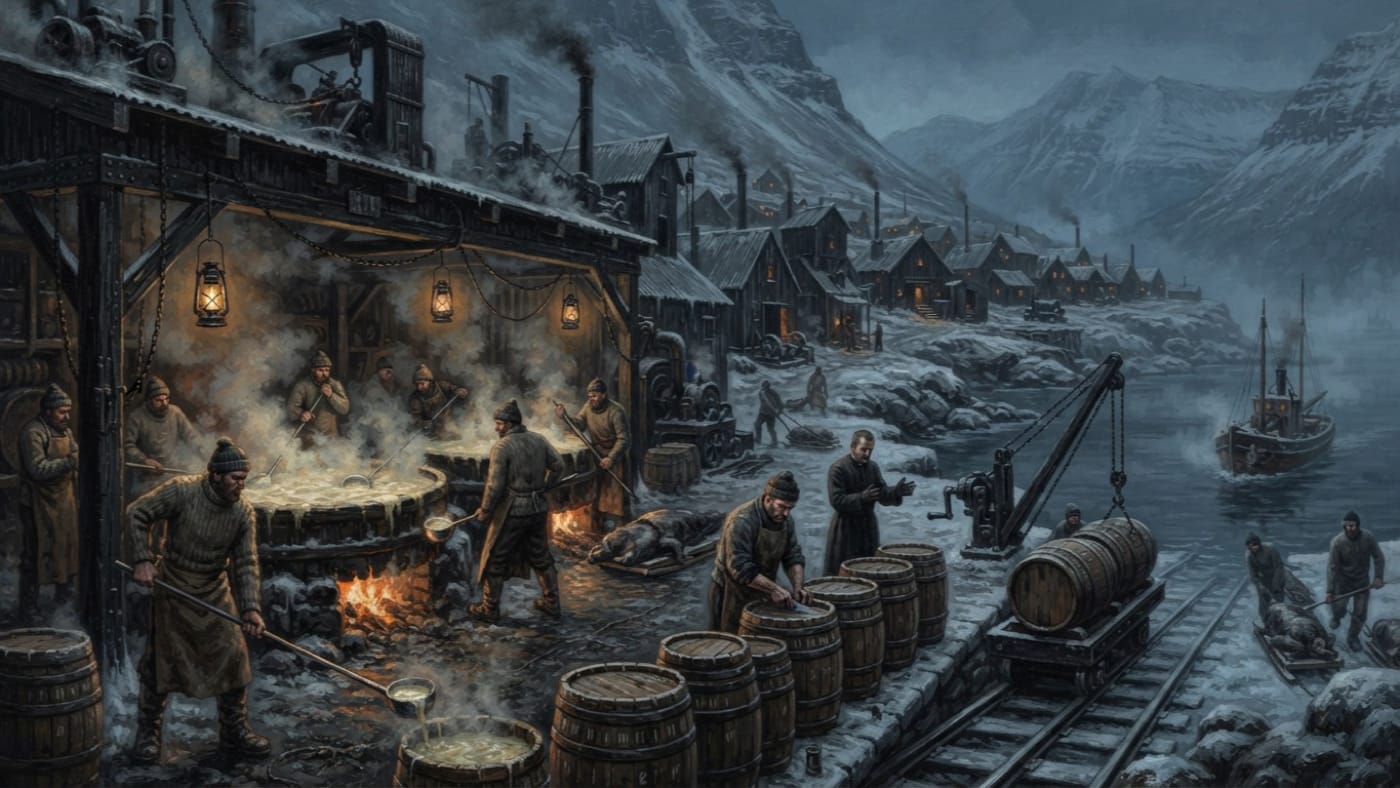
The hunt brings its carcasses to the Render Yards at the south end of the fjord. A shrine-clerk in soot-black gloves blesses each batch before the fat goes into the vats. The vats roar. The yard reeks of hot fat and salt, and the renderers work bare-armed because sleeves catch, and a sleeve caught over a vat means a funeral. Singing over an open vat is forbidden, on the grounds that it sours the oil. I asked whether anyone had tested this. Nobody had, and nobody intended to.
The oil goes into barrels and the barrels are carved. Paper rots in that damp and ink runs in that rain, so the North cuts its accounts into the staves as notches. A notch-code survives being dropped on shingle, rained on, frozen and rolled down a slipway. I know Strasbourg archivists who would weep to own a ledger so durable. I know others who would weep at how hard it is to alter.
Then three hands close on the barrel. The Clan Moot under Elder Sigrun Half-Wick sets the render schedules and decides where the warmth goes. By the published account she halved her own household's wicks in the Seal-Death Winter of A.S. 188, and the Moot still counts barrels as she does, without sentiment. The Shrine Chapter of the Blessed Wick has been under Prior Malthus of the South since A.S. 192. It holds the fast calendars, the confession ledger, the exemptions and the passage papers. That means it decides who may be excused from the count. The Winter Watch under Captain Rauk One-Eye decides which sledge gets an escort, which cliff path stays lit and whom the patrol goes out to find. The first hand can render a barrel and the second can bless it and excuse it, and it can still freeze on the ice because the third had other priorities.
Every household owes the oil-tithe, watch-hours, fast days and wick dues. The lamp audit checks what was owed against what was notched. The result is seldom in the household's favour.
#On Lamp-Time
In Strasbourg, grace is recorded. In Hrafnvik, it is metered.
Lamp-time is the light a household may draw from the communal lamps, counted in hours of flame through a dark that does not end at supper. It turns the oil into something a ledger can hold. It can be taxed, traded, owed and confiscated, and in every case it comes down to the same thing: a flame burns in one longhouse and not in the one next to it.
The Shrine Chapter teaches that light is grace and that handing it out is a sacrament. This register notes the teaching and concerns itself with the arithmetic that follows. A household in lamp-debt is at fault before the shrine as well as before the Moot. Confessions heard at the shrine are entered as oil-debt corrections. An unblessed wick is taboo. A hoarded wick is a sin. A lamp put out in spite is heresy, and the Chapter means the word.
Deprivation became punishment by the shortest route available. A household that misses its quota, falls short on its tithe or breaks a fast becomes a dark-house and is struck off communal lamp-aid. The line is drawn in a ledger, but the household feels it at home. There is no shared flame and no shared heat. Children sleep in wet wool against cold stone, and a Norwegian winter does not need to read the ledger to carry out the sentence. Some dark-houses have driftwood, a hoarded stub or a neighbour. Some have nothing. The Chapter does not record which.
A child's lamp stands outside all of this. Nobody may take it, pledge it, confiscate it or buy it. If anyone touches one, the matter passes from the shrine to the clans, and the clans settle it in blood.
#On Oil Beyond the Ledger
The notches record where the oil went. They do not record where it arrived.
Hrafnvik sends oil, wicks and cured hides south. It takes back grain, iron tools, medicines and warm papers: identity proofs, fast exemptions and passage documents. The papers matter most. A stamped exemption can keep a family on the count through a fast it would not survive. A passage document can carry a person south when the ice opens. The Warm Paper Brokers at the slipways sell both genuine papers and forged ones, and take payment in barrels and lamp-time. Whether a given paper is genuine is the buyer's problem, and the buyer seldom learns the answer before spring.
Oil-chits settle the larger debts and bone tokens the smaller ones. Neither has a fixed rate against the barrel. The temperature, the seal harvest and the length of the queue outside the Paper Hut set the rate.
Under the counted economy runs an uncounted one. By local reckoning, half the fjord runs on unlogged warmth. The Dark-House Circle moves oil and wicks out of the official count. Barrels lie in the frost pits under false inventory tags. Wicks go missing from shrine lamps. Certain paths through the settlement are walked without a light, so that there is no light to follow. The Bureau does not know who belongs to the Circle. What it does is keep some dark-houses from freezing.
#On the Unsettled Classification
The oil burns too long. The Bureau has been discussing this since A.S. 178.
The Bureau of Alchemical Standards has been trying to classify Hrafnvik oil since A.S. 178. None of its conclusions has yet survived its own committee. The working description is "anomalous caloric persistence under liturgical conditions." In plain words: oil rendered and blessed at Hrafnvik is reported to burn steadier and longer than rendered fat has any right to, and nobody with a stamp will say why.
ERRATUM — BUREAU OF DOCTRINE, DOCTRINAL REGISTER The Hrafnvik entry gave the classification wording as "rendered cetacean lipid." The seal is not a cetacean. The substance is rendered seal fat. The rest of the description stands, and so does its lack of a conclusion.
Stamped: Hieromnemon V. Drax — Bureau of Doctrine
The reports do not agree with each other, and the classifiers would rather forget it. Hrafnvik lamps hold through blizzards. By the settlement's own account, the first shrine stood where it did because its lamps stayed lit. The same lamps gutter in still air, on the flat windless nights when fog comes off the water and repeats whatever is said near it. In A.S. 199 the Bureau of Rites classified that fog as Category Two Localized Acoustic Distortion, Responsive. The designation applies to the fog. It says nothing about the oil, and the oil is still unclassified.
The locals take their own precautions. They burn triple-wick lanterns on the worst paths, renew salt circles after every tide and keep silent on certain routes. They also keep a rule: if the flame leans seaward, do not follow your own thoughts. The Chapter says the blessing keeps the flame. The Moot points to the vow-stones, which are older than the Synod. Prior Malthus talks about barometric pressure in the fjord.
None of these accounts makes the oil inexhaustible. No barrel refills itself. Bad oil exists, and knowingly selling it is one of the few crimes the whole fjord agrees on. The persistence is local, reported, partial and unexplained. I have filed it in exactly those terms.
#On Present Application
The south does not ask what the oil is. It asks when it will arrive.
Every barrel leaves Hrafnvik through the narrows. Ice and tide close them when they please, and the Moot can close them with one pull of the chain. Past the narrows, the oil goes to remote shrines and winter garrisons whose coal is also late. The garrisons do not enquire into caloric persistence. They light the lamp and are grateful, and their gratitude is not entered in any notch.
Hrafnvik's compliance was renewed in A.S. 201, conditionally and pending review. The renewal certifies that the settlement tithes, confesses and keeps its fasts within limits the Bureau is prepared to sign. It certifies nothing about the substance. It does not make every blessed barrel a relic or turn the Chapter's sacrament into the teaching of the Church. The bargain between Moot, Chapter and Watch was struck in one fjord by three parties who distrust each other. It is not the law of the North.
The dark-houses will be drawn again next winter, in the same ink and on the same terms.