

#On the Guild's Station
"Cut one line, the hunger travels." — Chain saying, current at every node and disputed at none
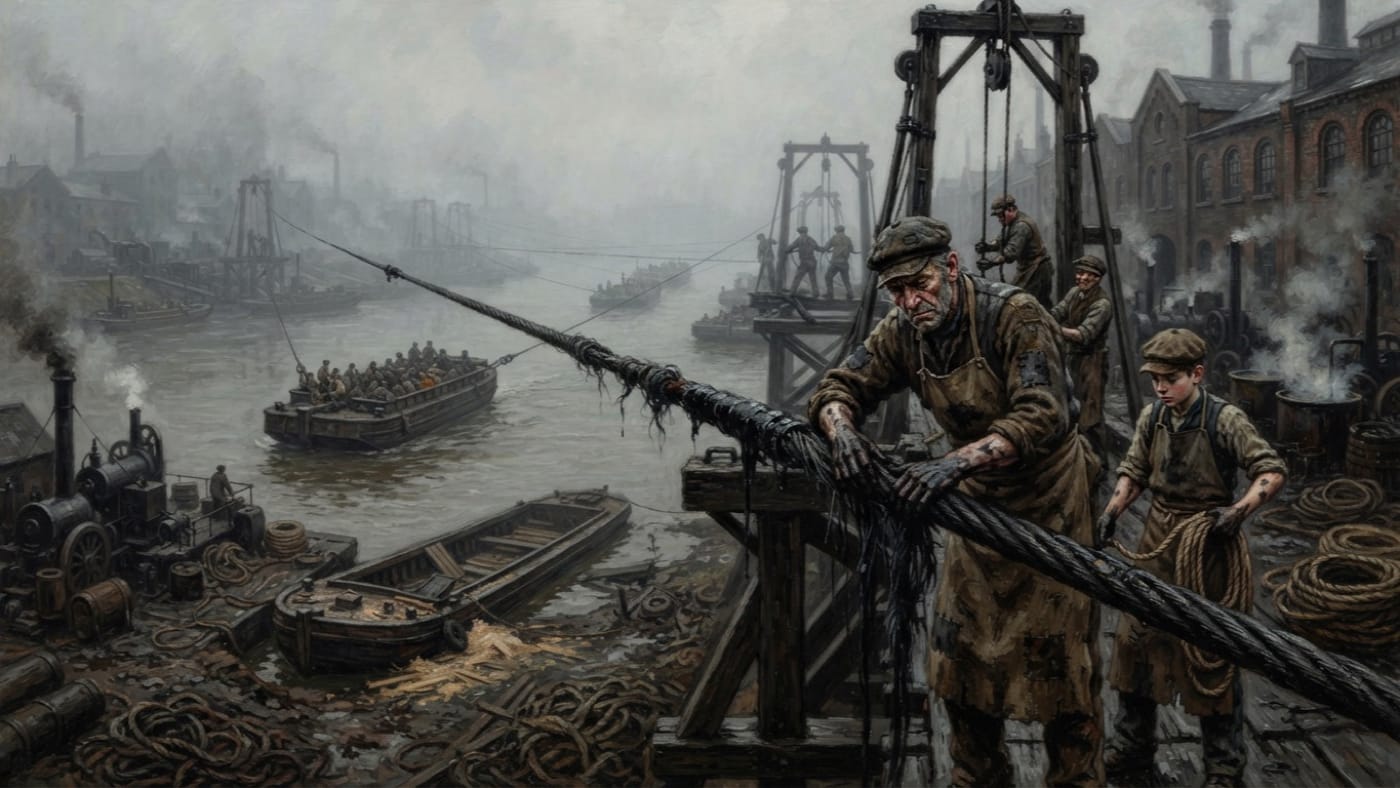
The Rope Guild keeps the cables of the Rope-Ferry Chain whole. The crews call it the Splicehands, the clerks call it the Splicehands, and the guild now calls itself the Splicehands with the ease of a body that has outlived the insult. Its station is the river-belt crossing corridor between Heartlands supply and the outer theaters, where twelve ferries labour across water that has never once consulted the schedule. Of the Chain's eight wards, it holds two. Upper Splice has the rope yard, where hemp is laid and apprentices are trained to lay more of it, and the air smells of tar and sweat. Cofferdam Ward has the repair barge, low in the water among sawdust and rot, which takes in whatever the river has chewed.
The guild's public function is safety and repair. That is true. A ferry is a barge, a cable, and a prayer, and only the cable can be inspected. When a mainline breaks, grain stops on one bank and conscripts stop on the other. Every cart on the Queue Road stops behind them, and the hunger reaches the downstream nodes first as rumour and then as a ration slip marked void.
Whoever holds the rope holds the Chain's hours. The Splicehands handle the stuff daily and need no tutor in that arithmetic.
#On Rope and Licensed Hands
Only licensed splicers may touch a mainline. The Chain recites its own history in order: a flood took three nodes, the Synod raised the Superintendentate, rope dues followed, then waiting-time permits, and last the guild was formalized and the mainlines closed to unlicensed hands. Nobody recites a year. I add none.
A mainline is thick hemp, tarred against rot, run through iron pulleys on timber gantries and hauled until its fibers have learned the weight of barges, livestock, coffins, and conscripts. Inspection comes at dawn with the rope-blessing. Words are said over the cable, a splicer's palm goes down the lay feeling for soft places, and a mark goes onto the inspection sheet. The blessing and the rot are both recorded. Only one of them bears load.
The work maims honestly. A rope that parts under strain whips back across the gantry hard enough to take off a jaw, and afterward the crews come down with what they call cut-fever and will not climb for a day. River rot gets into split knuckles and turns them green within the week. Men who fall in die of cold if drowning is slow about it. In flood season the yard at Upper Splice stands ankle-deep in water that smells of everything the guild boils.
An apprentice becomes a splicer when his first splice holds under load. The guild knot cord follows. After that the hands go black and stay black.
Around these licensed few works a larger body of rope labour. Haulers, tar boilers, cart-runners, and men taken from the queue lanes carry the coil, feed the kettle, and heave on the line, but none of them may lay a hand on the splice. The knot cord marks the difference. A hauler can drown on the same rope as a splicer. He is not permitted to mend it.
#On Dues, Shortages, and Labor
Rope dues are the maintenance levy. They are separate from the crossing fee, the waiting-time permit, and the cargo-weight tithe, and a traveller on the Chain may pay all four before noon and still be no nearer the far bank.
The guild wants the dues raised, and its case is sound. Hemp has to be brought in, pitch has to be boiled, and splicers have to eat. Kettles crack, and so do men. The Transit Office answers with permits, which the Transit Office prints itself.
The guild's methods are the controlled shortage and the delay. On the yards the shortage goes by the name fiber rot: a stock is declared unsound and is not issued. Sometimes the stock is rotten. Sometimes it is only withheld. The inspection sheet looks the same either way, and that is why the inspection sheet is so beloved. A delay needs even less: a repair that wants two crews and gets one, or a gantry left slack for an afternoon the master slate had promised to throughput. The guild calls these accidents, and so do the Chain's quotation marks.
The Splicehands seldom need to make a demand. A stalled crossing lengthens the queue, a longer queue lets permits lapse, and lapsed permits bring letters from bastions the Transit Office cannot afford to annoy. The guild only has to be slow first and reasonable after.
The waiting supply the rest. A traveller whose time permit expires owes the Chain for his hours, and the debt is turned into labour. The labour the Chain needs most is rope labour, so the debtor ends up on the hauling line. Press-gangs sweep the queue lanes for rope crews, and a declared flow emergency conscripts whoever stands nearest the gantry. Hauling under compulsion does not make a man a Splicehand. The guild gains backs without giving out cords.
Still, the cable must hold. A permit can be forged, a tithe evaded, a confession slip bought cheap from a broker. A ferry cable takes no notice of any of it. It holds or parts according to the hands that laid it. The best hands belong to the guild that profits most from their scarcity, and the river has never been persuaded to accept a cheaper truth.
#On the Other Authorities
Rope-Master Lysa Kett controls the rope supply and the maintenance crews. She is called "Splicehand" the way the Bend is called the Throat, a description that has stuck after anyone needed it explained. Her hands are stained black with tar. Her recorded fear is that sabotage will be blamed on her guild. It is a sensible fear. Her guild has access to every mainline and owns every cutting tool, and an inquisitor could build a motive out of those two facts before lunch. In the Church's catalogue of proofs, capability is the cheapest item, and the record holds nothing dearer against her.
She holds no schedule. Superintendent Halvick Sorn sets the crossings and orders the closures. He fears one snapped node bringing down the whole line, which makes him the guild's most anxious customer. Provost-Captain Merrow Venn arrests and confiscates, and she fears a riot at the Ration Slip Market. Kett can slow a crossing. She cannot close one, and she cannot arrest the man who complains about it.
Others gather round these three. The Ferry Chokepoint Brokers trade in papers, witnesses, and passage information. The quarantine wardens push their cordons outward. The underworld fights for the night crossings, which run black and run on the same rope as the day crossings. All of them need the cable sound, and none of them pays the dues gladly.
#On the Writing Mainline
The River Ledger has turned the guild's hemp into a document. In fog, wet mainlines darken from within and write names, numbers, cargo weights, dates, and tide-counts before the river makes them true. The cables the Splicehands supply and mend now announce drownings, arrests, and short manifests. Venn's skiffs read them, the brokers buy copies, Ink Dock enters them, and Strasbourg receives them in the monthly packet and asks for clearer ones. The Bureau of Purity burns whatever is cut away.
For the guild this is first a matter of maintenance. A splicer working a mainline in fog may feel letters forming under his palm. A ropehand stands as one of the three witnesses to every official copy, so the guild's own people put their names to the river's writing. And a crew that maintains a cable which foretold a theft will find the provosts asking who touched it last.
Tar-sealing is the countermeasure, and it is guild work: hot pitch brushed over the cable before the fog comes in. The pitch stiffens the rope and raises the risk of a snap. It ruins the hands of the men who brush it. It also fails, because the writing comes up through the pitch in raised black blisters that can be read by touch. The men nearest the line read first, in the dark, with their fingertips.
Since A.S. 199 the writing has quickened. In the winter fog of A.S. 200 a single event at Node Seven printed fourteen names. Sorn asked to move the mainline thirty yards upstream and was refused. Whatever lies beneath the old abutment at the Throat is sealed by the Bureau of Alchemical Standards. It stays sealed here.
The River Ledger does not write on new rope; cable fresh from Upper Splice is clean cable.
Corrected. The parent entry records twelve feet of unused rope blackening at the Bend Ferry before it entered service. Strained wet mainline remains the usual substrate. New rope is safer. It is no longer safe by definition.
#On Present Supply
Throughput on the whole Chain has fallen nine percent over three seasons. Rope supply is restricted, rope quality is getting worse, the quarantine cordons are spreading, the Queue Road sends more bodies than the ferries can carry, and the crews refuse heavy-fog crossings. The figure belongs to the Chain as a whole. No clerk has worked out the guild's share, though several have been eager to assign it.
The guild still wants higher dues, and the Transit Office still squeezes permits. The yards still speak of fiber rot. On the gantries someone still repeats the Chain's favourite lie, that cutting one rope only delays a day. Cutting a main cable remains a red line, and the penalty for it is total. Nobody has been proved to have crossed it. Gossip in the under-dock taverns is ahead of the record, as it usually is.
The cables hold this morning. The dawn sheet says so, and the hands that signed it are black to the knuckle.