

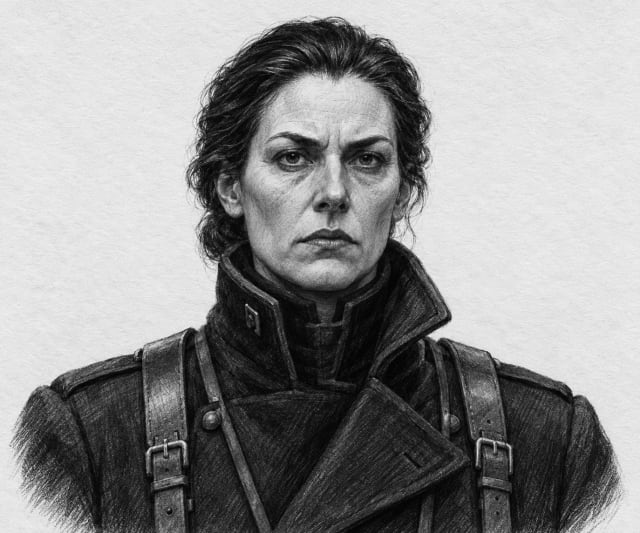
#On Her Station
"The schedule is a god with no face." — Rope-Ferry Chain proverb
This dossier was compiled in A.S. 201 from the papers the Rope-Ferry Chain keeps on itself: provost confiscation entries, the cage maintenance schedule, Transit Office returns, and what the crews say when someone with a seal asks them. It describes her present command. It gives no birth, no appointment and no oath of office, because none of the papers sent to this office contain them. Where the papers say nothing, the Warden says nothing.
The subject is Provost-Captain Venn. By the Chain's own account she controls the arrests, the confiscations and the drowning cages. Her provost squads patrol the nodes at night, hold the quarantine cordons, and clear the reed flats of smugglers, refugees, and anyone else who fails to produce the correct paper at the correct time. Her provosts wear the armband.
Her office is one of three hands on the river. Superintendent Halvick Sorn keeps the master closure slate in its floorbox beneath the Ink Dock Hall, and with it the hours. Rope-Master Lysa Kett and her Splicehands keep the mainline cable, and with it the question of whether any hour can be kept at all. Venn keeps the people. On paper the Chain Superintendentate answers to Strasbourg. On the water, each officer works a separate instrument and none can run the river alone. The record does not give Venn the slate or the rope licence, and neither do I.
The Chain's notes record one trait: a fear of riot at the Ration Slip Market. They record it as a fear. I have not been inside the woman's head and will not furnish it.
#On Arrests and Confiscations
A provost arrest on the Chain rarely needs a crime. It needs a missing paper. A traveller whose time permit has lapsed, whose quarantine stamp has been revoked, or whose name is absent from the register he swears he is on has made himself available to the provost office. The office takes him.
Quarantine inspections and stamps belong to the Lye Order, who wash, search and certify on the floating platforms of the fourth node. Venn's squads hold the rope fences and queue lanes around them. The Order has pushed its cordons outward three times in ten years, and each push narrows the lanes. The provosts put up with this because the Order shares what it learns. The account says no more, and I add nothing.
Seized goods are logged with a precision I would accept from any clerk in my own Bureau: item, weight, node, tide, the name of the man who lost them. After that the goods travel by channels the log does not describe. The Chain does not consider this a fault. The log records confiscation. Where the goods end up is someone else's business, and nobody will say whose.
Then the cages. They hang from the gantry towers at the Bend Ferry, Node Seven, which the crews call the Throat. Each is an iron lattice in which a man can stand but cannot sit, hung so that the river rises and falls around him. Sentences are counted in tides. Three tides is a warning. Seven is a punishment. Twelve is a message. A man who does not come out is entered as crossing casualty, weather-related. The Chain's records therefore show very few executions and a great deal of bad weather, all of it in Venn's jurisdiction.
The cage maintenance schedule calls for inspection every third tide and repair as needed, and lists occupant status as not applicable to maintenance schedule. I could not have phrased it better.
#On Names Read Beforehand
"If your name shows on the rope, don't cross." — Rope-Ferry Chain superstition
In certain fogs the wet mainline darkens. The darkening forms names, numbers and dates, in a hand nobody has identified, and the crews report that they match drownings and arrests that come afterward. The Bureau of Alchemical Standards has classified the phenomenon as a Category Two Localized Scribal Anomaly and has declined to investigate further. The crews call it the River Ledger.
Since A.S. 199 the Ledger has been writing more. The Chain's account gives three names per fog event as the old average. The latest events have produced eight, ten and fourteen.
At the nodes where the writing is densest, Venn has posted extra skiff patrols. Officially they keep order. The Chain's account gives a second purpose: her men read the rope before the crews can. The record gives no date for the posting order and does not prove that her interest in the rope began in 199. It shows only that her skiffs and the Ledger's growing output now occupy the same water.
The advantage is plain to anyone who has kept a register. A name read off the cable at first light reaches the provost office before its owner knows it, before the Schedule Choir can sing it into an omen, and before a frightened crew can spread it along the docks. Her office can hold such a name, trade it, act on it, or sit on it. The record does not say which she chooses. Nor does it say that every name becomes a warrant, that the provost office causes the writing, or that Venn decides the fate of the named.
That leaves a question I have asked before, in the Chain's own pages. A man named on the rope is later arrested. Did the rope foresee the arrest, or did a provost read the rope and make the arrest himself? The crews have no answer. Their tar-sealing, bell-cards and three-witness forms show only that they are frightened. If Venn's office has an answer, it has filed it where this compilation was not allowed to look.
#On the Night Patrols
Officially the Chain stops at curfew. The ferries are tied off and the gantry lanterns put out. Then the Black Ferrymen start work, three or four to a skiff, hauling passengers and cargo by hand-line through the reed channels between nodes.
Venn's night squads patrol the same channels. By the Chain account's estimate, roughly a third of the provosts sell their patrol schedules to the Black Ferrymen. Most of the rest arrest Black Ferrymen and confiscate their cargo, which finds its way back to them through middlemen. The estimate is the account's. No Bureau has audited it, and I have counted no provosts.
The record links none of this money to Venn herself. It does not show that she takes any of it, owns any crew, or holds any agreement. It shows an office whose seizures feed a trade its own men help to run, under the captain who signs the seizure entries. The Ink Dock fee schedule has struck through its line for night crossings. The crossings continue.
The Black Ferrymen's lantern codes change weekly, and the provosts know it. That is one of three signal systems on the flats, and I keep it apart from the other two, as the record does.
#On the Reed Mothers
Behind the Quarantine Piers, where the river shallows into marsh, the Reed Mothers keep their huts. They take in the children of the pressed, nurse the sick the quarantine has turned away, and hide people whom the registers no longer contain. They hold no licence. They signal with laundry: the arrangement of cloth on the drying lines tells the flats whether passage is safe, whether there is danger, whether a patrol is near, or whether there is food. That is the second signal system, and it belongs to the Mothers.
The account says they are raided twice a year. Each time they lose their shelters, and each time they rebuild within a week. Venn's squads carry out the raids.
The third signal comes before each raid. A provost lantern shows from the flats: two short flashes, then one long. The Mothers move whatever they can. The Chain account gives the reason. Provost-Captain Venn has three children of her own, and she understands that the Chain needs the Mothers as a pressure valve. That explanation is the Chain account's, and I file it under the Chain's name. Nobody has shown me an order authorising the lantern, and nobody has shown me one forbidding it. The record does not say who holds the lantern on any given night, and it contains no word from Venn on the subject.
The warning does not stop the raids. It buys the Mothers time to move. Then the provosts arrive, the huts come down, and the Mothers rebuild. The record gives them no sanctuary and no immunity.
#On Her Present Command
"Cut one line, the hunger travels." — Rope-Ferry Chain proverb
The account describes the Chain's present condition, not the captain's achievements, and I keep the two apart. Route-wide throughput has fallen nine percent over three seasons. The Splicehands are restricting rope supply. Crews are refusing heavy-fog crossings whatever the schedule says. The quarantine cordons keep widening, rations keep shrinking, and the Queue Road sends more bodies than the ferries can carry.
All of this lands on her office. A longer queue means more people with lapsed papers. Wider cordons mean more fence to hold. Short rations mean more people pressing on the Ration Slip Market at dawn, and that market is the one place the Chain's record says she fears. Each new fog adds names to the rope, and her skiffs are there to read them.
ERRATUM — Synod Transit Office, Filed A.S. 201 The Transit Office has retracted the claim above that throughput has declined. In its words, throughput has been restructured to give doctrinal cargo priority over civilian supply. This compilation records the Office's correction as filed. The refused fog crossings, the shrinking rations and the crowded queue lanes stand as reported.
The provost office still makes its arrests, logs its seizures and keeps the cages in service. The extra skiffs still sit at the densest nodes in every fog. Two short flashes and one long still precede each raid on the reed flats, and the Mothers still rebuild afterward. The Chain account says nothing more about Provost-Captain Venn, and neither does the Bureau.