

#On the Name and the Congregation
"Put my name on the list. I will sign the rest." — Heard at a vigil, Pilgrim Dormitory Maze
The dormitory preachers of the Ember-Priory of San Vesta give the name Third-Day Debtors to anyone who has eaten Resurrection-bread and signed for it. A smaller body has taken the name for itself. This entry concerns that smaller body: a pilgrim congregation that gathers in the Pilgrim Dormitory Maze, keeps vigil in its cloister walks, and petitions the priory, louder every month, to let more people into debt.
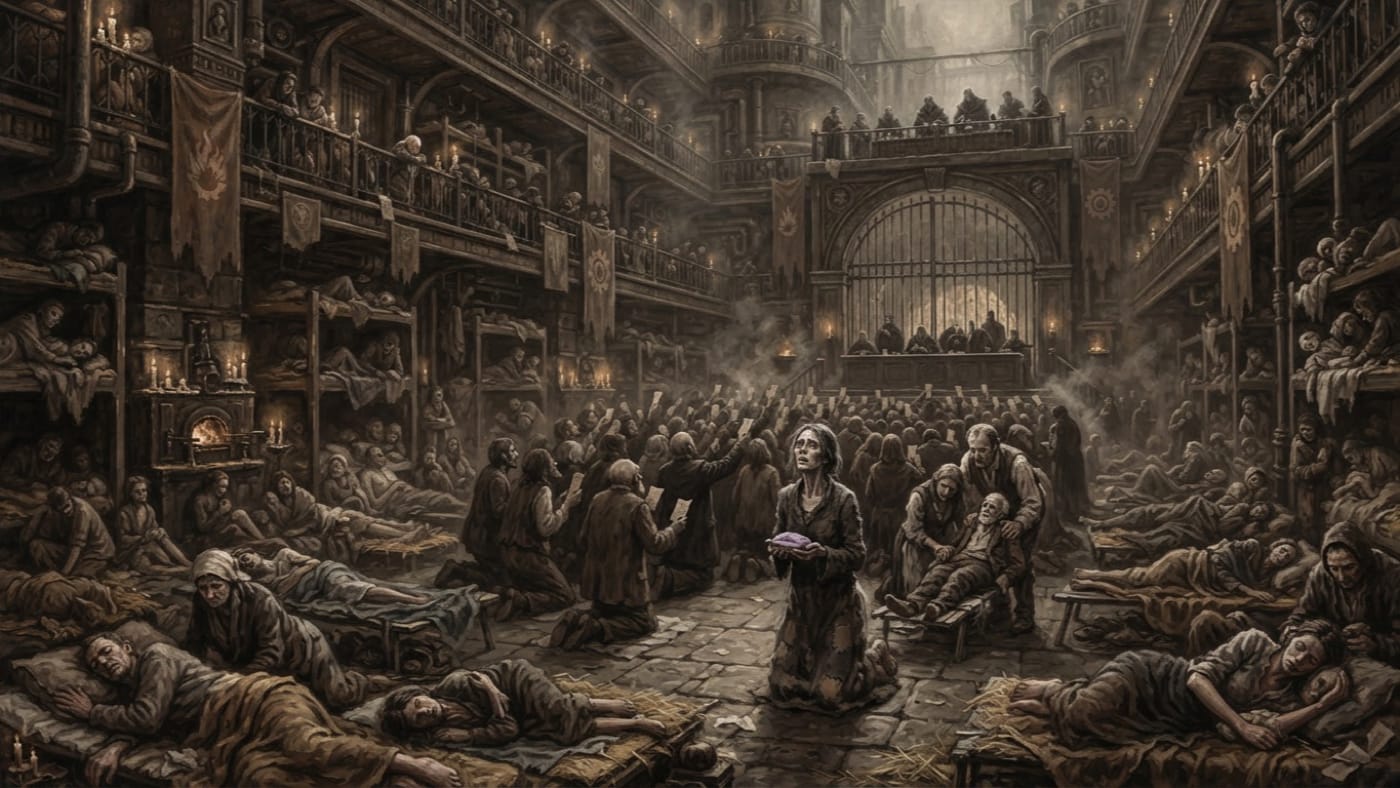
It has no chapel. It has the Maze, a set of converted cloisters above the Cinder Markets where the basalt holds the heat of the ovens all night and the arcades are full of bedrolls and litters. The congregation meets wherever the candle stubs are thickest. Prayer wax softens on warm stone and is never quite allowed to set. A visitor finds the vigil by its smell before he hears it: sweat, tallow, and a sick man's breath under a blanket nobody can afford to wash.
The reader must keep two lists. The first contains every recipient of the bread, and the dormitory preachers apply the name to all of them. The second contains the congregation. The two overlap, and nobody keeps the second. A woman fanning her father on a litter is a pilgrim. If she kneels at the vigil and adds her voice to its demand, she is a Debtor in the sense this entry intends. Most of the people on the cloister floor never kneel. They have a relative, a token and the next issue to wait for.
#On the Three Days and the Oath
A dying person who eats resurrection-bread lives three more days. The bread cures nothing. The fever or the grey cough or the shell fragment that brought the patient up the basalt road is still there on the third evening, deferred. Some recipients outlive the interval, since the bread postpones death and has never promised to schedule it. The priory does not say which recipients will last longer, and the Sister-Physics have learned to refuse that question politely.
The price is recovery service for life. Ordinary treatment at San Vesta is paid for in labour by the week: three weeks for a broken arm, six for a lung infection, a year for a full scorch-cure. Resurrection-bread is paid for with the rest of the recipient's life, on an oath drafted from a Bureau of Oaths template. The oath runs past the third day into whatever time remains, and the Tribunal assigns the service in the ovens, the canalworks, the kilns, or the dormitories where the debtor once waited.
The paperwork follows the body. At San Vesta every bread token is stamped with its bearer's name, and the Ledger Cloisters carry that name onto the labour schedule. A Debtor who survives returns to the same cloister walk, now on the side that issues the tokens, which keeps the arrangement in its own house. Holding a token proves only that its holder eats. Membership of the congregation cannot be read from one.
"Resurrection-bread is a gift." — Saying of the pilgrim road, as preached at the vigils.
A gift is given without consideration. Resurrection-bread is issued against a lifelong recovery-service oath, drafted on a Bureau of Oaths template, scheduled by the Ledger Cloisters and enforceable for the life of the recipient. The Codex records it as a transaction. The vigils may keep the word. This entry may not.
#On the Vigils
The congregation offers hope, and it does not sell it at a discount. A family arrives with a dying mother and a little savings, and spends the savings in a week on priority slips that do not move the list. The vigil asks only for the family's presence and its voice. When the vigils succeed, the bread they win is paid for with an oath, which the family would sign anyway, and does sign.
Their methods are crowds, pressure and martyrs. A vigil that fills a cloister walk is a petition the Tribunal cannot file and forget. The congregation recruits where recruiting costs least: among new arrivals still carrying dust from the road, at bedsides, and in the hour after a triage list goes up without the name a family expected. It holds up the example of its own martyrs. The records I have consulted name none of them and count none of them. I report the method, and I add no names to it.
There is a further use. Under the Doctrine of Acceptable Innovation, every experiment at San Vesta needs a written proposal, three seals and a patient. The priory's survey notes describe the Debtors as willing bodies for trials of the bread, which makes them the readiest supply of the third requirement. I have not been shown a trial register, and I will not invent one for the reader's satisfaction.
They do not argue against the oath. The Tribunal's own summary says that the Debtors dispute the queue. They want the line shortened and the issue widened, and they want the signing table brought closer to the litters.
Nobody has shown me a record naming a leader. The parent survey notes that the dormitories argue with a coherence suggesting that someone argues for them. I record the suggestion as the parent survey made it and add nothing.
#On the Tribunal's Mercy
Four hands govern the loaf, and the vigil can reach none of them directly. Prior Celestín of the Third Ember authorises production. The Infirmary Tribunal of Scorch decides who eats, and restricts the bread on the stated ground that "theological stability requires controlled access." Quartermaster Odran Ashweight of the Oven Quartermastery releases the flour and the coal, and every violet loaf starts as a sack of his. The Ledger Cloisters keep the schedules on which the debt is served. Sister-Physic Marra Vell runs Ward Seven and controls a good share of the triage lists. Some pilgrims call her the congregation's patron, and others call her its adversary. The records make her neither, and she has not volunteered an opinion.
The arrangement works well for the priory. The Tribunal refuses the bread to a crowd that begs to be bound, and whichever side prevails, the ovens get labour: the oath-bound if the vigils win, and the waiting pilgrims, still eating Ash-bread and owing for it, if they lose. A congregation that petitions for indenture saves the Bureau of Oaths a good deal of persuasion.
The Cool Mask Brotherhood is a separate matter, and I keep it separate. The Brotherhood makes respiratory masks and moves medicine and people out through the canalworks and the lava-tube underpaths. The Debtors press to get people in. The two challenge the same institutions from opposite doors, and no record I have seen joins them by alliance, quarrel or shared hand.
Bread fragments are sold in the Maze as well. The sellers promise a reprieve in proportion to the crumb. Nobody has established what a crumb does, and nobody has established that the congregation does the selling.
#On the Fourth Day and the Present Condition
San Vesta forbids talk of the fourth day, and in public the congregation obeys. Survival past the third evening is within what the bread allows, and it proves nothing more. The Bureau of Doctrine has received nine formal petitions to certify resurrection-bread as a miracle and has answered none of them. I read the silence as the Bureau's way of declining to say yes. That reading is mine. The Bureau has not ratified it, and the bread remains uncertified. In the canalworks and the Cinder Markets they say the bread borrows life from something under the sealed vent. That is the street's account, and I file it as the street's.
This entry supplements the survey of San Vesta's condition as of A.S. 201 (1911 CE), and it does not improve on that survey's facts. The pilgrim influx has tripled in four years. Prior Celestín has twice authorised more production in the last eighteen months, and demand has outrun both increases. The Tribunal has narrowed the issue. The flour convoy from Vall de Sal is late, so Ashweight has sealed the Flour Gate and begun the count of mouths against loaves. Each night the vigils run longer, and each morning the issue is thinner.
The survey does not say what the count will find.