

#On the Three Days
"Resurrection-bread is a gift." — Saying common on the pilgrim road, recorded here without endorsement.
At the Ember-Priory of San Vesta, a dying person who eats resurrection-bread lives three days longer. The records state this with a consistency they show nowhere else in the Iberian theater. The bread postpones death and cures nothing. The pilgrim who came up the basalt road with a grey cough, a wasting fever or a fragment of shell near the heart still has it on the third day. The illness has only been made to wait.
The price is recovery service for life, accepted by oath.
Pilgrims and lesser chroniclers confuse this loaf with Ash-bread, the ordinary ration of the priory, and the confusion is understandable, since the two come from the same flour and look nearly alike. They must be kept apart all the same. The Quartermastery's figures for ash-bread cover its keeping, its weight, its standing order with the Bureau of War and its output per watch. None of them has been shown to apply to the other loaf, and I decline to borrow them.
Three days is a short allowance and a precise one. It is long enough to dictate a letter or settle a debt at the Cinder Markets, or to be awake when a son is carried in off the road. The dormitories are full of people who have measured their lives in smaller units than that. They do not find three days a small thing, and the priory does not price it as one.
#On the Substance and the Separate Oven
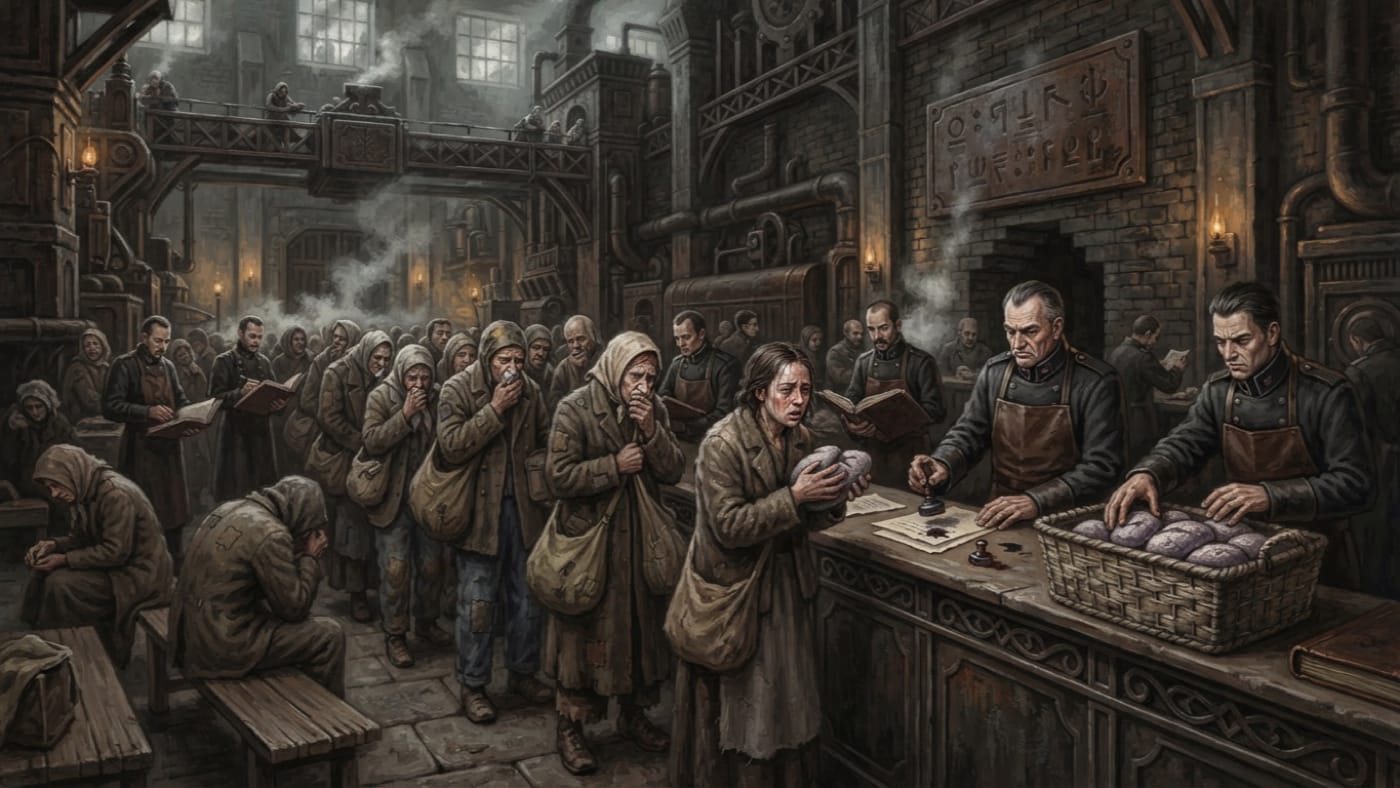
Resurrection-bread begins as the standard ash-bread mixture, flour worked with consecrated volcanic ash. To this the Kiln Hall of the Relic-Smoke Kilns adds three things: bone-ash, consecrated mineral salts, and a resinous substance that the Incense Binders will describe only as "theological." The Binders supply the compounds and guard what they know about them as jealously as they guard their incense blends, and that is very jealous indeed.
The loaves go into a separate oven, apart from the racks of the Great Ovens, and they are baked there at temperatures the Vent-Wardens call "inadvisable." The Vent-Wardens are the calmest men in the priory, and when they object to a heat the reader may take it as a strong objection. What comes out is a dense grey loaf with a gritty crust, the same as any ration, except for a faint violet tinge along the edge of the crust. The Tribunal has forbidden anyone to comment on the tinge in writing. I have described it, which is not the same as commenting on it, and this survey is sealed by the Bureau of Doctrine.
The recipe is classified. It gives no proportions, no temperatures, no order of working and no authorised portion, at least none that has reached me. Nobody has named the source of the bone-ash, and the Binders have not said where the resin comes from. The same Kiln Hall compounds go into relic-smoke, and that proves the two products share a supplier. It proves nothing else. Whatever makes the bread work, if it is the salts, the resin, the heat or the oath, has not been entered in any ledger I have been allowed to read.
#On Allocation and Recovery Service
Four separate hands control the loaf, and none of them holds the whole of it.
Prior Celestín of the Third Ember authorises increases in production. The Infirmary Tribunal of Scorch decides who receives the bread, and it restricts issue on the stated ground that "theological stability requires controlled access." Quartermaster Odran Ashweight of the Oven Quartermastery allocates the flour and the coal, and since every violet loaf starts as a common one, the Prior's authorisation is worth exactly as much as the sacks Ashweight releases. The Incense Binders hold the compounds. Dependence on their compounds gives them no say over who eats. The Flour Gate, with its one road, its ledger desk and its clerk's stamp, decides who eats ash-bread. The resurrection loaf is issued elsewhere.
Experimental work at San Vesta falls under the Doctrine of Acceptable Innovation. Before any flame is lit or patient touched, a proposal needs review by the Tribunal, approval by the Priorate Council, a counter-stamp from the regional office of the Bureau of Alchemical Standards, and filing in triplicate with the Ledger Cloisters. The dispensation was granted by the Bureau of Doctrine. The Bureau does not stamp each proposal itself, which suits its preference for being responsible in general and never in particular. These three seals should be kept distinct from the three partners who govern the priory. The Quartermastery belongs to the compact and has no signature on experiments. It has the flour, which counts for more.
The oath is drafted on a template from the Bureau of Oaths. The Bureau would admire the drafting if the template were not its own. All treatment at San Vesta is paid for in labour. A broken arm costs three weeks of recovery service, a lung infection six, and a full scorch-cure for advanced trench-fever a year, counted from the day the Tribunal declares the patient well. For resurrection-bread the term runs past the third day and into whatever life the recipient has left. It is served where the Tribunal assigns it: the ovens, the canalworks, the kilns, or the dormitories where the debtor once waited.
No one argues over the terms. A man who has carried his sister up the basalt on a litter will not ask for a clause to be struck while the queue moves behind him. The bread is scarce, and scarcity has done the bargaining before he arrives.
The Bureau of Mercy described San Vesta's infirmary, whose Tribunal issues every resurrection loaf, as "a model of compassionate efficiency."
The Bureau of Mercy has revised its assessment. The current classification is "efficient." The adjective was removed after an internal audit in A.S. 199, and the audit's findings remain sealed. No connection between the audit and resurrection-bread is asserted here. The Bureau has not offered one.
#On the Miracle Petition and the Fourth Day
The Bureau of Doctrine has received nine formal petitions asking it to certify resurrection-bread as a miracle. It has declined to answer every one of them. This is not certification, and the reader who treats it as certification will be corrected by people less patient than I am. Neither is it a denial. The Bureau has decided that the question is better left unanswered, nine times over and at some cost in filing fees, and an institution that keeps refusing to say what a thing is has usually worked out what it would cost to say so.
Three accounts of the bread circulate at San Vesta, at three different heights. The public account, preached in the dormitories and repeated at the Flour Gate, holds that the bread proves the Synod's mercy is real. The street account, heard in the canalworks and the Cinder Markets, holds that the bread borrows: that it takes heat, or life, from something living beneath the sealed vent and lends it to the dying for three days. The Bureau of Alchemical Standards has not classified the vent's contents, and neither will I. I record the street account as a saying of the street. Whatever is meant by the third account is not for this survey.
Speaking of a fourth day is forbidden at San Vesta, and I obey the rule. Some recipients survive past the three days. The bread delays death, and for some of them death keeps its distance after the third day. What happens to them afterward the records do not say.
The acceptable-failures ledger in the Innovation Annex has columns left empty. The accounts I have been given disagree about which columns those are. One says the names are blank, and the other says the causes of termination. I have not been shown the book, and I will not choose between the two accounts on behalf of a ledger that declines to choose for itself.
#On Restricted Distribution
As of A.S. 201, demand has outrun supply. The pilgrim influx has tripled in four years. Prior Celestín has authorised two increases in production in the past eighteen months, and demand has exceeded both. The Tribunal has answered by restricting distribution further. The Prior raises output and the Tribunal narrows the list of recipients. The pilgrims standing between them gain nothing by either.
The Pilgrim Dormitories receive most of the strain. Converted cloisters meant for temporary stays are crowded with families who arrived carrying someone and have not left. The Third-Day Debtors, as the dormitory preachers call them, keep vigils in the maze of the dormitory passages and press for wider access. Their congregation is organised, and it is loud. It is also smaller than the pilgrim population around it, and the reader should not take every woman sitting up beside a litter for a member. Most of the people in the dormitories belong to nothing except the queue.
Fragments of the bread change hands in the passages. The contraband lists call them resurrection crumbs. Sale outside the priory is forbidden, and the prohibition says nothing about crumbs sold three corridors from the infirmary. What the fragments do is unknown. The sellers promise a reprieve proportioned to the crumb. Nothing I have seen establishes that a crumb gives a fraction of three days, or anything at all. People still buy them, because the Tribunal's list is short and a crumb can be had tonight.
The flour convoy from Vall de Sal is late. Quartermaster Ashweight has sealed the gates and begun the count of mouths against sacks and sacks against shifts. Every loaf from the separate oven starts in that count, and it had not ended when this survey closed.