

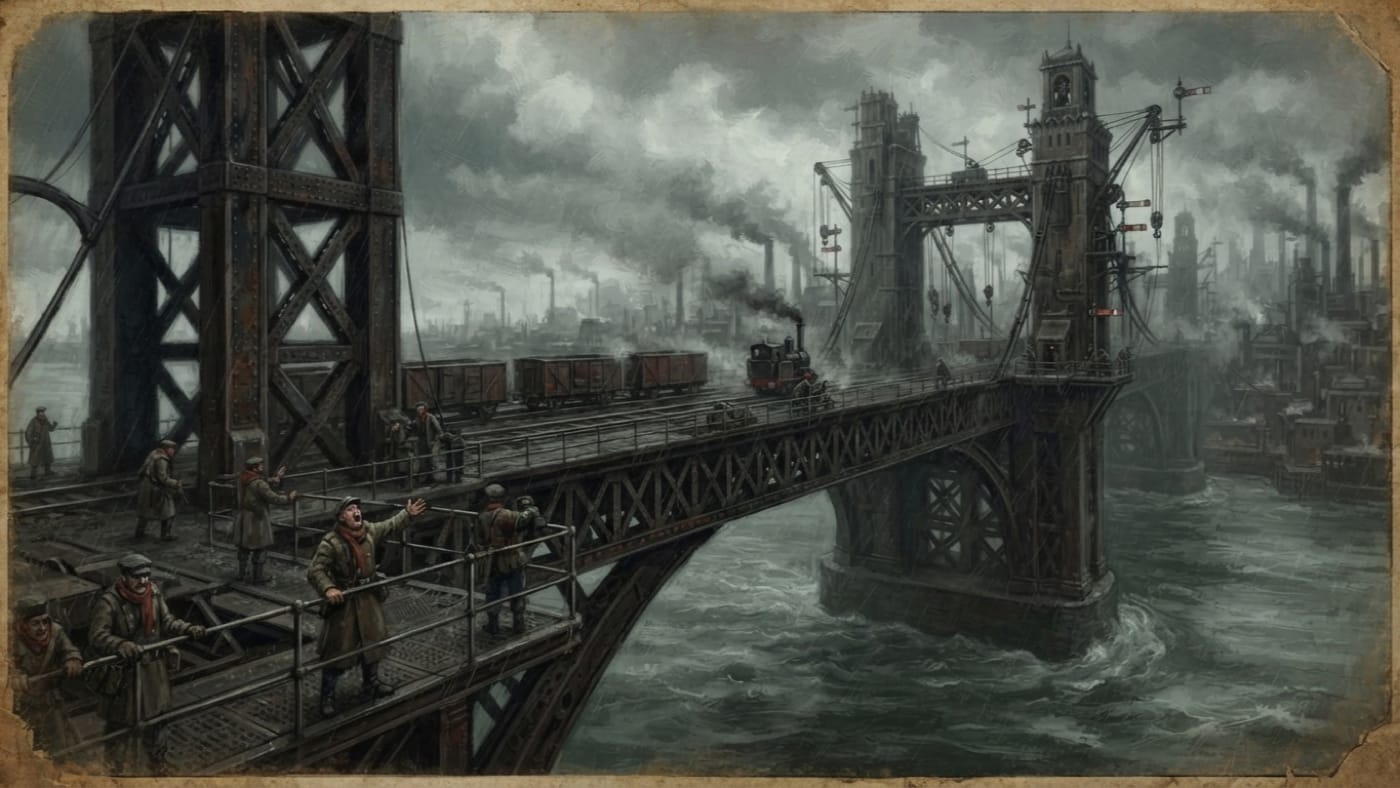
#On the Southern Approach
"Procedure is mercy. Mercy is sound." — Palatine Yard Command Inscription, Main Freight Arch
Twelve lines converge on the Palatine Switchyard of Lorn, and the yard lets them in through three fortified approaches. The Palatine Gate takes the west under its iron arch and bell horns. The Needle squeezes the east down to a single inspected track. The south comes in over water, on the Tri-Span Bridge. Of the three, it is the only one where a man who does his work correctly can still be killed, by the wind, by the iron under his boots, or by a sound that reaches him one measure after it was sung.
The river has no name in any file I consulted. This is either an oversight or an economy. Lorn has never spent a noun on anything that does not carry freight.
The Yard's own description of the crossing is short enough to quote whole: river crossing; wind and iron vibration; falls; the "echo measure" anomaly strongest here. Four entries. I have read longer notices about canteen spoons.
I crossed it during my inspection, on foot, because the Yard Palatine's office offered me a carriage and I have learned to decline anything Lorn offers without first asking who signed for it. The wind rises off the water from no fixed quarter and leans on everything taller than a rail: lamp posts, brakemen, cantors, clerks holding manifests down under their thumbs. The iron answers it. You feel the hum first in your boot soles, then your shins, then your teeth, the way a choir-stall feels the organ before the nave hears it. A loaded freight on the span adds its own note beneath that, lower and wider. Nobody at Lorn would call this an anomaly. It is just what iron does when the weather and the war both lean on it.
Wherever the Synod keeps elevated rail, it keeps bridge gangs, and the profession's ledgers list the same hazards everywhere: height, wind, structural stress, settlement and scouring at the abutments. Tri-Span adds nothing to the list. It just makes good on every item.
#On Procedure Over Open Water
"If it isn't stamped, it didn't move." — Manifest Basilica inscription
Nothing moves in Lorn until three authorities agree that it has. A certified cantor sings the measure. A tower caller confirms it. The signal clears, the switch is thrown, and somewhere behind soot-brick a clerk stamps the movement into existence. Routing priority belongs to Yard Palatine Odrin Kessel. Procedural certification belongs to Bell Marshal Sister-Calder and the Bureau of Bells. The manifests belong to Prefect Halden Wry, and through him to the Bureau of Records, which corrects them afterward in any case.
I looked for the bridge's own officer. No file I have seen gives Tri-Span a warden, a resident cantor establishment, a toll schedule or an inspection office. The crossing belongs to everyone who signs for the trains that cross it. In Lorn that is the exact formula for belonging to no one at the moment of the accident.
The regime that governs the span was born of the Silent Derailment of A.S. 112: forty-one men, a siding the manifests denied, a slag wall at its end. That did not happen on Tri-Span. I cite it because every measure sung at the southern approach is sung under the law it produced. Bell Marshal Gerren Stahl's argument was that sung procedure cannot be falsified without audible evidence. The Yard accepted it, and the cantors came. Industrial error became doctrinal offence, which gave every man at a lever a new way to be blamed and gave the blame a hymn to go with it.
The Switchmen's Union holds that its members throw the switches and carry the risk while the cantors only sing. On Tri-Span the risk can be counted in height and crosswind. The cantors hold that the voice is doctrine and the hands can be replaced. Both claims are true on the bridge, and neither man can let go of the rail to argue the point.
Earlier dispatches from this office repeated the Yard's founding assurance that, in Lorn, no sung procedure can be falsified without audible evidence.
Corrected. The evidence is audible. At Tri-Span it is also late. A measure that returns after the switch has thrown witnesses nothing except the interval in which the decision was already made.
#On the Echo Measure
"If the yard answers your hymn, don't take that route." — Lorn switchman's proverb
The ordinary and the anomalous have to be kept apart, because the Bureau is happy to blur them whenever blurring is cheaper. Wind tears at a voice. Iron hums under load. Water throws sound back off itself. A cantor singing a dispatch measure into a crosswind above a river expects his voice to come back ragged, or not come back at all. None of that is reportable.
What is reportable is the delay. Across the Palatine Yard, crews describe echoes repeating a measure late, and the dedicated survey puts this echo measure at its strongest on Tri-Span. It belongs to a larger condition the Bureau of Bells files as a "Category Two Localized Acoustic-Mechanical Disturbance," known locally as the Hymn-Phase Slip. The cantor sings the measure correctly. The caller repeats it correctly. The switch throws clean, the signal clears, and the train arrives somewhere it was not sent. The Bureau's published analysis says the Slip intensifies around Tower Nine and around this bridge.
The yard's other reported symptoms are manifests that smear as if wet, a yard that becomes briefly unfamiliar, and lamp sequences the Signal Manual does not contain. These are reports from the yard at large. I do not certify that any of them has been seen on the span, and I advise the reader against certifying it for me.
The difficulty is practical before it is theological. A man on exposed steel who hears his measure come back has very little time to decide whether he heard an echo or a second instruction. The procedure gives him no means of telling the two apart. It only promises to judge him afterward, which the procedure does very well.
As for cause: three Bureau analysts, in reports the Bureau of Doctrine has sealed, identify the pre-Synod clock tower bricked into Tower Nine's foundation as the probable resonance source of the Slip. That clock lies under Tower Nine, not under the river. Whether its influence reaches the bridge, how it would, and whether "resonance" is the right noun at all have not been established by anyone with the authority to establish them. That is a standing condition of every Lorn file, and I do not apologize for it on Lorn's behalf.
#On Tower Nine and the Hold
From its cage above the yard floor, Tower Nine aims its bell horns at three places: the Needle, the western receiving approach, and Tri-Span. The tower is not part of the bridge and does not stand on it. It watches the bridge, which in Lorn amounts to a claim on it.
The published Tower Nine account records one case that matters here. A westbound munitions train received a hold code that kept it from entering Tri-Span during a wind shear. The account gives no date, no crew and no tonnage, and I add none. A train full of munitions stayed off exposed iron at the moment the wind turned on it, and the instruction that held it came from a tower known for answering late, in codes the Manual does not admit.
Was that a danger or a warning? Every party in Lorn has its answer ready, and each answer happens to protect whoever gives it.
The tower's defenders call it coincidence. Its enemies call it manipulation by the Hush Tunnel Runners, who trade in lamp-talk the way other cartels trade in salt. The Cantor Corps holds that an irregular signal is irregular whatever it achieves, and that a saved train does not absolve a heretical blink. The Union counts a hold that keeps men alive as a hold, and keeps its own books. Records has a phrase for good outcomes reached by unratified means, "correct procedure following visual confirmation," and has used it before. Kessel's office cares whether the munitions reached the Line on time. As far as I could determine, they did.
I convened no tribunal and collected no fresh testimony on the matter, so I invent none here. I record the conflict as I found it. One irregular instruction at Tri-Span is on file. It apparently protected the traffic. No office will own it, because owning it would mean admitting that the system's most reliable protection is the part the system refuses to sanction.
#On the Present Condition
As of A.S. 201 the Tri-Span Bridge is open. Freight crosses it under sung measure, tower confirmation and stamped manifest, bound for the yard, the Needle and, by the Bureau of War's timetable, the Line. The wind has not been regulated. The iron still hums. Bridge gangs still work the exposed structure under the hazards their profession writes down everywhere. The echo measure is still reported, and still unratified, which is a different thing from absent.
Lorn as a whole stands at Amber. The Payroll Spur scandal that began in A.S. 199 is unresolved. The Bureau of Shadows keeps its advisory status active, and the Union, the Bell Marshal and the Basilica each prepare their separate defences against one another. None of that belongs to the bridge. It does set the temper in which the bridge's reports are read.
Inquisitor-Regent Veyl Hark has not arrived. Her commission names Tower Nine's bell codes and the sealed Hymn-Phase reports. Tri-Span is not named in it as published. It hardly needs to be. Nobody can review the Slip without coming to its strongest echo, and nobody can reach Lorn from the south without crossing the river. What she will find, and whether she will walk the span or have it sung to her elsewhere by cantors who have never stood on it, I do not predict. Predicting an inquisitor's findings is a Bureau of Shadows privilege, and they charge for it.