
#On the Measure That Arrives Late Enough to Kill
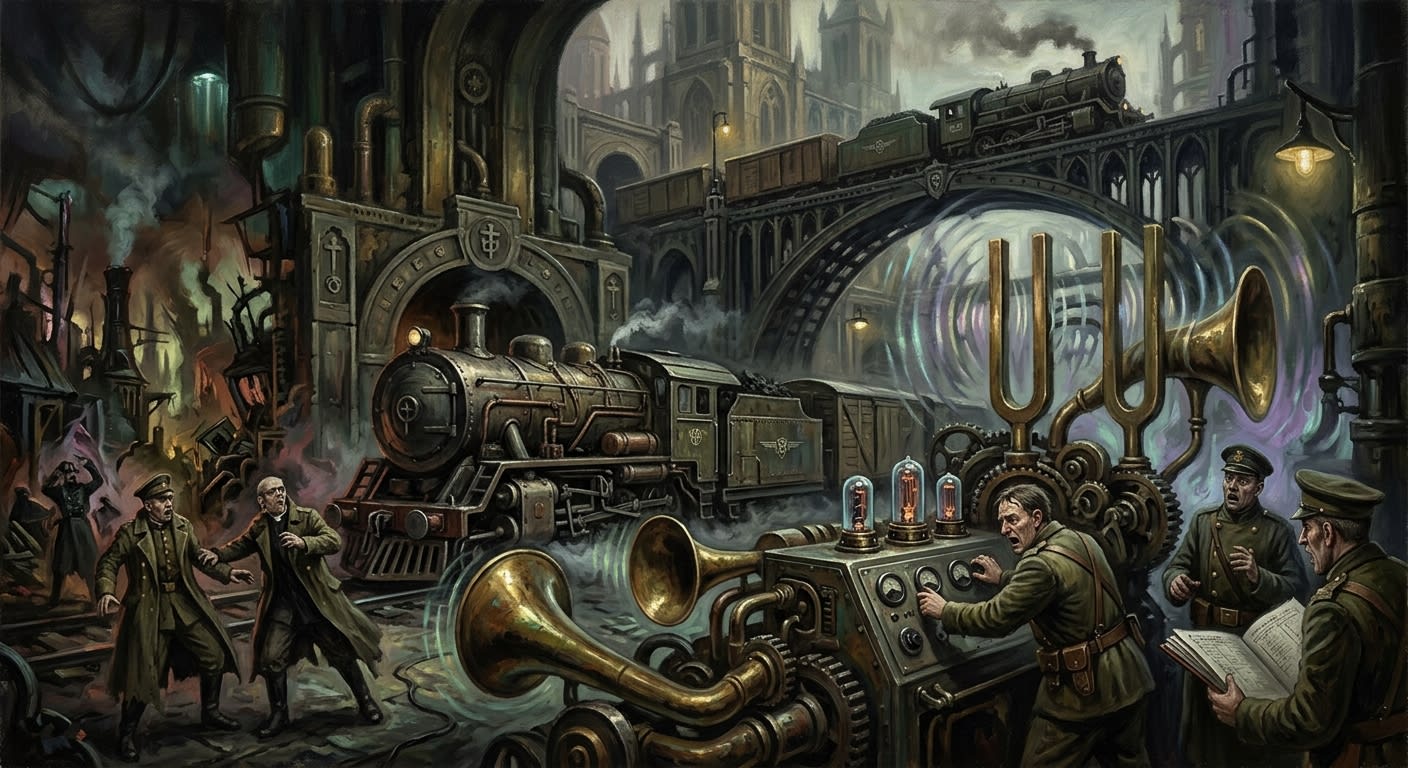
The Hymn-Phase Slip is the Palatine Switchyard of Lorn's private miracle against confidence: a Category Two Localized Acoustic-Mechanical Disturbance in which correct sung procedure produces incorrect physical routing. A cantor sings. A tower answers. A switch throws. A manifest agrees. The train departs with every sign of obedience and arrives in a place the schedule has not admitted since the last official lie was printed.
Ordinary error is humane, comprehensible, and readily blamed upon a clerk with no uncle in Strasbourg. The Slip is worse. It preserves the evidence of correctness while altering the consequence. It lets procedure wash its hands in clean water beside a corpse.
The anomaly belongs to Lorn's founding wound. In A.S. 104 the Bureau of War converted an old market town into the continent's iron throat. By A.S. 110 the yard was processing seven hundred departures per day. In A.S. 112 the Silent Derailment killed forty-one men on a siding the manifests denied existed. Every switch had been thrown under lawful procedure. Every available signal agreed. The bodies were found at dawn along a slag wall beside rails that had no installation number.
The Cantor Corps became mandatory afterward. No switch without hymn. No signal without measure. No movement without sound. This, naturally, made the problem religious and gave it better uniforms.
The phrase Hymn-Phase Slip was not coined by poets. That is how one recognises its danger. It came from analysts attempting to describe the interval between sung measure and iron result: the tiny lateness, the half-breath skew, the moment in which the yard hears correctly and answers from the wrong arrangement of itself.
#On the Original Misrouting
The Silent Derailment is Lorn's first bruise and the Slip's first public shadow. Forty-one men died because a siding existed where the manifest said nothing could receive them. Their train entered under correct dispatch. The cantor's measure was witnessed. The switchman's throw was witnessed. The tower slate logged clear. No crash bell rang. No alarm broke the night. Silence, which in Lorn is treated as error, became evidence after the fact and was punished too late to be useful.
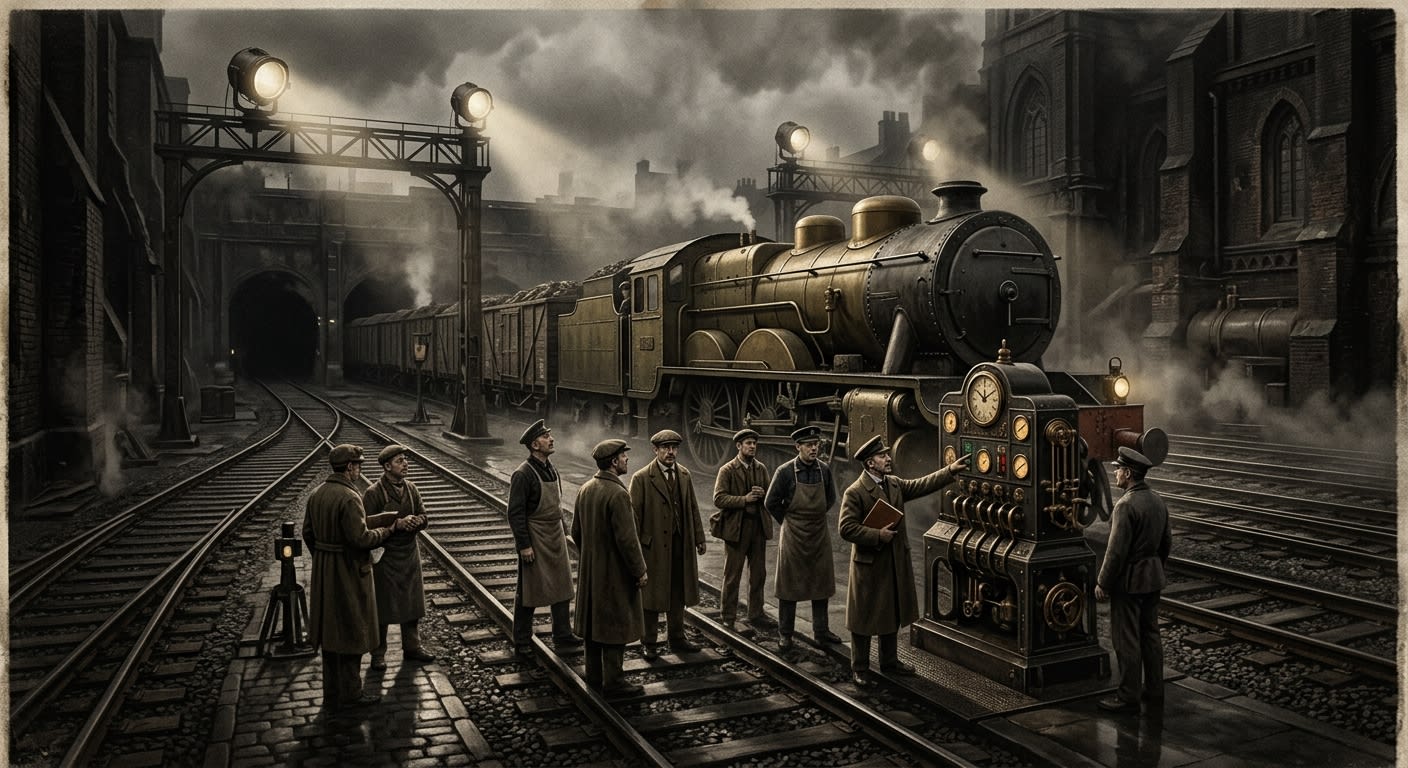
Tower Nine appeared in the annex as “adjacent control station,” a phrase so small it should be arrested for obstruction. Later sealed analysis found Tower Nine had answered a signal never sent from Tower Three (Unregistered). The answer was late by one measure. The throw was made according to the answer. The siding accepted the train. By dawn, the routing slate had sweated through its chalk and one lower lamp held a crack like a clock hand.
The first public attribution blamed Rationalist remnant sabotage by the Unmeasured (Unregistered).
Corrected. The Unmeasured were executed, which improved neither scholarship nor rail safety. Later sealed reports attribute the Derailment to a large Hymn-Phase event involving Tower Nine, unsanctioned tonal conditions, and a siding whose legal nonexistence proved tactically inadequate.
After A.S. 112, Bells declared voiced procedure the cure. This has a clerical elegance I almost admire. If unsung procedure failed, sung procedure must govern all motion. The fact that the anomaly appears inside sung procedure was treated as rude timing by reality and not, initially, as rebuttal.
The Switchmen learned a different lesson. The hand that throws may refuse if the hymn is false. The Thrown Hand grew from burial funds into oath funds, then into a labour brotherhood with the good sense to distrust distant music. Above ground the Cantor Corps acquired platforms. Below ground the Hush Tunnel Runners learned which silences moved bodies safely. Lorn acquired two doctrines from one grave: sing everything, and trust nothing sung.
#On the Mechanics, If One Permits the Vulgar Word
The Slip begins as agreement. This is why it passes inspection.
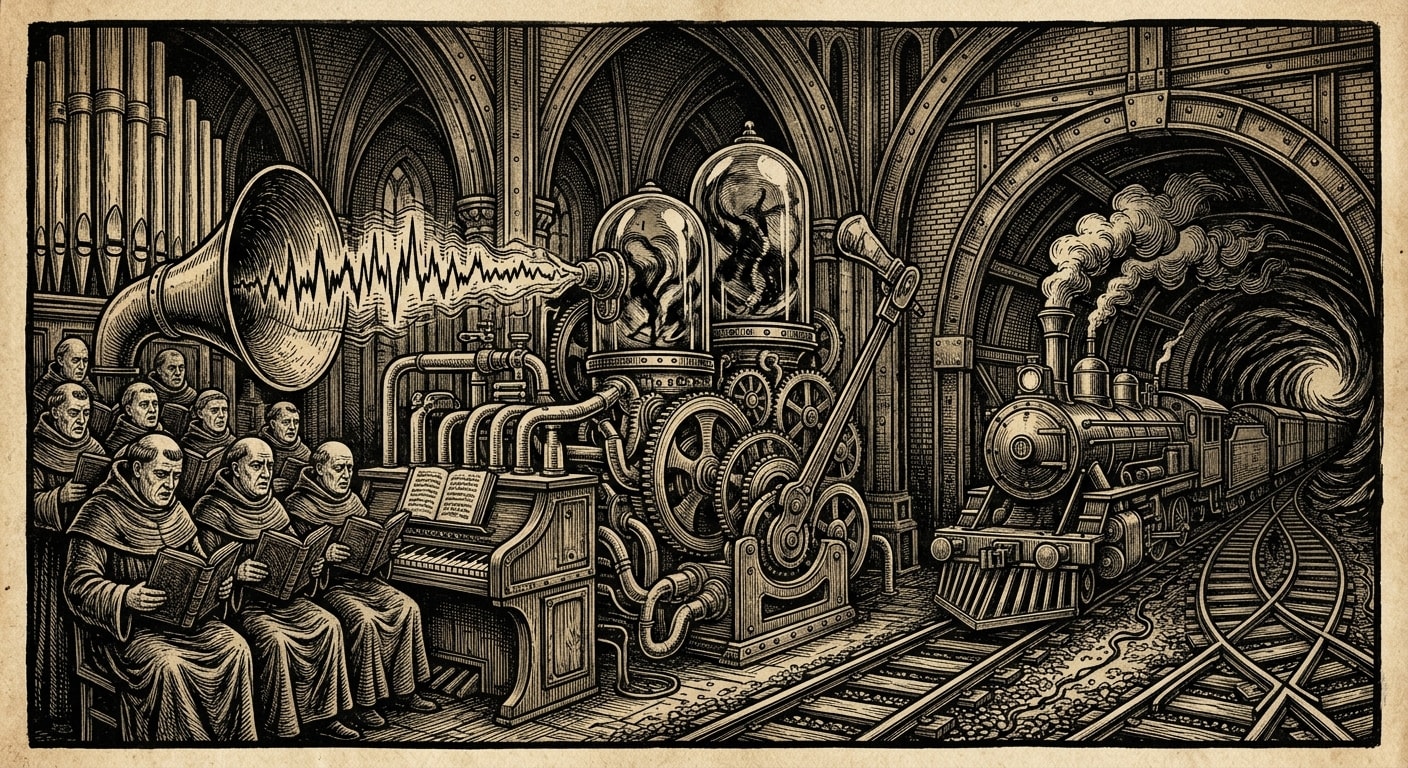
The cantor sings the dispatch measure. The tower caller repeats it. The switchman confirms. The lamp clears. The manifest receives its stamp. The train moves. In an ordinary yard, these stages produce routing. In Lorn, under certain tones, fogs, tower conditions, and subterranean moods, the stages produce a second answer. The second answer is quieter. It is later. It enters through lamp glass, routing slate, rail tongue, bell echo, or the worker's conviction that the track has always been slightly to the left.
The most common field signs are small: echo returning one measure behind; chalk dampening on dry slate; a switch housing warm without use; lamp colours holding after being logged out; manifests smearing as if wet; paired cantors hearing each other from the wrong side; under-yard puddles reflecting tower signals before the towers blink. The worst sign is familiarity turning sour. Crews report the same yard, the same rails, the same towers, arranged as if rebuilt by someone who knew the plan only through confession.
The probable source is the sealed pre-Synod clock tower (Unregistered) encased beneath Tower Nine. The old market town's clock was never demolished during the A.S. 104 requisition. It was swallowed: slag-fill buttresses, sound-deadening masonry, prayer, brick, and official forgetfulness. One prohibited survey sketch shows the hidden clock's hands fixed at an hour no Lorn schedule uses. That hour now keeps appearing where it is least wanted: in late blinks, in tunnel marks, in paperwork filed before the event it describes, in the long hesitation before the Needle (Unregistered) releases relic-priority freight.
Bells insists the sealed clock is a resonance source, which is a way of saying it makes sound misbehave without asking why the sound should listen. Records insists the relevant documents remain pending. War wants the trains moving. Purity wants culprits. The Yard wants throughput. The tower answers late.
#On Tower Nine and the Late Answer
Tower Nine is the Slip's public mouth and private throat. It stands over the Palatine Yard as an iron-and-glass routing cage with signal lamps, bell horns, wet rope, ozone stink, and a foundation nobody wishes to excavate. It commands relation rather than one switch: the Needle's eastern pinch, Payroll Spur sidings, secondary ladders, Cinderrow steam, Cantor Walk. A wrong signal from Tower Nine teaches the adjacent towers to agree with error.
Other towers signal. Nine answers.
The late blink first entered provost notes after the Silent Derailment, though the notes pretended not to name it. A tower sends a call elsewhere. Nine answers in the expected colour, one measure late. A caller obeys the answer and prevents disaster. He is commended, reprimanded, transferred. Lorn reserves its highest suspicion for good results achieved by unapproved means.
The Hush reads these answers greedily. Through drainage grates and pipe cracks, lamp-readers catch amber holds, false clears, gutter flickers, low blue after storm, and the delayed reply called Nine-late. A route-mother can move fugitives beneath an inspection sweep by counting a blink no Signal Manual (Unregistered) admits. A Union watcher can see a false clear before the cantor finishes. A child in Cinderrow knows whether the Needle is hungry from the duration of amber light. This is civic education in its least printable form.
TOWER NINE / UNDER-YARD LISTENING EXCERPT — SEALED Caller logs Tower Six dark. Lower puddle shows Six-green before Six lamp responds. Tower Nine blinks once, late, in decommissioned colour ███. Route mark appears on sealed clock masonry. Child witness: “The tower answered under itself.” Disposition: child classified unreliable; puddle drained; masonry resealed; colour removed from manual index.
The Slip intensifies after storms. Lightning blackens Tower Nine's cage and leaves blue halos in lamp glass. Workers say the tower sees better after being struck. Bell officials laugh in public and replace the glass under guard. Hush lamp-readers pay double for post-storm codes. Market behaviour is often the first honest theology in a frightened city.
#On Cargo That Obeys the Wrong Schedule
The Slip moves trains and categories.
A munitions train enters as eastbound, emerges as delayed, and receives a west-yard storage stamp before the clerk assigned to that stamp begins shift. A dead-wheel inspection car disappears under brake quarantine and reappears with two living men inside, both marked deceased by separate offices. A pilgrimage baggage wagon circles through the Needle three times without crossing it. A sealed axle consignment reaches Vire with Lorn soot inside the wax and a Vire toll receipt dated the previous day. The official explanations are numerous, tidy, and embarrassing.
The Payroll Spur losses of A.S. 199–201 made the anomaly politically taxable. Sealed relic-payroll crates consigned toward Bastion-Przemyśl left Lorn with correct seals, correct measures, correct stamps, and correct escort. They arrived empty. Yard Palatine Kessel (Unregistered) produced an audit proving absence. Prefect Halden Wry produced corrected paper proving transit. Sister-Calder (Unregistered) produced tonal records proving obedience. The crates produced nothing, which is the most eloquent cargo in bureaucracy.
The street blames the Runners. It is satisfying to imagine thieves with crates, crowbars, and laughter. The buried evidence points toward older route codes cut beneath Tower Nine, payments in salt nobody mined, wax nobody poured, and under-schedule movements that made the Hush Tunnel Runners look less like masters than hired witnesses. Theft may have occurred. It was not the whole instrument.
The Slip creates opportunity. Criminals exploit opportunity. Officials exploit criminals exploiting opportunity. Then Doctrine arrives and asks why opportunity learned to sing.
Yard Tribunal notices identify Hymn-Phase events as “misconduct masked by acoustic confusion.”
Corrected. Misconduct thrives in the confusion, but the confusion is not its mask. It is the weather under which all Lorn wrongdoing has become better dressed.
#On Countermeasures, Superstitions, and Their Prices
Lorn's approved countermeasures exist in layers, each one an admission wrapped as command. Double-canting requires two certified voices per measure, one primary and one shadow. Wax-sealing switch housings prevents after-throw tampering and fails whenever the tampering occurs before the throw agrees to have happened. Salt is scattered on Tower Nine steps. Quiet minutes are held before Needle release. Routing slates are warmed over brazier smoke. Bell glass is inspected after lightning. Callers work in pairs. No one answers the late blink, in theory.
The useful countermeasures are uglier. Switchmen repeat station numbers by touch while placing hands on the rods. Lamp-readers cover one eye when reading Nine-late so both eyes cannot be made wrong together. Route-mothers forbid singing beneath the clock foundation. Manifest clerks mark suspicious pages with grey thread under the top-left corner, a practice Records condemns and uses. Some crews spit on the rail tongue before a dangerous throw. Bells calls this vulgar superstition. The crews call it cheaper than funerals.
Sister-Calder's office hates unsung hand checks because they demote voice. The Thrown Hand loves them because a hand near iron knows when iron lies. The Runners love anything that slows the official schedule and raises under-schedule rates. Kessel loves nothing that cannot be filed as control. Wry loves grey thread only when he orders it. Hark will love none of it. That is why everyone is afraid.
#On Veyl Hark and the Question Lorn Has Avoided
Inquisitor-Regent Veyl Hark has not yet reached Lorn. Her delay has become part of the anomaly's pressure. She studies Tower Nine bell codes, Payroll Spur ledgers, corrected manifests, freight priority windows, and sealed Hymn-Phase reports from Strasbourg with the patience of a cold room. Hark's commission authorises audit, arrest, supersession, sealing, reopening, requisition, and interim command. More importantly, it authorises her to ask the same question after the first answer has made everyone comfortable.
Lorn expects her to blame someone. This is optimism disguised as dread. Hark will separate voice from record, record from route, route from profit, profit from alibi. She will make unrelated cantors sing Lorn measures outside Lorn air. She will copy lamp codes by hand. She will name the sealed clock in writing. That last act may prove the most violent. In the Synod, naming a sealed thing is half an excavation.
The pending question is simple enough to fit on a child's route-skin and large enough to make three Bureaus sweat: does the yard misroute because men corrupt the hymn, or because the hymn is answering a structure Lorn buried and kept using?
The Bureau of Bells wants an acoustic fault. Records wants documentary drift. War wants a tolerable delay. Purity wants a throat. The Hush wants routes. The Union wants fewer dead men blamed for sung mistakes. Kessel wants gloves. Wry wants stamps. Sister-Calder wants obedience at pitch. Hark wants the hinge.
At second bell, Tower Nine answers late. At third, the Needle holds amber. Under the yard, a puddle blinks green before any lamp has moved. A train waits with correct papers. A route-mother tells a child to close one eye. The cantor sings the measure perfectly.