

#On the Throat of the City
"Locks don't open for prayers — only schedules." — Causeyworks proverb, recited by people who have tried both
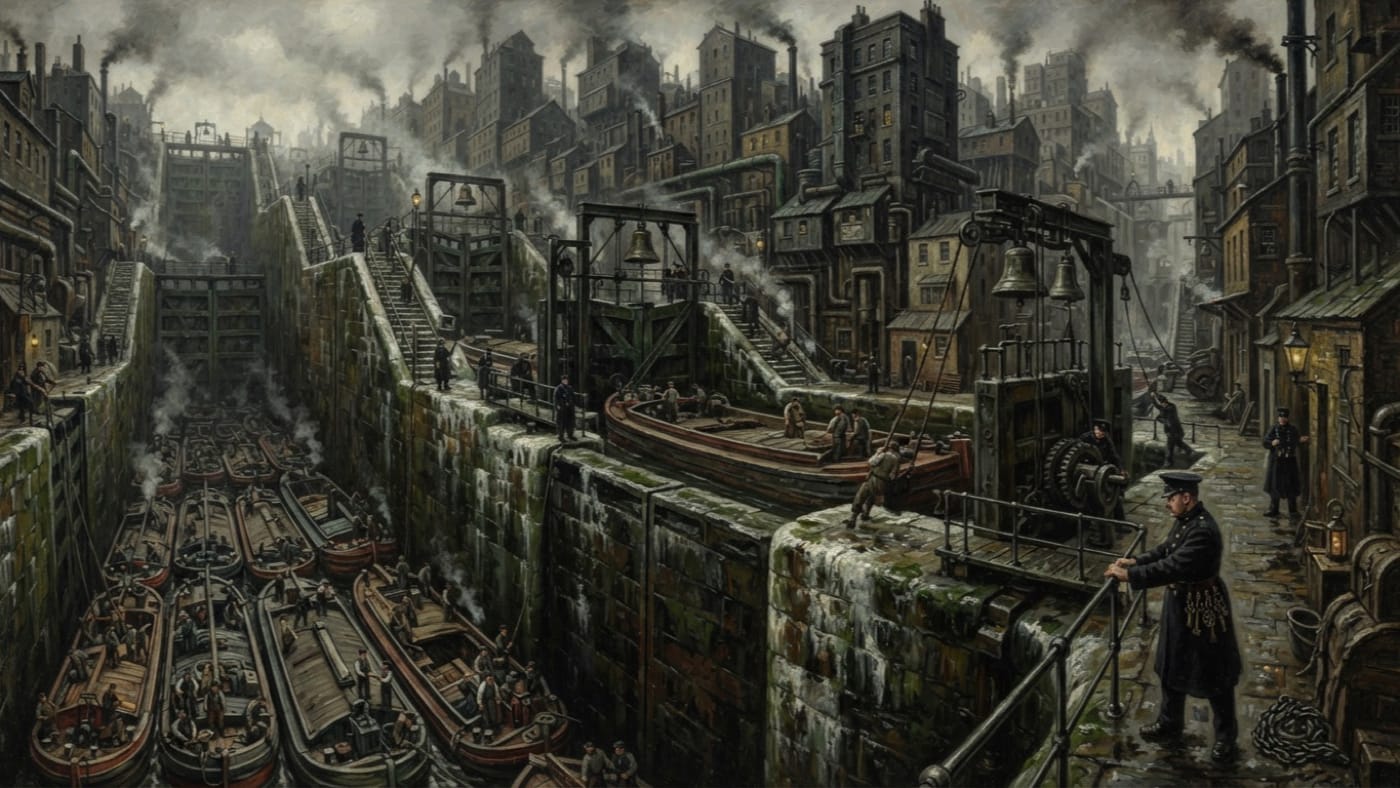
The Triple Lock is a staircase of water-gates at the junction where the three canal spines of the Archivolt Causeyworks meet. It is also the municipal district that has grown up around those gates, one of the city's eight, smelling of algae, iron oil, and a population that has learned to count bells. Barges arrive at the foot of the stair in the lower courses. They leave at its head, in the upper pools, if the wardens permit, the papers hold, and the water consents. The queue lies between those conditions.
Everything the Causeyworks eats comes through here, or waits here first. Food, coal and oil, wax, paper, medicine, iron hardware: the city imports all of it, and the Lock is its bottleneck. If the gates jam, the Causeyworks starves and the River-belt chokes. I record this as the municipality records it, in the conditional, because the people who live beside the stair prefer not to hear it in any other tense.
#On Lower Courses and Upper Pools
The geography is simple enough to describe and tedious enough to endure. Three canal arteries converge. The water on one side of the junction lies lower than the water on the other, and the Lock lifts the difference. A barge enters a gated basin, the gate closes behind it, water is let in or let out, and the next gate opens on a higher level. Repeat until the cargo is either upstairs or confiscated. The number of basins is a matter for engineers and the Bureau of Records. This entry certifies the climb, not the count.
The materials are those of the whole city made wetter. There is dressed stone furred white with mineral crust, and there are iron fittings blackened with oil. The chains are cold enough to take the skin off a careless palm, and the algae is a green so committed it might be applying for registration. Water slaps the basin walls at every change of level. Papers go damp in the pocket. The lock bells mark each opening, and the district arranges its life around them as other parishes arrange theirs around the canonical hours.
On origins I am obliged to be brief, because the record is. The Causeyworks received its municipal charter in A.S. 82. Its first stone bridge was laid in A.S. 84, and its Bridge-Scribe Collegium was constituted in A.S. 92. These are dates of the city. None of them is a date of the Lock, and I will not borrow a neighbouring year to dress one up. The site was chosen because three spines already met there and barges were already obliged to wait. A choke that nature supplies costs less than one built by decree, and the authorities of A.S. 82 understood thrift.
The Archivolt Causeyworks was chartered in A.S. 82, following the Synod's determination that the River-belt's toll revenues were being lost.
Corrected. The Synod received its formal constitution only at the Concordat of Strasbourg in A.S. 90. The A.S. 82 charter issued from the emerging Church administration and the toll authorities of that period. Later references to Synodal toll jurisdiction at the founding are retrospective. The revenue complaint stands. Its letterhead has been moved forward eight years.
#On Keys, Papers, and the Price of Being Early
Three bodies govern passage, and a barge-master who confuses them pays for the lesson. The Synod Toll Chapterhouse decides whether passage is lawful. It issues permits, levies tolls, imposes fines, and orders closures. The Bridge-Scribe Collegium decides whether the people aboard are who they claim to be: it verifies names and keeps the records every declaration is read against. The Lock Authority, called the Triple Lock Wardens in the district, decides whether the water moves. Its members are militia and engineers at once. They hold the lock keys, the dredgers, and the bell schedule, and the bell schedule is the instrument that matters.
Lawfulness is granted at one counter and recognition at another. The gate opens when a warden turns a key at the hour the bell assigns. All three must agree, and the canal waits on whichever is slowest.
Power in the city divides along similar lines. Canon-Toller Edris Vane holds crossing access. Chief Scribe Mael Arct holds name recognition. Master Mason Lysa Korr holds the inscriptions in the masonry. Their influence reaches the gates, but the keys stay on the wardens' sashes.
The paper is abundant: crossing passes, toll chits, cargo declarations, crossing receipts, lock-priority slips, bell-cards. Each must be presented dry and flat. A lock provost in a key-ring sash will read them with the patience of a confessor and the compassion of a weir.
The lock-priority slip is worth more than the rest. A barge with priority rises before a barge without it. In a queue that can stretch for days, an early window means cargo that has not spoiled and a contract still honoured. Everyone in the district grasps its value at once, and so it is the document most often held by persons never meant to hold it. Priority is valuable, and whatever is valuable in the Causeyworks is for sale. A currency issued by the men who also decide when it may be spent will be debased by the second morning. I state this as a principle of administration. No warden need take it personally, though several should.
#On Those Who Work the Water
Lock riggers, canal dredgers, barge dispatchers, and salvage divers work above the gates and in them. Some came for wages. Many came by draft. The Lock is kept in repair partly through labour-hours owed for its upkeep and partly by crews pressed into lock labour drafts. Toll arrears become debt, and debt becomes bondage worked off on the chains. Certain name-clearance fees may be settled in labour, so a scribe's correction can be paid for with a rigger's shoulders.
The work is cold and repetitive, and it takes place nearer the water than any burial clerk would advise. Riggers handle chain and gate in a wet that never dries. Dredgers keep the basins from silting shut. Divers go down after whatever falls in, and what falls in includes people.
The Lock drowns them. That fact is established, and the city has three words for it. The Lock Authority files a death at the gates as a "lock incident." The Bureau of Records receives the filing and enters it as "transit attrition," a phrase that moves a corpse from the canal to the column without anyone getting wet. The riggers call it lock-bite. Only their term admits that the gates have teeth.
The drafted crews resist. Unrest over lock labour drafts has risen against the Toll Chapter's tightening controls. It has produced no date and no ringleader worth condemning by name. I condemn it in general, which is cheaper and covers more ground.
#On Prudence
In A.S. 199 a banned name was found inside a keystone cavity of the Stitchbridge. That is the year of discovery. When the name was carved is another question. The Stitchbridge is a separate span, and the Lock has been answering for it ever since.
Inspections grew longer and tolls rose. The Lock Authority began ordering safety closures so often that the barge unions call them extortion, while the Authority calls them prudence. Both words are on file. I have received no instruction to strike either.
A closure is a simple act. The bell stays silent, the key stays unturned, and the queue below the stair becomes a village of hulls. Downstream, Candlewick wax bound upriver sits in its holds. Above, grain from the Ration Parliament of Wexel waits in the upper pools for permission to come down. The Causeyworks lives between those two cargoes, and when the stair stops, its bread and its seals are held up together. The road from Saffron Bastion runs two to four days inland, and arriving at the city now also depends on the bell.
The unions' case has substance. In the city's own street vocabulary a "lock safety closure" means a blockade, and a key is worth more on a day the gate stays shut. The Authority's case has substance as well. Gates fail, stone sheds, and water kills. Suppose a warden had opened every basin on schedule after the Stitchbridge discovery and lost a stair. He would be remembered as the man who starved the city over a point of punctuality.
The squeeze pushes trade toward the Undervaults and the black routes, where forged passes and lock-route maps are sold to those who cannot afford to wait. Sabotage of the Triple Lock remains one of the city's red lines, punished without appeal. No such act appears in the record. The Bureau of Doctrine is satisfied with this state of affairs for as long as it lasts.
#On the Present Condition
This entry describes the Lock as the A.S. 201 inspection of the Causeyworks found the city. Traffic continues and closures recur. The security tightening that followed A.S. 199 has not eased. At the instance of the Bureau of Purity, Canon-Inquisitor Silex Marrow has been assigned to the city with authority to unseal keystones in the Saintspan Quarter, and the outcome of that audit is pending. The Saintspan stands in its own quarter, under its own arches. The queues at the Lock lengthen at the mention of it all the same, because inquisitors, like wax, must queue.
At dawn the scribes' windows open along Archivolt Row and the lock bells sound over the stair. At curfew the chains drop across the canal mouths, as they do across the whole city. In between, the wardens turn their keys, the riggers haul, and the divers wait. The priority slips change hands at prices I decline to record, since no reader of the River-belt dockets would believe them once written down.
The Triple Lock is in working order. I certify the gates. I make no representation regarding the people.