

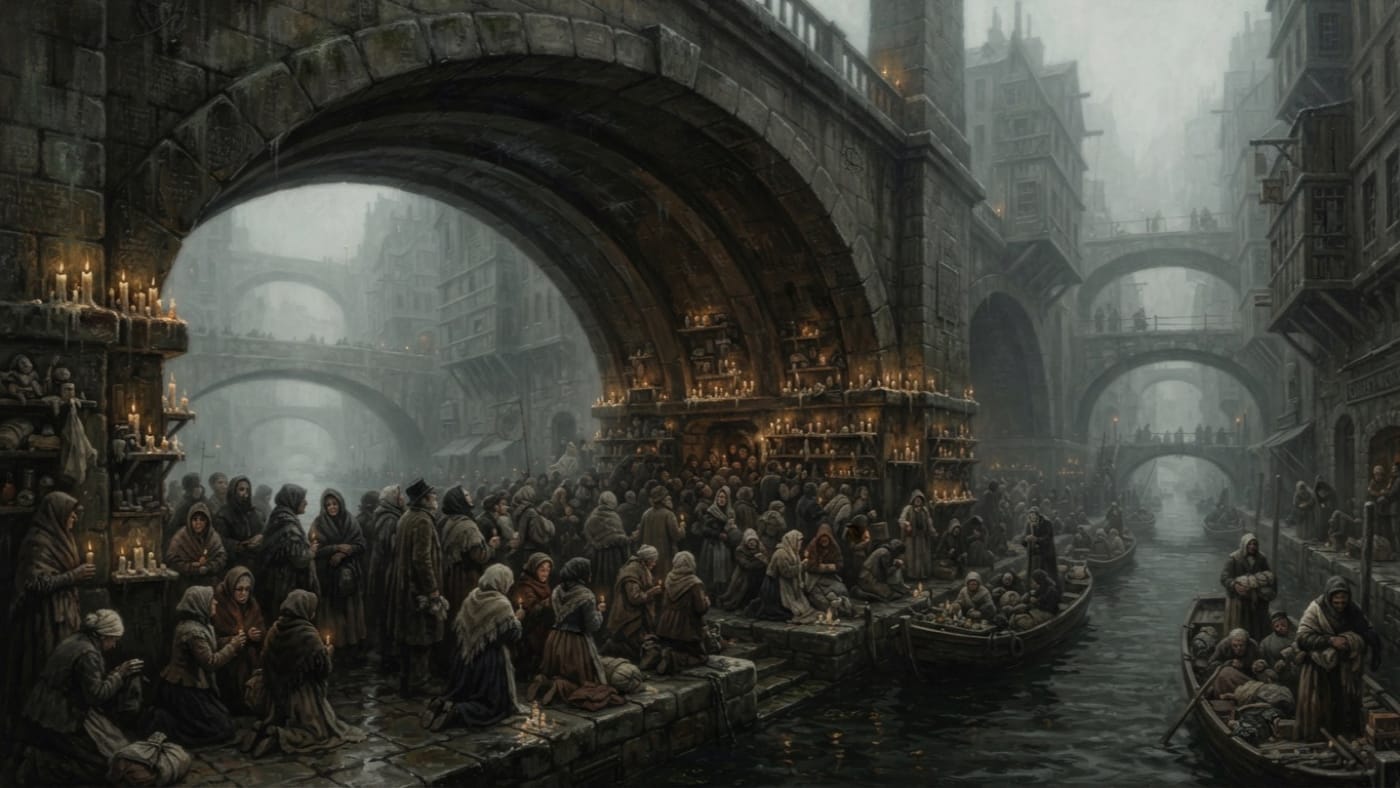
#On the Arch and Its Quarter
"Mind the third rib." — Said to strangers in the Saintspan Quarter. It serves as a greeting, a warning and a sales pitch.
The Saintspan is one arch. I say so first because the Archivolt Causeyworks tends to name its districts after their most troublesome feature, and visitors come expecting a basilica. What they find is a vault of wet masonry over canal water. It is distinguished from the other spans of a city built on spans by the crowd underneath it and by the third rib of its ceiling.
The Saintspan Quarter grew up around it: candle stalls, rented doorways, lodging rooms let by the night or by the miracle, and narrow lanes that a raid must clear before it can do anything else. The Quarter exists because of the arch. As far as any register shows, the arch would exist without the Quarter, and it would smell less of tallow.
What I can certify of the structure is brief. It is River-belt masonry, built of the damp, lime-mortared stone the canal cities use, and like every span in the city it carries its carved letters into the fog. Morning mist lies under the vault until the lock bells have rung twice. The ledger-drizzle crusts every inscription white. No file I was shown records the builder, the year it was laid, its dimensions, the number of its ribs, or the person, if any, whose sanctity the name commemorates. I decline to supply them. A Hieromnemon who invents a founder for a bridge will soon be asked to invent one for a heresy.
This survey is filed in A.S. 201 as a supplement to my second inspection of the Causeyworks. It covers the arch alone. For the city, consult the parent survey. For the city's debts, consult any parapet.
#On Names Spoken Beneath the Third Rib
Every crossing in the Causeyworks requires a registered name, spoken aloud, or a number bought in its place. Under most arches the name buys passage and nothing more. Under certain arches it buys rather more than the traveller intended. The Bureau of Alchemical Standards classifies the phenomenon as Name-Resonance Architecture and records three signs. Canal water shifts against the piers. Lime beads in the grooves of carved letters and runs down the face of the stone. Candles beneath the vault gutter in a pulse rather than at random.
At the Saintspan these signs are strongest at the third rib. There the inspection record adds a pairing found nowhere else: healing effects in the presence of properly registered names, and catarrhal effects in the presence of improperly registered ones.
I reproduce that finding at its own size and no larger. It does not promise a cure to every clean entry or a streaming nose to every defective one. It makes no claim that a clerk's register weighs the soul. The Creator has not been asked to co-seal the Collegium's books, and I would not care to be the clerk who drafts the request.
Properly registered is a term of art. Chief Scribe Mael Arct controls verification for the Bridge-Scribe Collegium, and verification has a tariff. A doubtful name can go to the Namewash Cloisters for scrubbing, a correction writ can be purchased, and a lawful correction is carved in stone beside the original entry. The original is never removed. A pilgrim may therefore arrive under the third rib with clean paper and contested stone, and no file tells her which document the arch consults. I asked. The Collegium referred me to Alchemical Standards. Alchemical Standards referred me to Doctrine. Doctrine is me.
Interpretation is divided along the usual seams. The pilgrims call the effects miracles. The Quarter calls the candle pulse liturgical, and the Collegium calls it atmospheric. Both sell candles. The Bureau of Doctrine holds the arch as a Category Three Structural Anomaly Pending Theological Assessment, which the clerks shorten to Category Three: Pending. They are fond of that colon. It is the only part of the designation that has ever been decided.
In A.S. 194, Inspector Corris filed an assessment attributing the effects to moisture and vibration in enclosed stone. The assessment was withdrawn and Corris was reassigned. The destination was never entered.
Two further signs are reported but not certified. Mudkeys of the Undervaults and pilgrims under the vault describe an echo that repeats a spoken name, sometimes in a voice other than the speaker's. Local lore holds that the ribs sweat lime before a raid. No inspection has found a second speaker, and the provosts deny receiving any warning. I record both accounts and certify neither.
#On Those Who Gather
The pilgrims come by barge, on foot and on the backs of relatives. They light candles along the pier ledges until the stone beneath the third rib is a shelf of wax. Then they speak names: their own, carefully, and those of kin too sick to make the crossing. The registered speak in full voice. The unregistered whisper, on the principle that a catarrh earned quietly is a smaller catarrh. I find no support for this in the record. I find no support against it either, and the pilgrims have not asked my opinion.
Brokers move among them. They sell candle stubs "from the right arch", places nearer the rib and, for a higher fee, a scribe's opinion on whether a given name is likely to count as proper. No Bureau licensed the trade, and none has managed to close it.
The Bureau dispatches raids. The provosts come down the lanes and the crowd scatters into doorways and stairwells and onto barges that had been waiting for exactly that. The wax stays on the ledges. Within a day or a week the pilgrims are back, lighting fresh candles beside the stubs of the old ones. The Quarter's chandlers have never once complained about a raid.
The Quarter keeps prohibitions of its own. Nobody whistles under the Saintspan. Scratching at an inscription carries a fine equal to three months' toll revenue. Speaking any name twice in fog is reckless everywhere in the city, one's own name included, but under this vault people treat it as an act against the household. Some cross with their lips sealed in real wax. Salt lines are laid at the piers and renewed after rain, which here means constantly. The stone-hush prayers are muttered low, in the hope that a vault cannot repeat what it cannot quite hear. All these precautions are practised, and most are sold. None is shown to work.
#On the Stone Under Several Seals
The Mortar Saints preserve forbidden identities in public masonry, sealing them in hidden keystone cavities or coding them into the carved ornament of ribs. Names that the Index Damnatus has struck from the lawful record go back into stone, where removing them would mean demolishing a bridge. The Saints favour the Saintspan. That is established. It is not established that they made the arch respond, that they steer the response, or that any pilgrim kneeling under it is one of them. A heretic who wants an audience goes where the crowd already is. Choosing the address does not prove he built the house.
Their work must also be distinguished from the city's lawful reconciliations. A correction carved beside an entry is public, sealed and paid for. A name sealed inside a cavity is none of those things. The two can look alike to an inquisitor standing on a ladder in fog, and the Lodge's masters do not enjoy the comparison.
Scrutiny sharpened after A.S. 199, when a banned name was found inside a keystone cavity of the Stitchbridge. Note the bridge. Nothing was found inside the Saintspan, and the discovery dates the finding, not the carving. After it, every rib in the city had to answer for its neighbour.
The offices with a stake in the arch are as follows. Canon-Toller Edris Vane holds the crossings, and the crossings pay. Arct holds verification, which settles which names count as properly registered under the third rib. Master Mason Lysa Korr holds the chisel, and with it every lawful cut and every correction made in stone. The Bureau of Records holds a co-seal and a grievance. The Bureau of Purity hunts the prohibited names. Each of these interests is enough to explain resistance to an audit, and none of them proves complicity. I name no Saint whom the file does not name, and the file names none.
Portable contraband is a separate matter. A keystone sliver is a piece of bridge cavity cut free and carried away. No sliver has been recovered from the Saintspan audit. Until one is, the arch remains in one file and the slivers in another.
#On the Unopened Rib
Beginning in A.S. 194, the Bureau of Purity requested comprehensive audit authority over the Saintspan seventeen times. Sixteen requests were refused on grounds of structural risk. One was refused because it overlapped the jurisdiction of Records, whose co-seal was awaiting a review of its own review procedure.
Canon-Inquisitor Silex Marrow now holds an active warrant to unseal keystones. It covers four items: the Saintspan's rib cavities, comparison cuts at the Stitchbridge, tool marks in the Stone-Ledger Yards and the Collegium's correction slates. The Toll Chapter petitioned against his assignment. Records has lodged an appeal, which is pending and has not stayed the warrant. The structural objection still stands as it did in sixteen refusals: a rib is part of what holds the vault up, and nobody has explained how to open one without asking the rest of the vault to manage alone.
The third rib is closed. Nothing has been removed from it. No contents have been described, no name read out, no verdict entered, and no officer of the city charged on its evidence. The authorisation has not yet produced an opened vault.
If Marrow opens the Saintspan's ribs, he will find what the Mortar Saints have put there.
Withdrawn. The Warden's A.S. 201 survey of the Causeyworks anticipated a finding that has not been made. The ribs may hold something the Saints placed there, something else, or nothing but stone and mortar. The matter returns to the status Doctrine has already assigned it: Pending.
In the meantime the pilgrims still gather. The candles still keep their pulse, and the Collegium still calls it weather. Arct still verifies names at the day's rate. Korr's masons still carve corrections beside the originals, and Marrow has the paperwork for a chisel.