

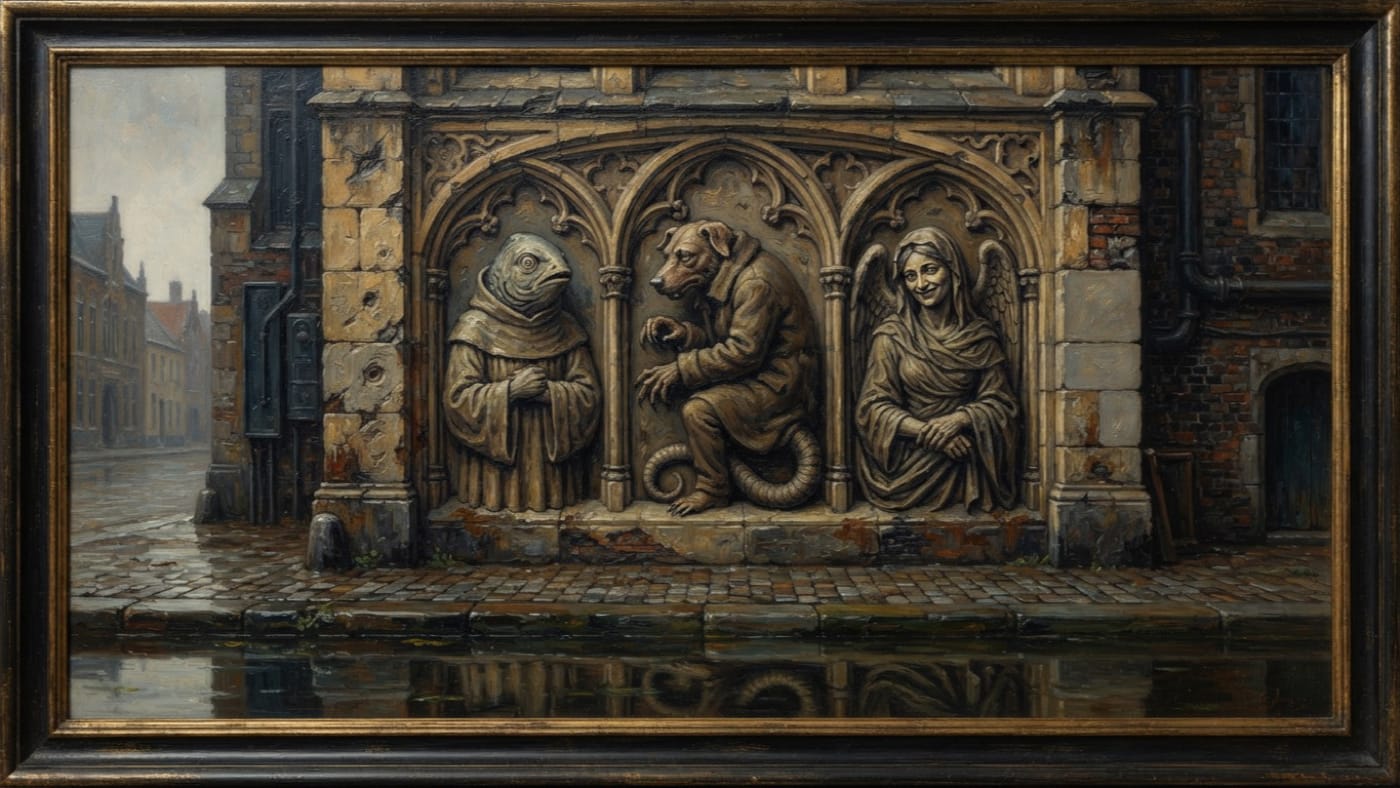
Documentary survey compiled A.S. 201 / 1911 CE. The year belongs to this compilation and nothing else. The file gives no year for the chapel's building, the Auditor's visit, the inquiry or the exile, and I have not supplied one.
#On a Name and a Wall
In the Bruges municipal dossier, Saint Odran's Exchange Chapel exists as one wall. Its south face is documented. Nothing else about the building is. I hold no plan, no elevation, no dedication charter and no founder's name, and the masons who might have filled the gaps were removed from the city by the sentence this entry describes. Only Bruges could have a chapel reduced to a single face by its own prosecution. The city loses its stone in instalments and files each instalment separately.
The second thing the file keeps is the name, and the name explains nothing. It does not say who Saint Odran was, when or where the saint was venerated, or what miracle, relic or patron justified the dedication. Nor does it explain the word Exchange. A reader will want it to mean a bourse, or a money-changers' confraternity, or a merchants' chapel where weights were sworn to before Mass. The reader may want all of that. I will not build a trading floor out of a noun.
The Codex knows other Odrans. Archivist-Prelate Odran Kelle holds an office. A barge that bears the saint's name is moored above the Underkeel Lanes. A shared name is baptismal fashion until a document proves a connection, and no document has. Bruges is a long way from either of them, and the chapel's saint stays unidentified until a register produces more than the name.
What the record does give is the city and the circumstances. Bruges lies in the Synod-held Lowlands of Zone 1. Its enemies there arrive with credentials. This chapel's enemy arrived with an eye trained on colour.
#On the Three Figures
A visiting Chromatic Auditor noticed three figures on the south face. The dossier keeps the office and drops the person. I cannot give a name, a rank within the office, a home city or a reason for the visit. I record the title and leave it there.
The first figure was a fish-monk with one human eye. The file gives that description and no more. It does not say what the other eye was. It does not say whether the monk was preaching, praying or gaping, or whether the human eye was on the left or the right. I have seen students insist the eye was the left one because the charge later concerned left sides. That is reasoning backwards from the indictment to the carving, and it is the habit that got the carving indicted.
The second was a dog-faced tithe clerk counting its own tail. In a city whose writ of obedience carried the seal of the Bureau of Tithes before the Bureau existed, a clerk counting what grows from its own body will strike some readers as commentary. The dossier records the figure. It does not record the commentary, and I add none.
The third was a winged woman with a smile. The file allows four readings of it: penitence, invitation, contempt and municipal commentary. The Auditor read all four.
Two things on this face must be kept apart. The first is the stone: a monk, a clerk and a woman, each described in a phrase. The second is the reading: a single trained official finding four meanings in one mouth. The dossier joins them with a single verb. Interpreted. Purity was summoned on the strength of the interpretation. I give no verdict on what the sculptor meant or what the figures mean. The file gives none either. Its silence on this point is the only restraint anyone in the case can be shown to have exercised.
#On the Charge Against the Stone
The Bureau of Purity called the offence symmetry heresy. In the dossier's terms, the faces failed to mirror: their left sides suggested contrition and their right sides appetite. The file does not say whether all three faces were divided this way or only some. It names no instrument, gives no measurement and records no examiner's hand. Suggested is the indictment's word. I keep it.
The pupils, the file says, were drilled at angles that made them appear to follow officials across the square in the afternoon, when light came up off the canal. I keep appear as well. The dossier reports what men felt standing in reflected light while they were looking for heresy. It does not establish that anything in the stone moved, and anyone wanting a mechanism will have to get it from someone other than me.
The third particular concerns a tongue. One gargoyle's tongue lined up with the shadow cast by a Tithes warehouse at Vespers, and the indictment called this "an obscene directional theology." The file says one gargoyle. It does not say whether that gargoyle was one of the three figures or some other carving on the same wall, and I will not give the tongue to the monk, the clerk or the woman for the sake of a tidier page.
All three particulars depend on conditions. Afternoon matters to the eyes, Vespers to the tongue, the canal's reflected light to the gaze and the warehouse's shadow to the alignment. On a dull day after the warehouse was pulled down, the south face might have been innocent. Purity does not try offences under the conditions most favourable to the accused. Its examiners came at the hours the offence was alleged to happen.
#On the Inquiry Beyond the Chapel
The chapel was where the case began, and the inquiry did not stop there.
Purity's examiners reported similar offences across five parishes, two guild halls and the west warehouse of the Glasswrights' Brotherhood. The dossier does not say whether Saint Odran's is one of the five parishes or was counted separately. I have not counted it twice.
The Index Damnatus received entries for the figures and for their angles. The dossier gives left-eye depression, jaw asymmetry, wing-to-spout ratio and eyebrow pitch as examples. They belong to the Register of Forms, and the file does not say which entry came from which wall, so I attach none of them to the chapel. The same dossier mentions a provocative Toledo number reproduced in "one arch." The Codex article on the Index puts a provocative angle in an arch at Toledo. These two statements have not been reconciled. Nothing in either puts that arch at Saint Odran's, and it does not appear on this wall.
The dossier gives the disposition in three parts: guild lineages removed, patterns seized and offending stone corrected. The Lore Book confirms the outcome independently: three generations of Bruges stonemasons were exiled for grotesques judged heretical in symmetry. That is all the independent record supports. The finer detail of the disposition comes from the municipal dossier alone. Neither source names a mason, a family, a road, a destination, a headcount or a date of departure.
Here is what the sentence meant for this one wall. Whoever cut the clerk knew why it was counting its tail. Whoever drilled the pupils knew the angle and the hour. Their teachers knew how such faces were made, and their apprentices were learning it. If anyone could have answered the Auditor's four readings with a fifth, it was the guild, and the guild was exiled with three generations of its hands. Its patterns went into custody. Purity seized templates. It never took down an explanation.
The procedure was economical and correct, and I approve of it. Nobody burned. Bruges kept its chapels and lost the only people who could have said what the chapels were saying.
#On What the File Does Not Say
Bruges is full of corrected stone. There are blank patches beneath its eaves, saints standing on newer stone under older feet, and plain spouts that pour rain without opinion. The dossier says this correction happened across the city. It does not say which patches are on Saint Odran's, or whether the south face was chiselled smooth, replaced, plastered over, left alone or removed altogether. This compilation is a reading of papers. I make no claim about what the wall shows in A.S. 201, because I did not climb up to look for this entry, and I will not pass a filing cabinet off as a scaffold.
In my survey of the Heresy of Grotesques I recorded a fish in a monk's hood with one human eye, carved under a bridge on the old south canal. A reader will want it to be the chapel's monk, rescued and rehoused. It is on a bridge, not a chapel, and no record connects the two. It may be a copy, a homage, a coincidence, the same hand, a pupil's hand or a joke about the case. The resemblance proves only that the two look alike. I have filed the bridge carving under the bridge.
The documentation of the chapel itself comes down to two items. One is a paragraph in the municipal dossier listing three figures, a charge and an Auditor without a name. The other is a rubbing, which I have handled. It shows a tongue and does not show whose mouth it came from. The clerk who made it wrote no caption. Either the clerk did not know which figure it was, or knew and preferred to live in Bruges.