

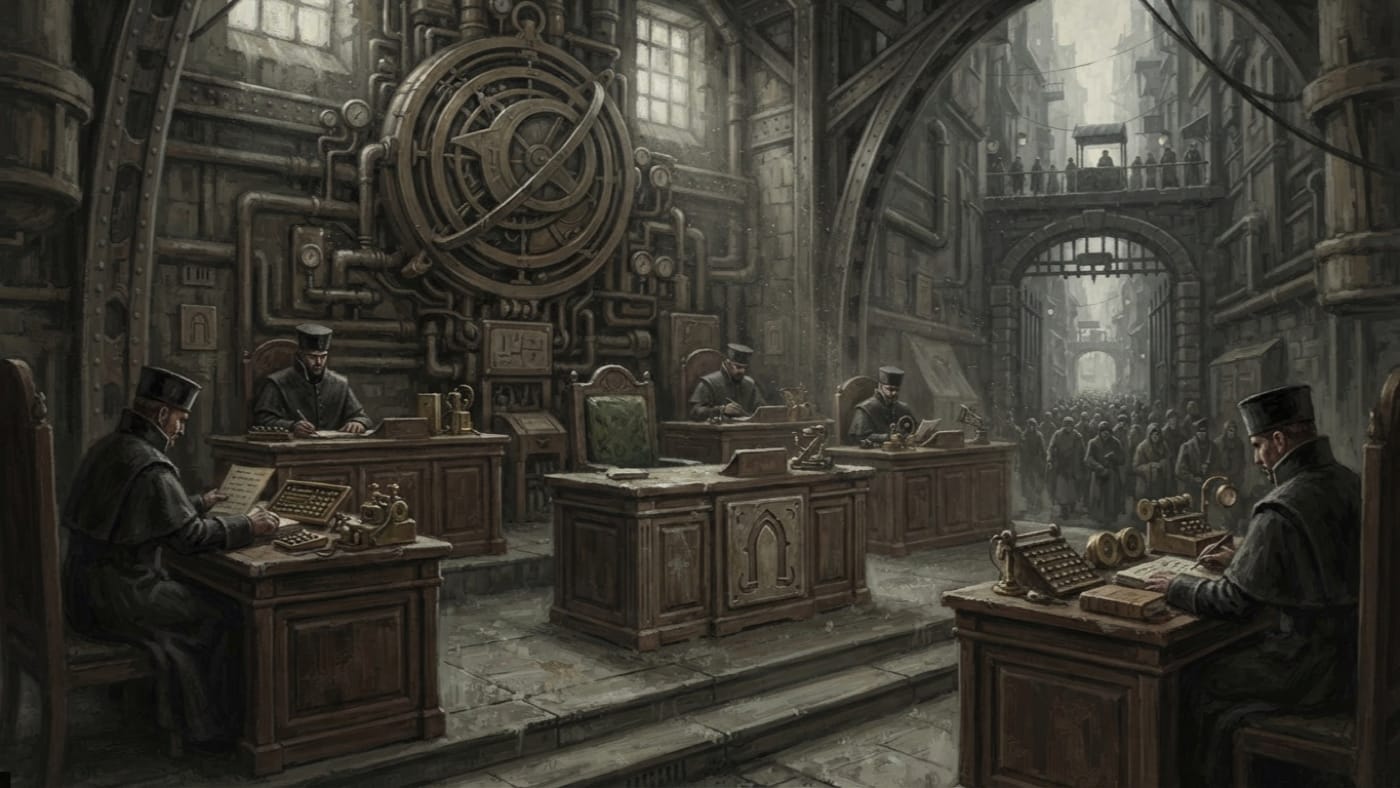
#On the Founding Household
"Offer water first." — Peregrine Row hospitality rule, older than the price list that now accompanies it
Voss is a household of Peregrine Row, one of the three whose names stand at the beginning of the place, and it is the middle name of the three. Whenever the Row's origins require a sentence, the clerks write Peregrin, Voss and Haelke in that order. Repetition has hardened the order into something close to precedence. The Voss have never been seen to object. A family in the middle of every list is guarded on both flanks and blamed first by no one.
What the record holds of them is brief. Before the Synod, at a shrine above a spring-fed cistern on the Pilgrim Roads, the three families taxed water and passage. That is the whole of the founding deed as the Bureau possesses it. No charter gives the cistern to one family and the gate to another. No ledger says the Voss were richer, crueller or earlier. The Echo Creed dossier names them among the three. The Peregrin and Haelke files name them again. None of these files places a Voss hand on any particular cup or toll.
The household's origin carries no date. The Bureau has resisted the temptation to supply one. It practises this restraint about once a decade and speaks of it for years afterwards.
#On Water and Passage
Peregrine Row is a throat. Two ambush canyons squeeze the road into a single funnel, ridges close both flanks, and the only water for a day's walk in any direction rises in one cistern hollow. Whoever stands at the narrowest point of such a place need not build a toll, because the rock has already built it. He needs only a hand held out and a voice that does not tremble.
The founding families charged for two things a pilgrim cannot refuse: a drink and a way through. The record treats the arrangement as collective, and it must remain collective here. Which Voss held the bucket, which Peregrin watched the pass, which Haelke counted the coin at dusk: the Bureau will not answer these questions by guesswork, however handsomely guesswork pays in other departments.
The market inherited what the geography made. Water chits now pass at the Row as currency. The Hall's own surveys call the cistern and the creed gate together the bottleneck, which is a merchant's word for a noose not yet tightened. Escort contracts, safe-window auctions, grief clauses and creed-clearance stamps are the old charge for water and passage dressed in better paper. The Voss were present when the charge was crude. They remained when it became sacred.
In its more generous moods the Road Chapter describes that early arrangement as the families' stewardship of the waters. I record the phrase because the Chapter is fond of it.
#On Licensed Incorporation
The Concordat of Strasbourg constituted the formal Synod in A.S. 90 (1800 CE). Both founders of the Church were already dead and could license nothing. The settlement was the work of the institutions they left behind. Four years later, in A.S. 94 (1804 CE), the Synod chartered the Road Chapter of Peregrine over "all matters of transit, devotion, and syllabic compliance," and the three founding households were incorporated into the Row's licensed brokerage.
The Bureau's word is absorbed. It is a good word. It suggests digestion without saying who was eaten.
A.S. 94 marks a licensing and nothing more. The Voss existed before it. Their council seat was first recorded at some later date nobody has given me. No seal bearing their name has reached my desk. The year records only the moment the Synod found a toll already being collected and decided to collect from it.
No file I have been shown preserves the terms of that incorporation. I can name no Voss signatory, no concession won or surrendered and no title granted. The Chapter received coercive authority: creed tests, gate provosts and detention. The brokers received the right to sell protection under licence. Between those two grants the founding families found their footing, and the Voss footing has held for more than a century.
In A.S. 94 the founding households surrendered their stewardship of the waters to the Synod.
Corrected. Nothing was surrendered. The families kept their place at the cistern and the pass. The Synod acquired a share of the proceeds and a doctrinal vocabulary for them. Stewardship is withdrawn as a description of a toll.
#On the Hereditary Interest
The Licensed Broker Compact Council sits at seven desks on the dais of the Choir-Broker Hall. According to published accounts of the Council, three of those seats are hereditary and belong to the founding names of Peregrin, Voss and Haelke. The other four rotate among the Row's licensed brokers. One desk in seven therefore belongs to the Voss by inheritance.
Who occupies it, I cannot say. The accounts name no Voss occupant, describe no rule of succession and give no year in which the seat became hereditary. A desk is entitled to a family. The record does not say whether the family passed it from father to son, from aunt to nephew, or by quarrel to whoever reached the seal first.
The seat gives the household a voice in the Choir-Broker Compact, which prices escort premiums, grief clauses and safe windows. It carries none of the Chapter's powers. The Voss desk issues no detention warrant, commands no provost and sits on no creed tribunal. Arrest belongs to the Road Chapter, the escort to the captains and the Quiet Pens to their Wardens. A broker family profits from all three without holding the key to any of them, which is the most comfortable posture a theocracy offers.
The present dais is crowded with names other than Voss. Cantor-Auditor Selm Peregrin speaks for the Chapter. Broker-Matron Lysa Vane sets the prices. Captain Odrik Ridge-Hook rents out the blades. No file I have consulted makes any of the three a Voss by blood or marriage, and I decline to arrange a wedding merely to tidy the chapter.
#On the Present Account
As of A.S. 201 (1911 CE) the Row is open, operating and under Amber review. The Bead Courts click. The Gate of Clean Tongues listens. Since the Year of Ash Rain in A.S. 143, the canyon has been filed as a Category Two disturbance. By the Chapter's accounting it returns a pilgrim's prayer with one vowel altered, which gives the gate its charge. A false finding at the gate produces a detention. The detention produces a processing fee, and an unpaid fee produces a labour contract. Premiums rise with the danger. Every licensed interest in the Hall feeds on that sequence. The Voss interest is licensed. The arithmetic is not difficult.
Arithmetic is still not evidence. In the ambush of A.S. 101, two hundred and fourteen of six hundred pilgrims died beneath the ridge caves. No record sets that massacre against the Voss name. The Canyon Saints were credited with the blades, the survivors were fined for doctrinal negligence, and no household was asked to answer.
Ninety-eight years later, in A.S. 199, a Compact schedule was recovered that spoke of a "demonstration risk event" timed to the canyon's agitation. The signatories' names were removed under Road Chapter privilege before anyone outside the Chapter could read them. The Bureau does not know whether a Voss pen touched that page. If the Road Chapter knows, it has chosen not to share.
The household stays on the ledger as the record leaves it. It is a surname on the Row's oldest list, with a licence from A.S. 94, a desk on the dais and a share of whatever the cistern and the canyon extract. For a century and more the Voss have given Synodal accounting nothing to write down except the toll. The Bureau has written down the toll.