

#On the Numbered Ward
White Ward Seven is one of the numbered wards of the White Ward, the primary infirmary complex of Marrowgate. This survey of it was commissioned and compiled in A.S. 201, which is 1911 by the old reckoning. That year belongs to the compilation. Nothing was founded, reopened, rebuilt or inspected in it, and I have not pretended otherwise to give the page a cornerstone.
The archive knows Seven by its numeral, by its parent and by one morning in A.S. 194. It does not know the ward's walls. Its dimensions, its count of beds, the names of those who kept it, the officer who answered for it and the door a visitor would knock on are all missing from every source available to this survey. I have not supplied any of them. A ward with no recorded director has not thereby earned an invented one, and no clerk should take a numbered room inside a complex for a separate establishment with its own street.
Readers ask what the seven means, and the answer is only that the ward was counted. The numeral gives no capacity, specialty or position in a floor plan. It also has no bearing on the Seven Names of Proper Intake, however neatly the coincidence would fit on a sermon card. A Mercy Ward Seven in some other city is another house under the same numeral and should be filed elsewhere.
#On the Intake Record
Seven's cabinet mattered because of the system that surrounded it, and that system belongs to the complex. Throughout the White Ward a confession receipt comes before treatment. The Civic Triage Tribunal allocates beds and rules on medical debt. Licensed Sealhands perform surgery and notarise it in the same sitting. The Mercy Ward-Sisters and Ward-Brothers provide the care and keep the ledgers that prove it was given. The Sanitation Chapter controls the gates, the cordons and the crossings. All of this is attested for the White Ward as a whole. Not one rule in it is documented as Seven's own, and I have not written any admission custom, shift observance or quarantine mark into the ward that the record has not put there.
An intake list in that system does more than help the staff remember who is in the beds. It is the instrument that decides what may be done to a body and on whose account. A discharge mark frees a bed and takes the patient off the ward's responsibility. A death classification closes the file and tells the city which of its routes to send the remains along. An amputation file, once notarised, revises the patient's duty and reassigns his debts under the new designation. Clerks sign these entries, wax seals them, and offices downstream rely on them without seeing the patient. When a list is wrong, every office that trusted it acts wrongly with perfect propriety.
For that reason the cabinet that holds the list is guarded as a reliquary would be, with a seal, a signature and someone answerable for it. In A.S. 194 the guarding worked as designed, and that did not stop what happened.
#On the Cabinet of A.S. 194
The account runs in documentary order, and I keep that order.
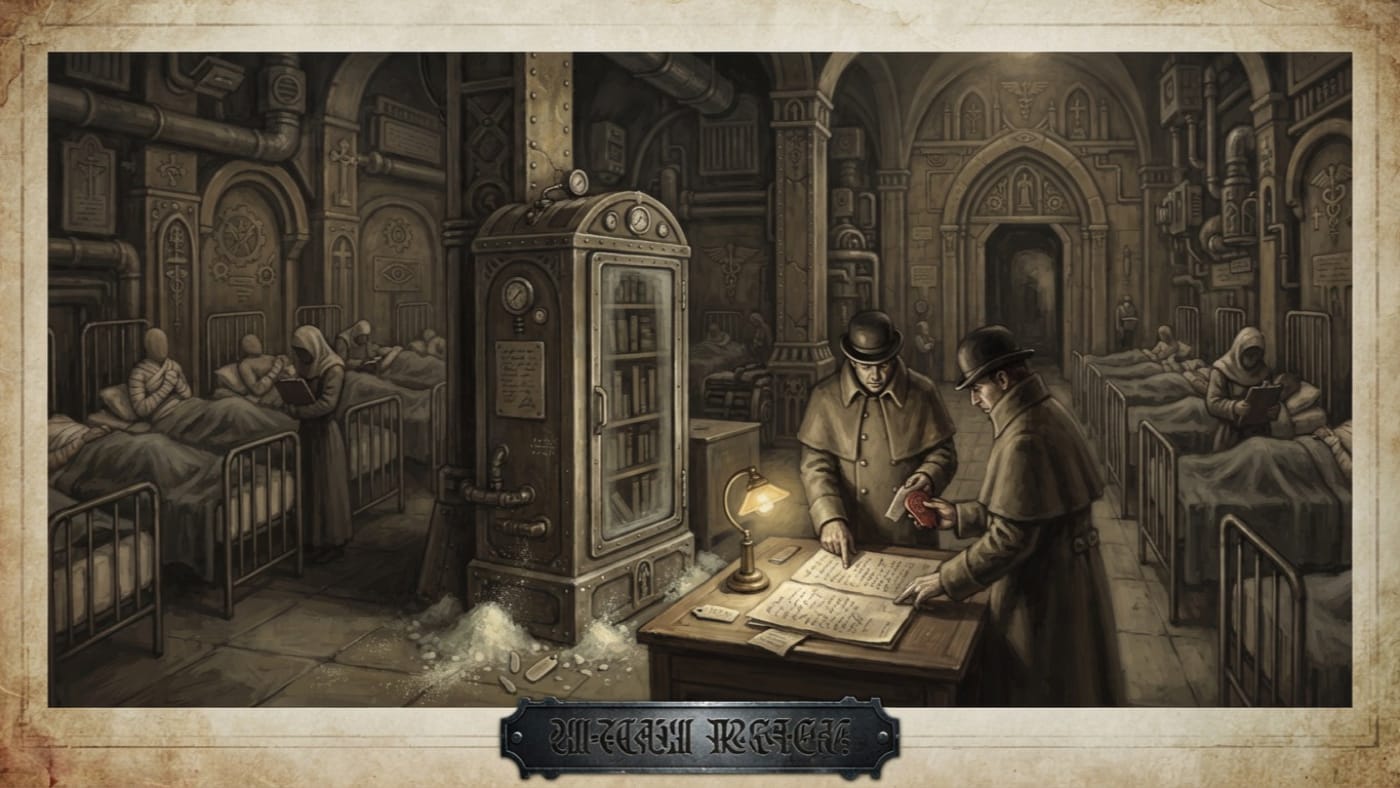
On the evening before, Seven's intake cabinet was washed, inspected, signed and sealed with Sanitation wax. By morning it contained three things nobody had filed in it: a deposit of chalk or lime dust, a cracked bone tag and a revised patient list.
The revised list corrected four death classifications. It restored two names that had been marked discharged. It amended one amputation file, recording a greater loss of limb than the original entry and noting that the patient's debt had been improperly assessed. The corrections proved accurate.
These are counts of corrections. They are not a count of patients, and nobody should add them up into a roll. The record available to me does not give the patients' names, the procedure by which the corrections were checked, or the identity of whoever, or whatever, wrote them. I give the figures and leave the rest unfilled.
The accuracy of the corrections was the offence. A false list could have been explained by sabotage, fever, a bad seal or a bribed porter, and Marrowgate keeps explanations of that kind on hand. A true list obliged four offices to admit that their certified entries had been wrong and that something outside any licensed hand had noticed first.
The official account of the event exists in two versions, and the gap between them is instructive.
Initial Sanitation Chapter notice, A.S. 194, described the White Ward Seven event as "minor contamination of storage materials."
Corrected by the Bureau of Records, whose correction reports that the same "minor contamination" also altered nine intake ledgers, two kiln tallies and Prefect Salvius's personal wash bill. These further effects are entered on Records' authority. They do not establish that the affected ledgers were kept in Seven. The Bureau accepts that the event occurred and does not certify who or what made the corrections.
Later accounts add details. Some give the hour of discovery, some count layers in the dust, and some extend the story of the amputation file into widows and debt notices. These elaborations do not agree with one another, and at this length I have kept to what they share: the cabinet was sealed in the evening and the contents were found in the morning.
#On the Burning and the Addendum
Prefect Salvius ordered the cabinet burned and its ash weighed. Burning a cabinet for telling the truth is unusual. Weighing the ash afterwards is entirely in Marrowgate's character.
The order covered the cabinet. No source has the ward burned, closed or rebuilt, or the complex shut for so much as an afternoon. Anyone who has seen an engraving of Seven in flames has seen an engraver's invention.
The weighing produced the second embarrassment, reported more narrowly than the first. The published account says that the next morning the Tribunal docket carried the ash weight with a marginal note reading "insufficient," and that no living clerk admitted writing it. The account in the Lime Yards says only that the ash "weighed wrong." Neither gives the figure. Neither tells us whether the ash was heavier or lighter than it ought to have been, or than what. I have not resolved the discrepancy, because no one has given me a scale reading to resolve it with.
The Chapter's own addendum survives in published form, and its concealment is reproduced here as published:
SANITATION INCIDENT ADDENDUM — WHITE WARD SEVEN Initial order: burn cabinet. Ash weighed: █ ounces. Next morning Tribunal docket amended: "insufficient." Clerk handwriting comparison: failed; failed; failed; matched too closely. Disposition of matched clerk: Lime Yard oxygen detail.
The addendum is a limited report and I treat it as one. It records handwriting comparisons and one clerk's reassignment. It does not name the clerk, it does not say whose hand his was compared against, and it does not make him the author of anything. I have added nothing to his story. A man reassigned for having handwriting too close to an anomaly's has suffered enough without being given a biography by the Codex.
#On the Present Register
The A.S. 194 cabinet is the earliest uncontested event of the Marrowwind, the dry chalk wind that Marrowgate's wards report rising out of the Lime Yards and amending records overnight. The Bureau classifies it as a Category Two Localized Atmospheric-Scribal Anomaly. That classification names the file. It does not name a cause, and it identifies no corrector.
Each office has its own explanation. Sanitation teaches that residual vocal particulate becomes trapped in lime dust. The Bureau of Doctrine has considered demonic mimicry, providential rebuke, and an unintended property of processed remains in a city that treats bodies as documents. The wards believe the dead are revising their own files. Every one of these positions is on record and attributed. None is certified, including the one the Marrowwind's own entry calls obvious. Readers who want the full spread of the wind, from the Wagon Quays to the Prefect's chamber, should consult that entry. Seven's share of it is the first uncontested morning.
The incident never made the corrections admissible. Four accurate classifications prove that four classifications were accurate. They do not give the dead any filing authority. The clean paper plague of A.S. 199 struck the same weakness in medical certification from the other side, and it is a separate matter, which should not be moved into Seven to give the ward a second chapter.
As of A.S. 201 the White Ward is operating. Whether Seven is occupied today, whether it still serves its old purpose, and whether any of its furniture survives the cabinet are not established, and I do not forecast them.