

#On the White Ward in the Present Register
The White Ward is the primary infirmary block of Marrowgate, and this survey of it was compiled in A.S. 201, which is 1911 by the old reckoning. The year belongs to the compilation and to nothing else. It does not date the ward's foundation, a rebuilding, an inspection or an edition. The record I have consulted gives no founding year for the ward and names no founder, architect, capacity or superintendent. I have supplied none of them. A survey that invents a cornerstone to look complete has earned the auditor it will get.
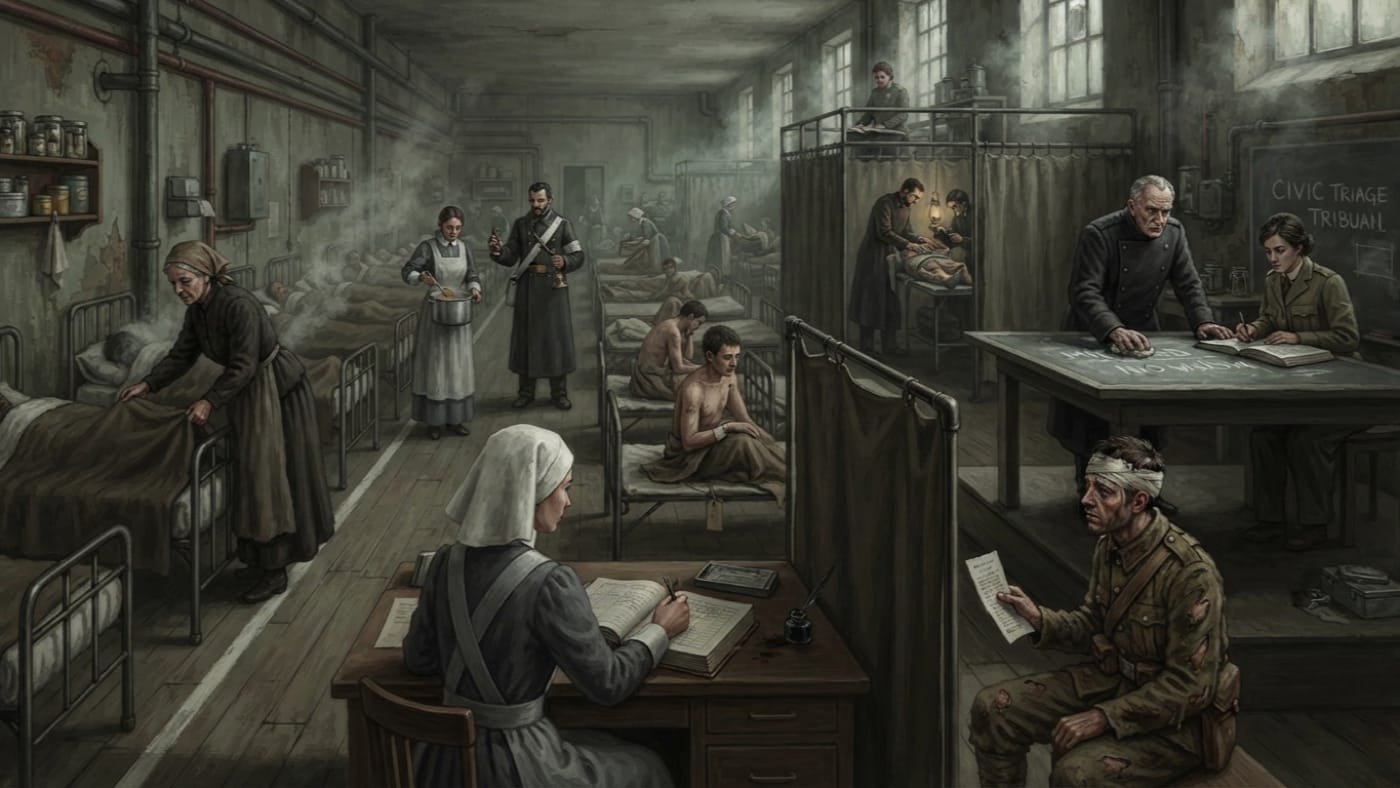
What the record does supply is a smell. Every account of the ward, mine included, starts there: vinegar smoke and boiled linen, carried through the shutters and out into the street. Visitors take it for the smell of sickness. It is closer to the smell of a supply line holding.
The ward has three names in common use. Ward staff and the older lore call it White Ward Central. The surveys of Notary Row speak of the White Ward blocks. Everyone else just says the White Ward. All three refer to the same infirmary complex. None of them tells you how many buildings it has or where its boundary runs, and I decline to count walls I have not been shown measured. The ward's numbered rooms (Two, Three, Seven, Fourteen) appear in Sanitation and Records reports. Those numbers belong to Marrowgate. A Mercy Ward Seven at Sofia or anywhere else is a different house, whatever the duplicate numeral tempts a tired clerk to file.
The ward's neighbours are attested, though its distances are not. Casualties come in at the Wagon Quays, in lanes that smell of wet canvas and horse sweat. Notary Row lies between the White Ward blocks and the seal registries, and it houses the Civic Triage Tribunal, the surgeon-notaries and the record offices. That is all the geography the archive will vouch for. I have seen maps drawing a single compulsory route from quay to ward to Row to registry. They were drawn by men who wanted the city to be simpler than it is.
The city around the ward is older than every office that governs it. Marrowgate was turned into an inland medical port around A.S. 72, when a river-market town near the Würzburg corridor was made to receive the war by wagon. The Sanitation Chapter laid its first cordon in A.S. 78, during the plague and the First Ossuary Panic. The Tribunal was constituted in A.S. 83. Both bodies are named here from later practice: the formal Synod under which they now sit did not exist until A.S. 90. Their shared intake protocols came under the Joint Mandate of A.S. 92, revised in A.S. 187. Somewhere in that sequence the ward took its present form. Where exactly, the record does not say, and I will not guess.
#On Admission and the Confession Receipt
The ward runs on bell-time. Intake bells sound at dawn, the wagon queues form, and the whitewash lines are repainted before the first stretcher crosses them. At the ward this sequence ends at a confession screen.
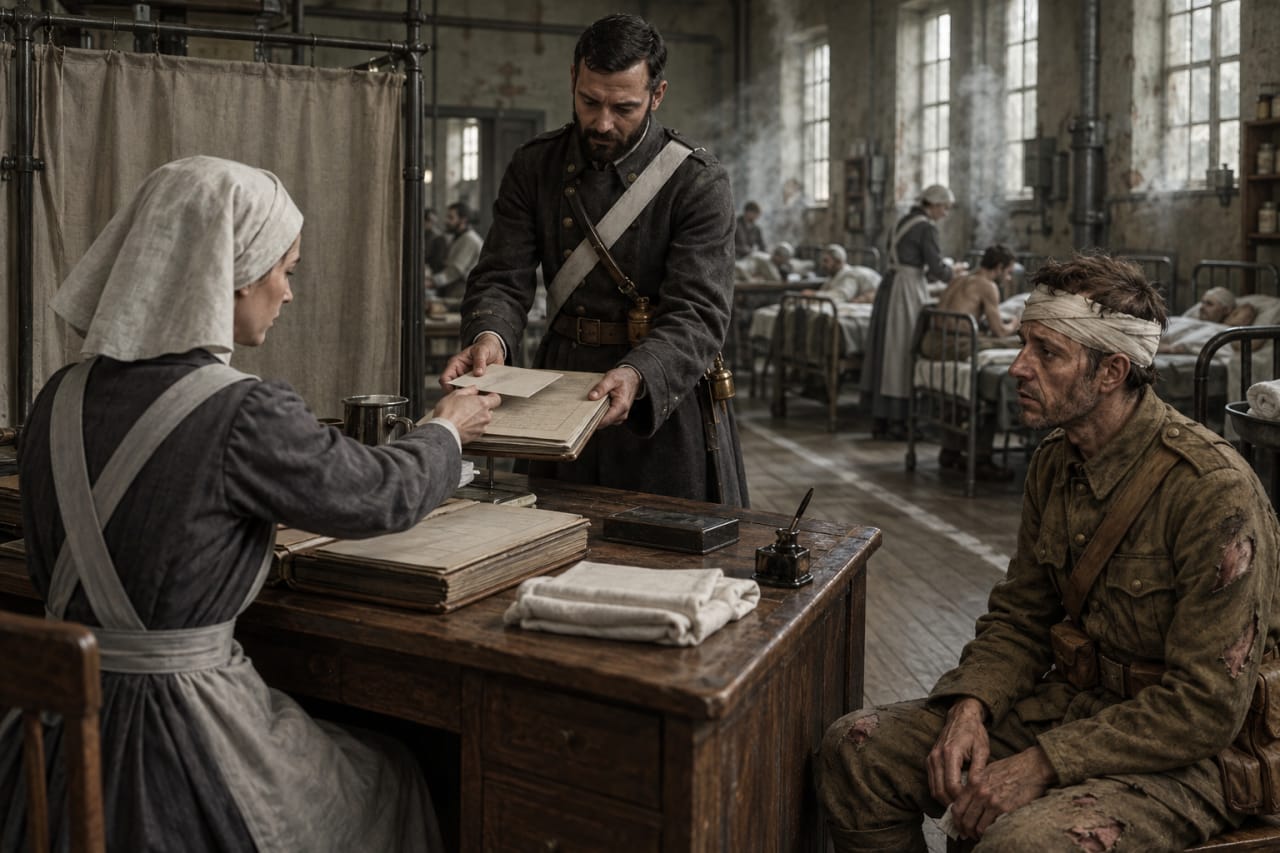
Marrowgate requires an intake confession, and the ward requires the receipt for it. In the city's own procedure, confession booths stand at the intake gates, receipts are required for entry to the wards, and the confessions are appended to the medical ledgers, where the Tribunal may read them before it rules. My own earlier survey put the rule in one line: confession receipts are required before treatment. I stand by the line. It is the shortest description of the ward that is also accurate.
Look at what the receipt does. A man arrives with a wound and a name. The receipt adds a third thing, his spoken account of himself, transcribed, signed and attached. From then on the ward is caring for a file with a body inside it, and the file has already testified. Families know this. They confess carefully. The Bureau calls that piety and the clerks call it throughput, and both descriptions are accurate.
The transcription takes time, and the time is the danger. A wound does not stop bleeding while a clerk trims his pen. My survey recorded, and I record again, that a man may bleed to death while his intake confession is being written down, that this has happened, and that the Sanitation Chapter classifies such deaths as "procedural." I give no name, number or date for any particular case. The record gives none, and an invented corpse would only make the paragraph more readable.
The general survey of the Mercy Wards describes a confession screen behind every intake desk, sometimes carved and sometimes a sheet on a cord. It also allows that practice bends under emergency, as practice in every crowded house eventually does. That survey covers several hundred registered houses across the Synod's reach. The Marrowgate account covers one city, and it records the receipt demanded before treatment and no standing exception. The two accounts differ in scope, so neither overrules the other. A reader who hopes the general allowance quietly applies at the White Ward's gate is welcome to hope. He should not wager a son on it.
The tags come next. The Mercy Ward-Sisters and Ward-Brothers triage by three measures: symptom, paper and behaviour. From those they assign a zone, with the tag tied at the wrist, because the ankle is reserved for the mortuary. Clean means recoverable. Grey means undecided, and the ward-hands call the grey zone the hinge of the house. Black takes the terminal, the contagious, the anomalous and those administratively beyond allotment. A black tag sends a patient behind a screen to a reduced ration and a closer watch. It does not by itself send anyone to a Hospice, a firing yard or any single diagnosis.
The ward's name causes a predictable confusion here. Its patients are not all clean-zone patients. The White Ward is a place. The clean zone is a classification inside it, and the Clean Paper is a certificate that travels outside it. In Marrowgate all three can describe one patient on one afternoon and disagree with each other. Patients learn the distinction fast, usually at their own expense.
#On the Midday Bed Board
A visible cot is not an available bed. This is the first rule of the White Ward, and most patients learn it while lying beside one.
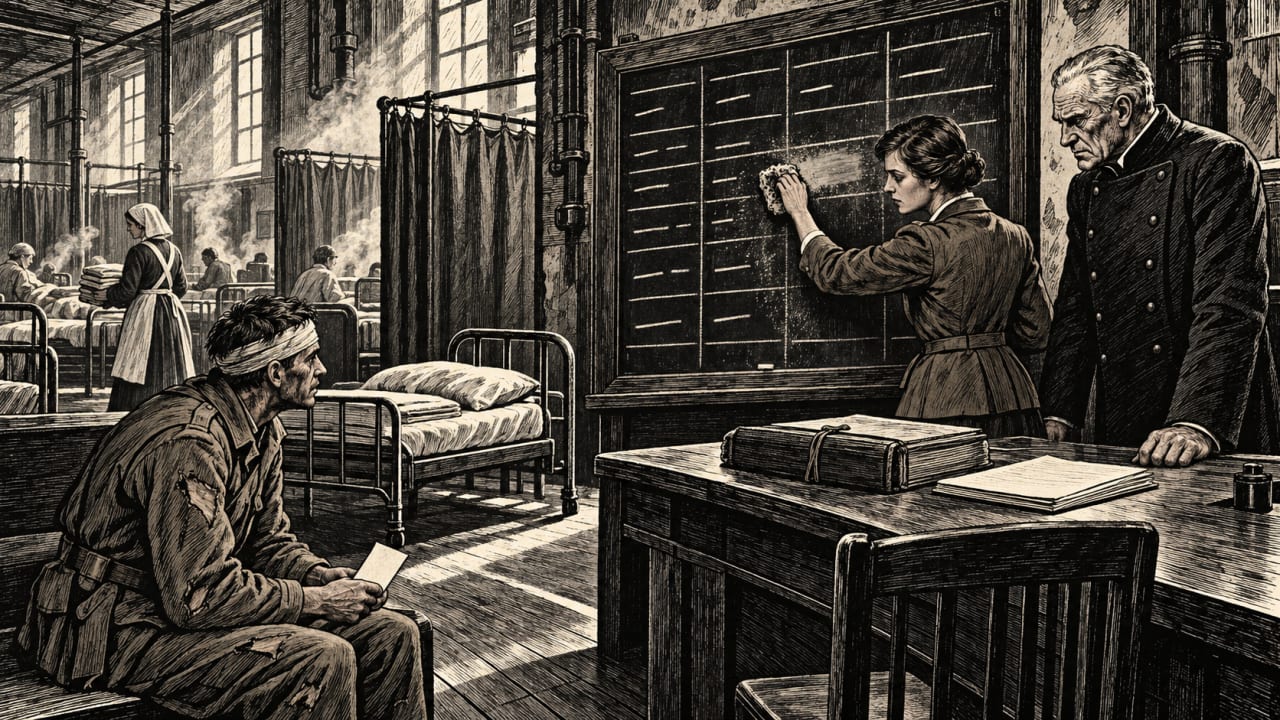
Bed allocation belongs to the Civic Triage Tribunal. Bed windows are posted at midday, chalked onto the allocation boards, and altered whenever circumstances contradict the chalk. A window is a grant of time, and what it buys is wider than the word suggests. Within that time the patient may be admitted, examined, treated, cut, isolated or reclassified. It entitles him to linen and broth, to visitation if his family's papers are in order, and to the right to suffer inside authorised walls. Without a window the patient is a body in a corridor that happens to be bleeding. Once he has one, the corridor has to treat him as a case.
The board is a plain object. It holds chalked windows, a clerk's hand moving among them, and a sponge kept within reach, because the sponge does as much of the work as the chalk does. Petitioners on Notary Row can see the boards from their benches, and a man can watch his window vanish without being moved an inch. A winter offensive turns a three-hour window into a dowry. Under quarantine, I have been told, a window becomes worth a murder done with good manners.
Two officers explain the board better than any diagram. Magistrate-Physic Toma presides over the Tribunal and decides. He hears a cough and calculates the risk to the ward. He sees an amputation and calculates what it will leave behind in law. Clerk Vessa sits below him and writes each ruling in the form that will survive appeal. Neither holds an appointment inside the White Ward, and the record gives them none. Their offices reach the ward the way weather reaches a field, by falling on it.
The Tribunal rules by category: Treat, Hold, Cut, Transfer, Labour, Hospice, Lime and Review. Treat grants a window. Hold keeps the grey case under observation. Review keeps a man on a bench with a docket number while his wound goes on with its work. At the ward these words become bodies placed on cots, taken off cots, or never brought near one.
Then the second authority intervenes. The Tribunal can grant a window. Only the Sanitation Chapter can let the patient cross the line between him and it. A bed may sit beyond a white line, and the line may be closed. When the Chapter changes a zone mark, a ward can lose usable beds between one bell and the next: the cots stay, but the crossing to them is shut. The Prefect who orders such a change practises no medicine and decides no individual diagnosis. He decides where a body may stand, and at the White Ward that settles most of what follows.
The Joint Mandate states the division without apology:
Under that division a patient can hold a valid window for a bed he is forbidden to reach. Both offices are acting within their powers when this happens. The patient is still in the corridor, and his window is still running.
#On Broth, Linen and Those Who Keep the Ward
The licensed staff of the ward are the Mercy Ward-Sisters and Ward-Brothers, who are vowed, registered and grey-aproned. Their work is the work the city prefers to watch from a distance. They ladle broth, dress wounds, change and boil linen, measure medicine by the drop, receive confessions in passing, and keep the ledger that proves they did all of it.
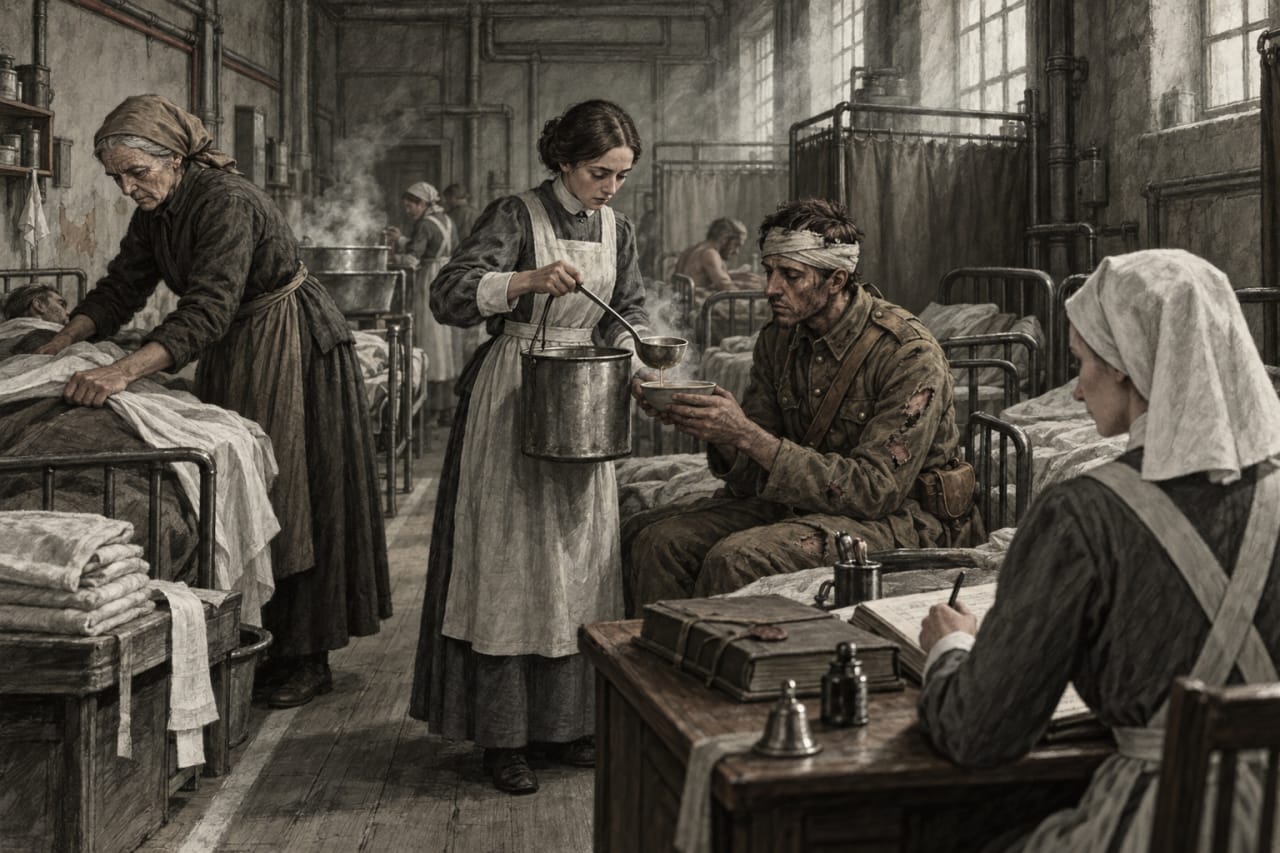
The ledger is the second ward. The Ledger Laws of A.S. 112, written after the Broth Riots, made mercy countable: every ladle, dose, linen length and death tag must carry an accountable signature. At shift's end the staff reconcile. Bowls are matched to bodies, morphine drops to signatures, and deaths to transfer tags. The ledger string is sealed in wax. When an auditor arrives he counts the drops before he counts the patients, because narcotics are where fraud becomes interesting.
Shortages show up in the margins first. The soap gets thinner one week. The next week grey patients get clean-zone broth watered down to grey-zone strength. After that a sheet is cut in two and entered as two sheets. A ward-hand who hides an extra ladle for a child has committed an allocation error and must either enter it or lie about it. Many lie. Some of the people in the White Ward's beds are alive because of a falsehood written in a careful hand. In the same ward, the same gaps let morphine out through the service door to come back at four times the price. Neither sainthood nor predation describes the staff fairly. They keep the books under audit and do what compassion they can around the edges of the columns.
Shift begins with a ritual, and the ward inherited it from the street. The Mercy Line was never the White Ward's admissions queue. It was a held-body appeal rope outside the Tariff-Chapel of Saint Morin during the Gray Clearance of A.S. 157, and it was abolished with the revocation in A.S. 158. The rope came down and the words moved indoors. At shift-start a Sister washes to the wrist, counts the ladles, taps the ward bell once even when it is not bell-hour, and says the Line under her breath. The text varies. Some say, "A fed body is an obedient body." Some say, "If it is not stamped, it is not mercy." No single version is the White Ward's compulsory text. The better ones, I am told, say nothing and begin.
The ward's other authority holds no licence. The Ward-Mothers are unlicensed matrons, each ruling her room by custom and force of character. They have no order, charter or common hierarchy, and no year is recorded for the first of them. A Ward-Mother trades mercy for obedience. She decides when the linen is changed, whose cot is nearest the stove, and who is quietly given a second ladle. She cannot open a cordon, allocate a bed, authorise a cut or stamp a chart. She sits among the people who can, in the room where their decisions land on a body. Her title confers none of their powers, and neither does any other title. Sister-Matron Ilka of the Mercy Chapel of the Unburdened is not a Ward-Mother, and she does not direct the White Ward. The record names no one who does.
Under all of this sits the smell. My survey of Marrowgate wrote that vinegar smoke and boiled linen are the ward's good smells, the sign that its disinfectant arrangements are working. The same survey warned that when the ward smells of nothing, the chemicals have run out, and that fever follows within seventy-two hours. I wrote that warning, and I attribute it here to that survey. It describes what the ward has learned to expect. It does not set out a clinical law, a disease model or a countdown any physician has certified. A ward can smell of vinegar and still be infected. The empty air is simply the earliest warning anyone in the building is likely to notice.
#On the Licensed Cut
At the White Ward, surgery and hearings run concurrently. While a ward-hand changes a dressing, the Tribunal may be ruling on the limb under it, and patients near the galleries can hear the saws from the benches.
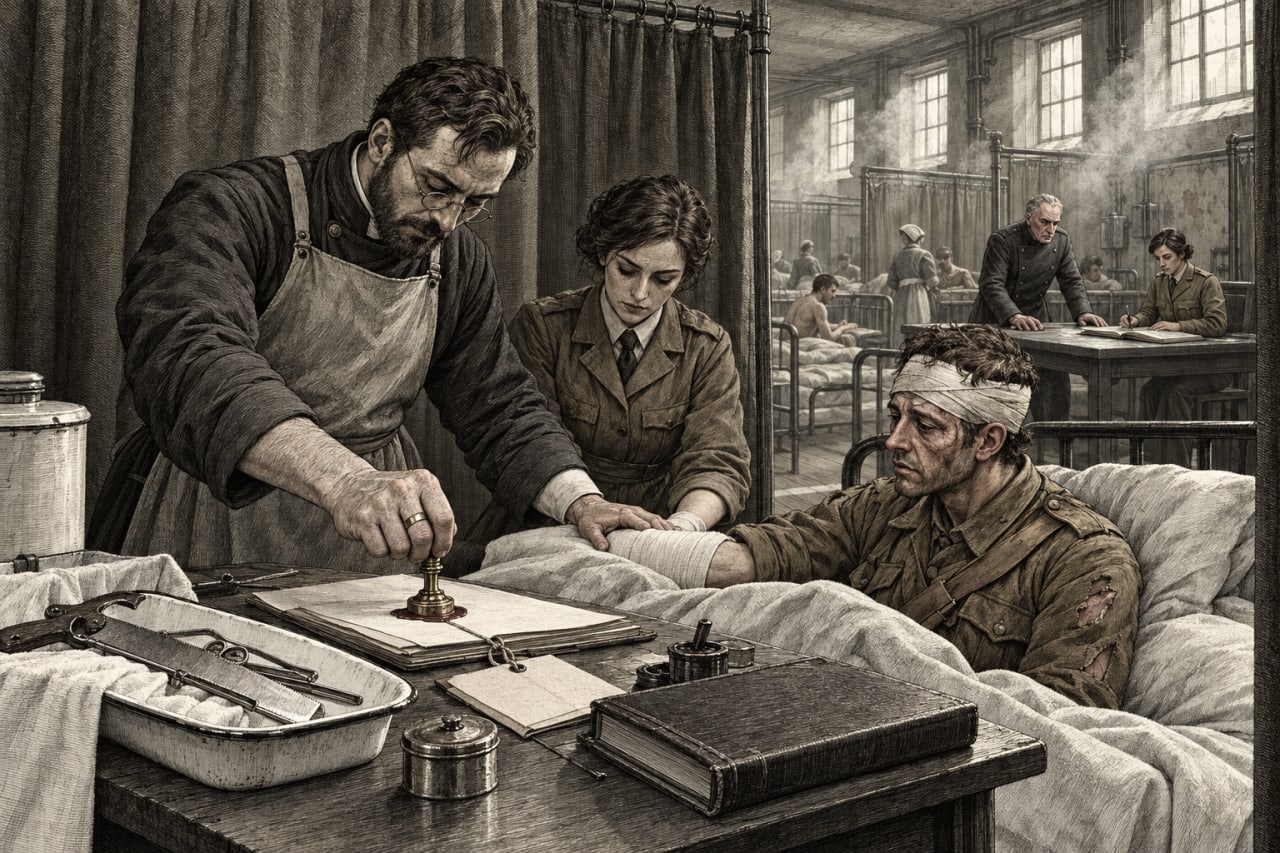
Lawful surgery at Marrowgate follows a fixed order. The Tribunal hears the case and issues its disposition. A Sealhand, one of the licensed surgeon-notaries with a brass ring on the third finger of the operating hand, performs the procedure and notarises it at the same sitting. The registry then revises the file. All three steps are required. A wound stitched without certification does not exist in the Tribunal's eyes. A limb removed without notarisation has not been lost as far as the Ledger is concerned, and the man who lost it can still be called back to duties that need two arms.
Chief Sealhand Orin heads the guild whose rings make the second step lawful. He takes no orders from Toma, and Toma has no authority over the rings. Every description of him mentions his hands: steady, cold, immaculate in their fees. I attribute no particular operation in the White Ward to him. In this system it hardly matters whose hand held the saw. What matters is whose seal is on the order he commands.
The cut-stamp is feared more than the saw. A notarised amputation seals the old file under notarial privilege, and the patient's pre-excision designation may no longer be used in official proceedings. His duty is recalculated and his employability reassessed. Before the stump has closed, the Prosthetics Guild has his maintenance account open. The fitting is affordable and the maintenance is not, and an unpaid maintenance account becomes a work prescription. The work prescription brings him back to the wards, this time to wash linen and carry stretchers instead of lying on them. Some of the hands that boil the White Ward's sheets belong to men the White Ward cut.
A Tribunal training note describes cut-stamp revision as "identity repair following bodily alteration."
Corrected for doctrinal clarity. The cut-stamp repairs the file. The patient's legal designation is revised to match the new file and his debts are reassigned under it. Whether he agrees to the revision is not entered.
Discharge from the ward is shaped by the stamp. A patient who leaves with a revised file leaves with a revised life: changed duty, prosthetic obligations and whatever labour the Tribunal later decides his balance requires. Many patients would rather lose the limb than receive the stamp, and the city has learned to respect that preference without honouring it.
The guild can also refuse, and refusal is its sharpest instrument. Last winter, after a counterfeit seal ring turned up in the Suture Slums, licensed surgeons in Marrowgate stopped operating for a week until the Tribunal had certified their rings. Seven patients died during that week. The Tribunal classed the deaths as administrative. The record does not say who ordered the refusal or in which ward the seven lay, and I will not supply a name or a ward that the archive withholds.
#On the Line Across the Threshold
The Sanitation Chapter oversees the White Ward. The phrase comes from the Chapter's own statement of its territory: gates, cordons, White Ward oversight. In practice it means white lines laid in limewash across thresholds and corridor mouths, inspectors in white sashes, handbells, fever sticks, mouth hooks, seal trays and crossing slates. A stamped person may cross. An unstamped person may plead.
The need is real, and I will say so before I say anything harsher. A ward of wounded men packed close is a breeding pen for fever. The general survey of the wards records typhus crossing a room because a kind attendant let a black-zone cot stand next to a clean one. Under Prefect Salvius, Sanitation has slowed fever in the districts it watches most closely and cut the number of men dying in visible queues. The lines save lives. A ward-hand who curses the inspector at noon will still want him at the door when the cough spreads at night.
Then there is the rest of what the Chapter does. When it changes a zone mark, the ward loses beds. It decides when a hearing can be reached, because a patient whose papers are being questioned at the line cannot be standing before the Tribunal. An inspector can demand a fresh mouth receipt before a petitioner gets to Notary Row. An audit notice hardens every gate at once. Every reclassification then needs a witness, and every unrecorded mercy a Sister has shown becomes a possible outbreak in the ledger. The black zones are officially staffed by specialists. They also receive staff transferred there as punishment for morphine irregularities, soft enforcement at the line, and ledger compassion.
The Chapter's own report of an incident in White Ward Two shows how this looks inside the ward. An inspector's mouth hook found a folded Tribunal order dry under an old woman's tongue. She said she had been keeping it safe. The order recorded her transfer three days earlier. The Chapter moved her before noon. I give the account as the Chapter gives it and add nothing to it.
Salvius wants more than oversight. Marrowgate knows that he is seeking permanent emergency authority. It also knows he has not declared the full lockdown he is believed to plan, and that he tightens control by small increments instead: an extra inspection, a revised crossing schedule, a temporary closure that does not expire. Among his public reasons for more power are Marrowwind incidents and damaged confidence in the White Ward. As of this compilation that ambition has not been realised. I enter it as an ambition and nothing more.
#On the Care Bought Elsewhere
Where lawful care runs short, the Stitchmarket sells what is missing. It is Marrowgate's underworld economy, centred on the Suture Slums and their drainage routes, and it sells forged clearances, illicit bed tokens, stolen anaesthetic, seal and name work, and surgery done at night behind tarps. Its own account of how it began names the White Ward in passing. It grew as bed windows became scarce, pain draughts thinned, the ward's gates hardened, and confession receipts delayed treatment.
Each product answers a particular gap at the ward. A bed token sells the time the Tribunal did not allot. A draught sold without a confession lets the buyer skip the receipt. Forged clean papers and the little blue travel notes get a patient from the White Ward to the Wagon Quays without a clerk reclaiming him. The best forgeries are deliberately imperfect, smudged and corrected once in an ugly hand, because a flawless document draws auditors. Night surgery supplies the cut the Sealhands refused or overpriced. It also leaves out the stamp, which some patients consider the main attraction.
The goods move through the laundry. Washer-runners carry messages folded into bandage hems. Linen runs between the wards and the washhouses, and so do the debt-bound labourers who launder it. Those labourers learn which sheets carry hidden stains, which patients have no kin and which clerks drink. A washer with a folded clearance can move what a surgeon cannot. I have found no record of a tunnel opening into any particular room of the White Ward. I have found no official partnership and no completed rescue, either, and I report none.
The ward depends on the market, and so do its staff. Ward-Mothers confiscate illicit tokens when they can and use them when they must, which is the market's own description of them. Some ward staff buy forged papers for patients they cannot save lawfully. Families buy ash by the pinch, tokens in the alleys of Mercy Market, and draughts at a price that would shame a bishop. The market takes something for every service. Some patients come out of night surgery worse than any Sealhand would have left them. A buyer of forged papers becomes an accomplice, and he cannot report the seller without handing his child back to the ward that locked her in. The market has a figure at its head called Needle-King Pavo. Purity has three faces on file for him, Records has two death notices, and Sanitation claims he is a legend. I leave his identity open.
#On the Records That Return Corrected
The White Ward's worst failures have been failures of its records, which is fitting for an institution that admits the file before it admits the patient.
In A.S. 194 the earliest uncontested event of the Marrowwind took place in White Ward Seven. The ward's sealed intake cabinet had been washed, inspected, signed and sealed with Sanitation wax. By morning it held chalk dust, a cracked bone tag and a revised patient list. The revision corrected four death classifications, restored two names that had been marked discharged, and amended one amputation file, increasing the recorded extent of the loss and noting that the patient's debt had been improperly assessed. The corrections proved accurate. That is the whole of the trouble, and the Chapter has never forgiven it.
Initial Sanitation Chapter notice, A.S. 194, described the White Ward Seven event as "minor contamination of storage materials."
Corrected by Records after the same "minor contamination" was found to have altered nine intake ledgers, two kiln tallies and Prefect Salvius's personal wash bill. The Bureau accepts that the event occurred. It does not certify who or what made the corrections.
The Prefect ordered the cabinet burned and the ash weighed. The next morning the ash weight appeared in the Tribunal docket with a marginal note reading "insufficient," which no living clerk admitted writing. What a responsible survey can say ends there. Patients' reports of the wind describe white dust under sealed bandages, voices speaking earlier names from basins and drain grates, sutures reopening in straight lines, and ledgers amended overnight in wet ink in no recorded hand. The Bureau classes the wind as a Category Two Localized Atmospheric-Scribal Anomaly. That classification names the file. It identifies no cause and no corrector. The wards believe it is the dead revising their own files. I record the belief and certify nothing beyond it. The A.S. 194 event is the earliest event no one disputes, and that does not make it the wind's origin.
The clean paper plague of A.S. 199 struck the same weakness from the other side. Health clearances declared people well while they were dying. Clearances issued in the White Ward went on to Mercy Market, Notary Row and the Wagon Quays, and out of Marrowgate to supply towns whose gate captains trusted a seal over a cough. The ward's tallies read clean. The patients did not. The official audit found systemic fraud in health certification. The disease has no name in any ledger I have been shown, and responsibility for the forgeries is still unassigned.
For this survey the lesson is a narrow one. The ward's care depends on its classifications: the zone tag, the window, the receipt and the clearance. Twice in seven years those classifications failed in public. In the first case, corrections came from a source no office will admit as a witness. In the second, the ward's own paperwork turned out to be the forgery.
One further report belongs here, kept subordinate and attributed. The published account says that in A.S. 200 a boy in White Ward Three swallowed his true-name slip on a wind-night. His fever broke and his file vanished. His mother recognised him and his assigned surgeon did not. His bed token read "available" while he lay asleep in the bed, and by morning the ward slate read "not discharged." The case establishes a contradiction between a mother, a surgeon and a bed record. It certifies no cure, no protective method and no solved identity, and Sanitation still confiscates the slips.
#On the Ward as Compiled in A.S. 201
As of this compilation in A.S. 201, the White Ward is operating. Stretchers still arrive from the Wagon Quays on the intake bell. Receipts are still taken before treatment. The boards are chalked at midday and sponged clean when the count changes. Hearings sit while the saws work. Sisters wash to the wrist, count the ladles and tap the bell once. Ward-Mothers salt their thresholds. Sanitation lays its line at dawn, and the Stitchmarket's runners carry notes in the laundry after dark.
The pressures I have described are still in place: overcapacity, supply strain, disputed movement and records that have proved fallible twice. The Tribunal holds the beds and Sanitation holds the crossings to them. The Sealhands hold the cut. The patients hold their own bodies, and the Ledger only partly recognises even that claim.
As long as the vinegar smoke holds, the ward is supplied, and my earlier survey said what follows when it fails. I have not repeated that warning as a prophecy, and I do not offer it as a cure.