

#On the Present Recitation
"These methods do very little, which is why they are mandatory." — Codex entry on the Marrowwind, On Countermeasures
This is a present survey, conducted in A.S. 201 (1911 CE), of one item on the approved list of countermeasures against the Marrowwind at Marrowgate: the recitation of the Seven Names of Proper Intake. It covers the recitation's standing, its setting and the measures listed beside it. It does not edit a text, and it does not teach a rite.
Its standing is secure. The recitation appears among the sanctioned measures with ash circles, salt-water washes, the burning of old linens and lime-trench fumigation. It shares their dignity in full. It is approved, it is required, and nobody of rank has claimed that it works.
The text is another matter. The sources available to this survey do not give the seven names. They do not give their order, their referents or their wording. They do not say when the names were set down or whose hand set them down. I have been asked, by persons who mistake a Hieromnemon for a vending cabinet, whether the seven are saints, wards, officers or classes of the dead. The Codex does not know, and it will not pretend to know because a title contains a number. A numeral in a title is a promise made by whoever wrote the title. That person has not come forward to keep it.
#On Intake and the Wind
Marrowgate is the Synod's inland medical port, and intake is its first sacrament. Casualties arrive at the Wagon Quays and are received into the wards. The Sealhands, those surgeon-notaries whose rings make surgery a legal act, notarize their treatment, and clerks enter wound, identity, debt and death as legal records. Whitewash lines on the cobbles divide clean from unclean, and stepping across one without papers is a crime. Every patient is admitted twice, once into a bed and once into a ledger. Only the second admission binds.
The authors of the recitation's title did not explain what they meant by "proper," and I will not explain it for them. On Notary Row, the word means that the stamp was in the right place.
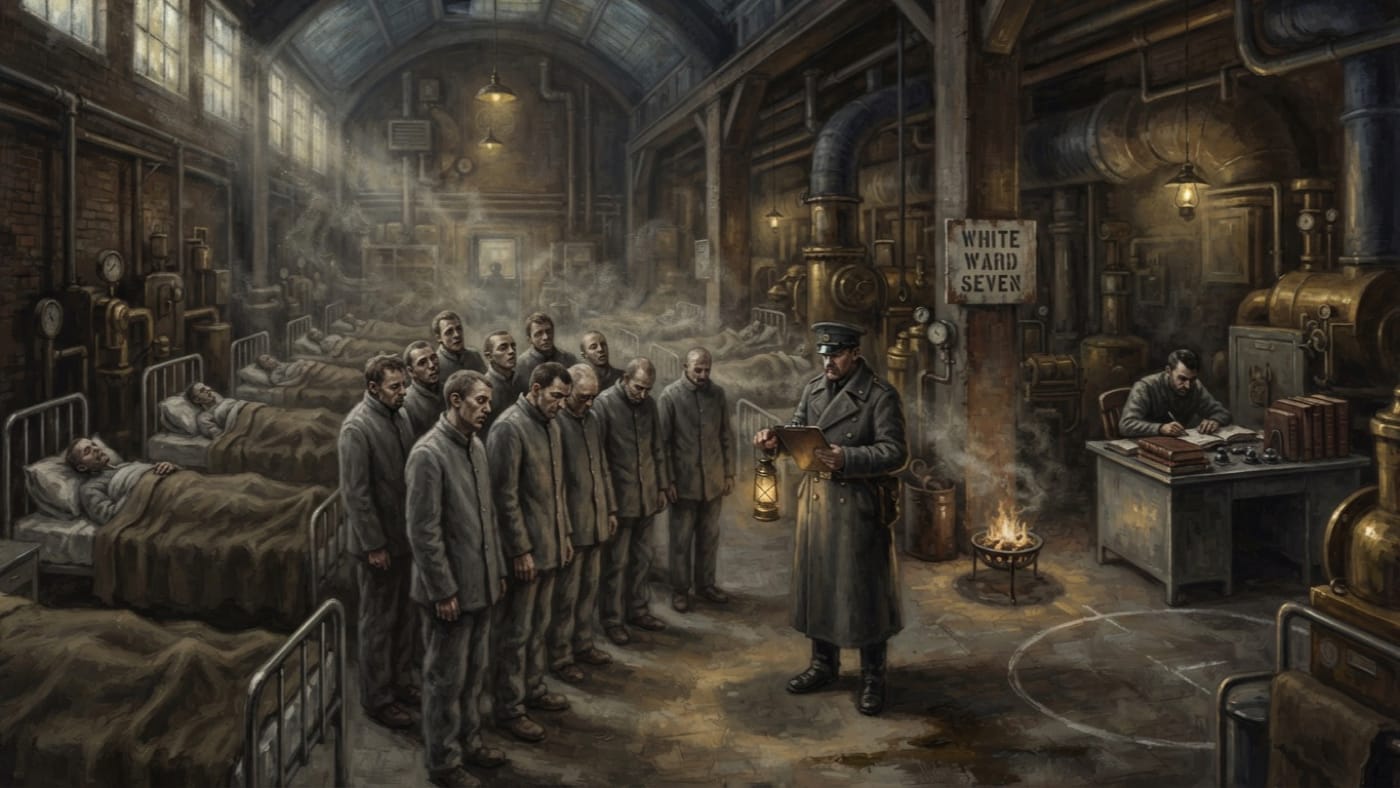
The Marrowwind is an offence against intake. In A.S. 194, chalk dust and a corrected patient list were found inside the sealed intake cabinet of White Ward Seven. This was the earliest uncontested event, and since that year the Bureau has classified the wind a Category Two Localized Atmospheric-Scribal Anomaly. Ward reports describe dry white dust under sealed bandages and between the pages of closed ledgers. They describe voices pronouncing patients' earlier names from basins and drain grates, sutures reopening in straight lines, and patients forgetting wounds the Ledger assigns them or remembering wounds it denies. They also report ledger entries amended overnight, in wet ink and in no recorded hand. The classification names the file. It does not name a cause, and no office has satisfactorily identified the voices or the corrector.
In A.S. 199 the clean paper plague exposed fraudulent health clearances across the wards. The parent account reports that corrections then arrived at scale. Neither date belongs to the Seven Names. The surviving record places the recitation on the approved list and is silent on when it arrived there.
#On the Approved Countermeasures
The list holds five measures: ash circles, salt-water washes, burning old linens, lime-trench fumigation and the recitation. It is only a list. It sets no sequence or officiant, prescribes no count of repetitions, names no respondent and fixes no hour. A reader who arranges the five into a liturgy has written his own, and he may answer to the Bureau of Doctrine for its authorship.
The parent's assessment is blunt: very little, and mandatory. I endorse the sentence for its economy. Its arithmetic is narrower than it looks. It judges the suite of five as a whole. No office has tested the recitation alone or compared a ward that recited against a ward that kept silent. None has certified that a single patient was spared by it. "Very little" is the verdict on all five together, and it cannot be divided by five.
What the suite does accomplish can be read off the city. Four of the measures speak in materials the Sanitation Chapter already commands: ash, salt, fire and lime. They are visible, they can be inspected, and they are cheap. The Chapter controls the cordons and wants more quarantine authority than it holds. A countermeasure performed under its eye proves that the ward is under its eye. That is my reading of the arrangement. The record supplies no formal rationale, and I have not invented one.
The recitation is the only item on the list made of words. In a city where words become entries and entries become debts, that distinction is not small. Whether the seven names do anything to the wind is unknown. What they do to a ward is plainer: on wind-nights the ward speaks in approved language.
The unofficial market is busier. The Stitchmarket sells counterfeit "uncorrection seals," which the parent describes as mostly useless and sometimes dangerous. These are not the Seven Names either, and no one should mistake a forged seal for an approved prayer, however similar their results.
#On Names Written in Family Hands
The Seven Names must not be confused with the true-name slips. The Sanitation Chapter would prefer that the slips not be mentioned at all.
Ward reports say that Ward-Mothers keep slips beneath patients' pillows, each bearing one patient's own true name in a family hand rather than tribunal script. The parent account describes a mouth-held variant, calls it the most dangerous of the unofficial practices, and reports that a slip which dissolves may be swallowed. The Codex records that these accounts exist and gives no procedure. A slip is a private name, written privately for one person. The Seven Names are an approved recitation with a public title and unrecorded contents. Nothing in the record makes the seven into patients' names or puts slips inside the recitation. Neither practice explains the other.
In A.S. 198 the Sanitation Chapter declared the slips contraband in every ward, corridor, quay, slum, chapel precinct and auxiliary medical space, and in the Lime Yards themselves. It allowed no exception. Enforcement was by confiscation, mouth inspection and debt adjustment.
The White Ward Three case of A.S. 200 is reported as follows. An unnamed boy swallowed his slip during a wind-night. His fever broke and his file vanished. His mother recognized him and his assigned surgeon did not. His bed token read "available" while he lay asleep in the bed. By morning, the account says, the ward slate bore the words "not discharged." The case establishes a contradiction among a mother, a surgeon and a bed record. It certifies no cure, no immunity and no method, and the Codex prints it as none of these.
Prior Doctrine guidance directed that true-name slips be destroyed on sight as "superstitious impediments to correct patient classification."
Guidance was revised after the A.S. 200 White Ward Three incident. Slips are still destroyed on sight. The stated reason is now "excessive efficacy outside licensed sacramental channels." The Bureau notes that the reason has changed and the bonfire has not.
#On the Authority to Correct
As of A.S. 201 the parent records that incidents are increasing. The dry gust now reaches beyond the Lime Yards into the Wagon Quays, the White Ward, the Mercy Chapel steps and the washhouses of the Suture Slums. Twice it has reached the private chamber of Prefect Salvius. The Sanitation Chapter wants a full emergency lockdown. The Civic Triage Tribunal wants jurisdiction over the corrections themselves, as though a chalk gust could be served with a summons. Each office treats the wind as a dispute over who may amend a record. Neither has enlisted the Seven Names in that quarrel, and this survey will not enlist them on either side.
The evidentiary problem stands open. The parent account reports that the corrections are almost always accurate. The Bureau of Doctrine's present ruling denies that they authenticate themselves. Both statements are on file, and neither cancels the other. "Almost always" admits exceptions that no clerk has yet located, and accuracy without a witness is not admissible.
Intake has always been work for the living, and the Marrowwind has not been granted a seal ring. A voice from a drain grate is not a witness under present doctrine. An amendment in no recorded hand becomes an entry only when a living clerk signs beneath it, and the signature is then the clerk's responsibility. The Seven Names of Proper Intake remain on the approved list. They are required, they are recited, and their words appear in no source available to this survey.