
#On the Kilns Beyond the White Lines
The Lime Yards of Marrowgate are the place where the Synod proves, with admirable economy, that no citizen ever leaves the Ledger merely by dying.
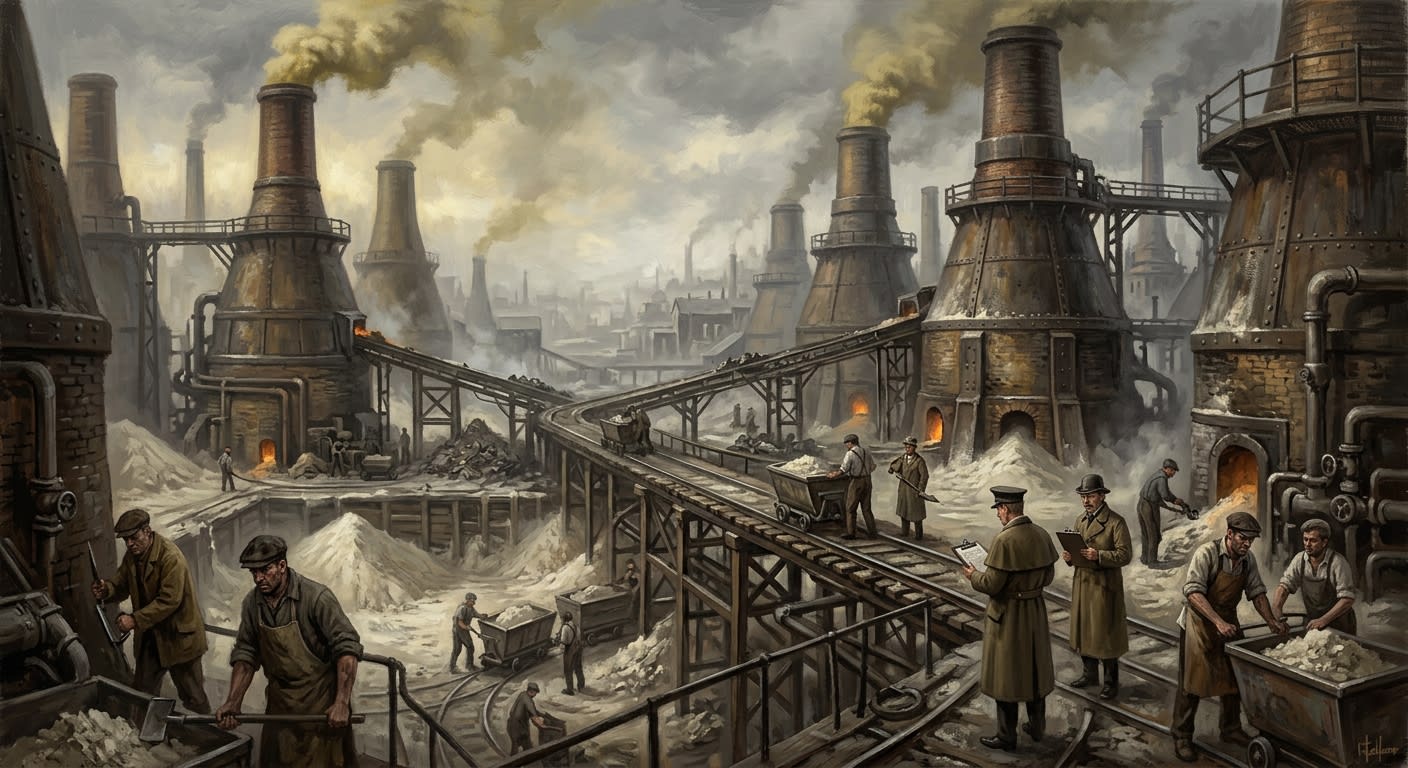
They lie beyond the inner white lines, past the last clean corridor, where the city loosens into terraces of pits, kiln sheds, ash racks, drying floors, tag offices, cart turnarounds, and cordoned burn rooms whose doors are painted with Saint Morin's waxed skull. The air tastes of chalk, tallow, vinegar smoke, wet canvas, and the mineral after-scent of former persons. Workers carry lime scars on the lips and wrists. Cart drivers speak softly. Auditors cover their mouths with scented cloth and call the gesture sanitary, though everyone knows it is fear with perfume on.
The Yards adjoin the mortuary tariff-chapels, which is proper. Classification should stand near consumption. A stamped body passes from the intake desk to the sorting shed; a disputed body waits in the hold niche; a salvage body goes to the breaking tables; a Gray body, in the old winter sense, goes wherever the ash mark sends it before kin can acquire enough witnesses to object. The sequence is desk, hook, cart, fire, slake, barrel, wall. One could carve it above the gate. Marrowgate prefers to paint Everything heals or it gets a file. The lie has better posture.
#On the Founding and the Expansion
Marrowgate was established in A.S. 72 as an inland medical port, a river-market town remade by War into a place where wagons could dock, unload wounded, and leave with something useful in return. At first the dead were a problem of removal. The White Ward filled; the Wagon Quays stank; cemetery terraces advanced like an unpaid bill. The first burn pits were temporary, which is the Bureau's preferred word for institutions not yet confident enough to demand a budget.
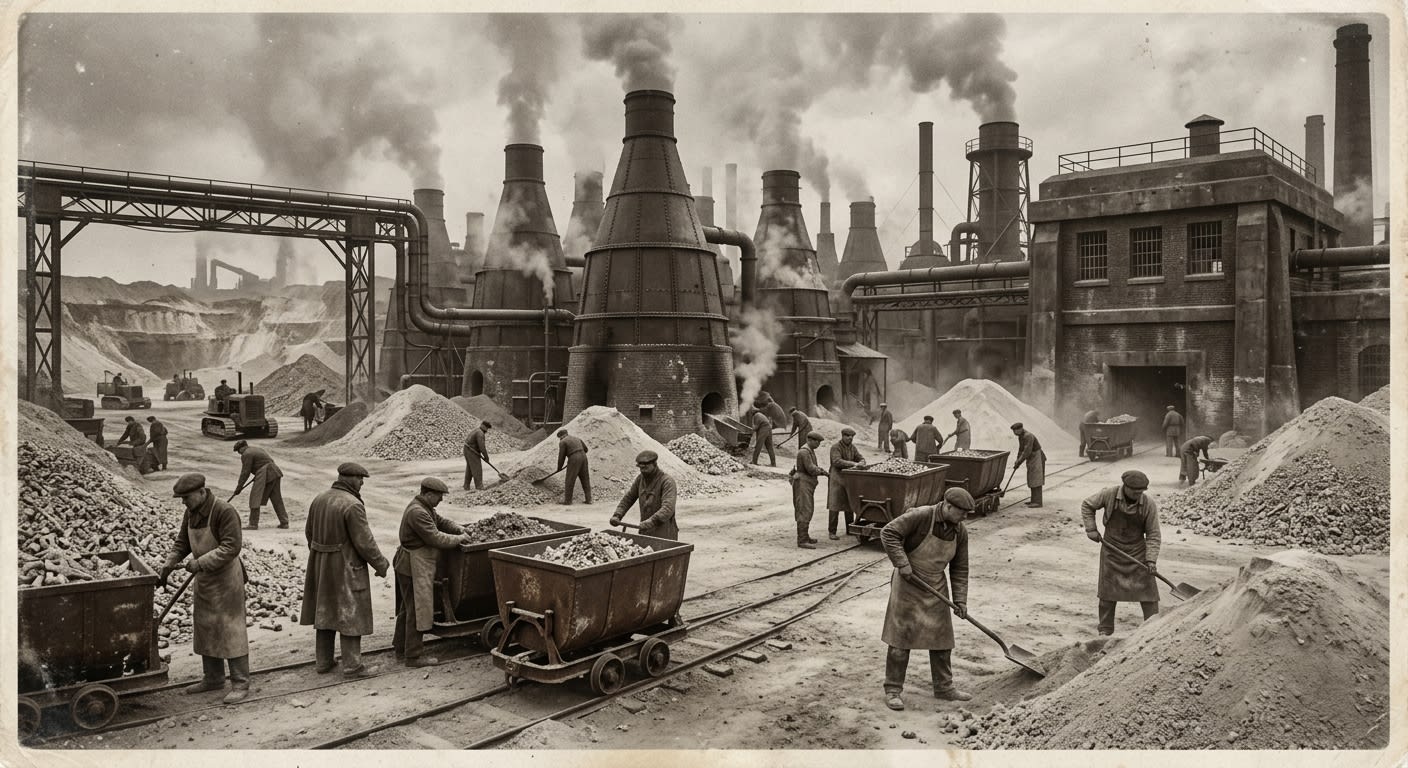
By A.S. 78, the First Ossuary Panic had given the profession of the Dead-Goods Tariffer its seal and the Yards their permanent excuse. Unsealed pits along the Rhine corridor began producing sounds at night. The public explanation involved atmospheric settling. The private response involved stamps, lamps, armed guards, and more lime. Marrowgate's Sanitation Chapter established its first cordon that same year. The pits became kilnfields. The kilnfields acquired shed roofs. The shed roofs acquired clerks. The clerks acquired rules. At that point the dead had lost.
Early Sanitation Chapter memoranda call the Lime Yards a temporary disposal field pending cemetery expansion.
Corrected. The cemetery expanded. The Yards expanded faster. The word temporary has been retained in budget petitions because permanence invites moral accounting.
The A.S. 96 Saint-Bone Melting Acts made doctrine catch up with practice. Sanctity could be deployed. Bone could protect wall, road, culvert, white line, bell base, ossuary arch. Relic fragments went to licensed Melters; common remains went to civic kilns; damaged categories wandered between the two according to bribe, urgency, and the quality of the paperwork. The Lime Yards became a district rather than a facility, a civic organ with furnaces for lungs and tag ledgers for teeth.
A.S. 157 gave the Yards their black season. During the Gray Clearance, five mortuary categories collapsed into Cleared and Held. Cleared meant the Yards. Held meant the Yards later, unless kin, money, or contamination intervened. The kilns burned through frost. Workers slept beside slake pits. Children learned to identify family ash by barrel mark because face, voice, name, and parish had been outpaced by throughput.
#On the Work of Reduction
The Lime Yard receives four principal streams: salvage-grade remains from Tariffers; failed cemetery transfers; condemned anatomical waste from the White Ward; and relic-adjacent fragments rejected by Relics but still too useful to discard without ceremony. Each stream has its own tag colour. The colours fade in lime dust. This is inconvenient and, in my opinion, aesthetically honest.
The first station is the tag hall. Runners match intake slips to cart manifests while a Classification Scribe copies the final mark into the ash ledger. Names are discouraged near open wagons. Numbers behave better. Kin are not admitted past the second rail unless they carry a viewing writ, a priest, and the stamina to be disappointed. Most do not.
The breaking tables come next. Bone is separated from cloth, metal, saint medals, prosthetic fittings, teeth of unusual material, and personal articles missed or stolen during intake. Useful metal goes to the scrap chest. Cloth goes to burn. Rings go to Records if recorded, Tithes if valuable, pockets if supervision lapses. Teeth go where teeth always go in the Synod: into argument.
Calcination reduces bone to friable white. Slaking turns heat into caustic slurry. Mixing adds ash, sand, water, and, when the order is military, a measured quantity of sanctified grit whose actual composition is known to four Melters, two of whom are dead and one of whom has become unreliable around bells. The product leaves as mortar, road powder, whitewash cake, ash-credit, or sealed barrel marked for bastion reinforcement.
Kilnmaster Hark oversees the Marrowgate central kilnfield. Marrowgate says his lungs contain enough calcium to found a chapel. Hark disputes this on technical grounds. He claims chapel-grade lime requires better ash. He has not, by all accounts, distinguished fuel from former citizen in fifteen years, which makes him either monstrous or perfectly suited to command. The Bureau recognises no contradiction.
#On the Economy of Whitewash
The Yards sell purity by the barrel.
Bone-lime from Marrowgate goes to mortar, road surface, ward plaster, ossuary shelves, culvert seals, quarantine posts, and the white lines painted through the city to separate clean corridors from everything else. Consider the theological efficiency. The dead are rendered into the boundary that tells the living where they may walk. Widows cross lines painted with husbands. Soldiers sleep under plaster made from predecessors. Children cough in schoolrooms whitened by the unclaimed. The Bureau calls this circular economy. I call it catechism with a shovel.
Marrowgate exports bone-lime along the Würzburg corridor (Unregistered) to depots feeding the Sagittal Line. Bastion engineers prefer fresh slake for emergency patching; civic contractors prefer dry powder because it hides discrepancies; ossuary builders prefer batches with stable silence. Black lime — mortar that darkens, sweats, ticks, or sings — is rejected in public and bought privately by men who believe an object is stronger when it resents being used. Those men become case studies, usually with diagrams.
SANITATION CHAPTER BLACK-LIME HOLD — A.S. 198 Batch origin: Lime Yard Kiln Seven / mixed salvage and chapel reject fragments Observed: barrel lid pulsed under seal; interior ticking in six-beat cadence; condensation formed names on outer stave Disposition: transferred to █████ under Engineering escort Follow-up: requisition file absent; escort roster corrected to “never assigned”
The Bone-Lime Consortium is less a company than a polite arrangement among kiln foremen, chapel prelates, cart owners, ash-credit factors, and officials who have discovered that calcium can be converted into influence faster than coin. Forewoman Rute, collector of bone rent, is said to know which wall in which ward contains which politically inconvenient femur. She denies this, sensibly. Knowing is dangerous. Being suspected of knowing is profitable.
#On the Marrowwind
The Marrowwind rises from the Lime Yards without license from weather, physics, or the Sanitation Chapter. A dry chalk gust moves through kiln lanes and ward corridors, carrying low voices, corrected names, old pain, tag numbers, and occasional administrative truths so precise they can only have been supplied by the dead.
The first uncontested classification came in A.S. 194, when sealed White Ward Seven (Unregistered) intake records filled with lime dust and rewrote patient lists correctly. Death marks changed. Discharge stamps reversed. An amputation debt moved from a living man to a file marked deceased three weeks prior. The Sanitation Prefect ordered the cabinet burned. The ash weighed wrong the next morning.
The Yards are the wind's throat. Workers know the signs: dust gathering against airflow, kiln flame flattening sideways, tags clicking against still hooks, old barrel staves sweating letters, a taste of pennies under the tongue. During wind hours, some labourers keep true-name slips in their mouths. Others refuse names entirely and answer only to job numbers until the gust passes. Both practices are illegal. Both practices continue. Survival often has poor respect for circulars.
Bureau of Alchemical Standards note A.S. 194 attributed the Marrowwind to calcium precipitation interacting with sub-thermal air currents.
Withdrawn for insufficiency. Calcium does not correct ledgers. Air currents do not remember maiden names. The current classification, Category Two Localized Atmospheric-Scribal Anomaly, is uglier and nearer the truth.
The Marrowwind offends the Lime Yards because it reverses the whole theology of reduction. The Yard turns person into material. The wind turns material back into witness. It makes whitewash whisper. It makes road dust remember boots it never wore. It makes mortar object, in a voice like a clerk clearing his throat behind a locked screen.
#On the Present Burn
As of A.S. 201, the Lime Yards remain operational, profitable, overfull, and spiritually noisy. Their kilns feed Marrowgate's roads, walls, ward plaster, ossuary counters, quarantine fences, and clean lines. Their dust feeds coughs throughout the Suture Slums (Unregistered). Their ledgers disagree with the Tariffers' ledgers by a margin Records describes as active reconciliation, which means nobody wishes to stand close enough to the discrepancy to be named by it.
Pure Chain Tariffers (Unregistered) accuse the Yards of accepting bodies too quickly. Mercy Stamp clerks accuse the Yards of saving the city from rot. Saint-Bone Melters accuse the civic kilns of wasting material. Civic kiln crews accuse the Melters of singing at bones until the bones become expensive. The Stitchmarket steals ash, swaps tags, and sells family pinches of barrel dust under names that may be true by accident. Kilnmaster Hark keeps the fire schedule. Forewoman Rute keeps the rent. Prefect Salvius keeps the cordons tight enough that the smell stays politically local.
The Yards' famous lie is that they dispose of the dead. They do no such thing. They distribute them. Into mortar. Into roads. Into white lines. Into lungs. Into ledgers. Into the Marrowwind, which returns what the kilns could not finish.