

#On the Ring and the Apron
"Better a scar than a file." Marrowgate proverb, recited in the Suture Slums and, more quietly, on Notary Row.
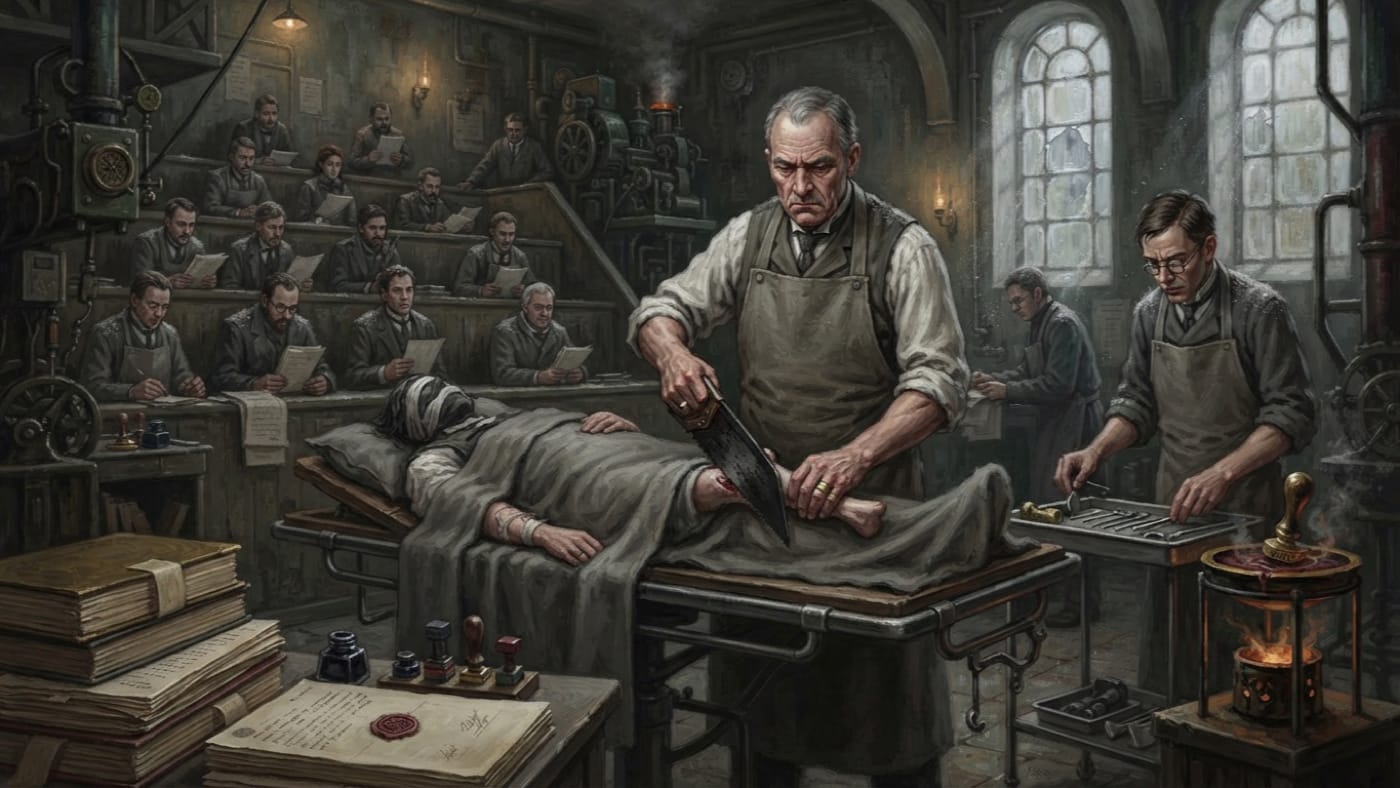
You can identify a Sealhand at forty paces by the grey apron and at four by the ring. The ring is brass, plain enough to pass for a tradesman's ornament, and it sits on the third finger of the operating hand. Every incision a Sealhand makes is therefore made by the same hand that will shortly authenticate it. The design is economical. I admire economy in an institution. In Marrowgate it is rarely the economy of anything but suffering.
The Sealhands are the licensed surgeon-notaries of Marrowgate. They form a guild or a professional order, and the city has never troubled to decide which. They hold exclusive authority over legal surgery. Their work begins in the operating wards and ends in the offices of the Sealhands' Gallery and along Notary Row, where wax is kept warm beside the antiseptic. Their power lies in the distance between those two rooms. A wound that has been stitched but not stamped has no standing before the Civic Triage Tribunal. An amputation that has been performed but not notarized records no loss. The soldier from the Line may hold up the stump. The Ledger will decline to look at it.
#On the Licence
Before the licence, the old river-market town had healers. Marrowgate's own account of itself calls them honest in trade and unregulated in practice. Their "pre-licensing" cures are now held in archives that nobody is permitted to open. The reform that created the Sealhands turned medical acts into legal acts. I have found no source I am prepared to certify that gives the reform a year. The founding of the city, around A.S. 72, belongs to the port. The birth of the order belongs to an undated reform whose author, issuer and first chief have all been filed somewhere the Gallery does not show its visitors.
Chief Sealhand Orin presides now. The hands are as steady as their reputation. That is rarer than it sounds, because most reputations in Marrowgate are steadier than the hands that earned them. The Chief has the temperament of a registry: patient, closed, and jealous of every drawer. Of Apprentice Nila the order says only that the apprentice is too curious. In a guild that sells certainty, curiosity is a disciplinary category.
The order does not govern alone. The Tribunal holds the beds and the legal dispositions. The Sanitation Chapter holds the cordons, and with them the question of whether a patient reaches a bed at all. The Prosthetics Guild holds the fittings. The Sealhands hold the signature, one of the few things the city never openly offers for sale. Each of these offices can spoil the others' afternoon. None of them can close a case without the stamp.
#On the Cut-Stamp
The soldiers named it, as soldiers name everything they fear more than the enemy. The cut-stamp is the notarized amputation: the work of the saw, entered, sealed and made true.
What follows is less a procedure than a chain of consequences, and their order varies with the ward, the bell and the file. The patient's prior record is sealed under notarial privilege, and a revised designation replaces it. From that hour the old name may not be spoken in any proceeding. Custom carries the prohibition into the wards, where an orderly who calls a man by the name on his parish roll commits a small and punishable heresy. Nothing in the man himself has been erased. He still remembers his mother's kitchen and his company number. The Ledger has simply stopped recognising the person who remembers them.
Then the documents arrive. Each is issued by a different office, and each requires the one before it. A confession receipt opened the ward door, and a stamped bed-window kept it open. The cut-stamp establishes what was lost. Only an established loss qualifies for a fitting. A fitting comes bound to a Prosthetic Maintenance Contract, and an unpaid contract becomes medical debt. In the Tribunal's hands, debt can become a work prescription, which sends the patient back to the wards with a mop in place of a musket. The Sealhand writes none of these later papers. Every one of them cites the stamp.
The order defends this arrangement on doctrinal grounds. The body, it argues, is a text the Creator composed and the Synod administers. Injury is a revision of that text, and an unlicensed revision is heresy in the flesh. The Bureau of Doctrine has never formally adopted this argument. It has never formally rejected it either, and that is the Bureau's highest form of endorsement.
I will say this much in the order's favour. I once watched a Sealhand take a leg above a gangrenous knee in the time it took the clerk to trim his wick, and the man lived. Whatever the stamp did to him afterwards, the cut was clean. Marrowgate's critics seldom mention that the usual alternative to a Sealhand is a Stitchmarket knife in a drainage tunnel.
#On the Monopoly
The order presents itself to the public as skill and mercy. Its interest is a monopoly on legal surgery and on what Notary Row calls identity repair: the amendment, restoration or substitution of a person's recorded self. It defends that monopoly by the oldest method of any guild. When the Sealhands' authority is questioned, they stop operating.
Denial of service is their excommunication. A patient who lacks proof of legitimacy waits. A ward that has offended the order finds its surgical list grown thin. A magistrate who presses too hard learns that the Tribunal's dispositions are only as good as the stamps that come before them. The order keeps its own tool caches, trains its own apprentices and holds its own rings, so it never has to borrow the instruments of its refusal from another office.
Its enemy is the counterfeit. The Stitchmarket sells forged clearances, stolen anaesthetic and black surgery. It also sells seal rings cast from melted brass by forgers who call their trade "making holy." A forged ring threatens the order more than any audit does, because it proves that the authority lives in the brass and not in the hand. The Sealhands answer the threat by insisting more loudly that the hand is everything. They are half right. The hand is skilled. The brass is what the Tribunal reads.
The street adds a further story: that the Sealhands keep a private ledger of "profitable outcomes" and steer their care by it. It is a street story, and I record it as one. I have never seen such a ledger. I observe only that the rumour never lacks buyers.
#On the Dry Auditor
The Marrowwind troubles every office in Marrowgate. For the Sealhands the trouble is jurisdiction, because the wind amends the very documents they alone are licensed to finalise.
The first uncontested correction, in A.S. 194, struck at the order's own instrument. An amputation file reading "left arm, below elbow" was found rewritten overnight to "left arm, shoulder, with subsequent debt improperly assessed." In Marrowgate an amputation file is a stamped file. The patient had been dead for nine months. His widow received a revised debt notice before noon.
Since then the wind has done what the order thought impossible: it has disagreed with a stamp. Chalk dust collects in the grooves of cut-stamps. Sutures attached to false notes reopen in straight lines. Revised designations smear, and parish names surface beneath them. In the guarded wording of my own earlier report, the corrections are almost always true. That "almost" is all that stands between the Sealhands and a public admission that a dry gust from the Lime Yards audits better than they do.
White Ward Fourteen, clean paper plague, A.S. 199: twenty-six patients certified "cleared."
Re-entered by Marrowwind correction as "infected, concealed by certificate fraud." Seven of them were already buried. Records has not published whose seals stood on the original clearances. The Gallery has not asked it to.
The clean paper plague was a crisis of certificates, and certificates are a Sealhand's native tongue. Clean papers travelled outward from Notary Row while fever travelled inward under the linen. A health clearance and a cut-stamp are different instruments, and the licence governs the second. The distinction is real. The wind pays it no attention whatever.
The Ward-Mothers are unlicensed matrons who run their wards like households and trade mercy for obedience. They now salt the thresholds on wind-nights and will not meet a Sealhand's eye. The licensed Mercy Ward-Sisters and Ward-Brothers keep to the chapel's forms and say nothing. Caught between the two, the order has learned that a guild can be indispensable and distrusted in the same corridor.
#On the Present Application
A.S. 201. The Sealhands are working. The intake bell rings, and the wagons arrive three deep. The Bureau of War wants its men returned fit for duty, which means men cut cleanly and filed correctly. Nobody in Marrowgate proposes doing without the order. The Stitchmarket dreams of a "paper liberation" that would free thousands from the stamp. If it ever comes, it will deliver them to tunnel surgeons. The order knows this, and it counts on it.
What has changed is the standing of the seal. The Bureau of Doctrine holds that corrections made by the Marrowwind do not authenticate themselves and are inadmissible without living corroboration. The order clings to that ruling as a drowning clerk clings to his ledger. Meanwhile the incidents increase and the review remains pending. The Bureau of Records wants the corrected folios sent on to it. The Bureau of Purity, which has always taken an interest in heresy of the flesh, watches Notary Row the way it watches any institution that has begun to mistake its seal for its sanctity.
Nihil obstat for the saw. The stamp remains under review.