

#On the Heights
"Light before bread, and no questions about the light." — Candlewick rule of hospitality, as it is explained to visitors who have already broken it
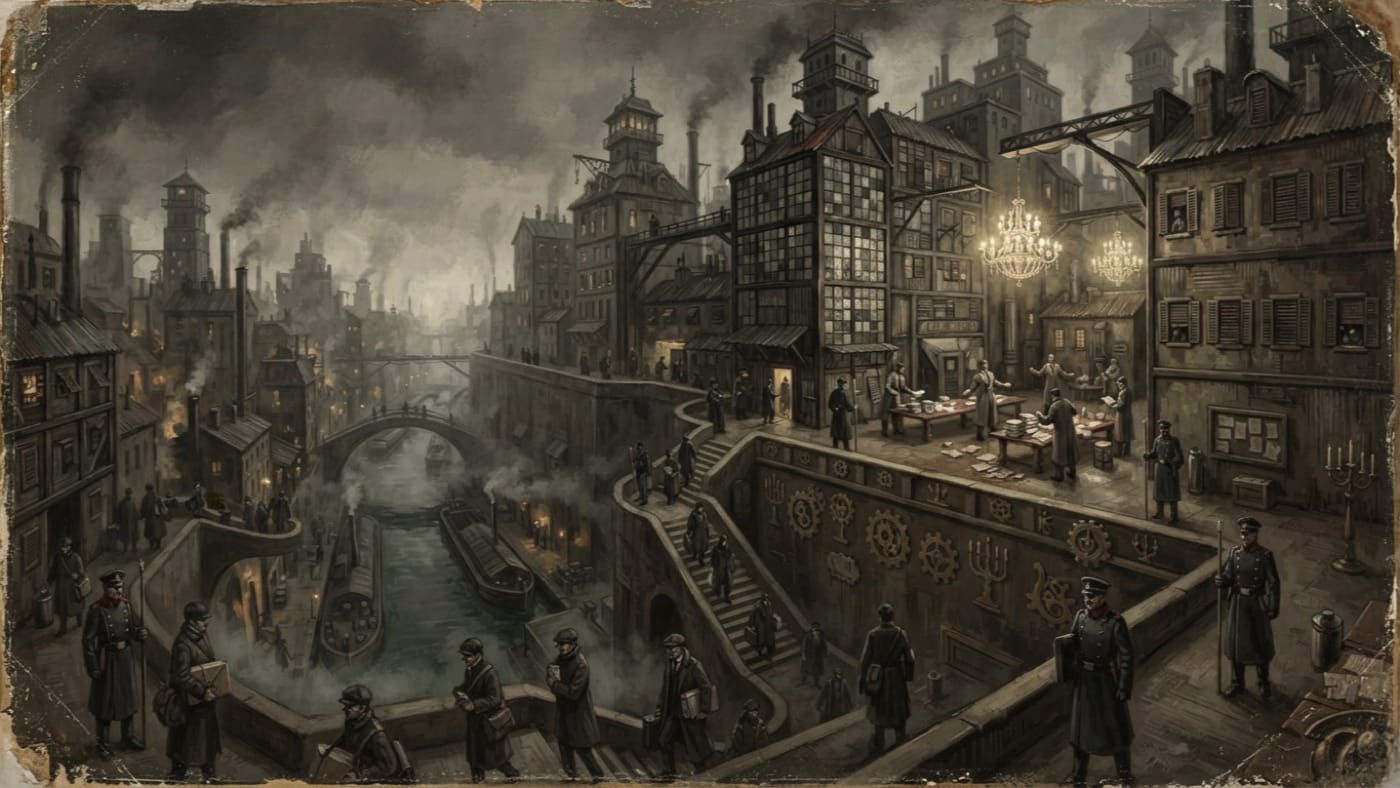
This is a survey of Wickcourt Heights in its present condition, taken in A.S. 201. The Heights crowns the centre of Candlewick Palatinate and is the seat of the Seven Palatine Houses. Its guild palaces stand in lacquered wood and salvaged glass, ringed by a city of dikes, low terraces and canal water that has never fully settled whether it is a street. The district smells of incense and hot wax polish. Every other quarter of Candlewick smells of what it makes. The Heights smells of what it can afford.
No survey on file gives the Heights a measured elevation, a boundary, a population, or a count of its palaces. The Palatinate has never needed the figures. In Candlewick, height is a matter of who may look down on whom, and from the upper windows of the guild palaces a House factor looks down on the chandlery smoke of the Lantern Mile and the dye-steam of Vatmarsh Row. Those two districts pay for the polish. The windows were glazed so the debtors could be watched.
Nothing is manufactured on the Heights that a scale could weigh. Candles are dipped elsewhere and salts boiled elsewhere. Inks are stoppered at Bottle Quay, and the lawful colours wait in the vaults of the Chromatic Registry. What the Heights produces is agreement: quota bargains, audit settlements, hospitality debts, marriages of convenience between monopolies. The paper that records them arrives from downhill, with its ink and its wax.
Salvaged glass is the Palatinate's nobility of material, gathered from older windows and older buildings. The inventories decline to say where it came from, and so shall I. Set in lacquered frames, it gives the palace interiors a slight unevenness, as if each room had been reglazed by a different century. The floors are waxed until a careless guest can read his own boots in them. Where that wax comes from is a question the customs of the Heights forbid.
#On the Charter and the Houses
The order of events must be set down correctly. The Bureau has hanged better clerks than me for setting them down loosely.
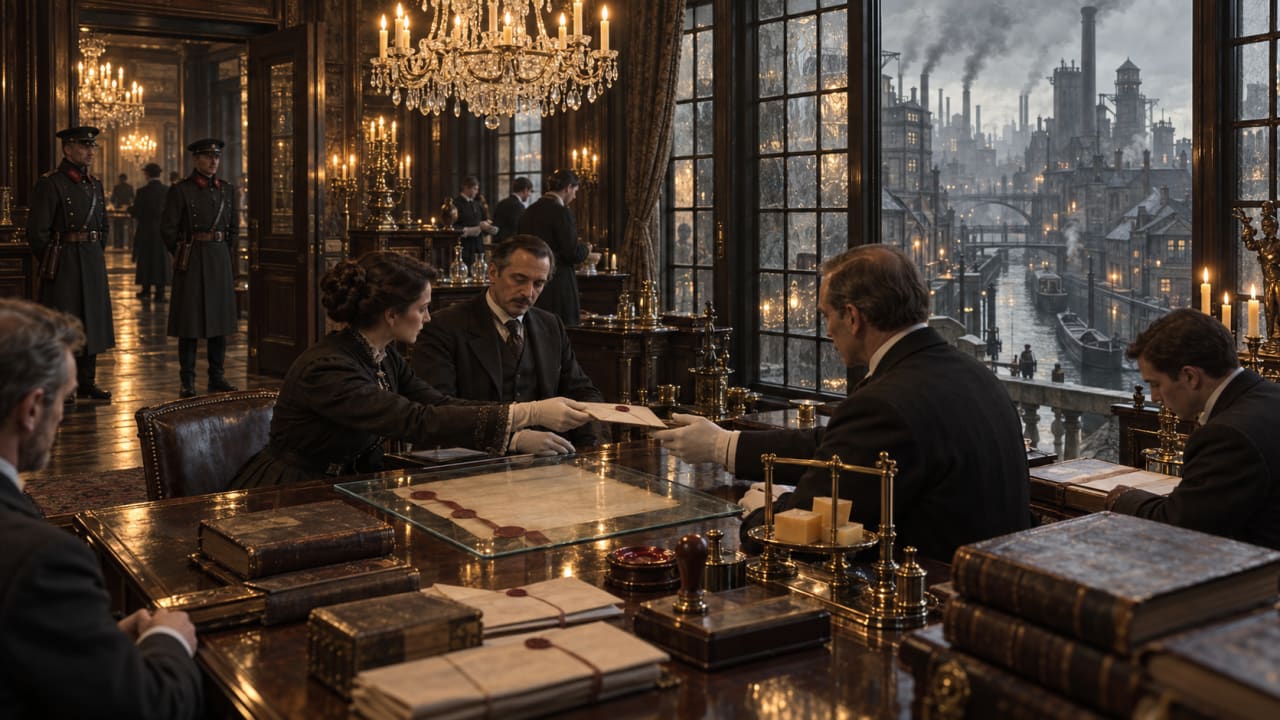
The Synod's constitutional settlement came with the Concordat of Strasbourg in A.S. 90. In A.S. 92 Candlewick's charter was ratified and the Bureau of Records installed its Annex in the city. That is the date of the city's administrative settlement. It is not the founding date of the Heights, which has none on file. Within the following decade the old artisan neighbourhoods, free printers, dyers and chandlers who had answered to guild custom and river tolls, were absorbed into the Seven House Compact. No year of that absorption is recorded. Nor is it recorded when the first palaces rose on the Heights, which came first, or who drew the plans. The decade is the honest unit, and the Heights will have to make do with honesty, an unfamiliar furnishing in its rooms.
The Great Fire of circa A.S. 98 ended the old order. Enough stock burned to make strict wax quotas necessary, and that winter House Wickwarden took over the distribution of candles. It has never given it back. Nothing on file says the Heights burned that year or was rebuilt afterwards, and I decline to set a district alight for a better paragraph. The fire's lasting work lay in the ledgers. Quotas became the currency of the Heights, and every palace enlarged since has been paid for, one way or another, in allotments.
By A.S. 104, Wickwarden ration seals governed the household candle and the chapel taper alike. By A.S. 110 mass mobilisation had made Candlewick's seals continental: a conscription order, a transit pass or a death certificate required wax, and the wax required the Houses. The money came uphill. It stayed there.
#On the Palaces
Seven Houses keep palaces on the Heights. The records consulted for this survey name two of them. The other five sit in the Compact, vote by quota and keep their halls. I will not name them, give them trades or paint their arms, because no file in my keeping supplies any of it. A Hieromnemon who invents a noble family to complete a list deserves to be entered on that list among the defaulters.
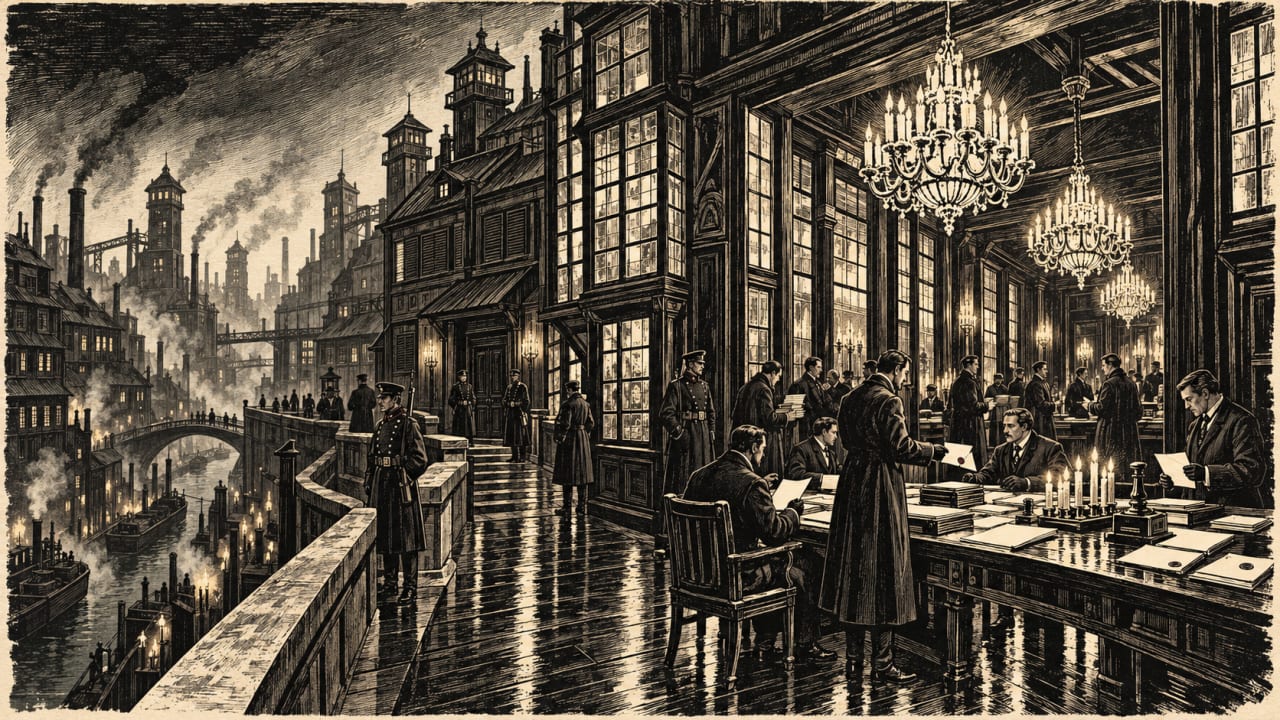
House Wickwarden holds the richer salons and the candle halls. Its manufacturing base is the Lantern Mile, where the wick is spun and the towers smoke. Its business is conducted here, by factors in gloves perfumed with beeswax. Lady Maris Wick, present head of the House, receives visitors on the Heights. She is one House head among seven, holding one quota-weighted vote. She is not sovereign of Candlewick, governor of the Heights, or commander of anything that wears a Provost's badge. That visitors so often take her for all three says something about wax and something about visitors.
Her hands are perpetually warm. Supporters credit piety. Rivals say she melts candle wax between her fingers while calculating their ruin. Both explanations come from people who want something from her, and I enter both without endorsing either.
House Vatmarsh also keeps palaces on the Heights, smaller than Wickwarden's candle halls and better guarded. The Vatmarsh Matriarch, whose authority rests on custody of the House recipes, attends Compact sessions behind a gauze mask tinted the colour of dry bone. Her vats and salt lofts are not here. They remain on the Row, along the eastern canals, where the air bites. On the Heights, Vatmarsh keeps only the instruments of negotiation: clerks, guards, sealed correspondence, and a reputation that comes up the hill ahead of every cask.
The difference in scale explains a good deal. A chandlery House lives by visible supply: lit windows, delivered tapers, chandeliers burning at a cost the guests are meant to calculate. A House of mordants works after the lamp is out, once the ink has dried and the page has either held or faded. Wickwarden builds salons because its power has to be seen to be believed. Vatmarsh builds walls because its power is believed without being seen.
#On the Bargains
On paper the Compact runs simply. The Houses vote, weighted by quota. The Charter Court of Impressions settles disputes. The Records Annex audits compliance, and its audits can override any local decision the Houses reach. No source in my keeping gives the weighting formula, a quorum, a presiding officer or a veto, and none names a council chamber on the Heights. I will not build one. Where the Houses meet is their affair, and so far it has stayed that way.
The institutions stay distinct. Under High Registrar Sable Vorn, the Chromatic Registry decides which colours are lawful, from its own vaults in its own district. The Charter Court keeps its own judges. The Seal Provosts enforce colour-law with raids and seizures. All of them reach into the palaces. None of them lives there.
The bargaining rests on dependence. The Registry may define a shade, but the shade must be pressed into Wickwarden wax and fixed with Vatmarsh salts. Inspection needs a lamp. A witness has to see the seal pressed, and the seal needs something to press into. When the materials are late, the administration waits, and an administration that waits is one the Houses can negotiate with.
In the eighteen months before the present assessment, three wax shortages coincided with Records audits. Each began in a different warehouse and cited a different cause. Each ended in concessions that the Records Annex denies making and the Houses deny demanding. In the same seasons Vatmarsh hoarded mordant salts and called it conservation. Both Houses deny coordinating shortage and hoard, and this survey records the denials alongside the dates. No terms have been produced and no minutes found. I can supply neither, and I will not supply a conspiracy in their place. A conspiracy without minutes is entered in the ledger as coincidence, and coincidence on the Heights has excellent manners.
One shortage darkened the outer queue of the Charter Court long enough for seventy-three shade petitions to lapse. The petitioners were not on the Heights. The Heights was lit throughout.
#On Hospitality
The Palatinate's rule is simple and very old. The host offers light before food, and the guest does not ask where the candle came from. On the Heights this courtesy carries the force of a statute and the fees of a toll.
A candle offered in a guild palace is registered wax, properly allotted, burned in a district where many households are counting their tapers. To accept it is to accept a gift that the giver's House rations to everyone else. To ask its source is to suggest the host's stock might not bear examination, and the rule exists so that nobody suggests any such thing. The candle is lit and the bread follows. Nobody looks at the candle for too long.
The other courtesies follow from it. A guest shows clean hands, free of dye, presents a mask properly, and lets the inspectors speak first if any are present, which on the Heights they sometimes are, as guests. A guest does not blow out a candle. Candlewick holds that to extinguish a flame with breath is to steal time, and stealing time in a House palace is stealing from the House.
Bribes on the Heights are paid in small legal luxuries: clean wax, registered ink droplets, mask filters. These are currencies the Houses themselves control. A petitioner who brings a House a gift has usually bought it from that House first.
I set that down as testimony, and it stays testimony. The Bureau has declared nothing about candles on the Heights, and I will not do Doctrine's work for it in a margin. I obeyed the rule and kept the stub.
#On the Winter Below
The Fading Winter began in A.S. 199, when documents across the River-belt started losing their text. The wax and signatures stayed, and the words went. The Registry called it heresy. House Vatmarsh called it a failure of mordant-salt supply. The Black Canal called it a market, which was at least candid. Vatmarsh has since blamed fog exposure during wax overcoating, and Wickwarden blames counterfeit mordants. Some affected pages show the black halos of Hungry Ink, while others simply paled until nothing was left. A record of A.S. 143 notes that Hungry Ink correlates with periods of heavy atmospheric ash. A correlation is a line in a register. No finding on file establishes that the two afflictions are one, that either was manufactured, or that a cure exists.
Earlier assessments described the Fading Winter as "a contained incident."
Superseded. The Fading Winter continues at the A.S. 201 assessment. Documents still lose text at a rate the Registry declines to quantify, and the mordant-salt supply remains compromised. The Registry has stabilised the symptoms by enlarging its own jurisdiction, a cure the physician recommends to himself.
The Registry issued new purity standards, ordered every household's shades revalidated, and ran a programme of chromatic reconciliation under audit cover through Bottle Quay and the Lantern Mile. Across the city, eighteen workshops closed and forty-seven workers were reclassified as unlicensed. Two Lantern Mile wick halls are counted within those closures, not added to them. No palace on the Heights appears in the total.
The Heights felt the Winter as a change in prices. Wax overcoats became mandatory for vulnerable documents, and Wickwarden's overcoat wax tripled in price. Salts grew scarce, and Vatmarsh holds the salts. Each House can say, with some truth, that it is managing a public emergency. Each also profits while the emergency continues at a manageable pitch. This survey does not find that either House caused the Fading Winter. It finds that the salons are fuller during it.
The cost was paid downhill. A worker who defaults on quota loses guild protection and is reclassified as unlicensed labour. That ends his mask rations and his shade tokens, the colour-coded scrip that serves as wages and as permission to cross a district at a given hour. It ends his access to the infirmary. Candlewick calls this soft severance. It takes longer than a hanging and produces a file. When a shortage darkens an audit, the wick-spinners still owe their quota, and when salts are withheld, the stirrers on the Row still owe theirs. The quota ledger has no column for politics. It records a shortfall, and in time a reclassification. Meanwhile the concessions behind the shortfall are settled on the Heights and denied there.
The Black Canal now threatens both monopolies at once. It has circulated a counterfeit bureau shade so exact that three separate auditors certified it genuine before being told its origin. If such ink reaches the Heartlands' ration permits and transit passes in quantity, the Houses lose their monopoly on substance and the Registry loses its monopoly on definition. No palace on the Heights has been shown to have any connection to the Canal's trade. Everyone in the district has nonetheless learned to say Black Canal in the tone of a man discussing a neighbour's mistress.
#On the Present Condition
At the A.S. 201 assessment, Candlewick stands at Operational Amber, and the Heights does business as usual. The palaces are occupied and the salons hold their receptions. Vatmarsh's doors are guarded and Wickwarden's chandeliers are lit. House factors walk between them carrying correspondence that still says what it said this morning.
None of the contests has been settled. The Records Annex wants tighter control, most often reported as a single source for bureau inks. The Houses want autonomy, price, and the right to time their own shortages. Every advance in counterfeit shade strengthens the Annex's case for centralisation and weakens its confidence that centralisation would hold. No party can break the others. The Synod cannot fight a war on unsealed paper, and the Houses cannot sell wax to an administration that has stopped buying.
As a servant of the Bureau, I ought to report the Heights as guild arrogance kept within proper limits. In honesty, my own office licensed the arrogance. The Annex installed in A.S. 92 needed seals, and the seals needed suppliers. A district of lacquered palaces and incense was the price of a Synod that cannot issue a decree without wax. The Bureau has paid that price in concessions for a century, denying each as it went. It will pay again at the next audit.